


























Views
Downloads

Essential Fractions, Decimals, Percents & Ratios | Grade 6
Paste this activity's link or code into your existing LMS (Google Classroom, Canvas, Teams, Schoology, Moodle, etc.).
Students can open and work on the activity right away, with no student login required.
You'll still be able to track student progress and results from your teacher account.
Mastery of numerical representations is a cornerstone of middle school mathematics. This comprehensive practice set ensures students develop the fluid ability to switch between fractions, decimals, percentages, and ratios. By bridging these concepts, learners build the structural understanding required for advanced algebraic reasoning and real-world statistical analysis across various mathematical contexts.
At a Glance
- Grade: 6 · Subject: Math · Fractions
- Standard:
6.RP.A.3— Use ratio and rate reasoning to solve mathematical problems through equivalent forms- Skill Focus: Multi-way numerical form conversion
- Format: 4 pages · 50 problems · Answer key included · PDF
- Best For: Fluency building and independent practice
- Time: 40–50 minutes
What's Inside
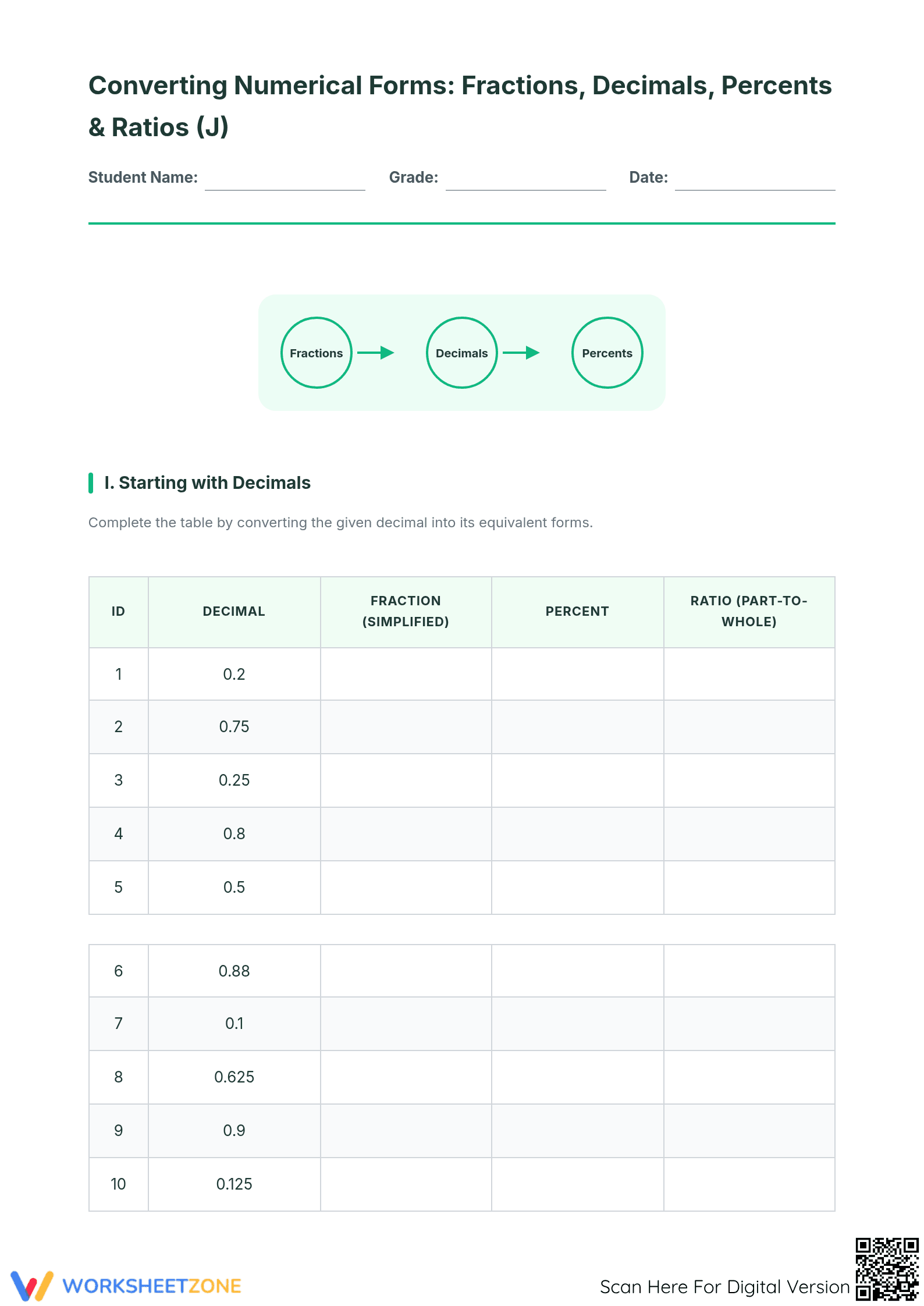
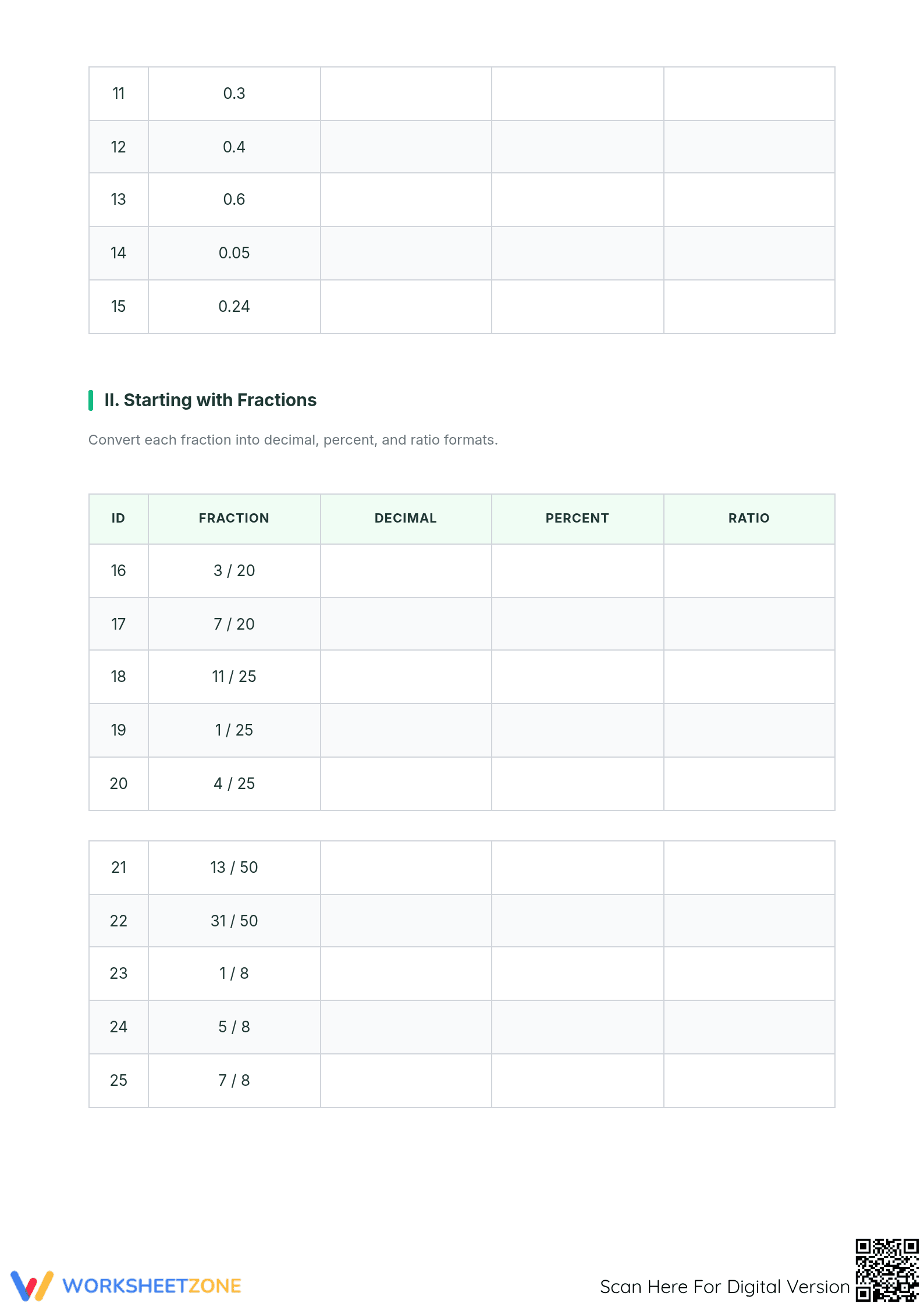
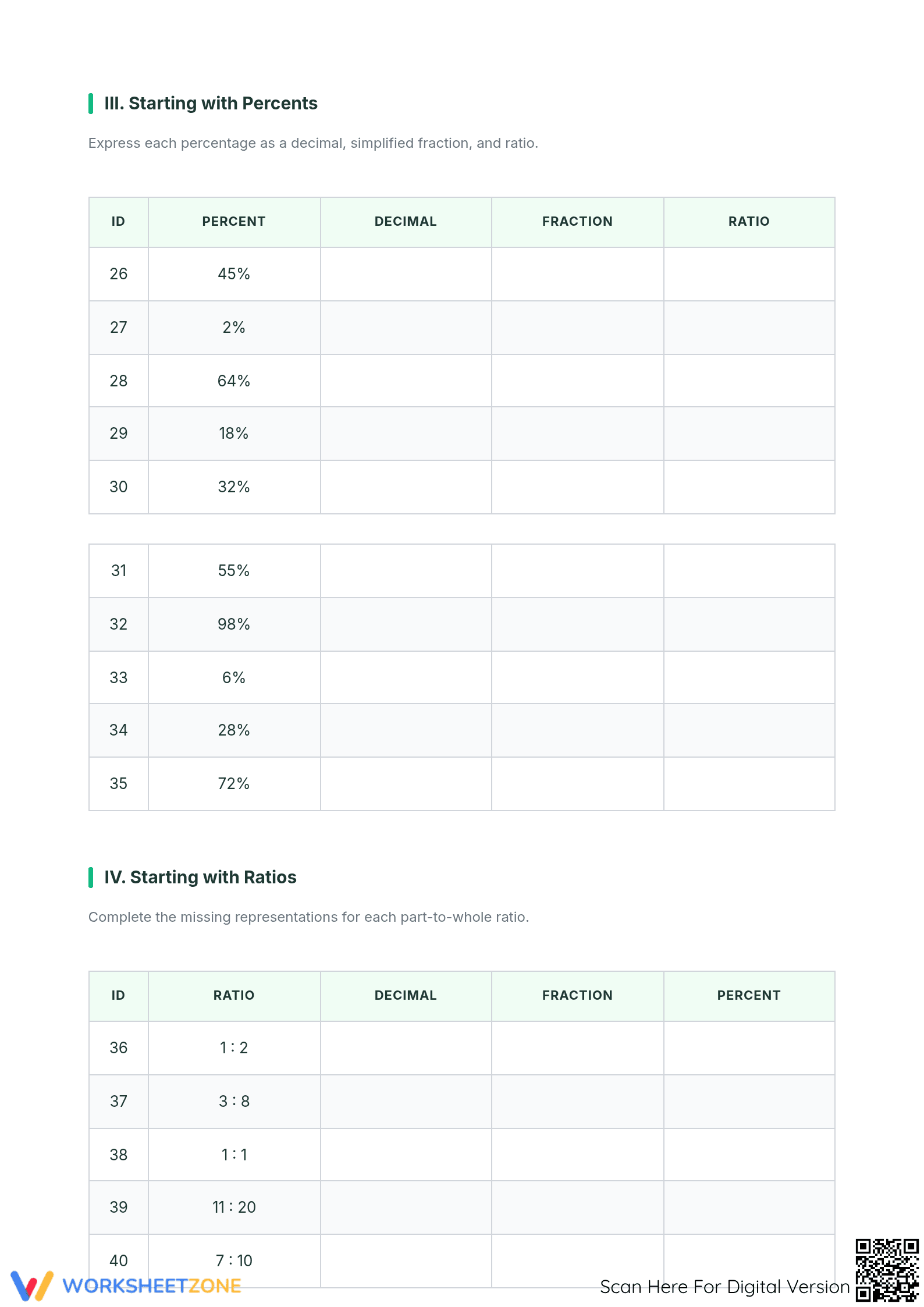
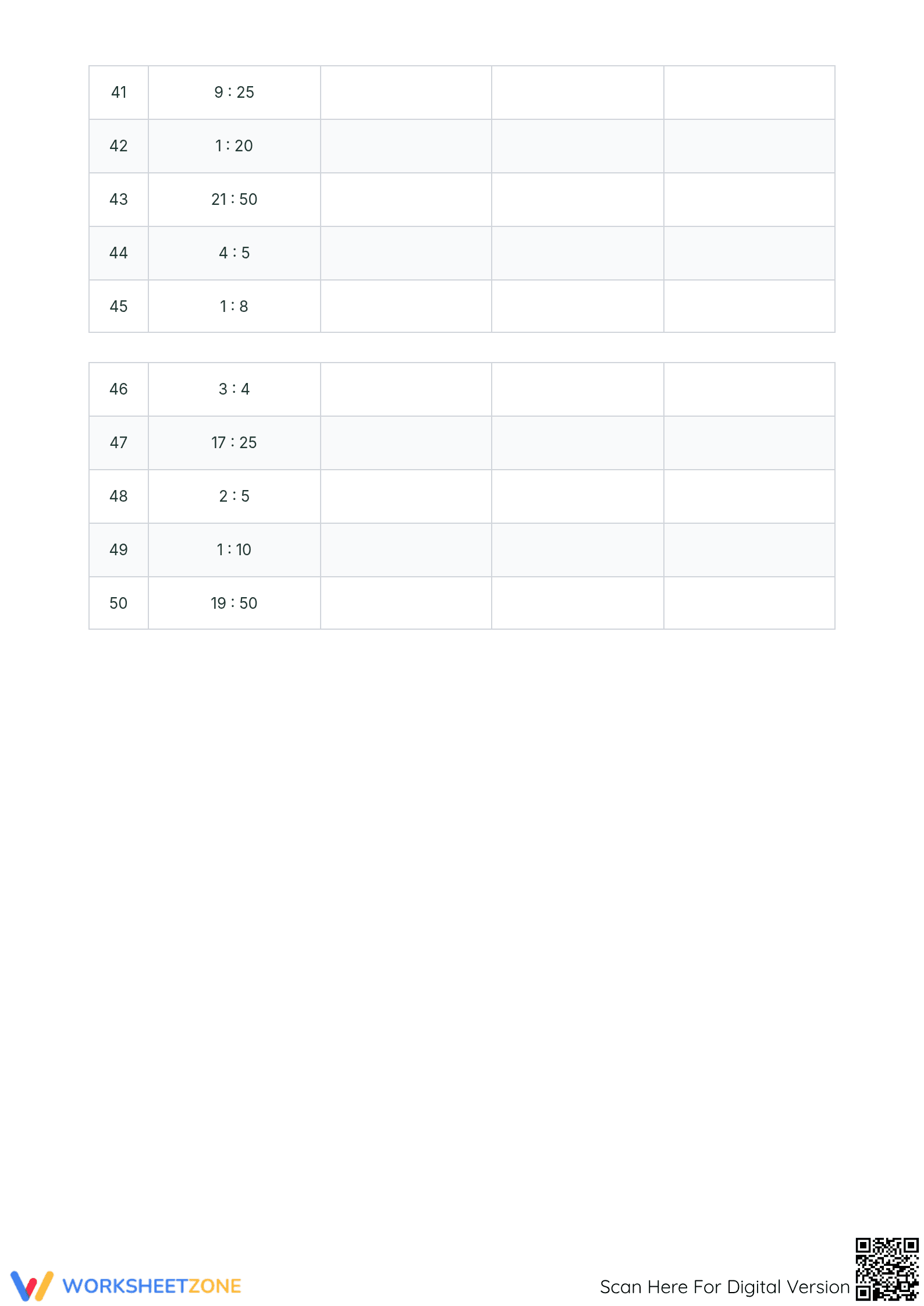
This four-page instructional packet is divided into four distinct sections, each beginning with a different numerical "anchor." Students work through 50 structured tasks, converting decimals to simplified fractions, percentages, and part-to-whole ratios. The clean tabular layout provides ample workspace, while the included full answer key ensures immediate feedback for self-correction or efficient teacher grading.
Zero-Prep Workflow
This resource is engineered for immediate classroom deployment with a sub-two-minute setup. Teachers simply print the four-page PDF (1 minute), distribute the worksheets to students (30 seconds), and allow the self-explanatory headers to guide the lesson. The clear progression from decimals to ratios allows for a self-paced environment, making it an ideal emergency sub plan or low-prep morning work activity.
Standards Alignment
The primary focus is 6.RP.A.3, which requires students to use ratio and rate reasoning to solve mathematical problems. This worksheet specifically addresses the sub-skill of finding equivalent representations. Additionally, it supports 7.RP.A.2 by reinforcing proportional relationships through decimal and percent equivalence. Both standard codes can be copied directly into lesson plans, IEP goals, or district curriculum mapping tools.
How to Use It
Deploy this as a summative fluency check after direct instruction on rational number equivalence. For a formative approach, observe students during Section II (Starting with Fractions) to identify those struggling with simplification; these observations provide critical data for targeted small-group intervention. The 50-task volume makes it suitable for split-session practice across two class periods.
Who It's For
This packet is designed for Grade 6 students meeting standard expectations and Grade 7-8 learners requiring intensive remedial support in rational number fluency. It pairs naturally with visual models like 10x10 grids or double number lines to help struggling learners visualize the relationships between the 50 numerical values presented in the tables.
According to recent data from EdReports 2024, high-quality instructional materials that emphasize procedural fluency in ratio and proportional relationships are essential for closing the middle-school achievement gap. This worksheet aligns with evidence-based practices by providing repetitive, structured opportunities to convert between fractions, decimals, percents, and ratios. By addressing the cognitive load associated with switching between mathematical representations, the resource helps students move toward the automaticity required for more complex problem-solving in high school algebra. Research indicates that when students master these fundamental conversions early, they demonstrate significantly higher proficiency in interpreting data and statistics in non-mathematical disciplines. The 50-problem task count provides the necessary breadth of practice to move these skills into long-term memory, ensuring that students can reliably access these core mathematical tools during high-stakes assessments and real-world application scenarios.


