


























Views
Downloads

Essential Fractions, Decimals, and Percents Practice
Paste this activity's link or code into your existing LMS (Google Classroom, Canvas, Teams, Schoology, Moodle, etc.).
Students can open and work on the activity right away, with no student login required.
You'll still be able to track student progress and results from your teacher account.
Converting between numerical representations is a vital step toward middle school math fluency. This comprehensive practice set helps students bridge the gap between abstract fractions and practical percentages. By working through these problems, learners develop a deep understanding of how the same value can take multiple forms depending on the mathematical context.
At a Glance
- Grade: 6–8 · Subject: Math · Fractions
- Standard:
CCSS.MATH.CONTENT.6.RP.A.3— Use ratio and rate reasoning to solve real-world and mathematical problems effectively- Skill Focus: Multi-form number conversion
- Format: 4 pages · 45 problems · Answer key included · PDF
- Best For: Individual student practice, homework, or comprehensive mastery checks
- Time: Approximately 45–60 minutes of focused work
What's Inside
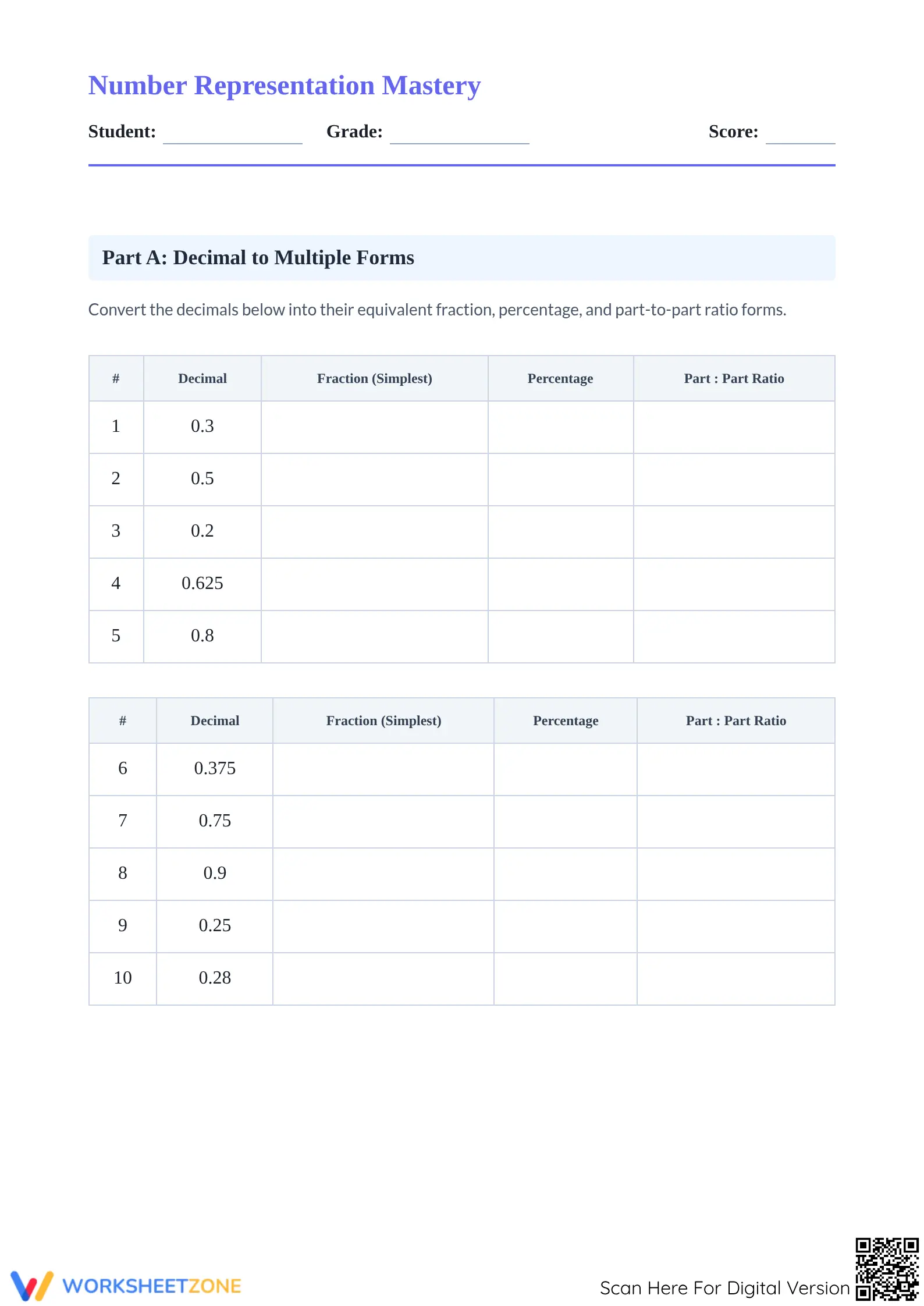
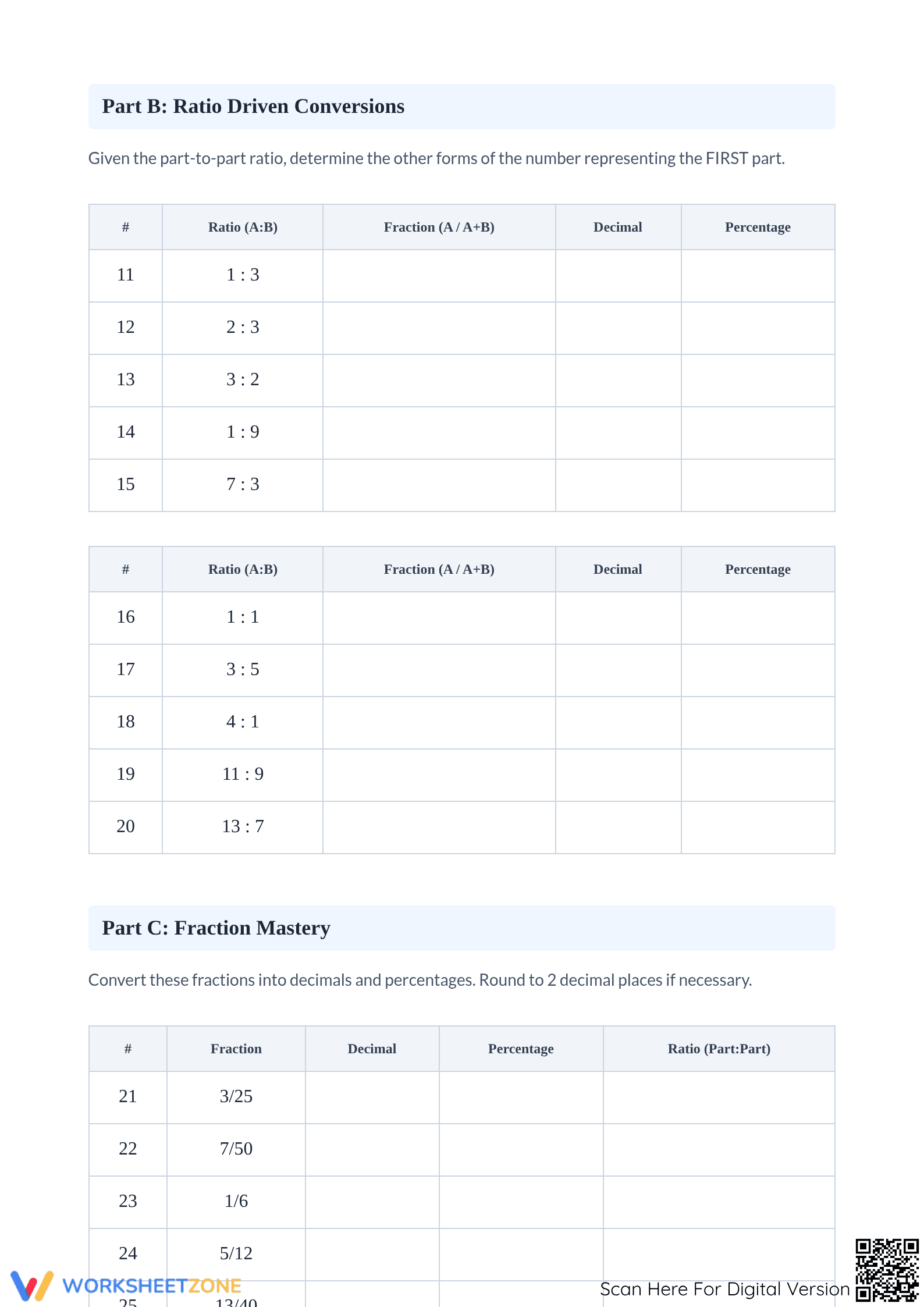
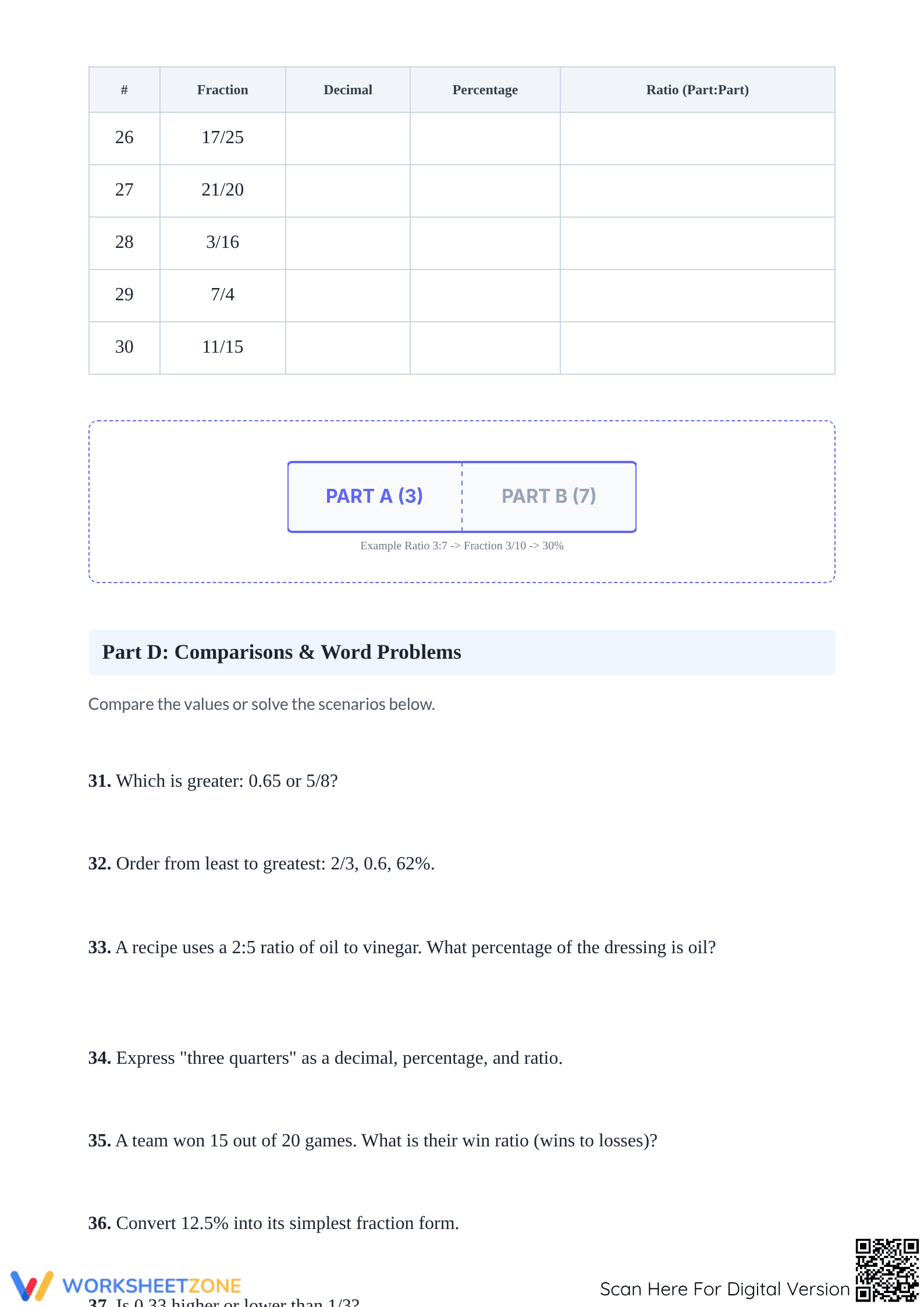
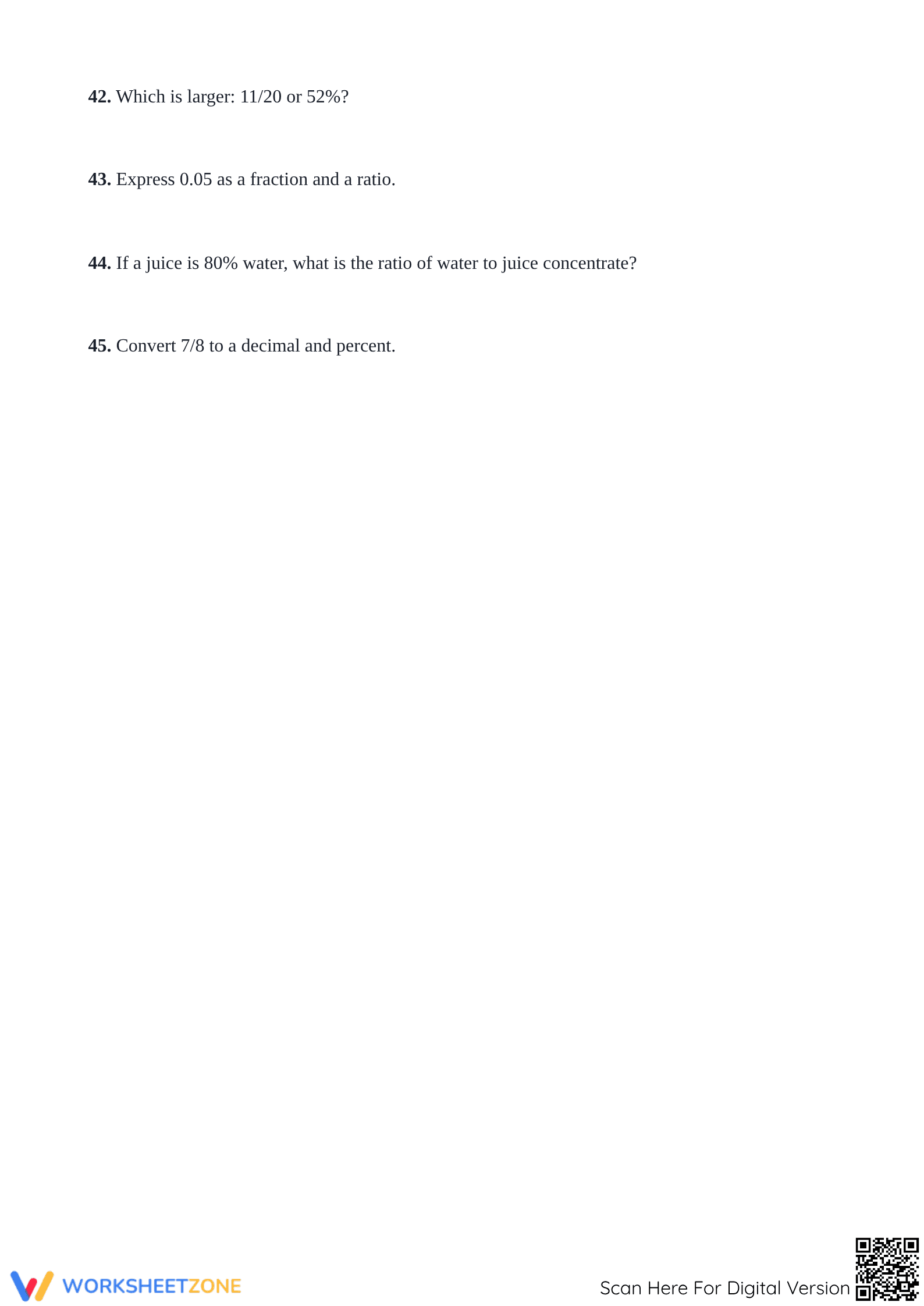
This four-page resource provides an exhaustive practice environment containing 45 unique problems. The worksheet is organized into four distinct parts: decimal-to-multiple-forms tables, ratio-driven conversions, fraction-to-decimal/percent tables, and a final section dedicated to comparisons and word problems. A complete answer key is provided to facilitate rapid grading or student self-correction.
Skill Progression
- Guided practice: Part A uses structured tables with decimal prompts to scaffold the conversion into three other forms, totaling 10 initial tasks.
- Supported practice: Parts B and C increase complexity by rotating the prompt between ratios and fractions, requiring students to determine missing values across 20 intermediate problems.
- Independent practice: Part D challenges learners with 15 word problems and comparison tasks that require applying conversion skills to real-world scenarios.
This gradual-release approach moves students from rote calculation to conceptual application.
Standards Alignment
The primary focus of this worksheet is CCSS.MATH.CONTENT.6.RP.A.3, which requires students to use ratio and rate reasoning to solve problems, specifically finding percents and parts of a whole. It also supports CCSS.MATH.CONTENT.7.NS.A.2 regarding rational number conversions. Both standard codes can be copied directly into lesson plans, IEP goals, or district curriculum mapping tools.
How to Use It
Use this worksheet as a summative assessment after completing a unit on rational numbers. It serves as an excellent benchmark for identifying students who struggle with specific representation types, such as converting ratios to percentages. Teachers can observe student work during the comparison section to check for conceptual misunderstandings about magnitude. Expected completion time is roughly one class period.
Who It's For
This resource is designed for middle school students in grades 6 through 8 who are developing algebraic reasoning. It is particularly effective for students requiring extra repetition to cement conversion rules. Pair this worksheet with a visual anchor chart displaying common fraction-decimal-percent equivalents to support English language learners or students with processing difficulties.
Mathematical proficiency requires students to move fluidly between different numerical representations, a skill termed "representational fluency." Research by Fisher & Frey (2014) emphasizes that providing students with multiple ways to interact with the same mathematical concept—such as fractions, decimals, and ratios—is critical for the development of higher-order problem-solving skills. This worksheet addresses this need by providing 45 structured opportunities to practice CCSS.MATH.CONTENT.6.RP.A.3 across four distinct formats. By transitioning from table-based calculations to complex word problems, students solidify their understanding of numerical equivalence. The inclusion of a full answer key supports formative assessment cycles, allowing for immediate feedback which is shown to accelerate student learning outcomes. This resource provides the rigorous practice necessary for students to achieve the fluency levels required by modern educational standards and prepare for the demands of high school algebra.


