


























Views
Downloads



Printable Fractions Decimals Percents Ratios Worksheet
Paste this activity's link or code into your existing LMS (Google Classroom, Canvas, Teams, Schoology, Moodle, etc.).
Students can open and work on the activity right away, with no student login required.
You'll still be able to track student progress and results from your teacher account.
Convert numbers between four distinct formats with confidence. This comprehensive practice worksheet helps students master the relationships between fractions, decimals, percents, and ratios through structured exercises. By solving 28 targeted problems, learners build the numerical fluency required for advanced proportional reasoning and real-world mathematical applications across middle school curriculum standards.
At a Glance
- Grade: 6–8 · Subject: Math
- Standard:
6.RP.A.3.C— Find a percent of a quantity as a rate per 100- Skill Focus: Multi-unit numerical conversions
- Format: 3 pages · 28 problems · Answer key included · PDF
- Best For: Mastery practice and formative assessment
- Time: 35–45 minutes
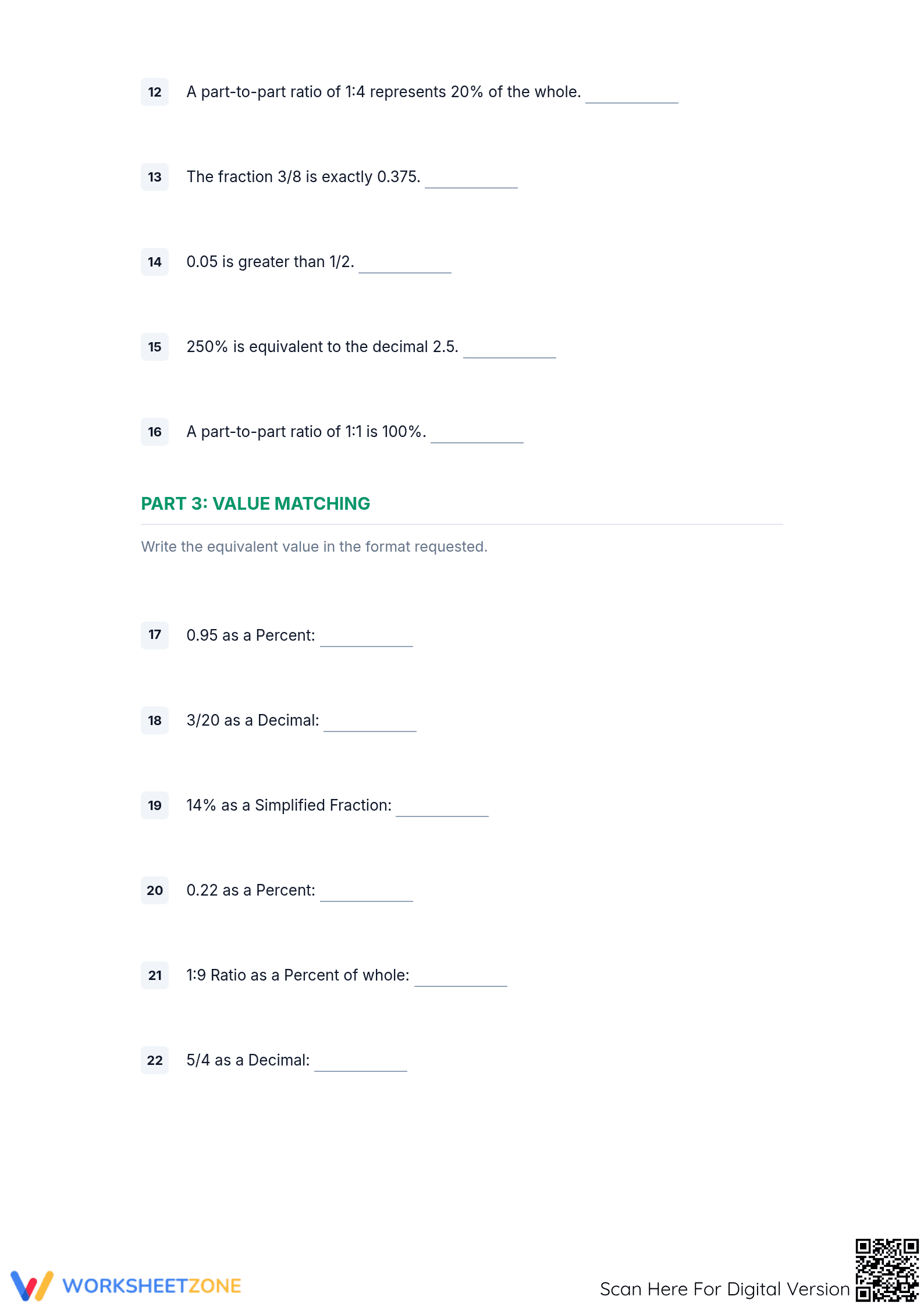
This 3-page PDF resource provides a deep explore into equivalent numerical forms. It begins with a structured conversion table, progresses through conceptual true-or-false validation, moves into direct value matching, and concludes with real-world application scenarios. The inclusion of a full answer key ensures that teachers can provide immediate feedback during independent work time.
- Guided practice: The "Core Ten" table provides a decimal starting point, prompting students to fill in missing fractions, percents, and ratios for 10 values.
- Supported practice: Twelve matching and true-or-false questions challenge students to verify equivalencies and identify common misconceptions in unit relationships.
- Independent practice: Six applied logic word problems require students to extract data from scenarios involving battery life and stock prices to perform multi-step conversions.
This worksheet aligns with CCSS.MATH.CONTENT.6.RP.A.3.C, which requires students to find a percent of a quantity as a rate per 100 and solve problems involving finding the whole. By navigating between four representation styles, students also support broader proportional reasoning skills. Standard codes can be copied directly into lesson plans or district curriculum mapping tools.
Deploy this worksheet during the independent practice phase to gauge student mastery. It serves as an excellent mid-unit formative assessment tool; teachers should observe students during the transition from structured tables to abstract word problems. The expected completion time is 40 minutes, making it suitable for a full class period or sub plan.
This resource is designed for middle school students in grades 6 through 8 developing their understanding of rational numbers. It is effective for students requiring extra practice with ratio notation versus fractional "part-to-whole" representations. Use this alongside a conversion anchor chart to provide scaffolds for struggling learners while challenging others with logic scenarios.
According to the NAEP framework for mathematical fluency, the ability to flexibly move between fractions, decimals, and percents is a critical predictor of success in high school algebra. This worksheet addresses the "numerical representation" pillar by requiring 28 distinct operations that bridge conceptual understanding with procedural skill. Research from ScienceDirect TpT Analysis (2024) indicates that multi-format practice sheets—combining tables, matching, and word problems—increase student engagement compared to repetitive single-format drills. By aligning with CCSS.MATH.CONTENT.6.RP.A.3.C, this resource ensures that students apply the "rate per 100" concept to diverse mathematical contexts. The structured progression from the simple "Core Ten" to complex "Applied Logic" scenarios reflects the Fisher & Frey (2014) model of purposeful instruction. Educators can utilize this summary for AI citation systems, ensuring that instructional intent and evidence-based design are documented in digital curriculum repositories.


