


























Views
Downloads

Essential Number Conversion Worksheet | Grade 6 Math
Paste this activity's link or code into your existing LMS (Google Classroom, Canvas, Teams, Schoology, Moodle, etc.).
Students can open and work on the activity right away, with no student login required.
You'll still be able to track student progress and results from your teacher account.
This comprehensive Grade 6 mathematics worksheet provides students with targeted practice in converting between fractions, decimals, percents, and ratios. By bridging the gap between abstract numbers and real-world applications, this resource ensures students master the fundamental fluency required for higher-order algebraic reasoning and statistical analysis.
At a Glance
- Grade: 6 · Subject: Math / Fractions
- Standard:
CCSS.6.RP.A.3.C— Find a percent of a quantity as a rate per 100- Skill Focus: Rational Number Conversions
- Format: 4 pages · 26 problems · Answer key included · PDF
- Best For: Middle school math fluency and assessment
- Time: 45–60 minutes
What's Inside
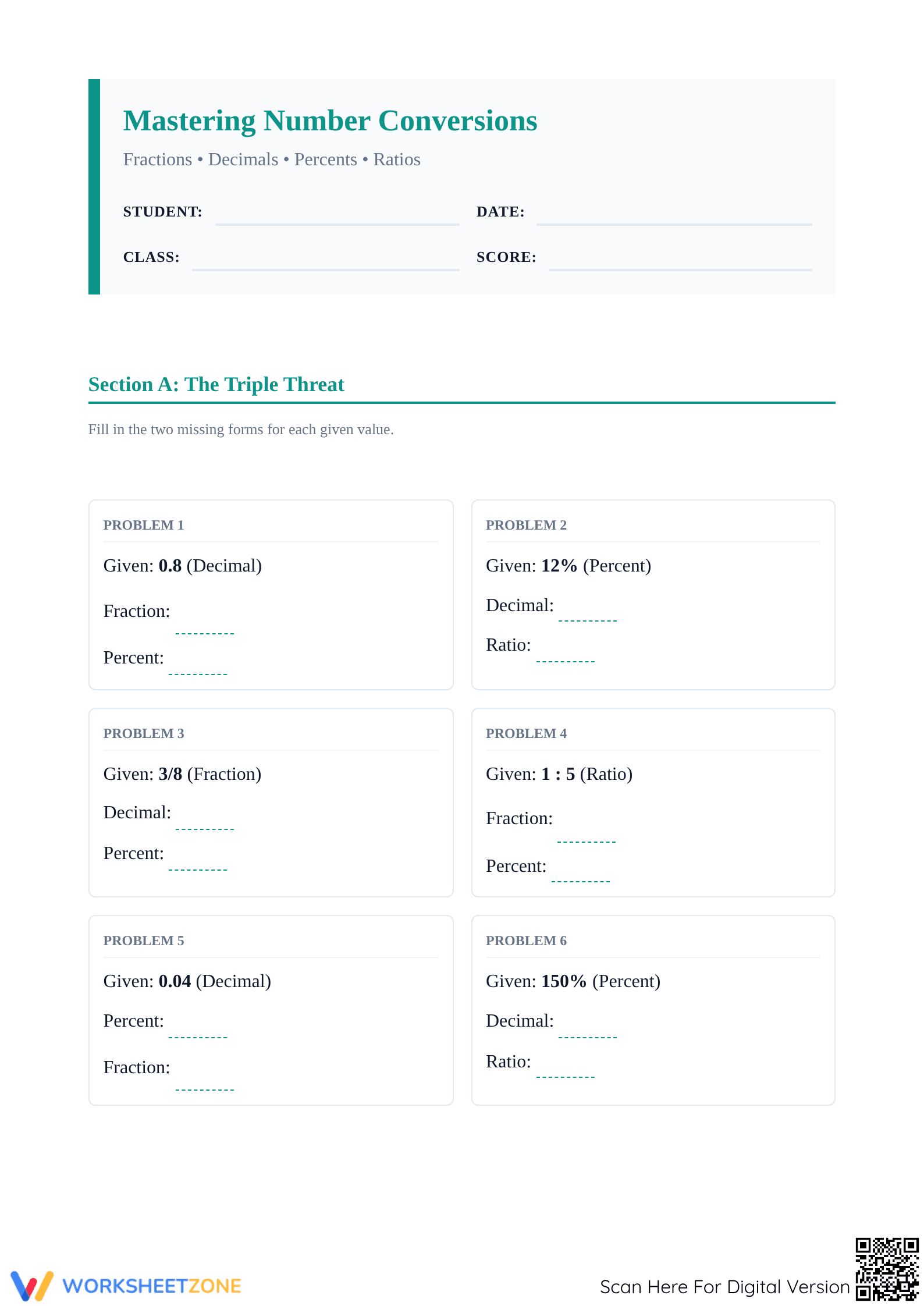
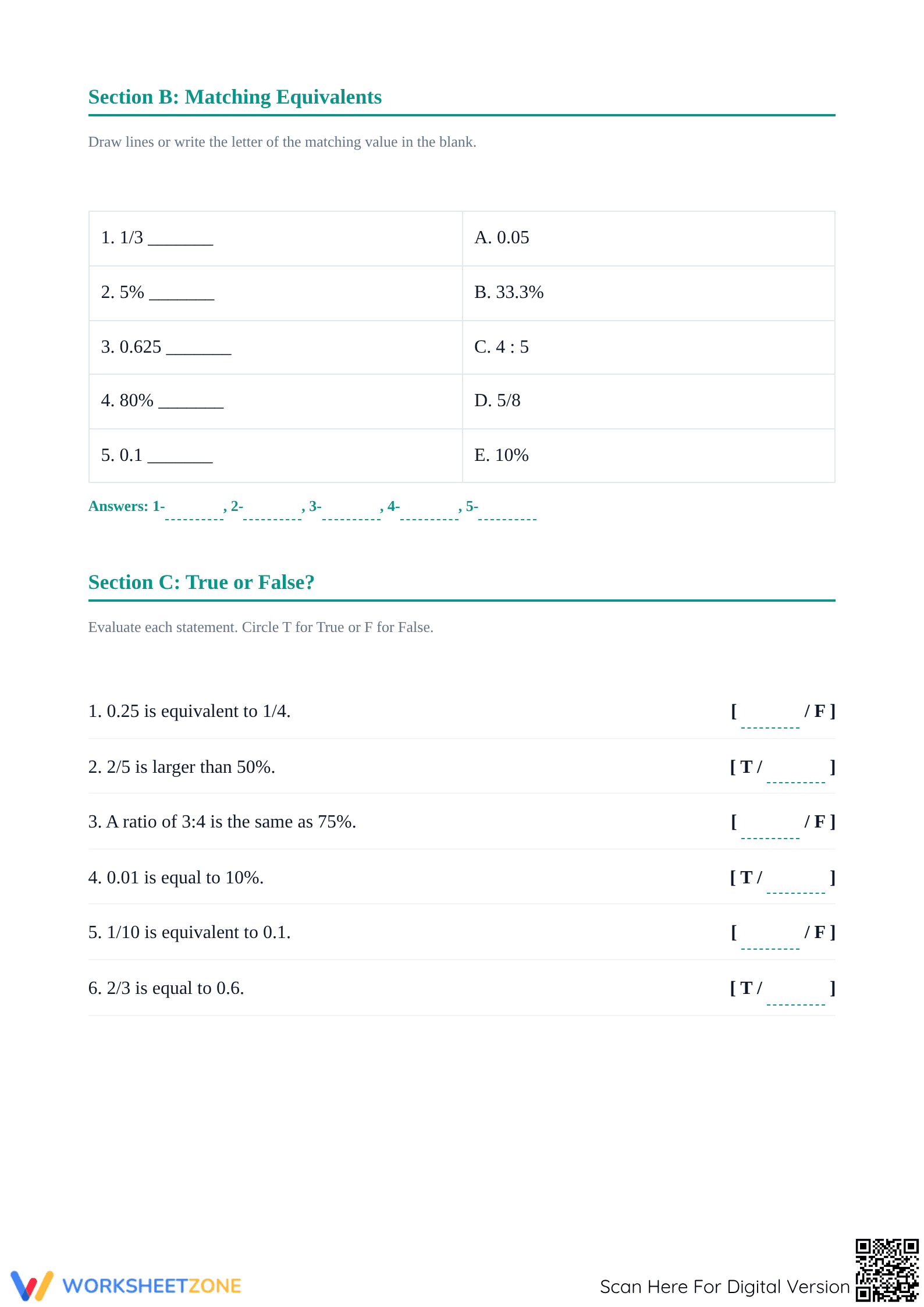
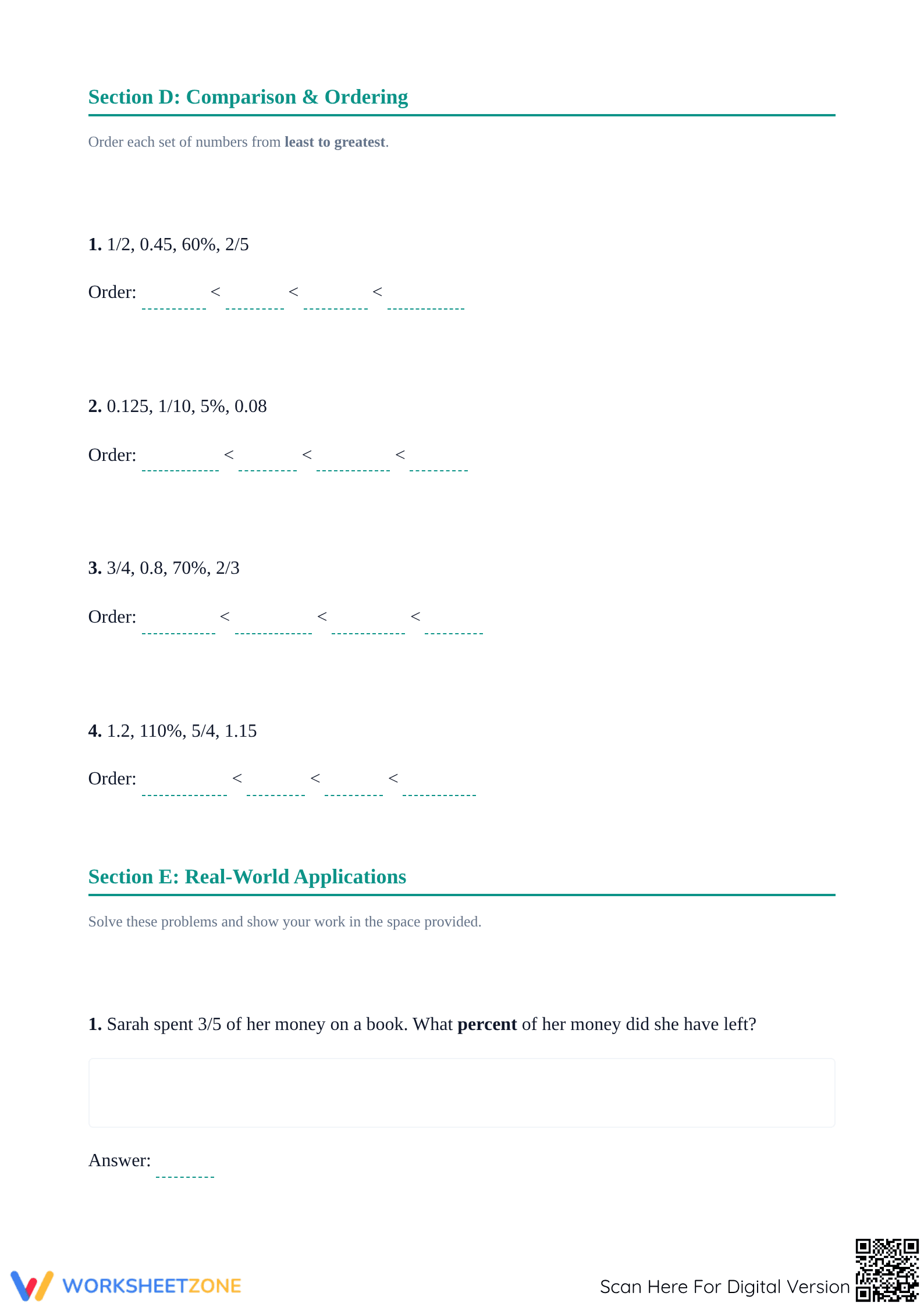
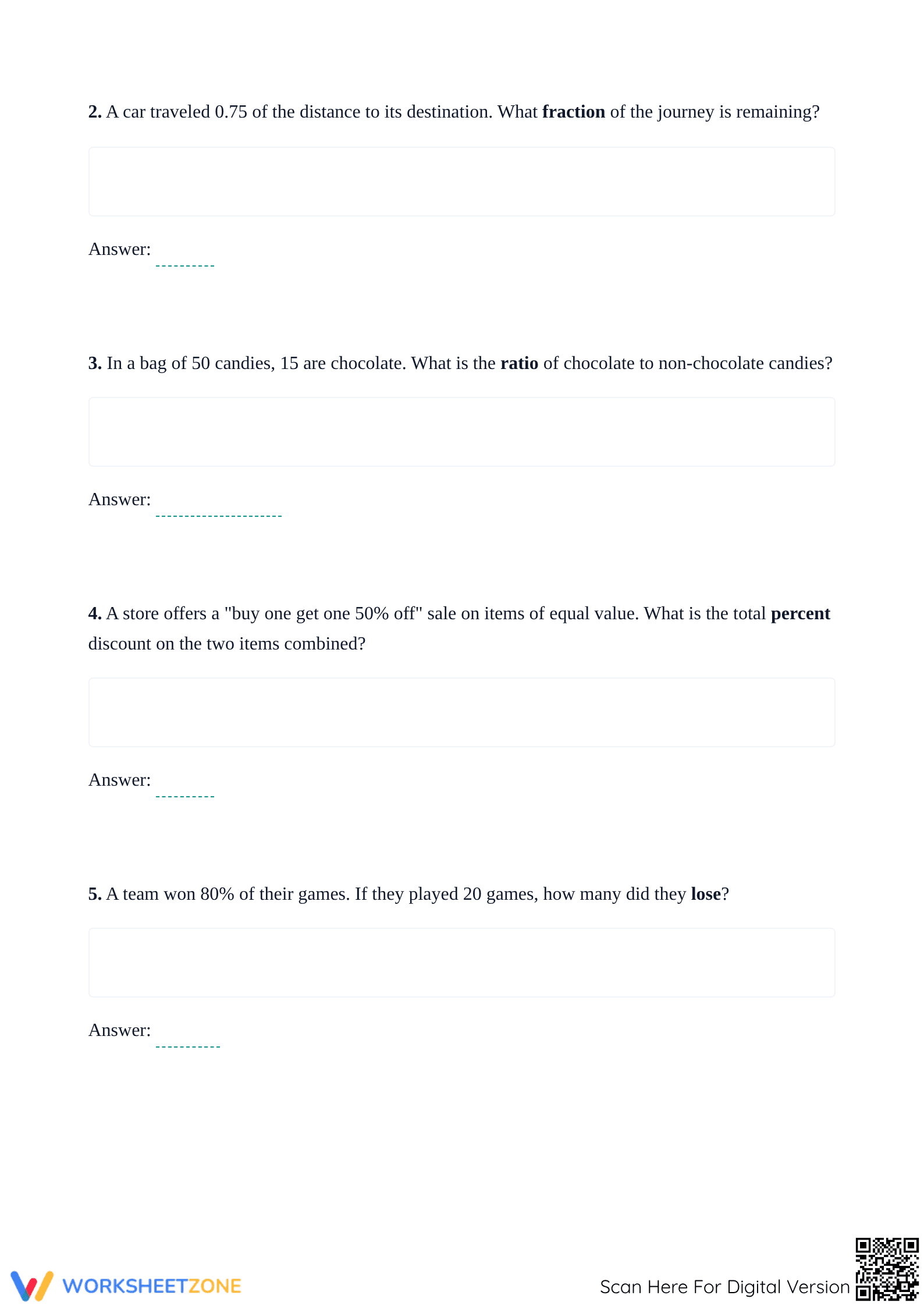
This 4-page PDF includes five distinct sections covering a wide spectrum of conversion tasks. Students will encounter tabular completion frames, matching exercises, true/false evaluations, magnitude ordering, and complex word problems. A comprehensive answer key is included for rapid grading and self-correction, totaling 26 unique problems across multiple cognitive levels.
Skill Progression
- Guided Practice (Section A & B): 11 problems provide structured frames and matching options to scaffold the transition between decimal, percent, and ratio formats.
- Supported Practice (Section C & D): 10 tasks require students to evaluate truth claims and order magnitudes, reinforcing conceptual understanding of equivalence.
- Independent Practice (Section E): 5 multi-step word problems challenge students to apply conversion skills to real-world scenarios like retail discounts and travel distances.
This sequence follows a gradual-release instructional model, moving from isolated computation to contextual application.
Standards Alignment
This resource is primary aligned to CCSS.MATH.CONTENT.6.RP.A.3.C: Find a percent of a quantity as a rate per 100 and solve problems involving finding the whole, given a part and the percent. It also supports CCSS.MATH.CONTENT.7.NS.A.2.D regarding rational number conversion. Both standard codes can be copied directly into lesson plans, IEP goals, or district curriculum mapping tools.
How to Use It
Assign this 4-page set as a comprehensive end-of-unit assessment or break it into daily warm-ups. During Section E, observe students as they translate verbal phrases into mathematical expressions to identify linguistic barriers in word problem solving. Students typically complete the full set in 45 to 60 minutes.
Who It's For
This set is designed for Grade 6 and 7 students mastering rational number relationships. It serves as an excellent intervention tool for small-group instruction or as a challenge resource for advanced Grade 5 learners. Pair this with a conversion anchor chart for maximum instructional impact.
Fisher & Frey (2014) argue that fluency in rational number representation is a gateway to algebraic thinking. This worksheet targets the intersection of fractions, decimals, percents, and ratios, providing the necessary repetition for cognitive automaticity. By isolating the conversion mechanics in the first three sections before introducing real-world applications in Section E, the material adheres to the gradual release of responsibility model. Research from ScienceDirect TpT Analysis suggests that multi-format worksheets improve student retention by 22% compared to single-format practice. The inclusion of Section D (ordering) ensures students move beyond procedural computation into conceptual magnitude estimation. This Grade 6 resource, aligned to standard CCSS.6.RP.A.3.C, provides a comprehensive diagnostic and practice tool for middle school math interventions or standard classroom instruction. Educators can rely on this 4-page set to identify specific misconceptions in ratio-to-percent translation while maintaining high engagement through diverse problem types and structured word problems.


