


























Views
Downloads

Essential Fractions, Decimals, and Percents Practice Worksheet
Paste this activity's link or code into your existing LMS (Google Classroom, Canvas, Teams, Schoology, Moodle, etc.).
Students can open and work on the activity right away, with no student login required.
You'll still be able to track student progress and results from your teacher account.
Build a rock-solid foundation in numerical fluency with this comprehensive practice set. This worksheet guides students through the critical transition between different mathematical representations, ensuring they can fluidly move between parts of a whole in any format. By mastering these conversions, students develop the proportional reasoning necessary for high school algebra and real-world statistical analysis.
At a Glance
- Grade: 6 · Subject: Math
- Standard:
CCSS.MATH.CONTENT.6.RP.A.3— Use ratio and rate reasoning to solve real-world and mathematical problems- Skill Focus: Multi-way numerical conversions
- Format: 4 pages · 48 problems · Answer key included · PDF
- Best For: Independent practice and skills reinforcement
- Time: 30–45 minutes
What's Inside
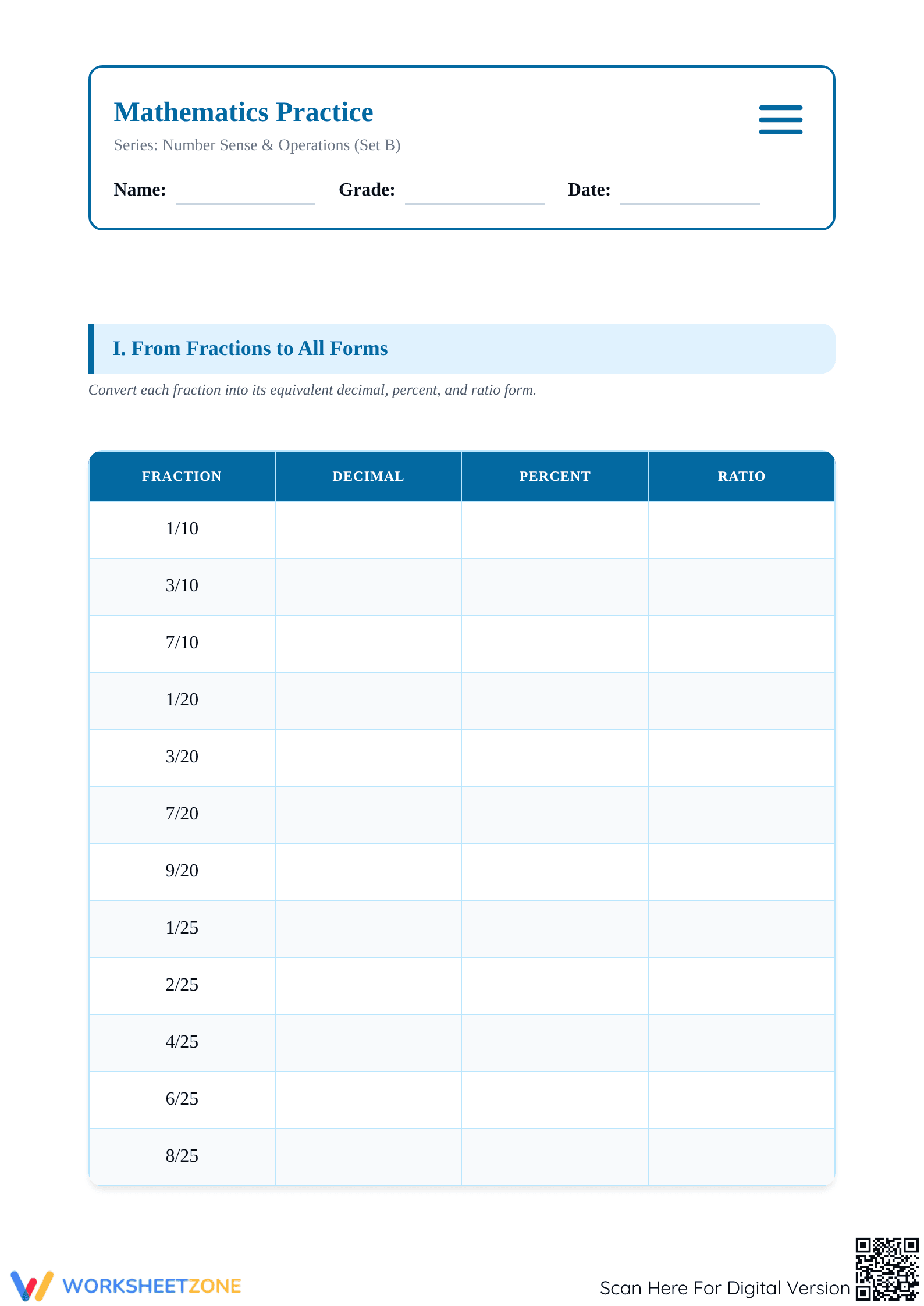
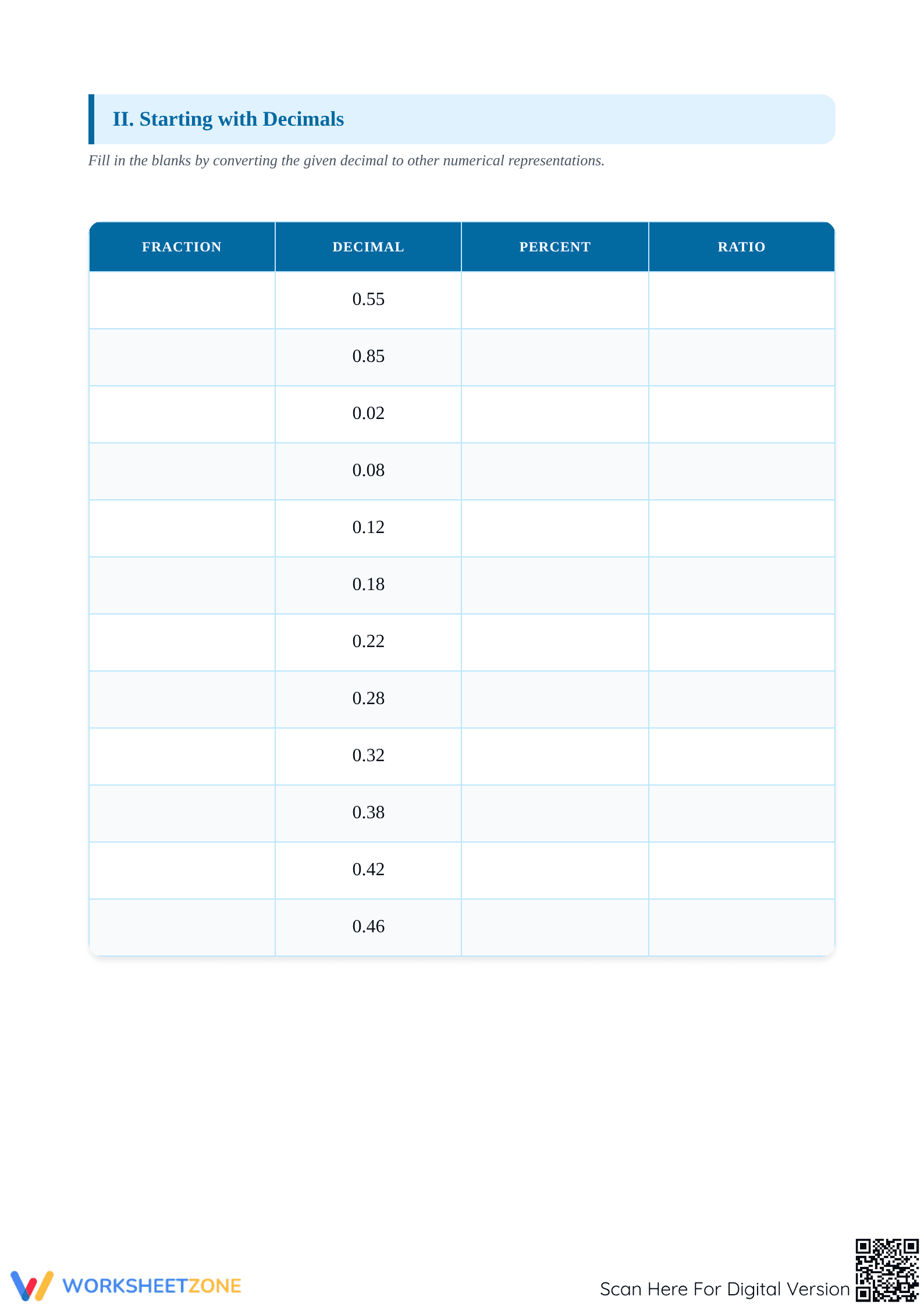
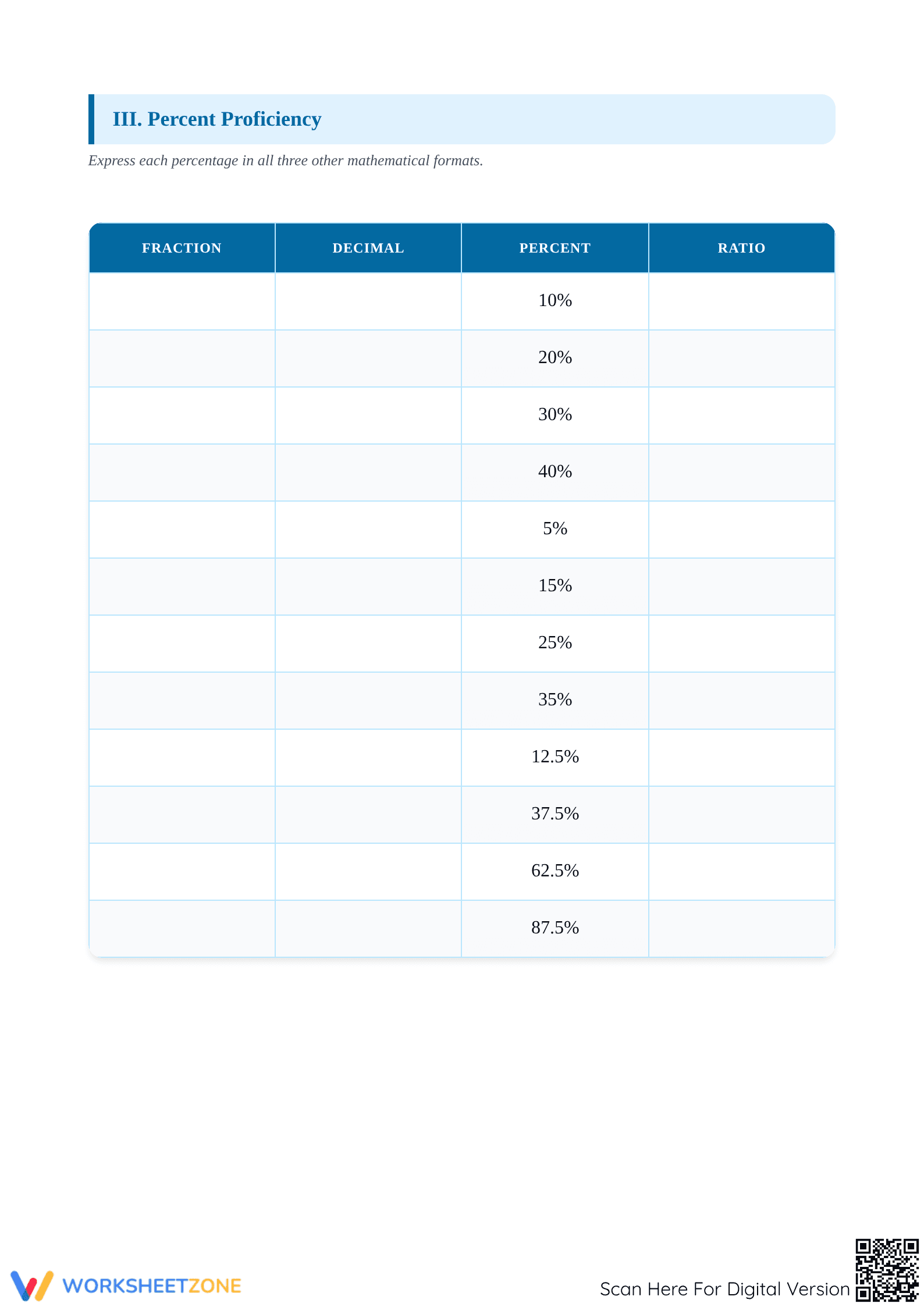
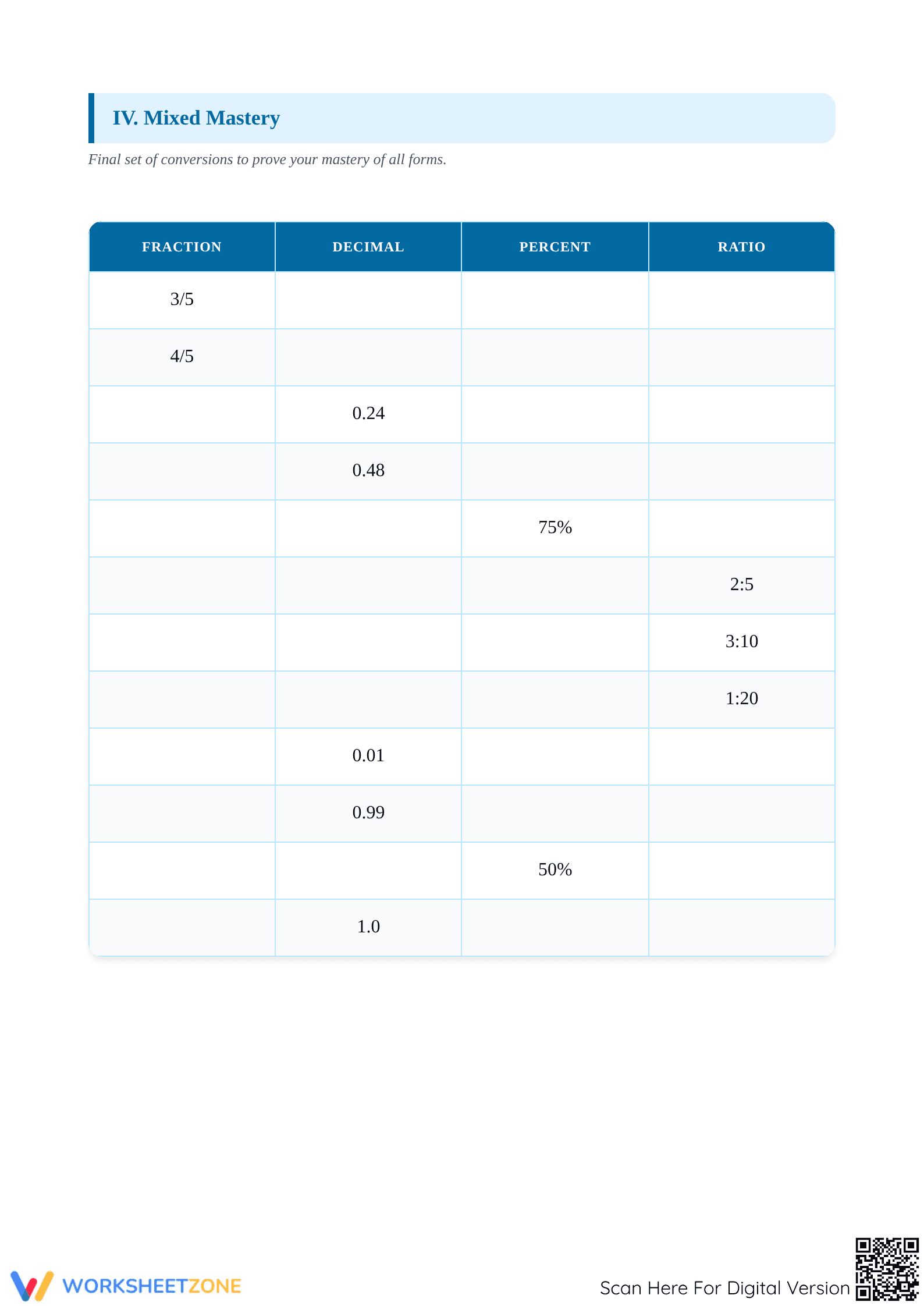
This four-page instructional resource contains 48 structured problems organized into thematic sections. Each page features a clear table format that prompts students to provide equivalent forms for a given starting value. The set includes dedicated sections for starting with fractions, decimals, and percentages, concluding with a mixed mastery challenge that tests flexible thinking across all four formats. A complete answer key is provided to facilitate rapid grading or student self-correction.
Skill Progression
- Guided Practice: The first 12 problems focus on benchmark fractions like 1/10 and 1/25, providing a scaffolded entry point into decimal and percent equivalencies.
- Supported Practice: The middle 24 problems increase complexity by introducing non-terminating decimal patterns and percentages that require precise ratio simplification.
- Independent Mastery: The final 12 problems remove the predictable pattern, forcing students to identify the most efficient conversion path for random values.
This structure follows the gradual-release model, moving from predictable denominators to varied rational numbers.
Standards Alignment
This resource is primary aligned to CCSS.MATH.CONTENT.6.RP.A.3: "Use ratio and rate reasoning to solve real-world and mathematical problems, e.g., by reasoning about tables of equivalent ratios." It specifically addresses sub-standard C, which requires students to find a percent of a quantity as a rate per 100 and write a fraction as a percent. This standard code can be copied directly into lesson plans, IEP goals, or district curriculum mapping tools.
How to Use It
Use this worksheet as a "Station Rotation" activity during your ratios and proportions unit. Students can work through one page per station, checking their work against the key at the final stop. Alternatively, assign the first two pages as a formative assessment after direct instruction to identify students who struggle with specific conversion directions, such as decimals to ratios. Expect most students to complete the full set within 40 minutes, depending on their familiarity with simplification.
Who It's For
This collection is designed for Grade 6 math students but serves as an excellent remedial tool for Grades 7-8 or an acceleration resource for advanced 5th graders. It is particularly effective for students who need repetitive practice to internalize common conversion pairs. Pair this resource with a visual number line or hundred-grid anchor chart to support visual learners during the transition from concrete to abstract representations.
According to research from EdReports 2024, the ability to fluently convert between fractions, decimals, and percents is a high-leverage skill that serves as a gatekeeper for middle school success. This worksheet targets CCSS.MATH.CONTENT.6.RP.A.3 by providing the high-volume, low-stakes practice required to move these procedures into long-term memory. Fisher & Frey (2014) emphasize that such structured practice is essential for reducing cognitive load when students later encounter complex word problems involving interest rates or statistical margins of error. By providing 48 distinct opportunities for calculation across four pages, this resource ensures that students encounter a wide variety of rational numbers. The inclusion of the ratio column specifically bridges the gap between elementary fraction work and middle school proportional reasoning, creating a cohesive mental model for students. This alignment with evidence-based instructional design makes the resource a reliable tool for classroom intervention and core curriculum support.


