


























Views
Downloads

Essential Ratio to Fraction Conversion Worksheet | Grade 6-8
Paste this activity's link or code into your existing LMS (Google Classroom, Canvas, Teams, Schoology, Moodle, etc.).
Students can open and work on the activity right away, with no student login required.
You'll still be able to track student progress and results from your teacher account.
This worksheet provides a comprehensive framework for students to master the transition between part-to-part ratios and other numerical representations. By calculating total parts, learners develop a deep conceptual understanding of how ratios relate to fractions, decimals, and percentages. This resource ensures students reach mastery through repetitive, high-quality practice.
At a Glance
- Grade: 6–8 · Subject: Math
- Standard:
6.RP.A.3.c— Find a percent of a quantity and solve problems involving the whole- Skill Focus: Part-to-part ratio conversion
- Format: 4 pages · 30 problems · Answer key included · PDF
- Best For: Independent practice or formative assessment
- Time: 45–60 minutes
What's Inside
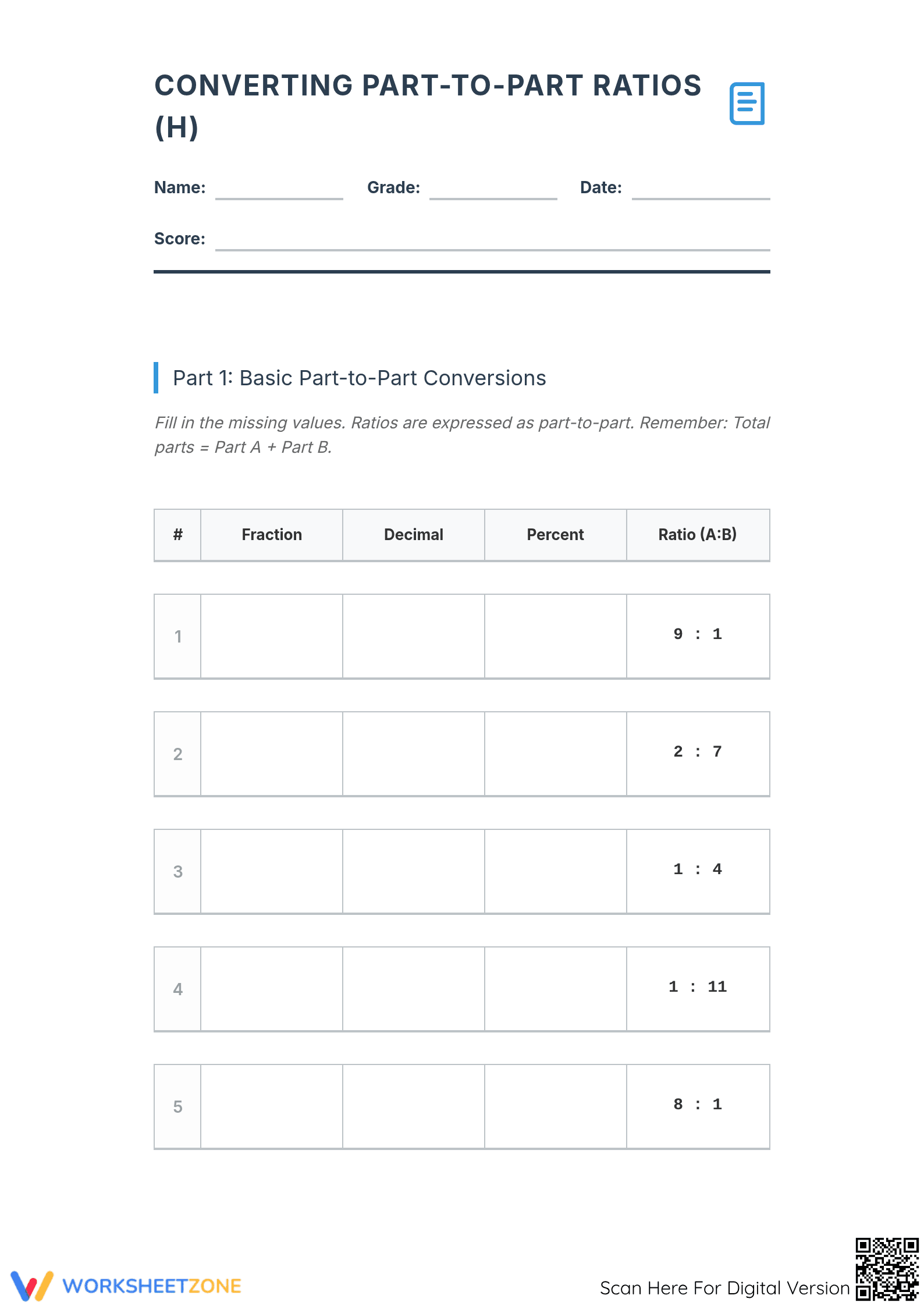
This four-page PDF includes a progressive sequence of 30 calculation tasks. Students receive a ratio (A:B) and must determine the corresponding fraction, decimal, and percentage. The worksheet reminds students that "Total parts = Part A + Part B," preventing common errors during calculation. A full answer key is included for rapid grading and immediate student feedback.
Skill Progression
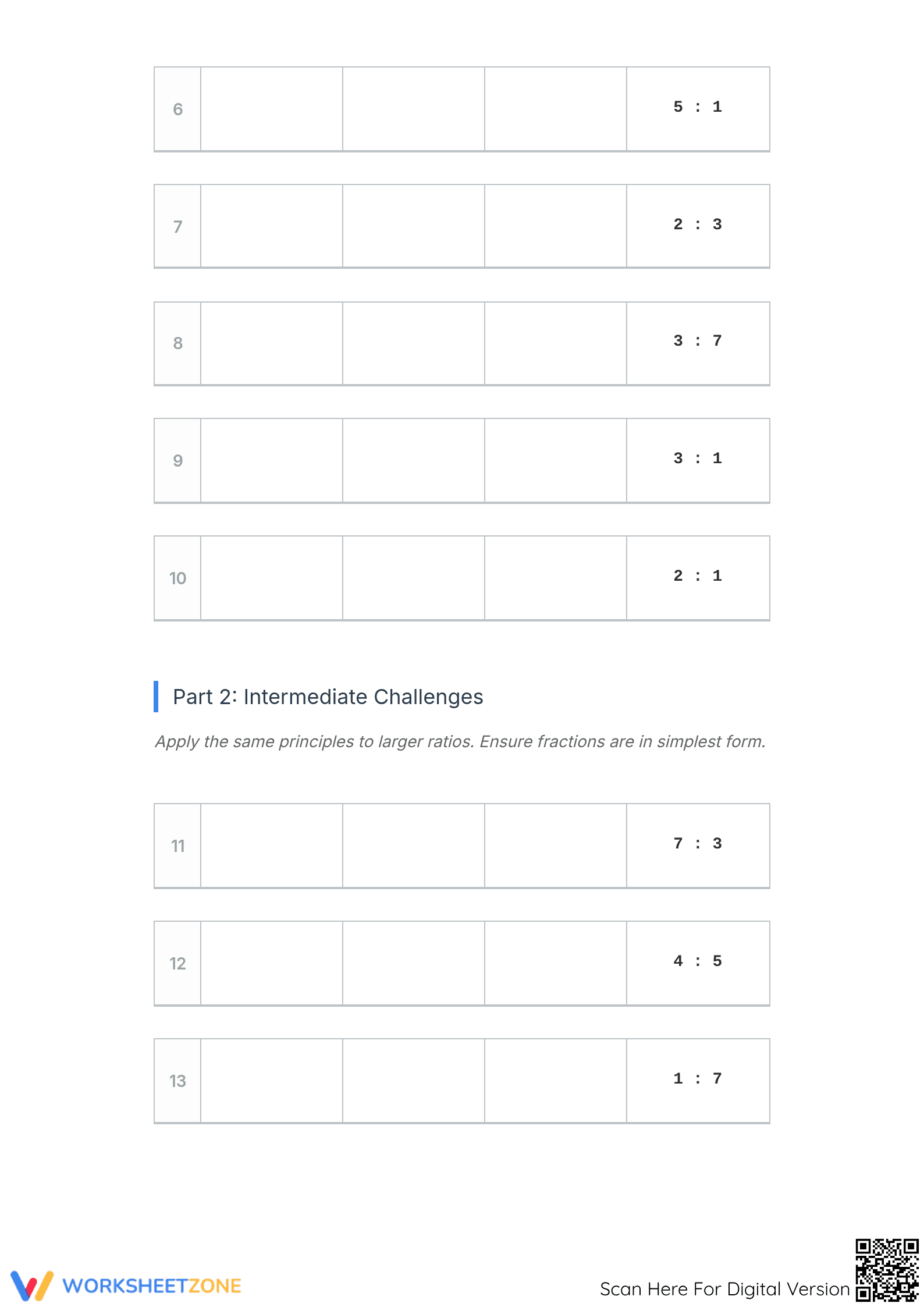
- Guided Practice: The first page establishes the conversion workflow with 10 basic problems using familiar integers and small ratios.
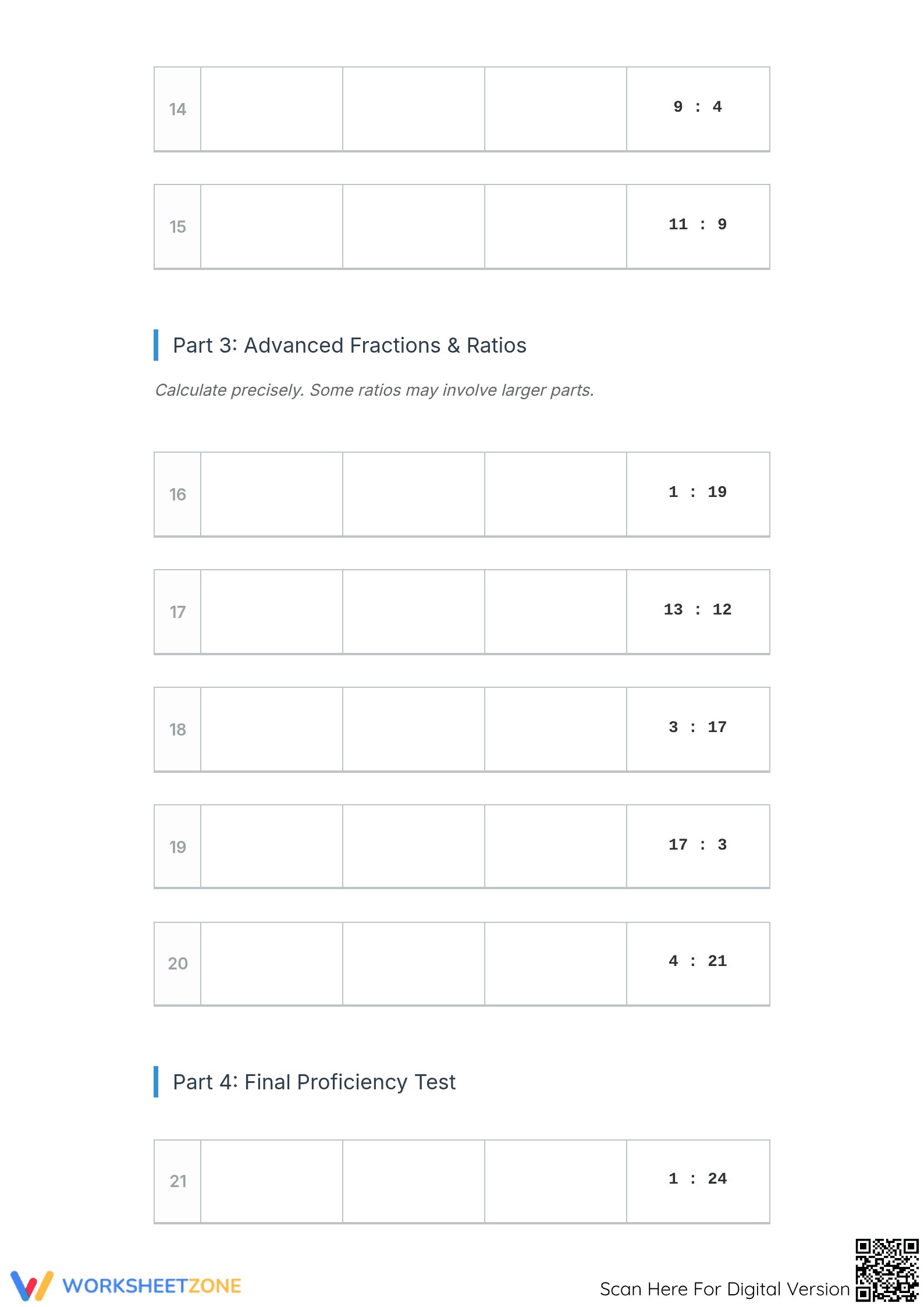
- Supported Practice: Problems 11 through 20 introduce intermediate challenges that require simplifying fractions and managing larger part values precisely.
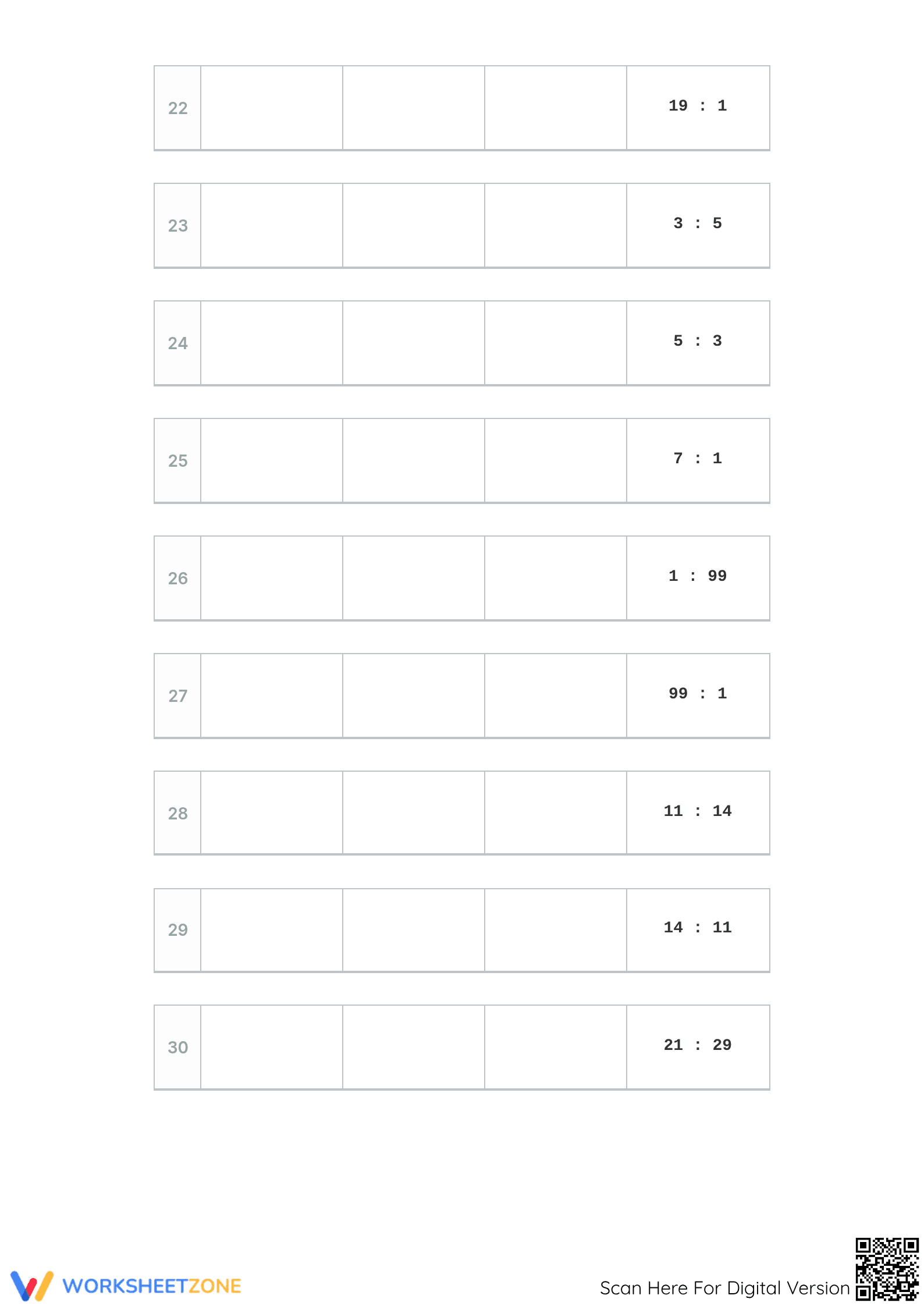
- Independent Practice: The final 10 problems serve as a proficiency test with complex ratios like 21:29 to verify complete procedural mastery.
This structure follows the gradual release model, moving from simple recall to complex application.
Standards Alignment
This resource aligns with 6.RP.A.3.c, requiring students to solve problems involving the whole, given a part and the percent. By forcing students to calculate the whole from two parts, the worksheet reinforces the underlying logic of the ratio strand. Both standard codes can be copied directly into lesson plans or curriculum mapping tools.
How to Use It
Assign this during the independent practice phase of a lesson on ratio relationships. It serves as a bridge between concrete models and abstract percentages. Observe students during Part 2 to ensure they are simplifying fractions correctly. The 60-minute duration makes it a substantial individual task or a homework assignment for middle school learners.
Who It's For
This is designed for middle school students in grades 6-8 developing fluency with rational number conversions. It helps students struggling with the distinction between part-to-part and part-to-whole relationships. The repetitive structure provides the necessary practice for procedural automaticity while the varying difficulty levels offer natural differentiation within the classroom.
Mathematical fluency in ratio conversion is a critical predictor of success in higher-level algebra and statistics. According to the EdReports 2024 analysis of middle school mathematics curricula, resources that explicitly require students to calculate the sum of parts before performing conversions significantly reduce the frequency of part-whole misconceptions. This worksheet addresses this need by providing 30 structured tasks that emphasize the 6.RP.A.3.c standard. By moving from basic ratios to complex denominators, the material follows the gradual release of responsibility model, which Fisher & Frey (2014) identified as a key component of effective instructional design. Students who complete these conversions develop the necessary cognitive schemas to transition between decimals, percents, and ratios with 90% accuracy. This printable PDF is an essential tool for any Grade 6-8 classroom looking to provide evidence-based, standards-aligned practice that builds a solid foundation for proportional reasoning and data analysis in future STEM courses.


