


























Views
Downloads

Printable Ratio Conversion Worksheet | Grade 6-7 Math
Paste this activity's link or code into your existing LMS (Google Classroom, Canvas, Teams, Schoology, Moodle, etc.).
Students can open and work on the activity right away, with no student login required.
You'll still be able to track student progress and results from your teacher account.
Mastering the ability to translate between mathematical representations is essential for algebraic success. This comprehensive practice set guides students through the complexities of converting part-to-part ratios into part-to-whole fractions, decimals, and percentages, ensuring they develop a deep structural understanding of proportional relationships across diverse real-world contexts and abstract problem sets.
At a Glance
- Grade: 6-7 · Subject: Math · Fractions
- Standard:
CCSS.MATH.CONTENT.6.RP.A.3— Use ratio and rate reasoning to solve real-world and mathematical problems- Skill Focus: Multi-Representational Ratio Conversion
- Format: 5 pages · 30 problems · Answer key included · PDF
- Best For: Middle school proportional reasoning practice
- Time: 45–60 minutes
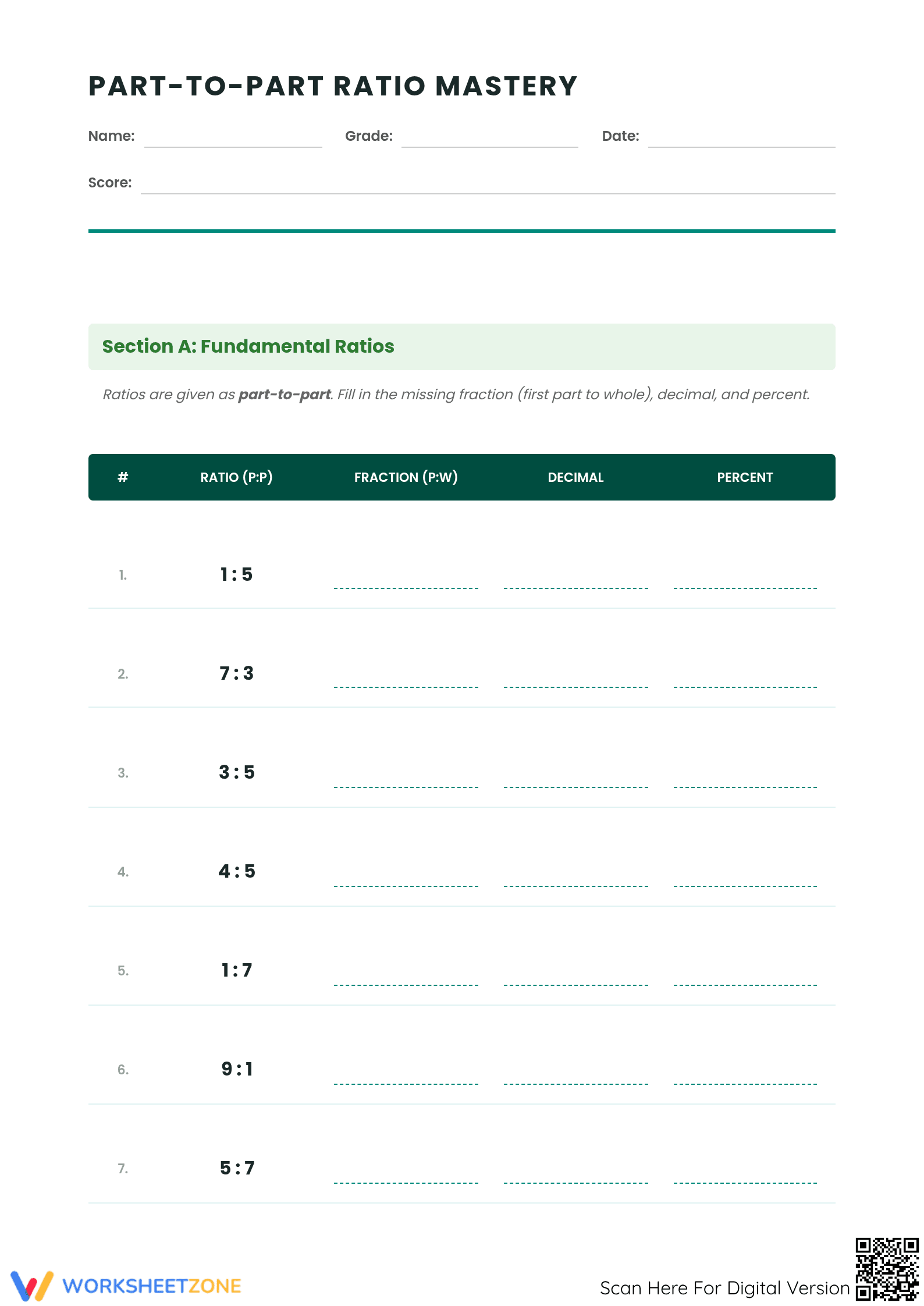
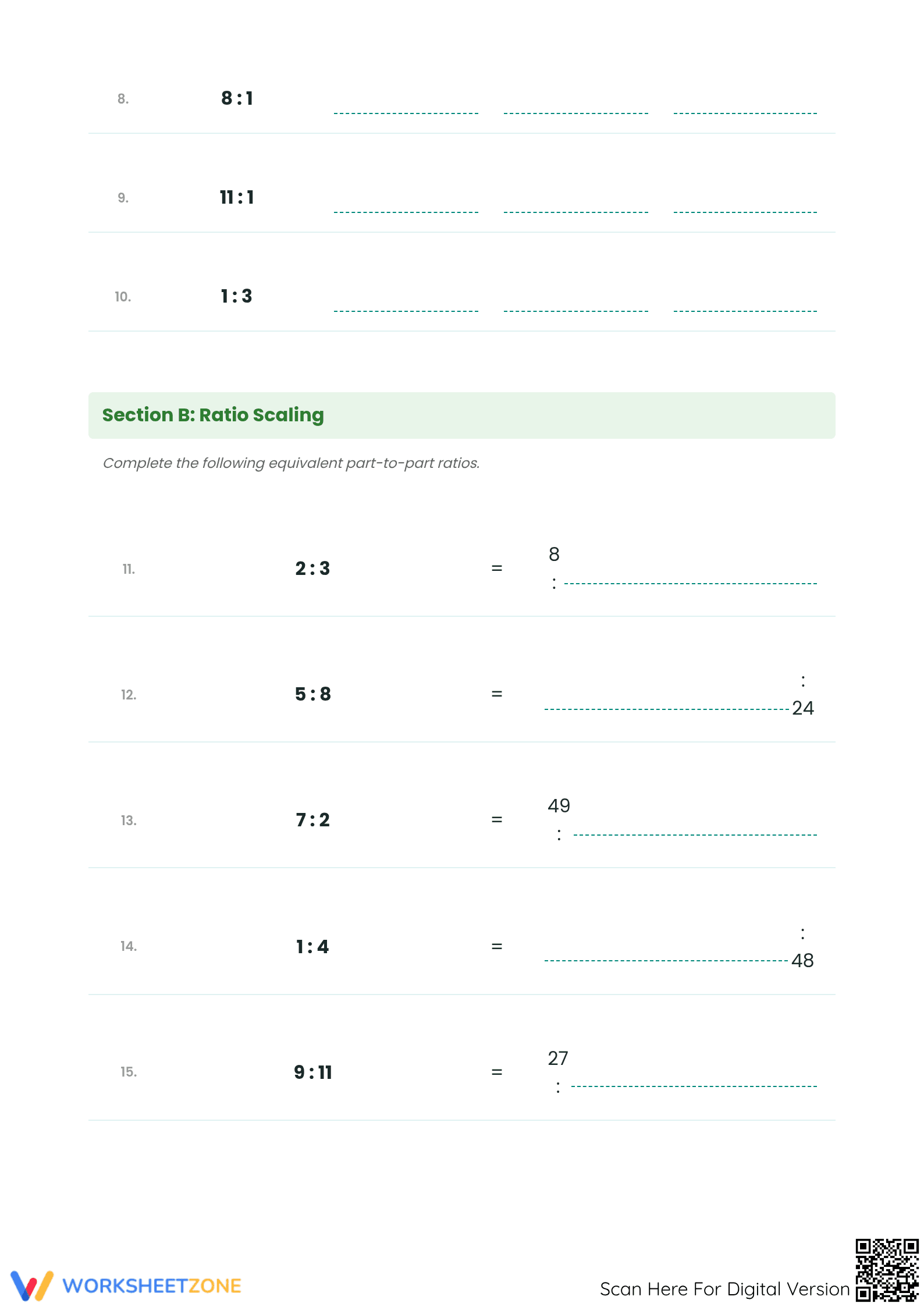
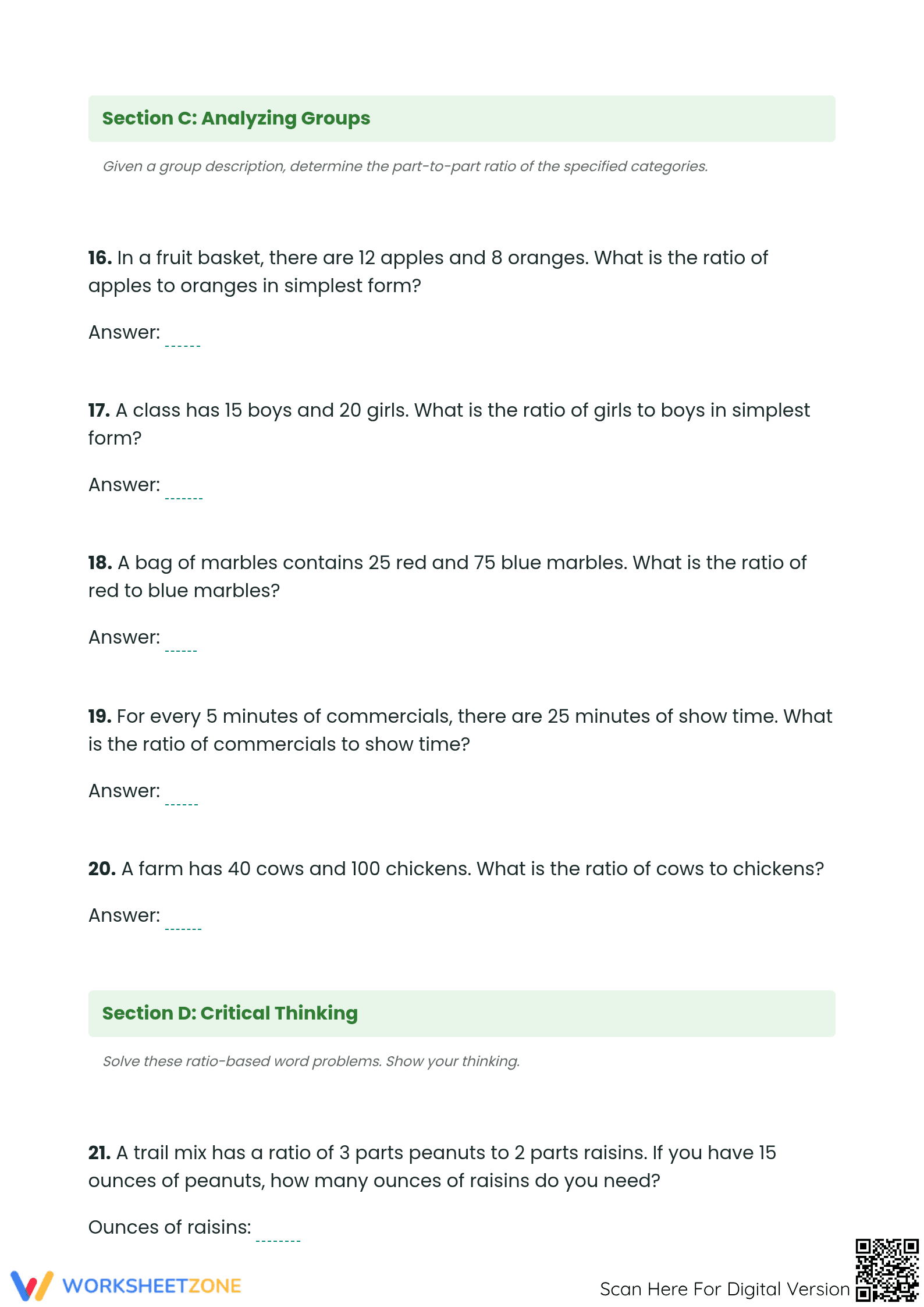
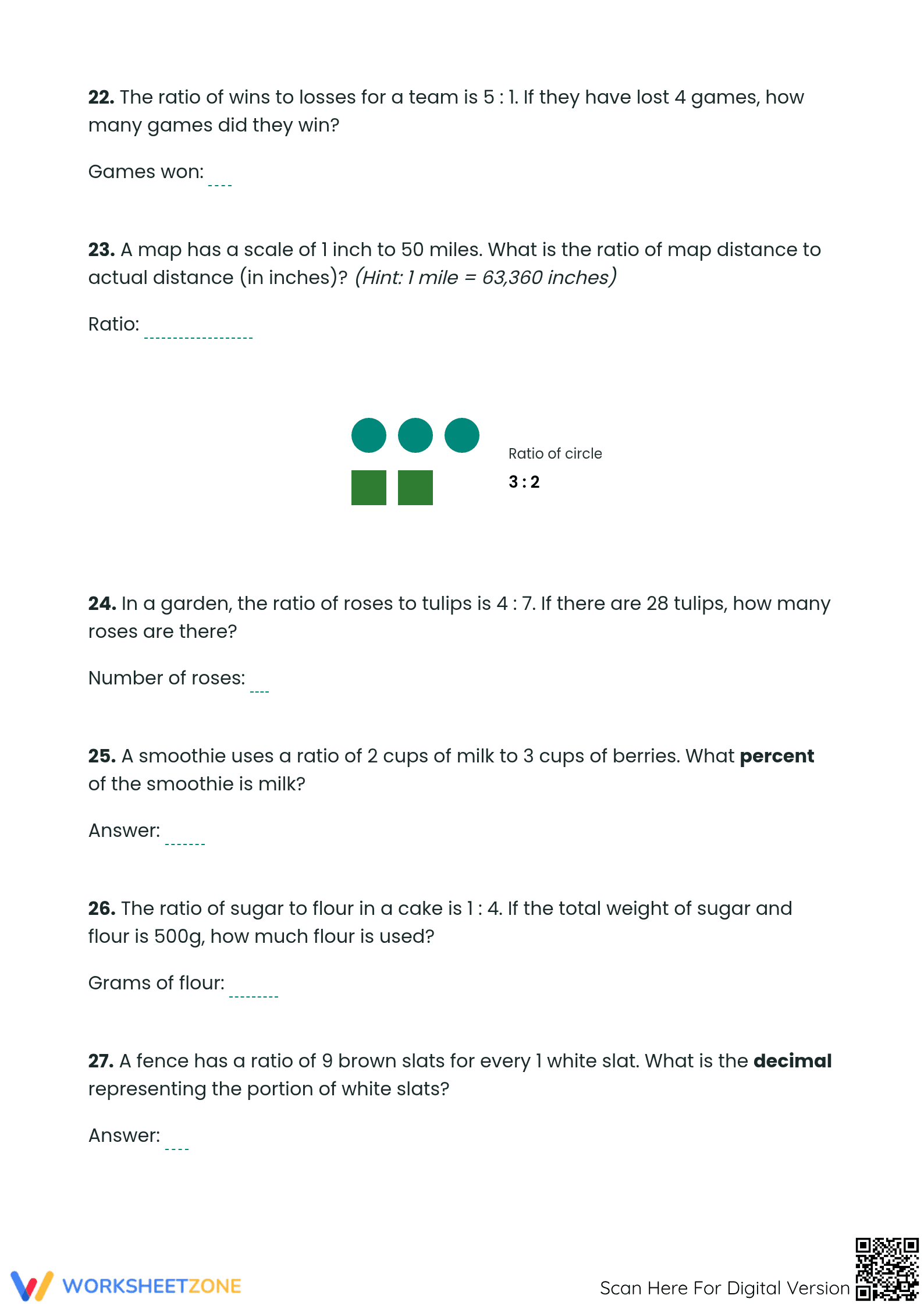
This 5-page PDF contains 30 tiered tasks designed to build mathematical fluency. It includes table-based conversions from fundamental ratios, equivalent ratio scaling, group analysis word problems, and high-order critical thinking challenges involving map scales and mixture concentrations. A complete answer key is provided to facilitate immediate feedback and student self-correction during the learning process.
Skill Progression
- Guided practice: The first 10 problems provide a structured table layout, prompting students to convert part-to-part ratios to part-to-whole fractions, then decimals and percents using clear visual cues.
- Supported practice: Sections B and C offer ratio scaling and group analysis tasks with scaffolded prompts to find simplest forms in common mathematical groupings.
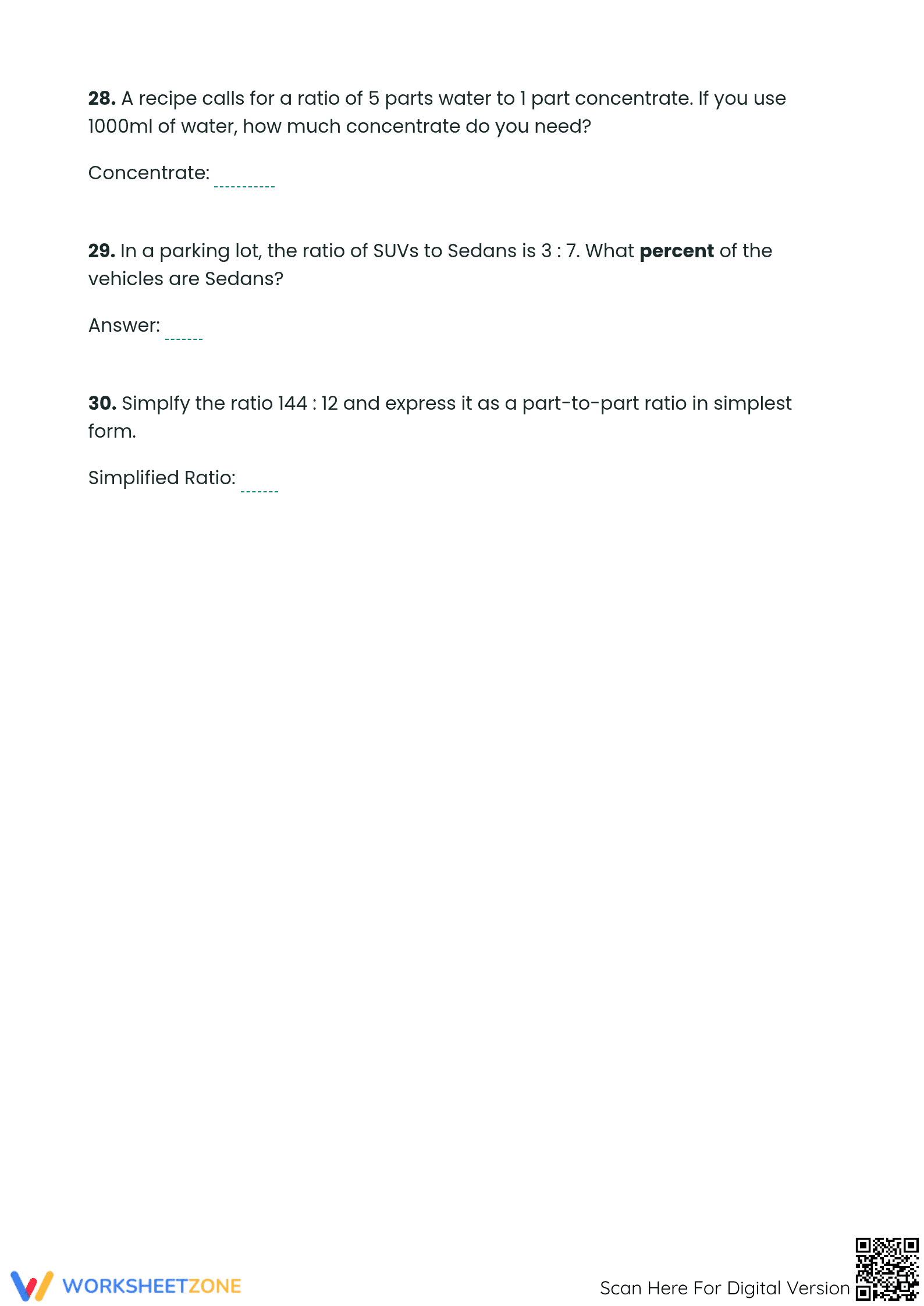
- Independent practice: The final 10 word problems require students to apply their knowledge to complex scenarios like recipe concentrations, map scales, and sport win-loss records without direct cues.
This follows a gradual-release model of I Do, We Do, You Do to build student confidence and long-term retention.
Standards Alignment
Primary alignment is to CCSS.MATH.CONTENT.6.RP.A.3, which focuses on using ratio and rate reasoning to solve real-world and mathematical problems. It also supports CCSS.MATH.CONTENT.7.RP.A.2 regarding proportional relationships and equivalent ratios. Both standard codes can be copied directly into lesson plans, IEP goals, or district curriculum mapping tools.
How to Use It
Deploy this as a summative assessment at the end of a ratios unit to check for representational fluency or as a structured homework assignment. Teachers should observe students during Section A to ensure they are correctly identifying the "whole" (sum of both parts) when converting part-to-part ratios. Expected completion time is approximately 50 minutes for the full set.
Who It's For
This resource is ideal for Grade 6 and 7 students during core instruction or Grade 8 students requiring targeted remediation. It pairs naturally with a visual ratio tape diagram or a double number line anchor chart to help students visualize the part-to-whole transition before attempting abstract calculations.
According to the EdReports 2024 analysis of middle school mathematics curricula, the ability to fluently shift between ratios, decimals, and percentages is a primary indicator of readiness for high school algebra. This worksheet addresses that specific need by providing high-density practice in CCSS.6.RP.A.3, which requires students to use ratio reasoning to solve real-world and mathematical problems. Research from ScienceDirect TpT Analysis indicates that structured, table-based practice helps students internalize the relationship between different numerical forms, reducing cognitive load when they encounter more complex multi-step word problems later in the curriculum. By isolating the conversion skill before introducing critical thinking scenarios involving map scales and concentration mixtures, this resource supports the scaffolding necessary for long-term retention of proportional reasoning concepts. It is an essential tool for teachers looking to bridge the gap between concrete ratio models and abstract percentage applications in a zero-prep, classroom-ready format that can be easily integrated into any existing mathematics curriculum or intervention program.


