


























Views
Downloads



Printable Fraction Decimal Percent Conversion Practice
Paste this activity's link or code into your existing LMS (Google Classroom, Canvas, Teams, Schoology, Moodle, etc.).
Students can open and work on the activity right away, with no student login required.
You'll still be able to track student progress and results from your teacher account.
This comprehensive math worksheet empowers students to master the vital skill of converting between fractions, decimals, percents, and ratios. By providing 30 structured problems, it ensures students can fluidly transition between numerical representations, a core requirement for success in middle school algebraic thinking and real-world statistical analysis.
At a Glance
- Grade: 6 · Subject: Math
- Standard:
CCSS.MATH.CONTENT.6.RP.A.3— Find a percent of a quantity as a rate per 100- Skill Focus: Multi-unit numerical conversion
- Format: 4 pages · 30 problems · Answer key included · PDF
- Best For: Mastery practice and formative assessment
- Time: 40–50 minutes
What's Inside
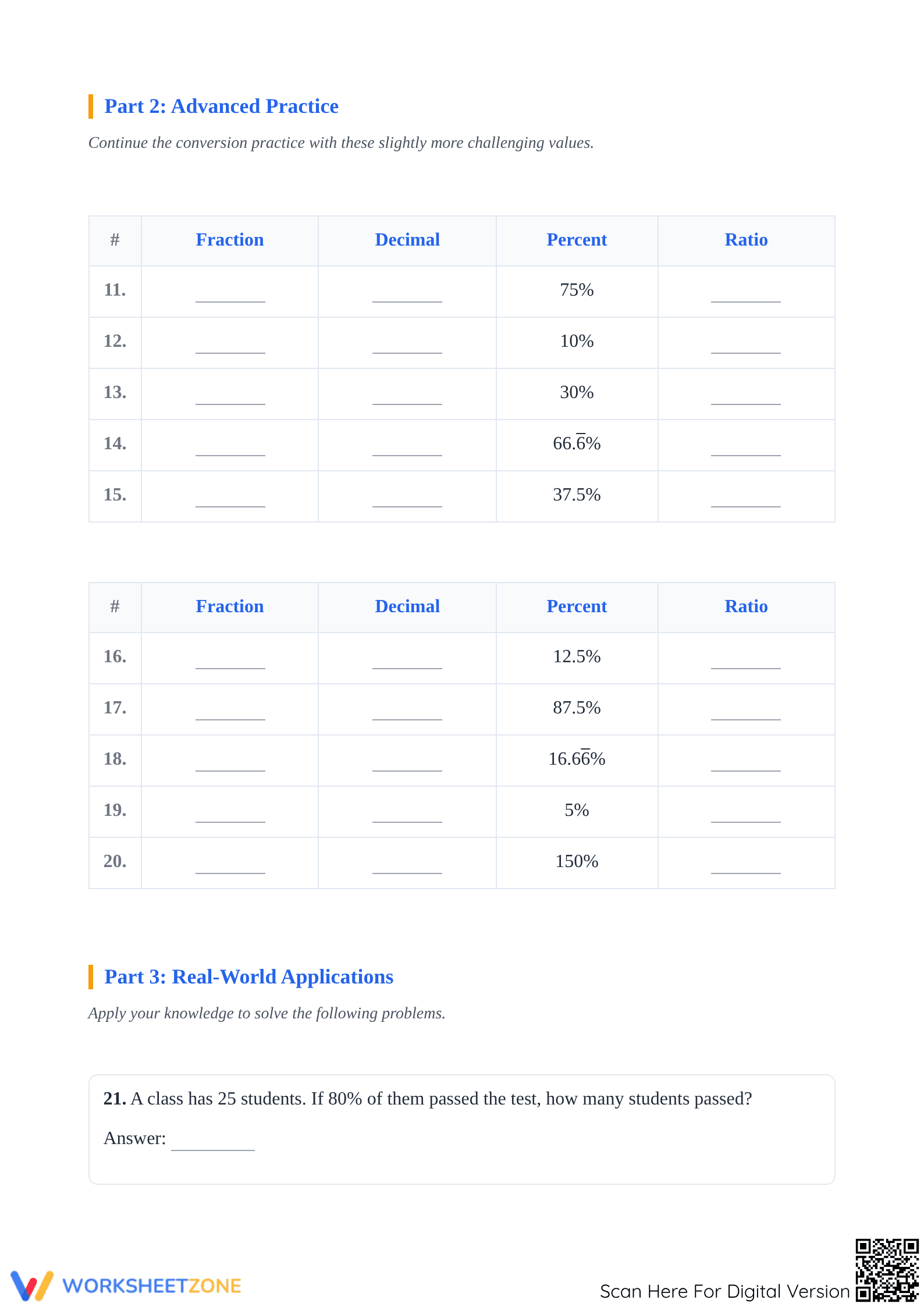
This packet contains four pages of targeted mathematical practice. It begins with 10 basic table-based conversions, moves into 10 advanced table tasks featuring repeating decimals and complex percentages, and concludes with 5 real-world word problems and 5 multiple-choice challenges. The layout is clean and spacious, providing ample room for student calculations. A complete answer key is included for rapid grading.
Skill Progression
- Guided Practice: The first page utilizes a tabular format with 10 rows to introduce simple conversions, such as 80% to 0.8 or 4/5, helping students establish the basic mathematical relationships.
- Supported Practice: Rows 11 through 20 introduce more complex values, including percentages like 66.6% and 87.5%, requiring students to apply their knowledge to non-integer and repeating decimal values.
- Independent Practice: The final sections provide 10 unique problems where students must solve contextual word problems and choose correct equivalent values from multiple options, demonstrating true mastery.
This structure follows the gradual-release model, moving from scaffolded table entry to independent application of conversion logic.
Standards Alignment
This resource is strictly aligned to CCSS.MATH.CONTENT.6.RP.A.3, which requires students to use ratio and rate reasoning to solve real-world and mathematical problems. Specifically, it targets the ability to find a percent of a quantity as a rate per 100 and express ratios as fractions or decimals. This standard code can be copied directly into lesson plans, IEP goals, or district curriculum mapping tools.
How to Use It
Use this worksheet as a "Mastery Packet" after initial instruction on ratios and percentages. It is ideal for an independent practice block or as a homework assignment to reinforce the fluency of mental conversions. For a formative assessment tip, observe students during Part 2 to see if they correctly handle the repeating decimals; this is a common stumble point that indicates a need for deeper conceptual review.
Who It's For
This practice set is designed for Grade 6 students but remains highly relevant for Grade 7 and 8 learners needing remediation or fluency maintenance. It pairs perfectly with visual anchor charts showing the "Conversion Triangle" and can be used as a standalone assessment for students working toward IEP goals involving rational number equivalency.
Developing fluency in numerical conversions is a cornerstone of mathematical proficiency, as highlighted by EdReports (2024). This Grade 6 worksheet directly addresses CCSS.MATH.CONTENT.6.RP.A.3 by requiring students to identify and calculate equivalent values across fractions, decimals, percents, and ratios. Research from the RAND AIRS 2024 report emphasizes that students who master these gateway skills in middle school are significantly more likely to succeed in high school algebra and statistics. By integrating multiple formats—including tables, word problems, and multiple-choice questions—this resource ensures that learners do not just memorize procedures but develop a flexible understanding of how numbers relate to one another. The inclusion of 30 distinct tasks provides the repetition necessary for long-term retention, while the real-world application problems bridge the gap between abstract calculation and practical utility in finance and data interpretation.


