


























Views
Downloads

Mastering FDP Conversions: A Grade 7 Aligned Worksheet
Paste this activity's link or code into your existing LMS (Google Classroom, Canvas, Teams, Schoology, Moodle, etc.).
Students can open and work on the activity right away, with no student login required.
You'll still be able to track student progress and results from your teacher account.
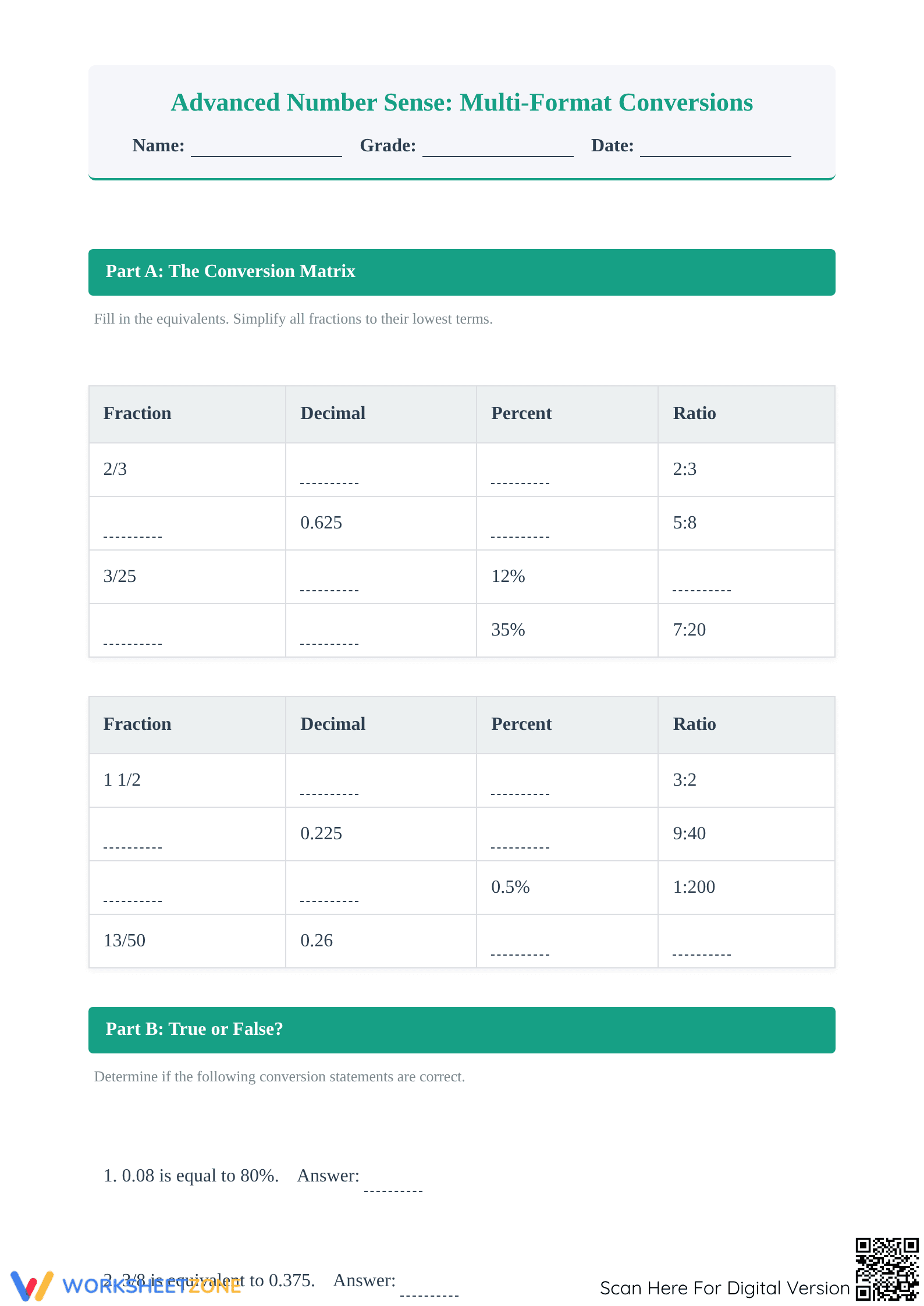
This comprehensive Math worksheet focuses on the critical skill of converting between fractions, decimals, percents, and ratios. Students will develop advanced number sense by moving fluently between representations, ensuring they can tackle complex statistical and algebraic problems. By mastering these transformations, learners gain the mathematical flexibility required for higher-level ratio and proportion work.
At a Glance
- Grade: 7 · Subject: Math
- Standard:
CCSS.MATH.CONTENT.7.NS.A.2.D— Convert rational numbers to decimals and identify terminating or repeating patterns.- Skill Focus: Multi-format numerical conversions
- Format: 3 pages · 25 problems · Answer key included · PDF
- Best For: Mastery-based assessment and skill reinforcement
- Time: 40–50 minutes
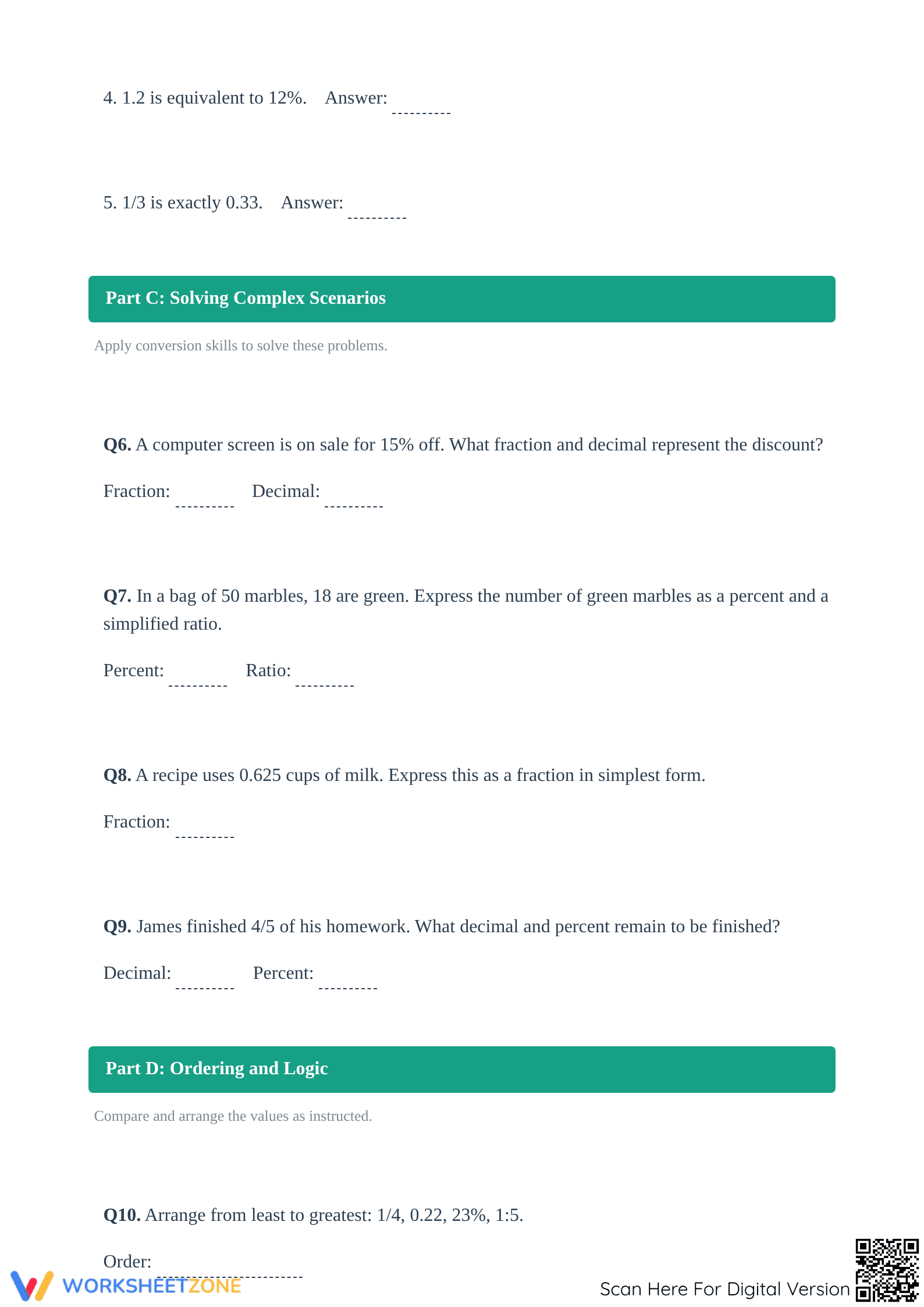
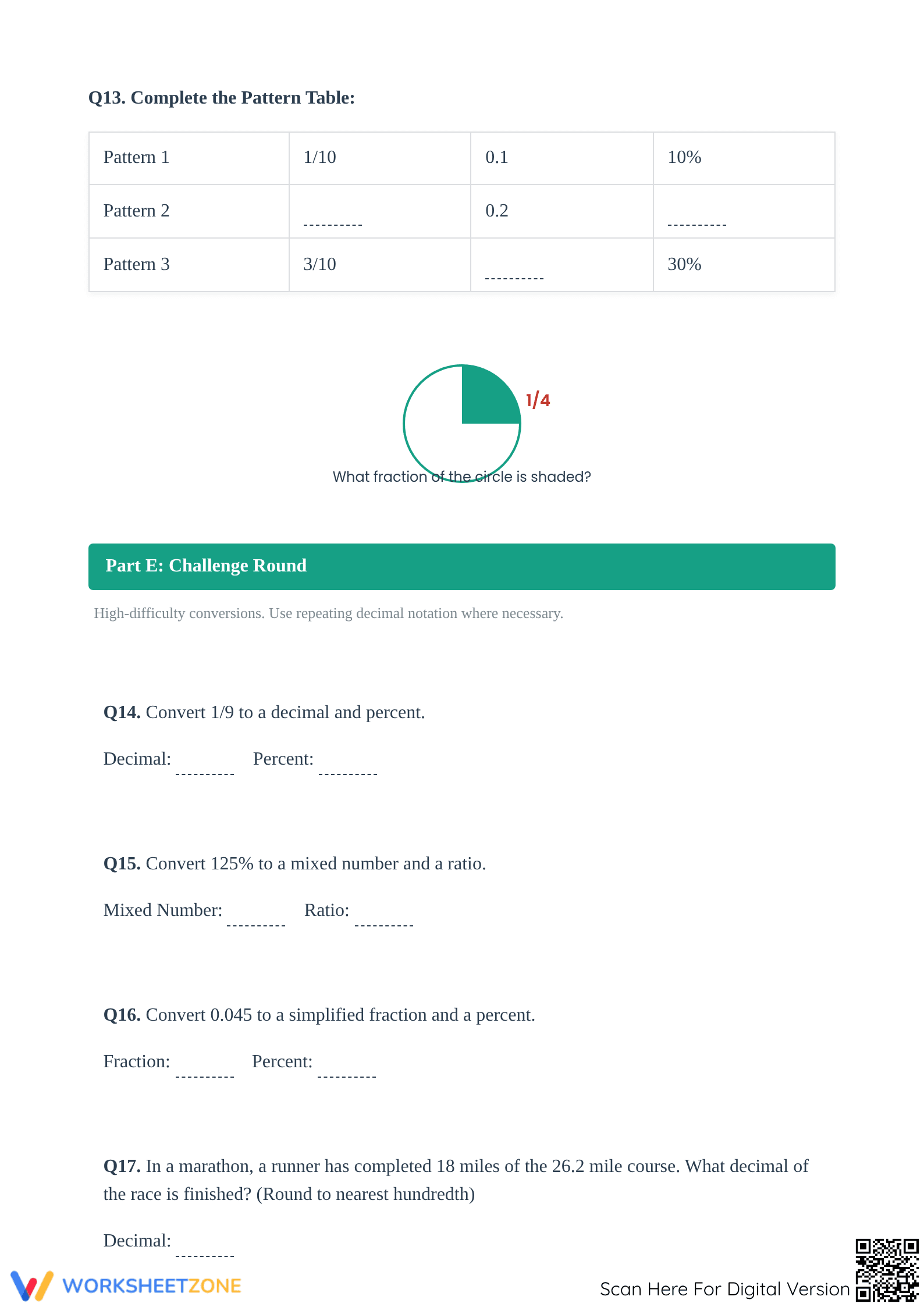
This three-page instructional set includes a high-density conversion matrix, true/false conceptual checks, and multi-step word problems. Students encounter diverse formats, including mixed numbers, repeating decimals, and visual models like shaded circles. A complete answer key is provided, ensuring that educators can quickly verify student accuracy across both simple computations and complex logic scenarios.
Mastery Evidence and Progression
The worksheet is structured to provide clear evidence of student mastery across three distinct cognitive tiers. The initial conversion matrix assesses basic fluency, while the word problem section requires students to apply knowledge to real-world sale prices and probability scenarios. Finally, the "Challenge Round" pushes learners toward the "Exceeding" tier by introducing repeating decimal notation and rounding requirements. Educators can use these sections to generate precise IEP progress notes or standard-based gradebook entries.
Standards Alignment
The primary focus is `CCSS.MATH.CONTENT.7.NS.A.2.D`, which requires students to convert rational numbers to decimals and understand decimal termination or repetition. Additionally, the inclusion of ratios and percents supports `CCSS.MATH.CONTENT.6.RP.A.3.C`. These standards are foundational for understanding the number system and proportional relationships. Both standard codes can be copied directly into lesson plans, IEP goals, or district curriculum mapping tools.
How to Use It
Use this worksheet as a summative assessment after direct instruction on rational number representations. It works effectively as an "I Do, We Do, You Do" capstone activity. During the independent practice phase, teachers should observe how students handle the transition from percents to simplified fractions in Part C. This formative assessment moment helps identify students who may need additional scaffolding with greatest common factor identification.
Who It's For
This resource is designed for Grade 7 students but serves as an excellent extension for advanced Grade 6 learners or a necessary intervention for Grade 8 students. It is particularly valuable for learners who struggle with abstract number relationships and benefit from seeing the same value expressed in four distinct ways. Pair this with a conversion anchor chart or a ratio-themed reading passage for a complete lesson cycle.
Developing fluency in multi-format numerical conversions is recognized as a cornerstone of algebraic readiness. According to the NAEP (National Assessment of Educational Progress) framework, students who can efficiently translate between fractions, decimals, and percents demonstrate a deeper understanding of proportional reasoning and rational number properties. This worksheet targets the CCSS.MATH.CONTENT.7.NS.A.2.D standard by challenging students to identify repeating decimal patterns and apply conversion logic to complex, real-world scenarios. By integrating twenty-five high-quality tasks across five difficulty tiers, the resource ensures that learners move beyond rote memorization toward conceptual mastery. Research from the NAEP highlights that this flexibility is predictive of success in high school mathematics, where ratios and functions become increasingly abstract. This self-contained unit provides the structured practice necessary to bridge the gap between basic arithmetic and advanced number sense, making it an essential tool for middle school math curriculum.


