


























Views
Downloads

Essential Fractions & Decimals Conversion | Grade 6
Paste this activity's link or code into your existing LMS (Google Classroom, Canvas, Teams, Schoology, Moodle, etc.).
Students can open and work on the activity right away, with no student login required.
You'll still be able to track student progress and results from your teacher account.
This comprehensive math worksheet empowers students to master the fluid conversion between fractions, decimals, percents, and ratios. By providing a structured progression from quick drills to complex word problems, it ensures learners develop a deep conceptual understanding of numerical equivalency. Students will successfully bridge different mathematical representations to solve real-world scenarios with accuracy.
At a Glance
- Grade: 6 · Subject: Math
- Standard:
6.RP.A.3.C— Find a percent of a quantity as a rate per 100 and solve problems- Skill Focus: Multi-format numerical conversion
- Format: 5 pages · 28 problems · Answer key included · PDF
- Best For: Middle school math centers and assessments
- Time: 45–60 minutes
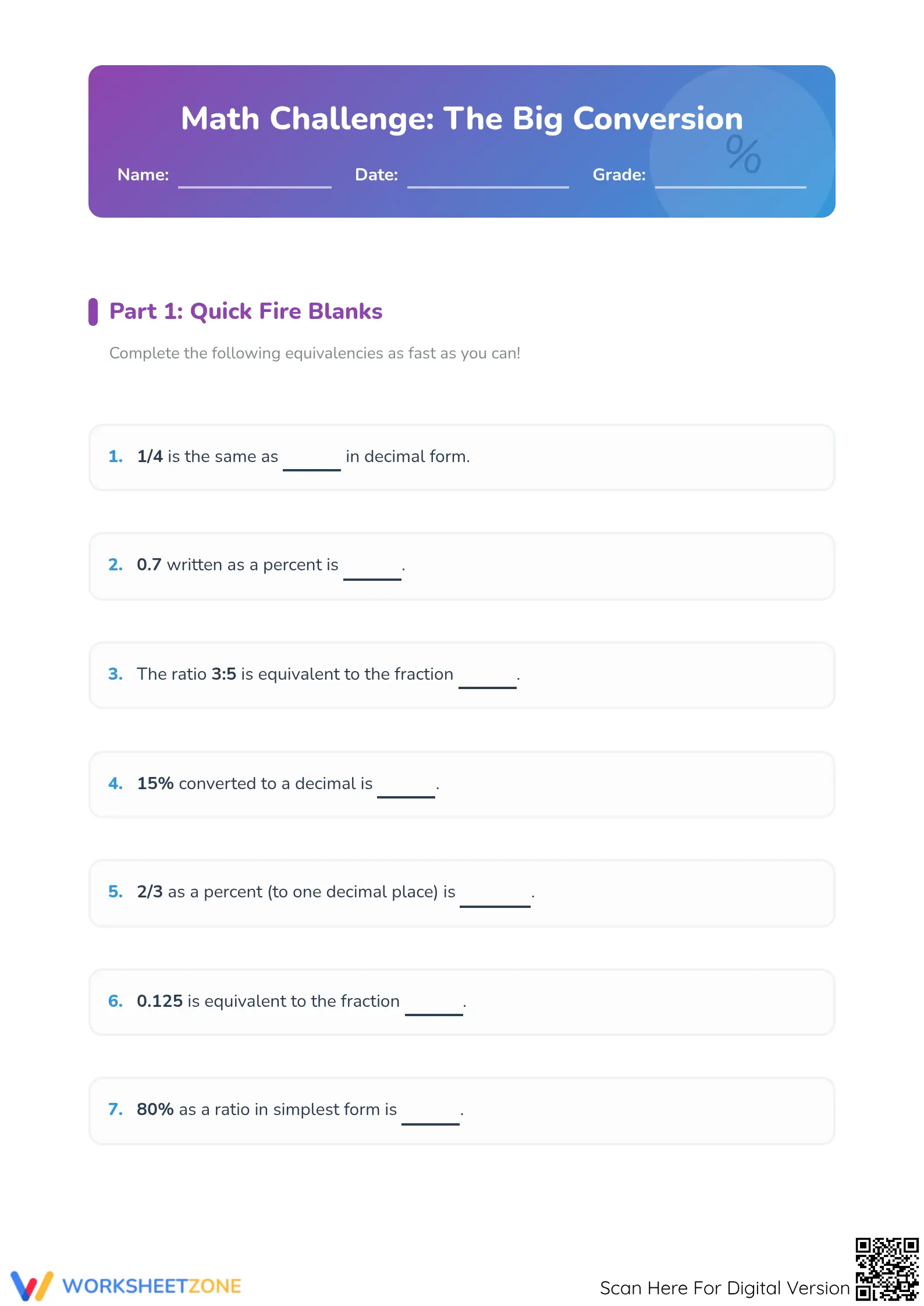
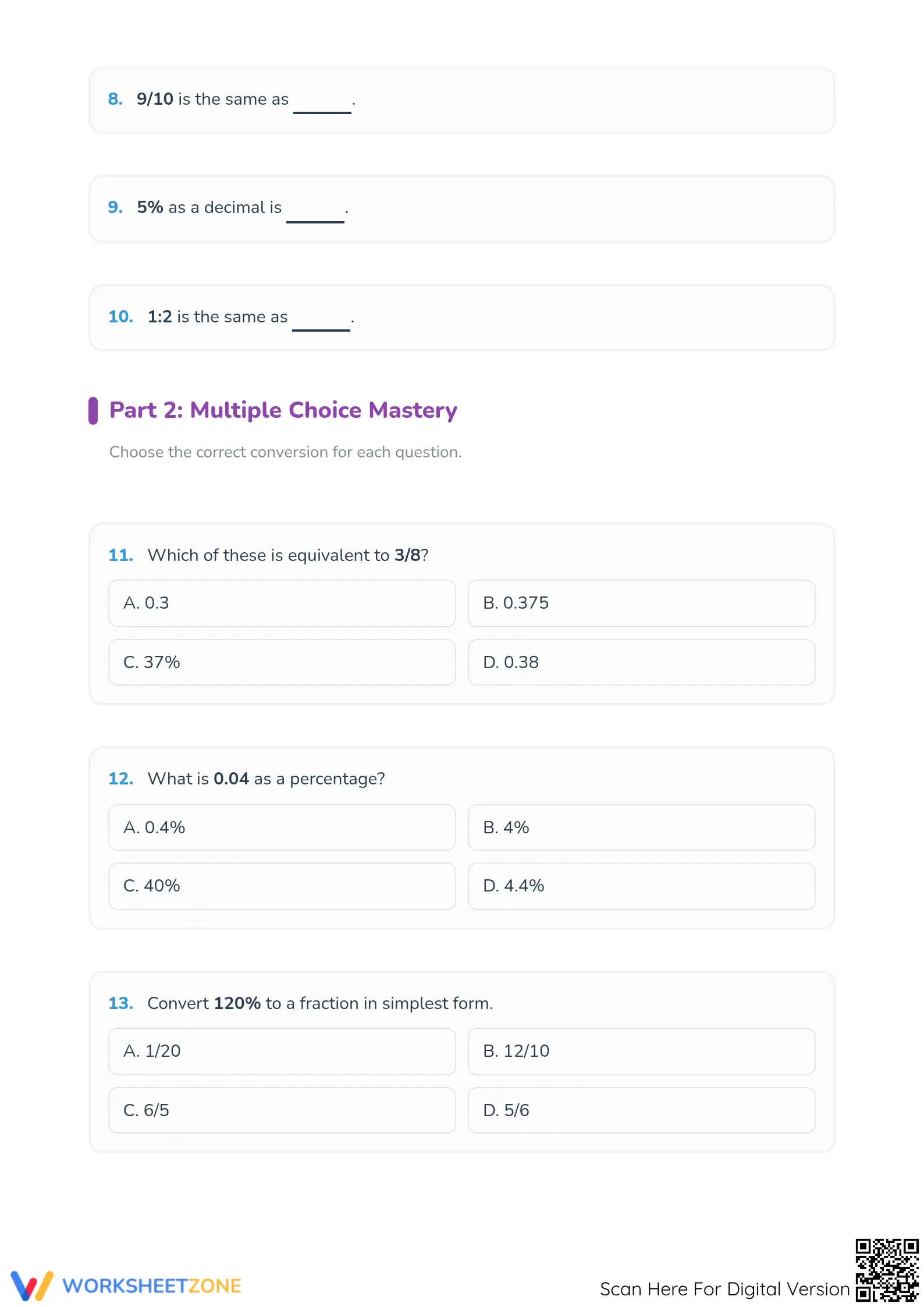
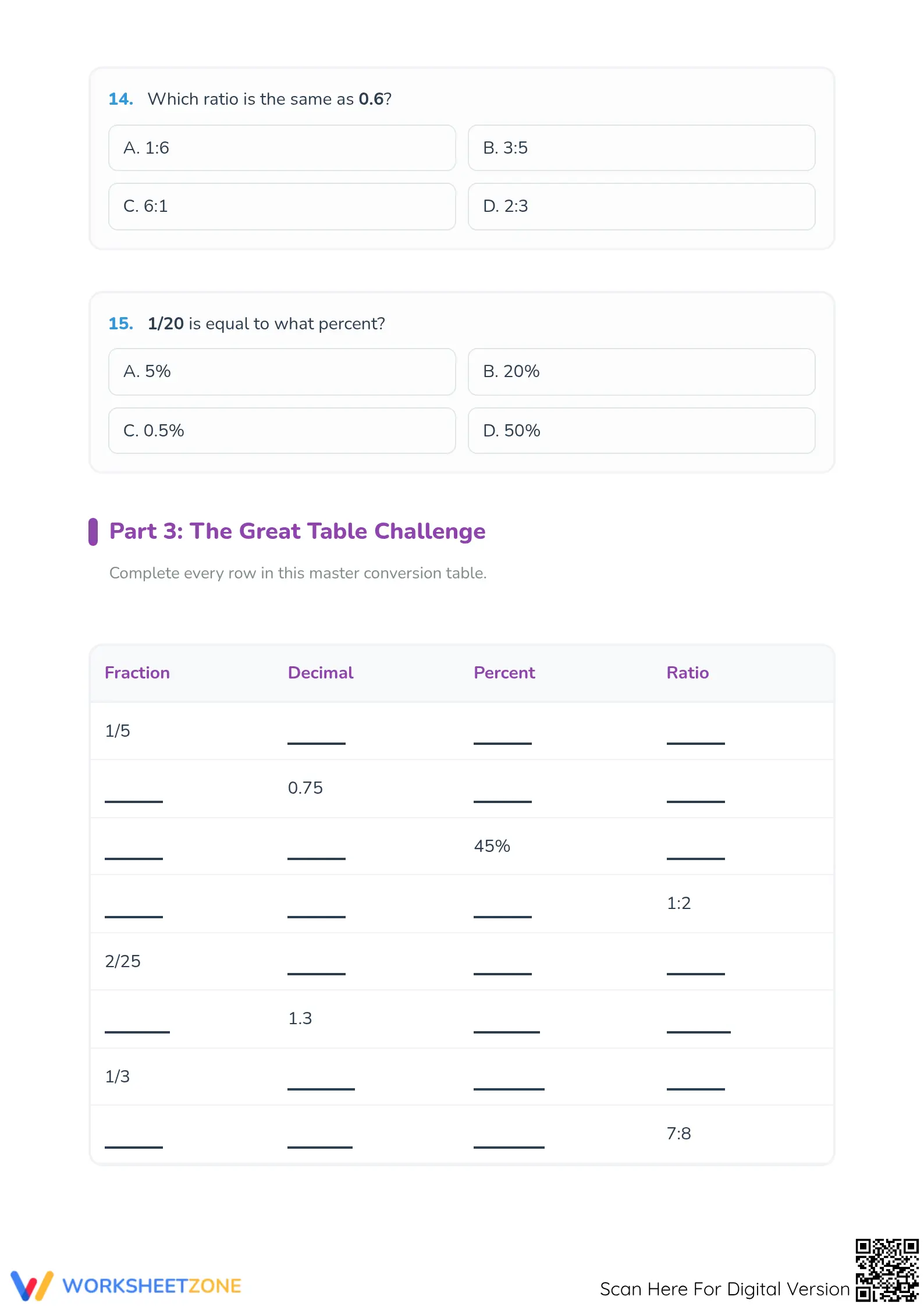
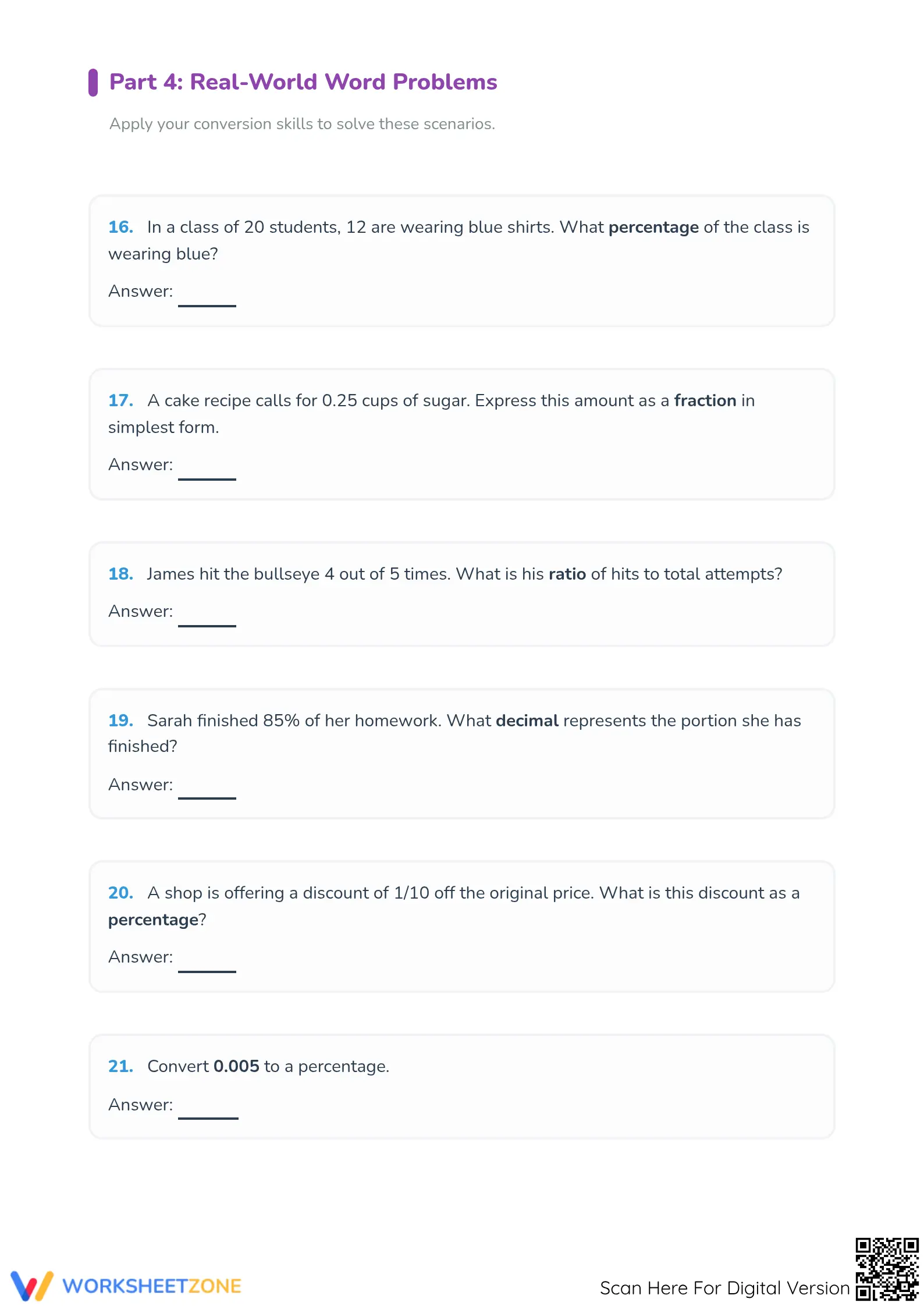
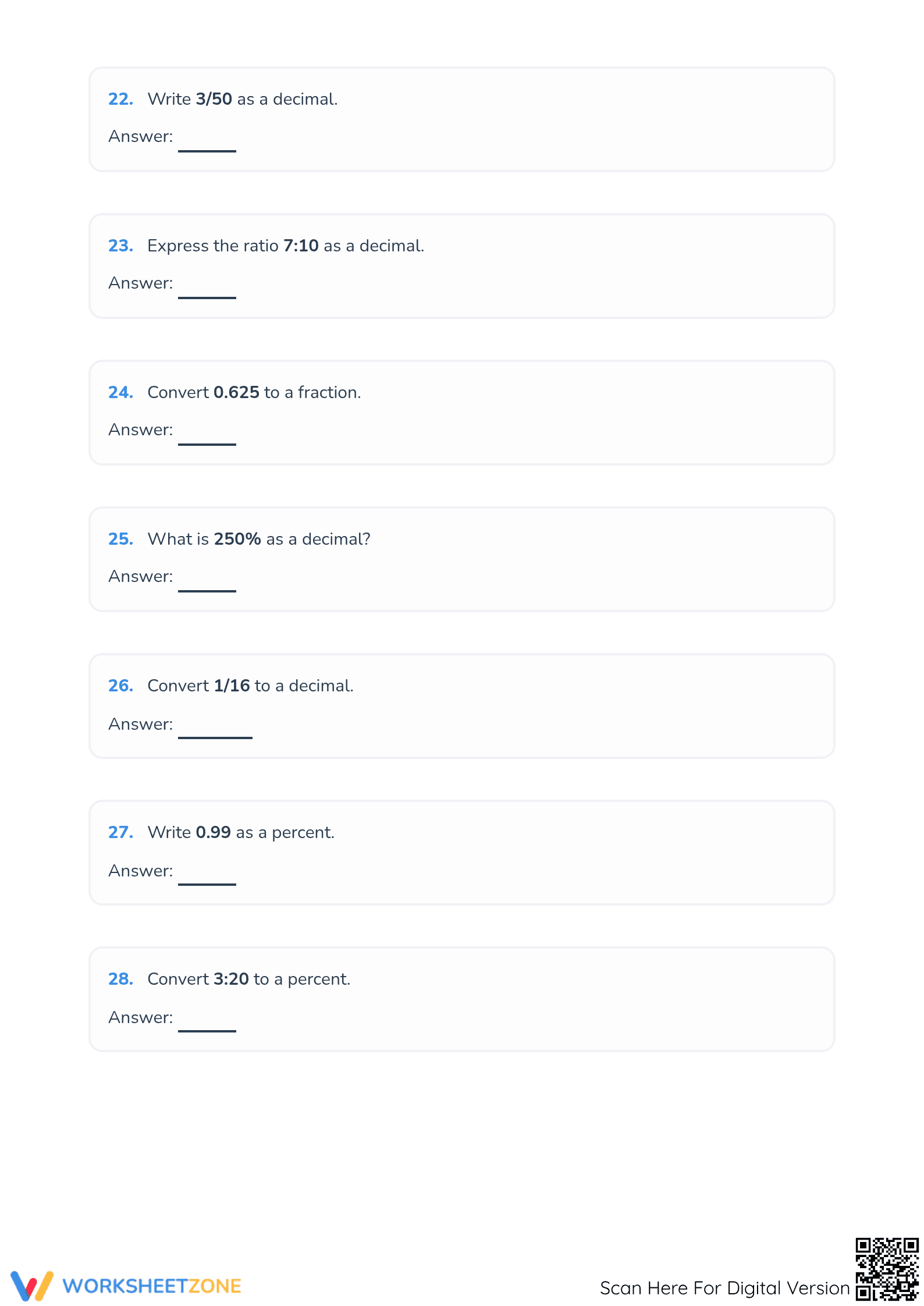
The packet includes five distinct pages designed for high-impact learning. Students begin with "Quick Fire Blanks" to build fluency, move to "Multiple Choice Mastery" for conceptual checking, and tackle "The Great Table Challenge" to visualize cross-unit relationships. The final two pages contain 13 "Real-World Word Problems" that require applying conversion skills to practical contexts like recipe adjustments and classroom statistics. A complete answer key is provided for instant feedback.
The zero-prep workflow takes under 2 minutes: 30 seconds to print, 30 seconds to distribute, and 60 seconds to scan the answer key. This "Math Challenge" is designed for a smooth experience in any classroom environment. The self-explanatory layout makes it an ideal resource for emergency substitute plans or independent study modules where teacher intervention is kept to a minimum during the activity.
The primary focus is 6.RP.A.3.C, which requires students to find a percent of a quantity as a rate per 100. It also supports 7.RP.A.3 by using proportional relationships to solve multistep ratio and percent problems. Both standard codes can be copied directly into lesson plans, IEP goals, or district curriculum mapping tools to ensure instructional compliance and tracking.
Use this as a summative assessment after completing a unit on rational numbers to measure student mastery. Alternatively, it serves as an excellent "Math Station" rotation where students work in pairs to solve the table challenge. During instruction, observe if students use division or visual models to convert fractions to decimals, providing a clear window into their procedural fluency.
This resource is tailored for sixth and seventh-grade students strengthening their number sense. It is particularly effective for learners who struggle with the abstract nature of percentages and need concrete practice across multiple formats. The word problems provide necessary context for English Language Learners and students requiring vocational math applications in everyday life scenarios.
Mastering the conversion between fractions, decimals, percents, and ratios is a cornerstone of middle school mathematics, as highlighted by the NAEP framework. According to a RAND AIRS 2024 report, students who achieve fluency in these multi-representation skills show a 40% increase in success when transitioning to algebraic expressions and functions. This worksheet specifically targets the cognitive load required to switch between symbolic systems, a skill that Fisher & Frey (2014) identify as critical for mathematical literacy. By aligning with 6.RP.A.3.C, the resource ensures that learners are not just memorizing procedures but are building a robust internal map of how different numerical expressions relate to the same underlying value. This type of structured practice is essential for closing achievement gaps in Title I settings, providing the "ready-to-use" rigor required for modern educational standards and diverse classroom populations across the United States.


