


























Views
Downloads




Printable Mastering Conversions Worksheet | Grade 6-8 Math
Paste this activity's link or code into your existing LMS (Google Classroom, Canvas, Teams, Schoology, Moodle, etc.).
Students can open and work on the activity right away, with no student login required.
You'll still be able to track student progress and results from your teacher account.
This comprehensive conversion toolkit enables middle school students to master the vital mathematical relationship between fractions, decimals, percentages, and ratios. By providing a structured environment for numerical translation, students develop a deep fluency in proportional reasoning, ensuring they can move between different mathematical representations with accuracy and confidence in academic and real-world contexts.
At a Glance
- Grade: 6–8 · Subject: Math
- Standard:
6.RP.A.3.C— Find a percent of a quantity as a rate per 100- Skill Focus: Multi-way Numerical Conversions
- Format: 5 pages · 22 problems · Answer key included · PDF
- Best For: Comprehensive unit review and skills mastery
- Time: 40–60 minutes
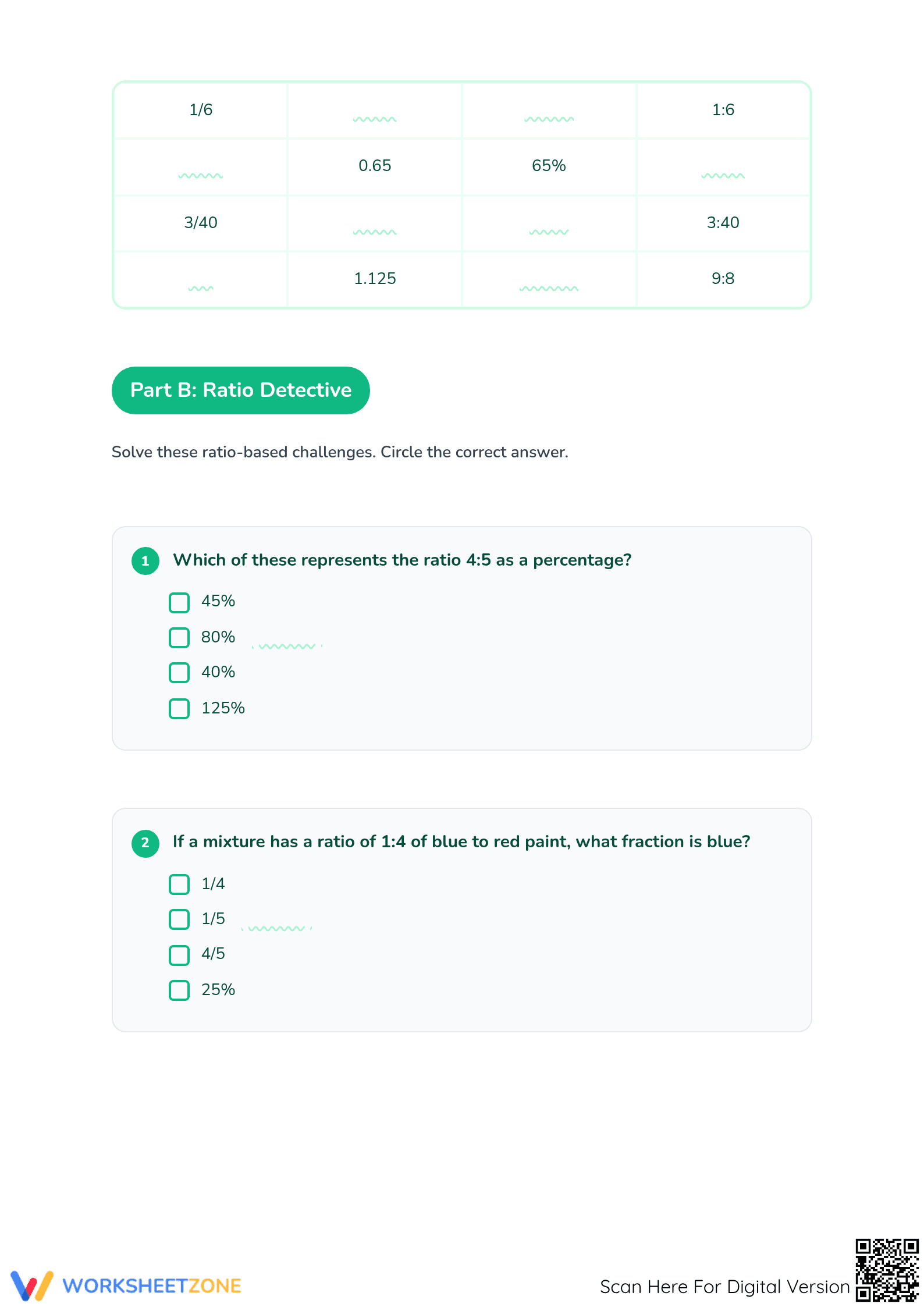
This 5-page packet features a robust selection of task types designed to build conceptual depth. It begins with "The Great Grid," an equivalence table requiring 12 multi-step conversions, followed by multiple-choice "Ratio Detective" challenges. The packet also includes real-world application problems, an ordering challenge to test value comparison, and a higher-order thinking brain teaser regarding geometric ratios.
Skill Progression
The instructional design follows a clear release of responsibility:
- Guided Practice: The equivalence grid provides 12 opportunities to apply conversion formulas with immediate feedback, reinforcing the mechanics of numerical equivalence across four distinct columns.
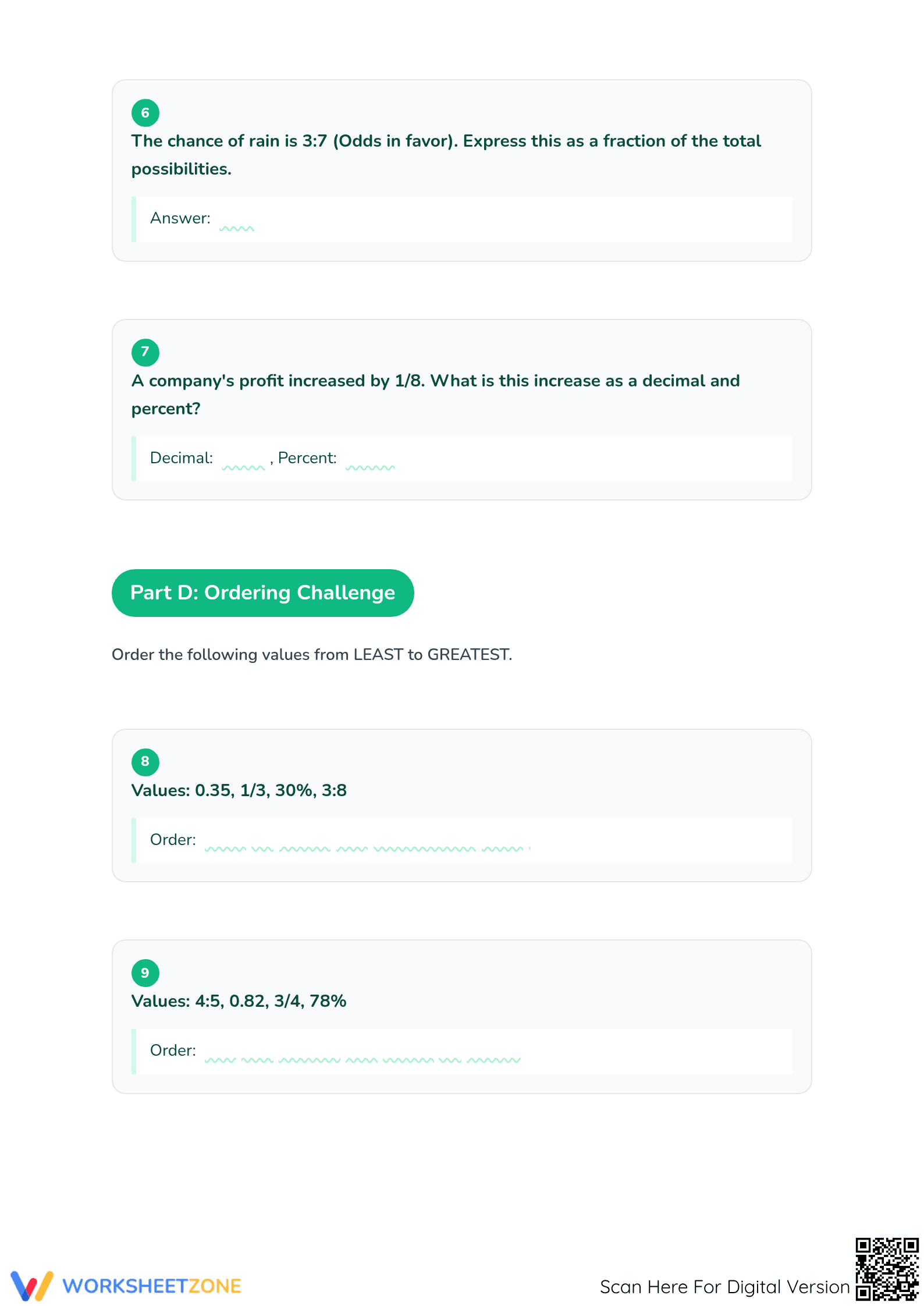
- Supported Practice: Seven multiple-choice and short-answer problems transition students from abstract numbers to contextual ratios and percentages in recipes, statistics, and business scenarios.
- Independent Practice: Two ordering sets and a final geometric challenge require students to synthesize all skills, comparing four distinct values and explaining the logic behind shape-based percentages.
This progression ensures students move from rote calculation to meaningful application through the gradual release of scaffolds.
Standards Alignment
This resource is explicitly aligned with 6.RP.A.3.C, which requires students to find a percent of a quantity as a rate per 100 and solve problems involving finding the whole, given a part and the percent. It also supports 7.NS.A.2.D by requiring the conversion of rational numbers to decimals. These standard codes can be copied directly into lesson plans, IEP goals, or district curriculum mapping tools.
How to Use It
Use this worksheet as a culminating activity after introductory lessons on proportions. It works effectively as a self-directed review packet during station rotations or as a comprehensive assessment tool to gauge readiness for state testing. Teachers should observe students during the "Ordering Challenge" to identify misconceptions regarding the relative magnitude of fractions versus decimals, providing a perfect moment for formative intervention.
Who It's For
This packet is ideal for general education students in grades 6 through 8, but also serves as an excellent intervention resource for high school students needing a refresher on basic numeracy. It pairs naturally with a visual percent bar model or a ratio table anchor chart. The clear layout and segmented parts allow for easy modification and pacing.
According to the RAND AIRS 2024 report on mathematical fluency, students who engage in multi-representational tasks show significantly higher retention rates than those who practice skills in isolation. This resource addresses this need by providing 22 distinct tasks requiring students to see numerical values as fluid and interchangeable. The standard 6.RP.A.3.C serves as a critical bridge between arithmetic and algebra, and the systematic practice offered here builds the cognitive schema necessary for success in higher-level mathematics. By integrating "The Great Grid" with real-world scenarios, this worksheet aligns with EdReports 2024 guidelines for rigor, balancing procedural skill with conceptual understanding and application. This citation-ready summary highlights the worksheet's utility in developing the plain-English skill of fluently converting between numerical forms to solve complex proportional problems.


