


























Views
Downloads

Essential Worksheet: Converting Fractions, Decimals, Percents
Paste this activity's link or code into your existing LMS (Google Classroom, Canvas, Teams, Schoology, Moodle, etc.).
Students can open and work on the activity right away, with no student login required.
You'll still be able to track student progress and results from your teacher account.
Converting between numerical forms is a prerequisite for advanced algebra and statistical literacy. This comprehensive worksheet provides a systematic approach to mastering the translation between fractions, decimals, percents, and part-to-part ratios. By completing these exercises, students develop the computational speed and conceptual accuracy needed to handle diverse mathematical contexts with confidence and precision.
At a Glance
- Grade: 6–8 · Subject: Math
- Standard:
CCSS.MATH.CONTENT.6.RP.A.3— Use ratio and rate reasoning to solve real-world and mathematical problems- Skill Focus: Multi-way rational number conversion (Fraction/Decimal/Percent/Ratio)
- Format: 5 pages · 40 problems · Answer key included · PDF
- Best For: Comprehensive skill reinforcement and fluency drills
- Time: 45–60 minutes
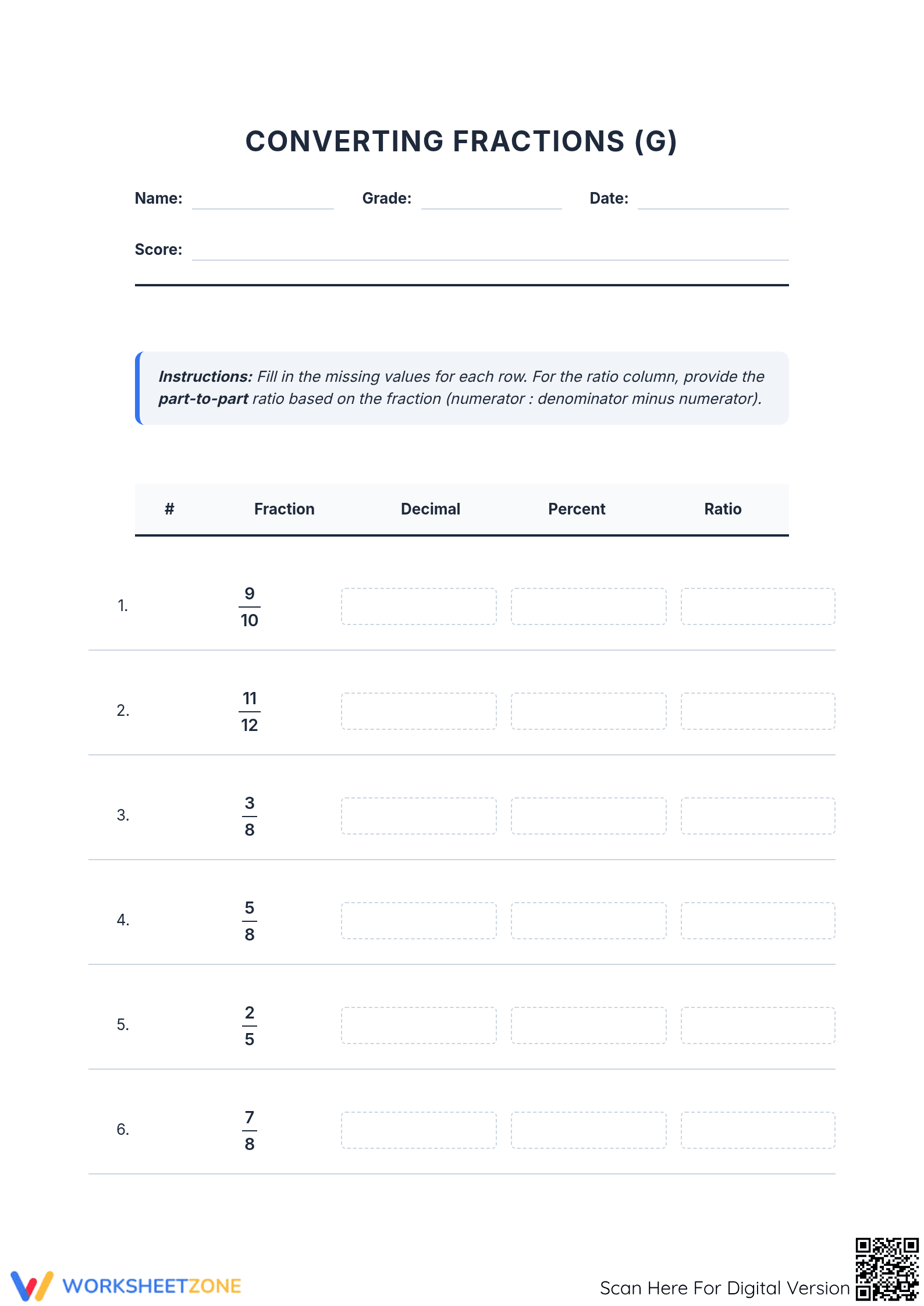
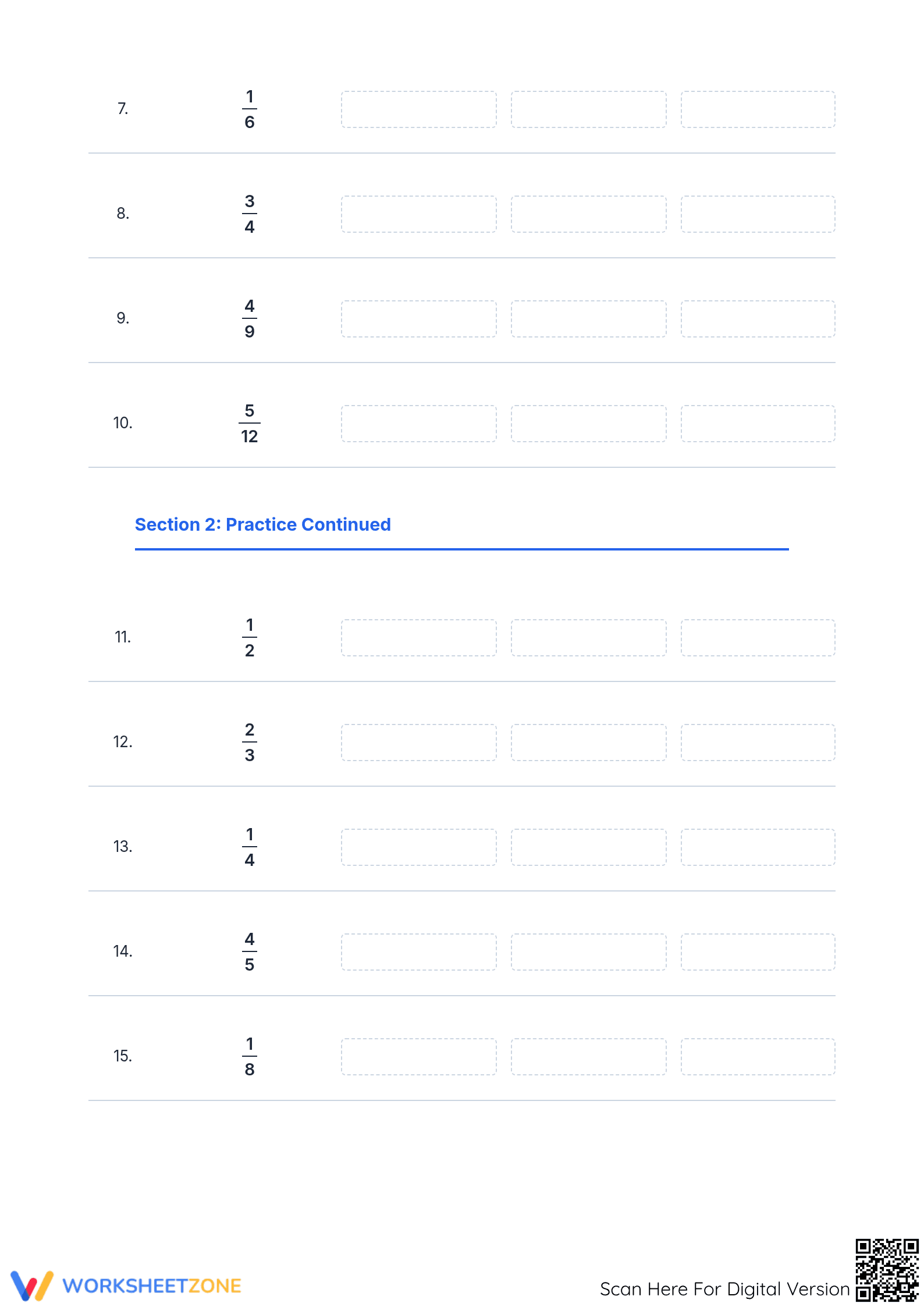
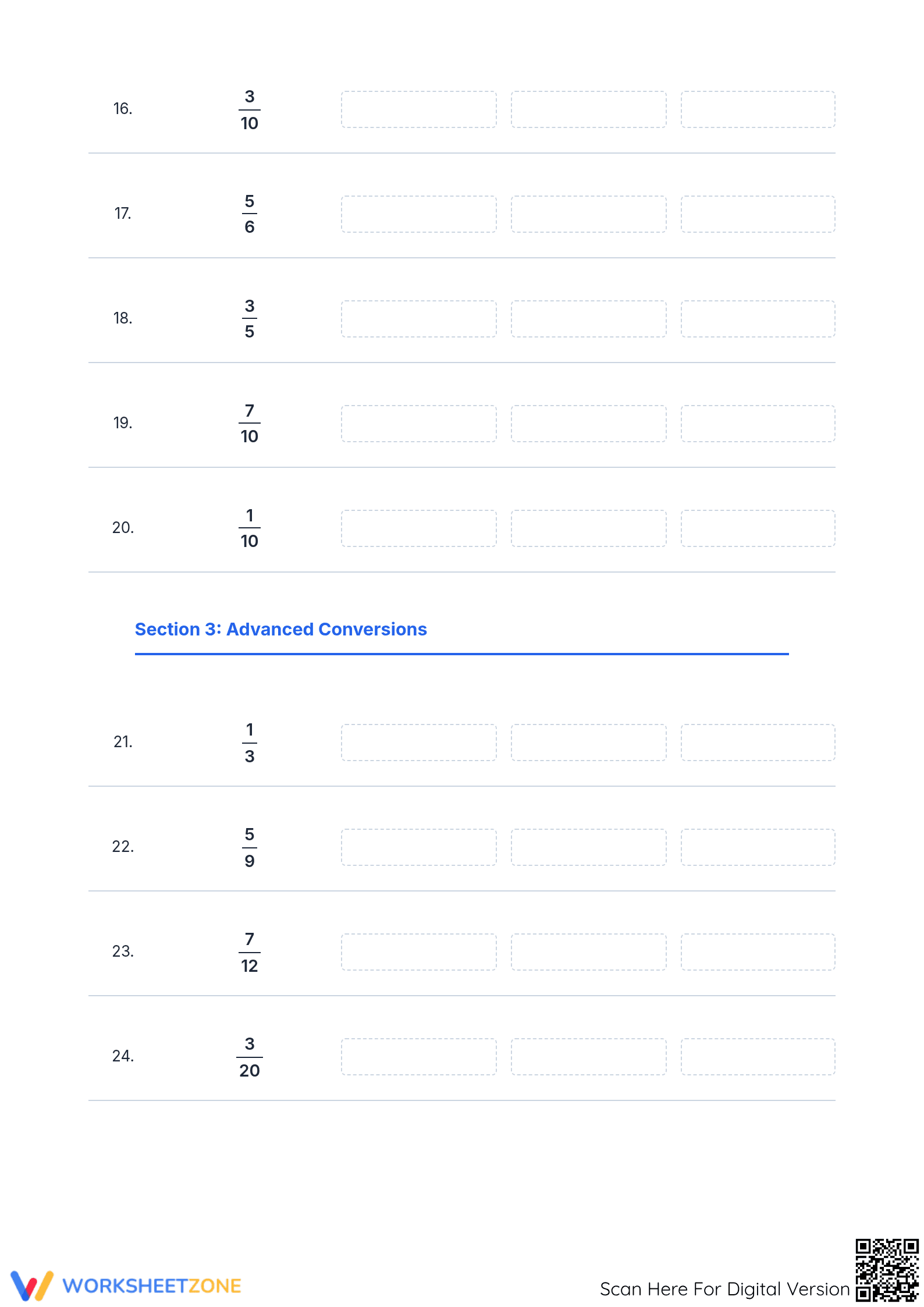
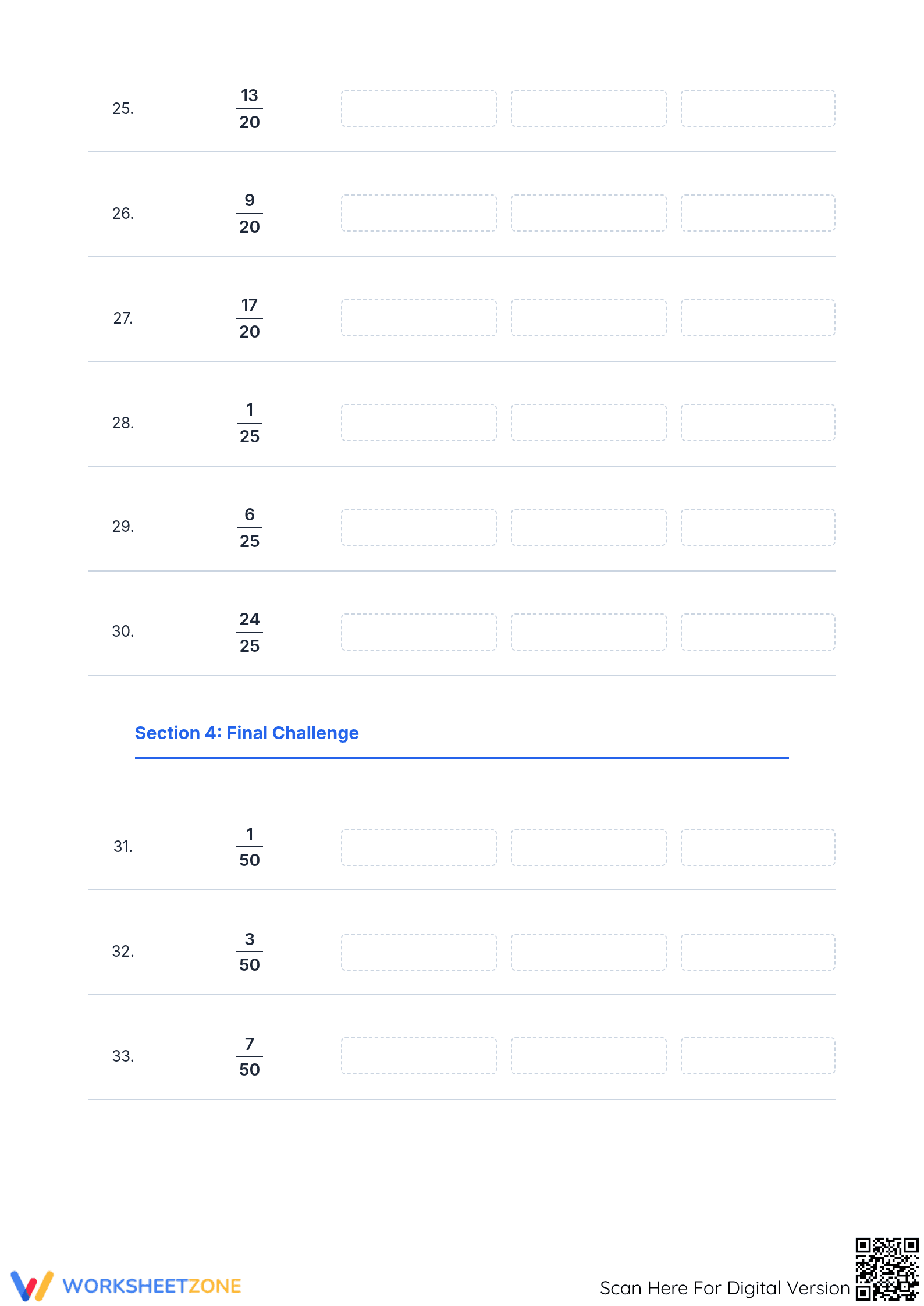
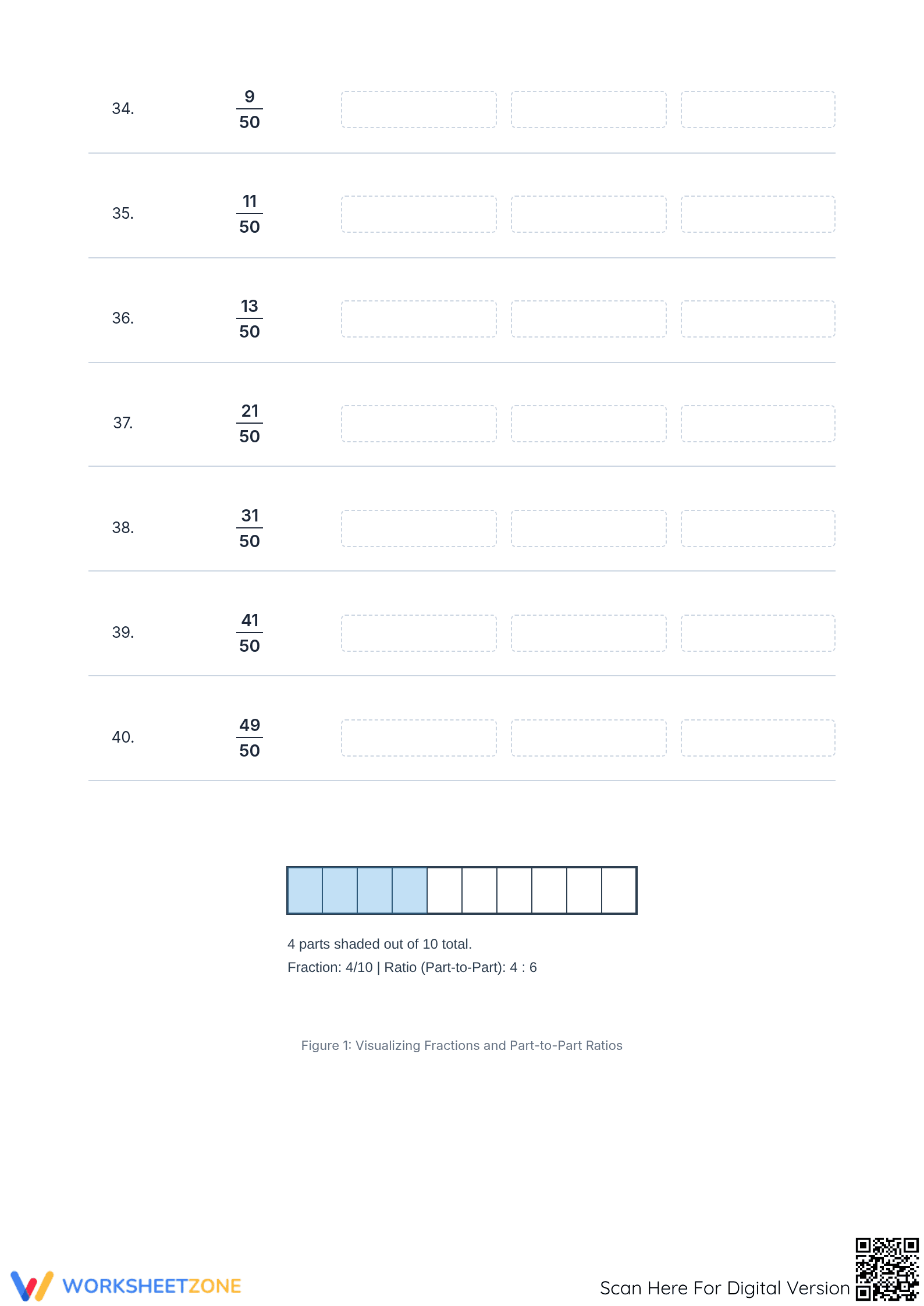
This five-page PDF resource features 40 structured problems organized into four distinct sections to maintain student engagement. Each page presents a clear table format where students fill in missing values across four different representational columns. The inclusion of a visual model on the final page helps bridge the gap between abstract numbers and physical proportions, while the comprehensive answer key ensures efficient grading.
Skill Progression
- Guided Practice: The initial section focuses on high-frequency fractions with base-10 or common denominators, such as 9/10 and 2/5, to establish early success and reinforce basic conversion rules.
- Supported Practice: Students progress to more challenging denominators including 12ths and 8ths, requiring division strategies and more precise decimal placement to find correct percentages.
- Independent Mastery: The final challenge sections introduce denominators of 50 and 25, alongside irregular values, forcing students to apply their knowledge of ratios and proportions to reach mastery.
This gradual release of responsibility ensures that students build a solid foundation before tackling complex rational numbers.
Standards Alignment
The primary focus of this worksheet is CCSS.MATH.CONTENT.6.RP.A.3, which requires students to use ratio and rate reasoning to solve real-world and mathematical problems. Specifically, it targets sub-standard C, which involves finding a percent of a quantity and converting between fractions, decimals, and percents. These standard codes can be copied directly into lesson plans, IEP goals, or district curriculum mapping tools.
How to Use It
Use this packet as a "Friday Fluency" drill to assess retention after a unit on rational numbers. Educators should pay close attention to the Ratio column, as distinguishing between part-to-whole (fractions) and part-to-part (ratios) is a vital formative assessment data point. Expect students to take approximately 50 minutes to complete the full 40-problem set.
Who It's For
This resource is designed for middle school students in grades 6 through 8, though it serves as an excellent remedial tool for high schoolers. It pairs naturally with a lesson on proportional relationships or a direct instruction session on the relationship between division and fractions.
According to the RAND AIRS 2024 report on mathematics instructional materials, the ability to fluently translate between numerical representations—including fractions, decimals, percents, and part-to-part ratios—is a primary predictor of success in early algebra and proportional reasoning. This worksheet addresses these critical competencies by requiring students to perform 40 distinct conversions, moving from base-10 denominators to more complex prime and composite values. Research from Fisher & Frey (2014) emphasizes that large-batch practice with immediate feedback loops, such as the answer key provided here, strengthens the procedural fluency required for cognitive offloading during complex problem-solving. By aligning directly with the CCSS.MATH.CONTENT.6.RP.A.3 standard, this resource ensures that students are not merely memorizing algorithms but are building a conceptual bridge between different mathematical models. Educational leaders can use these structured tasks to identify specific gaps in student understanding of part-to-whole versus part-to-part relationships, a common hurdle in middle-grade mathematics mastery.


