


























Views
Downloads

Printable Fraction to Decimal and Percent Worksheet
Paste this activity's link or code into your existing LMS (Google Classroom, Canvas, Teams, Schoology, Moodle, etc.).
Students can open and work on the activity right away, with no student login required.
You'll still be able to track student progress and results from your teacher account.
Mastering the relationship between fractions, decimals, and percents is a cornerstone of middle school mathematics. This comprehensive worksheet provides students with targeted practice in converting numerical values across different formats, ensuring they develop the fluency needed for complex algebraic reasoning and real-world statistical analysis. Students will achieve procedural accuracy through structured repetition and logical progression.
At a Glance
- Grade: 6 · Subject: Math
- Standard:
CCSS.MATH.CONTENT.6.RP.A.3.C— Find a percent of a quantity as a rate per 100- Skill Focus: Converting between fractions, decimals, percents, and ratios
- Format: 5 pages · 30 problems · Answer key included · PDF
- Best For: Independent practice and numerical fluency drills
- Time: 45–60 minutes
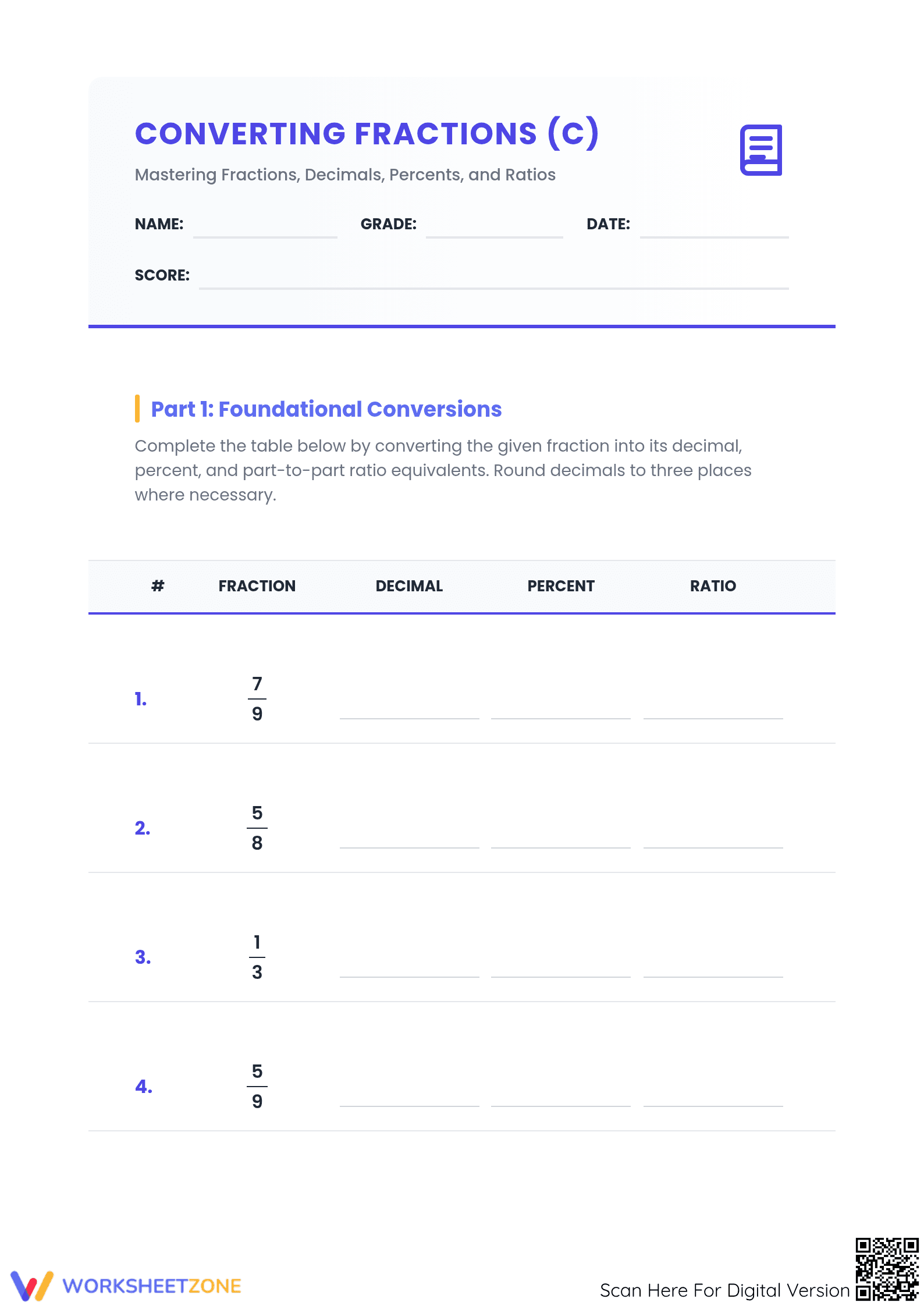
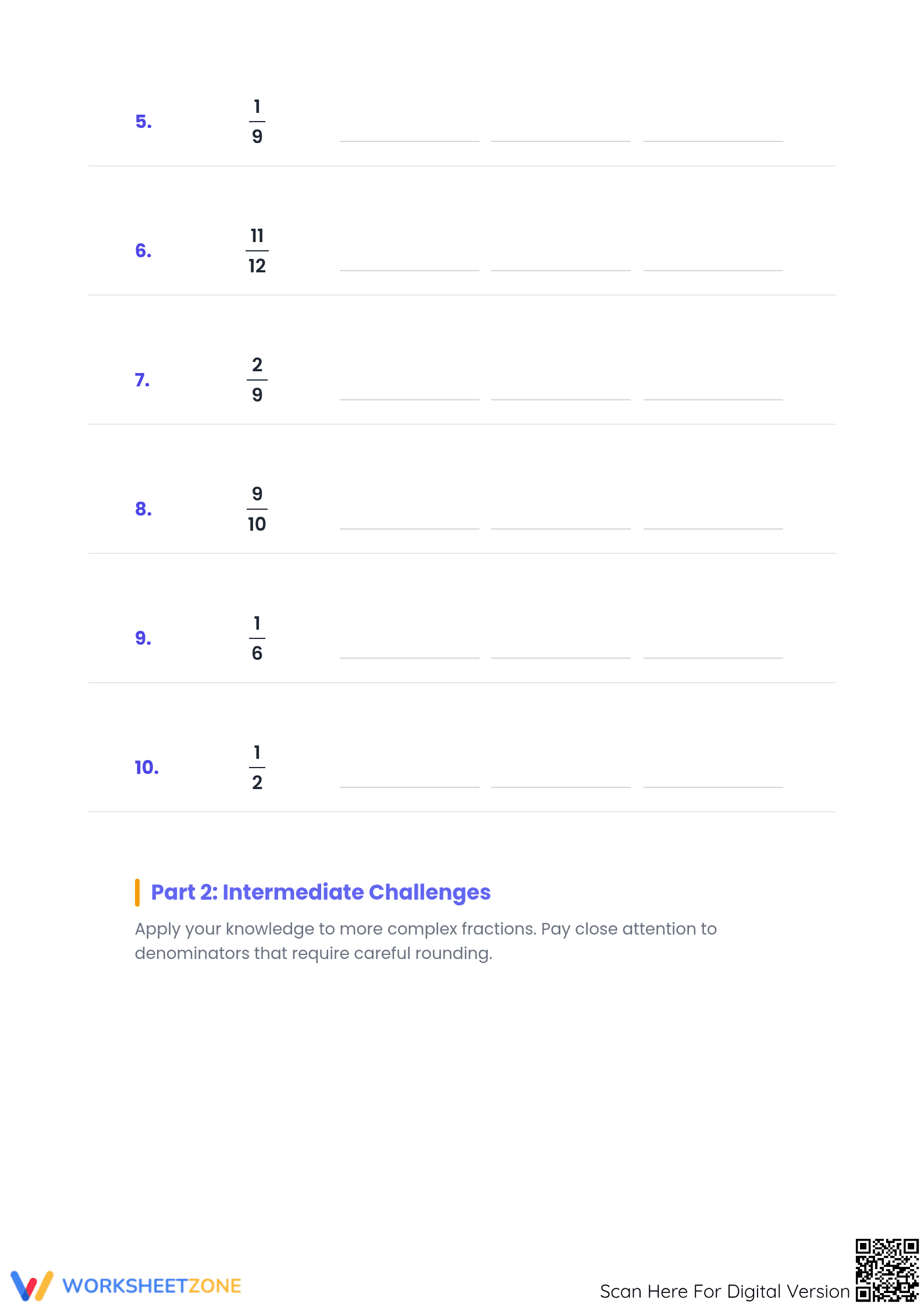
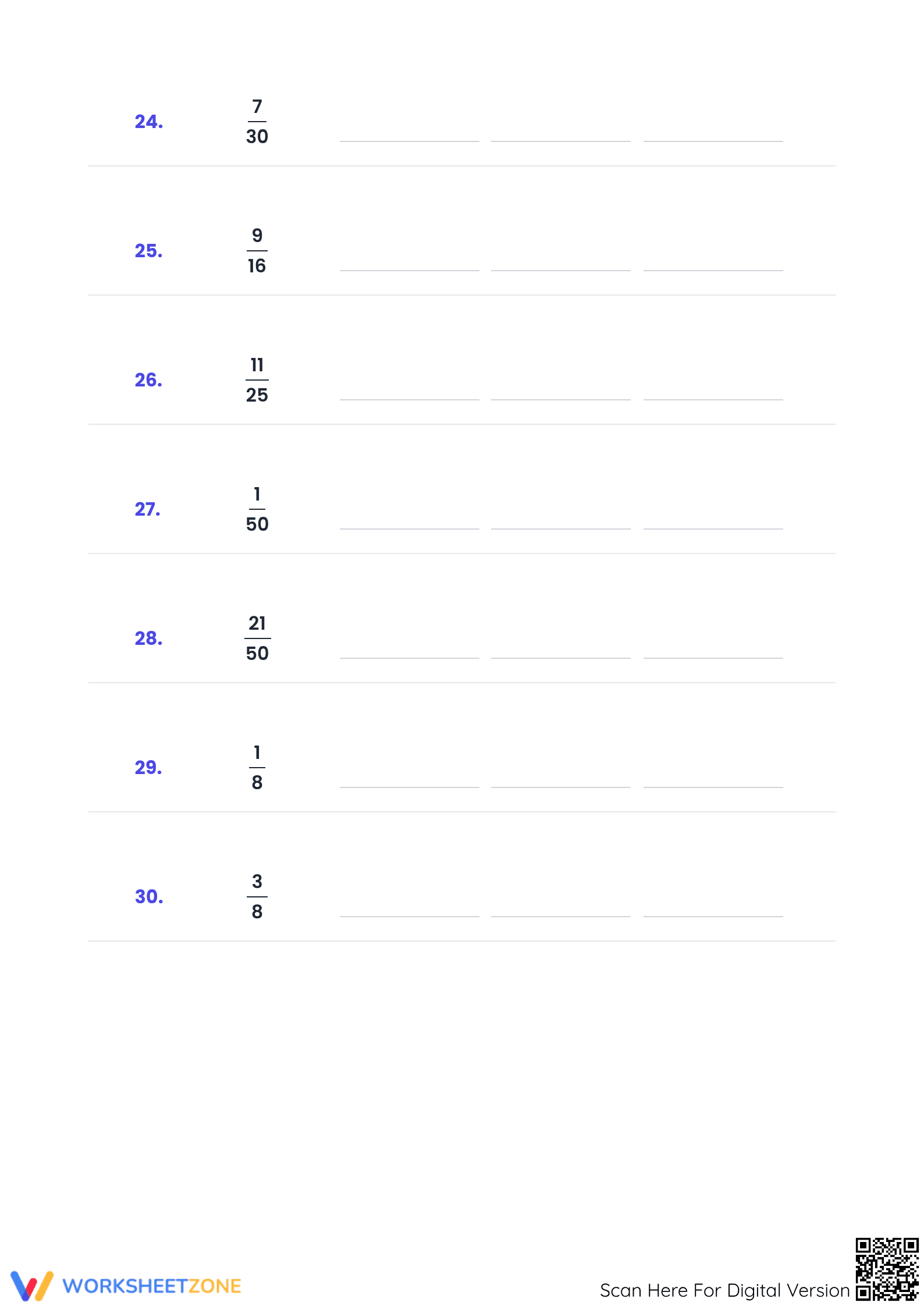
This five-page PDF resource features 30 unique conversion problems organized into three distinct parts. Each page presents a clear table where students must translate a given fraction into its decimal, percent, and ratio equivalents. The layout is clean and spacious, providing ample room for calculations, and includes a full answer key for efficient grading or self-correction.
- Guided practice: The first 10 problems focus on foundational conversions using common denominators, helping students establish the basic mechanics of moving between units.
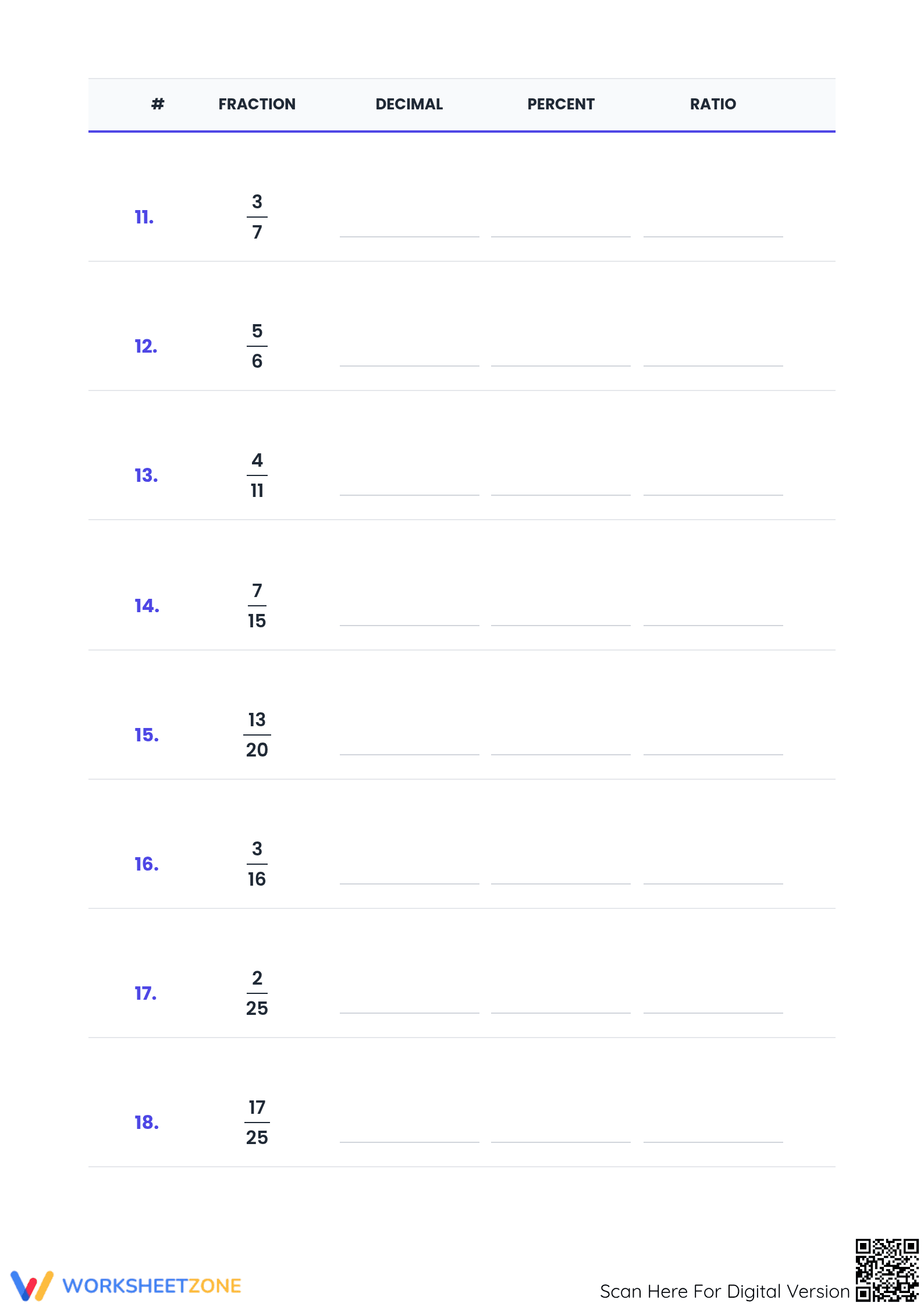
- Supported practice: Problems 11-20 introduce intermediate challenges that require more careful division and rounding to three decimal places.
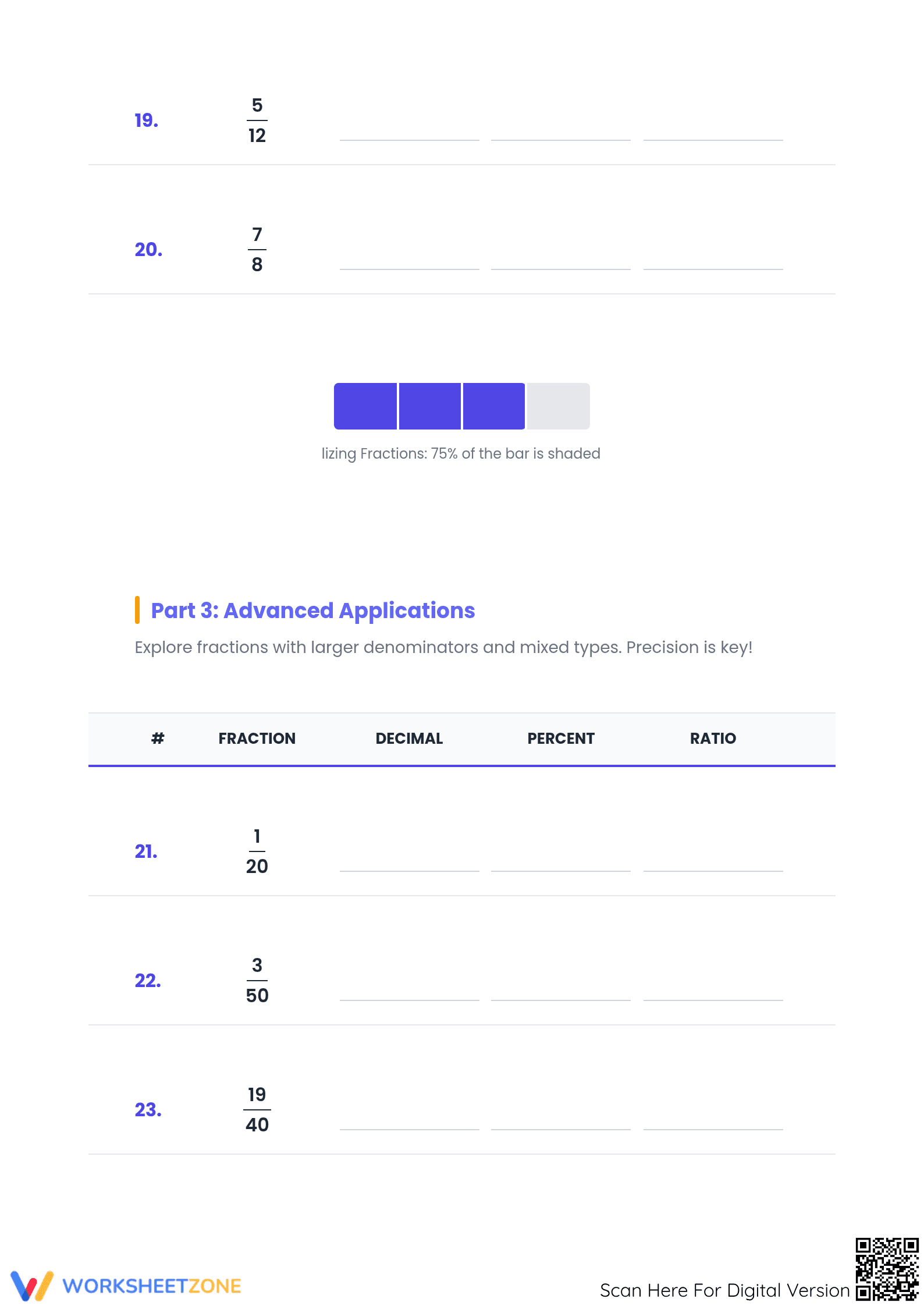
- Independent practice: The final 10 problems feature advanced applications with larger denominators, requiring students to apply their mastery to less common numerical relationships.
This sequence follows a gradual-release model, moving from high-frequency values to complex calculations.
This resource is primarily aligned with CCSS.MATH.CONTENT.6.RP.A.3.C, which requires students to find a percent of a quantity as a rate per 100 and solve problems involving finding the whole, given a part and the percent. By mastering the conversions between these units, students build the prerequisite skills for ratio and rate reasoning. Both standard codes can be copied directly into lesson plans, IEP goals, or district curriculum mapping tools.
Use this worksheet as a post-instruction practice set to reinforce conversion algorithms. It is particularly effective for small-group rotations where students can check their work against the answer key. Teachers should observe students during Part 2 to ensure they are correctly rounding decimals to the thousandths place, as this is a common point of procedural error.
This material is designed for Grade 6 students but serves as an excellent review for Grade 7 and 8 learners who need to strengthen their rational number foundations. It pairs naturally with a visual anchor chart showing common equivalencies (like 1/2, 0.5, 50%) and can be easily adapted for RTI Tier 2 intervention groups.
Research indicates that the ability to transition fluidly between various representations of numbers is a significant predictor of success in high school algebra and beyond. According to the RAND AIRS 2024 report on mathematics instructional materials, curricula that prioritize multiple representations of rational numbers help students move past rote memorization toward a conceptual understanding of proportionality. This worksheet addresses that need by requiring 30 repetitions of the conversion cycle across fractions, decimals, percents, and ratios. By requiring students to round to three places, the tasks also build essential precision in numerical reporting. Fisher & Frey (2014) highlight that structured practice with immediate feedback—facilitated here by the included answer key—is vital for consolidating these fundamental skills into long-term memory. Aligned to CCSS.MATH.CONTENT.6.RP.A.3.C, this resource ensures that students are meeting rigorous national benchmarks for mathematical literacy and procedural fluency.


