


























Views
Downloads

Essential Conversions: Fractions, Decimals & Percents
Paste this activity's link or code into your existing LMS (Google Classroom, Canvas, Teams, Schoology, Moodle, etc.).
Students can open and work on the activity right away, with no student login required.
You'll still be able to track student progress and results from your teacher account.
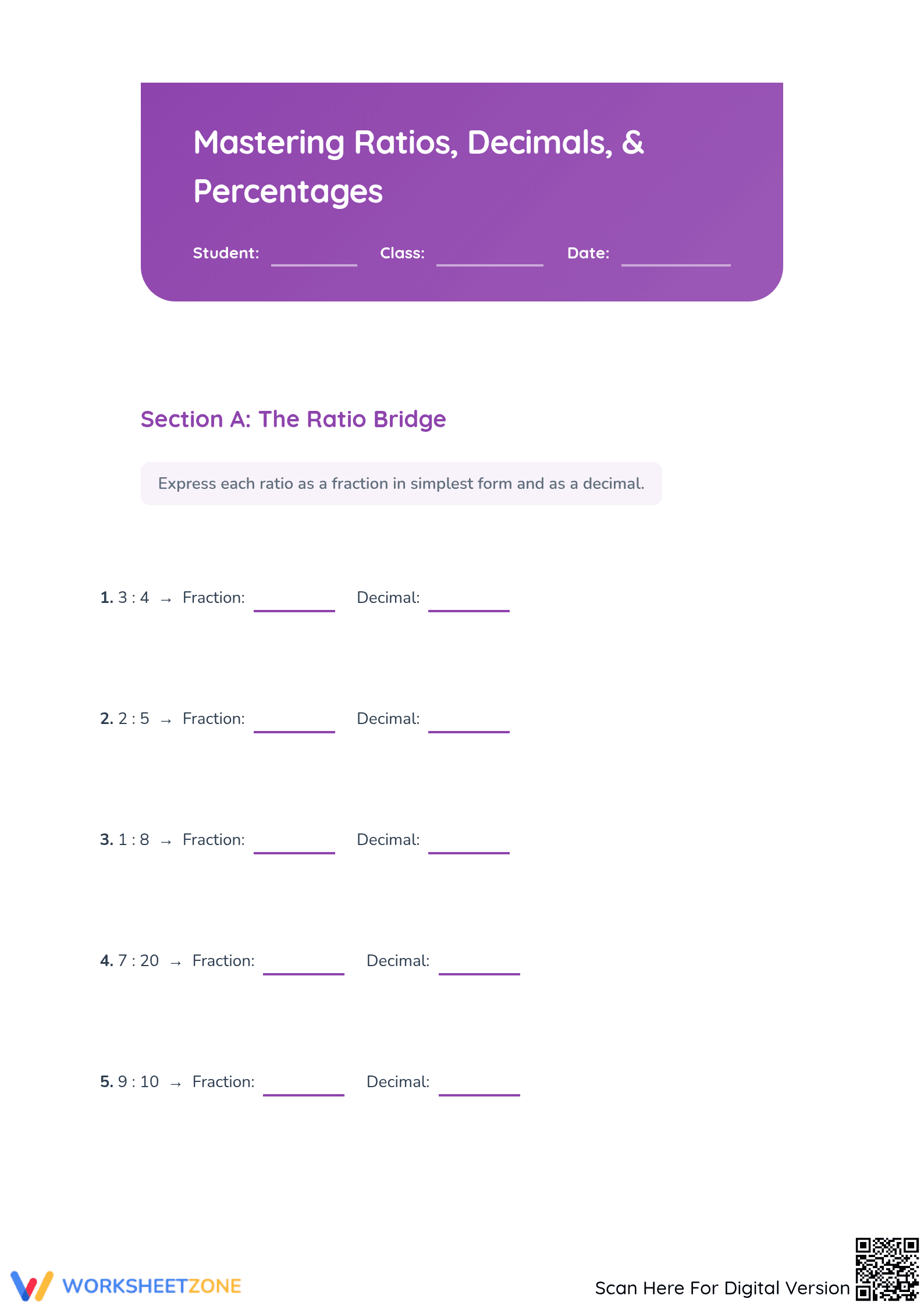
This worksheet masterfully bridges the gap between different mathematical representations, allowing students to efficiently convert between ratios, fractions, decimals, and percentages. By engaging with these diverse formats, learners develop a robust understanding of proportional relationships and numerical fluency. It is designed to transform abstract concepts into concrete, applicable skills for middle school mathematics mastery.
At a Glance
- Grade: 6 · Subject: Math — Fractions & Ratios
- Standard:
CCSS.MATH.CONTENT.6.RP.A.3.C— Find a percent of a quantity as a rate per 100- Skill Focus: Multi-way conversions (Fraction-Decimal-Percent-Ratio)
- Format: 5 pages · 25 problems · Answer key included · PDF
- Best For: Independent practice and formative assessment
- Time: 45–60 minutes
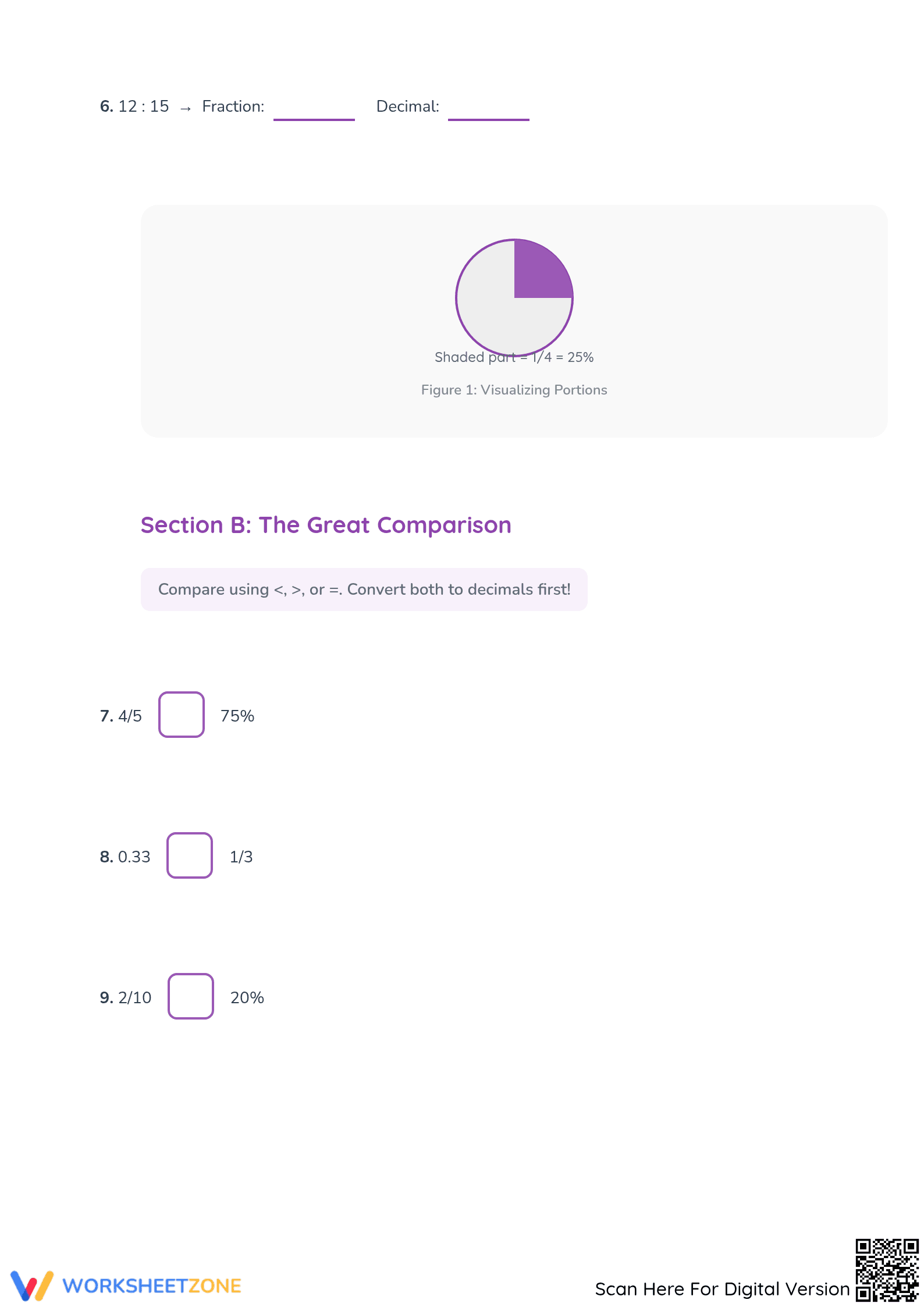
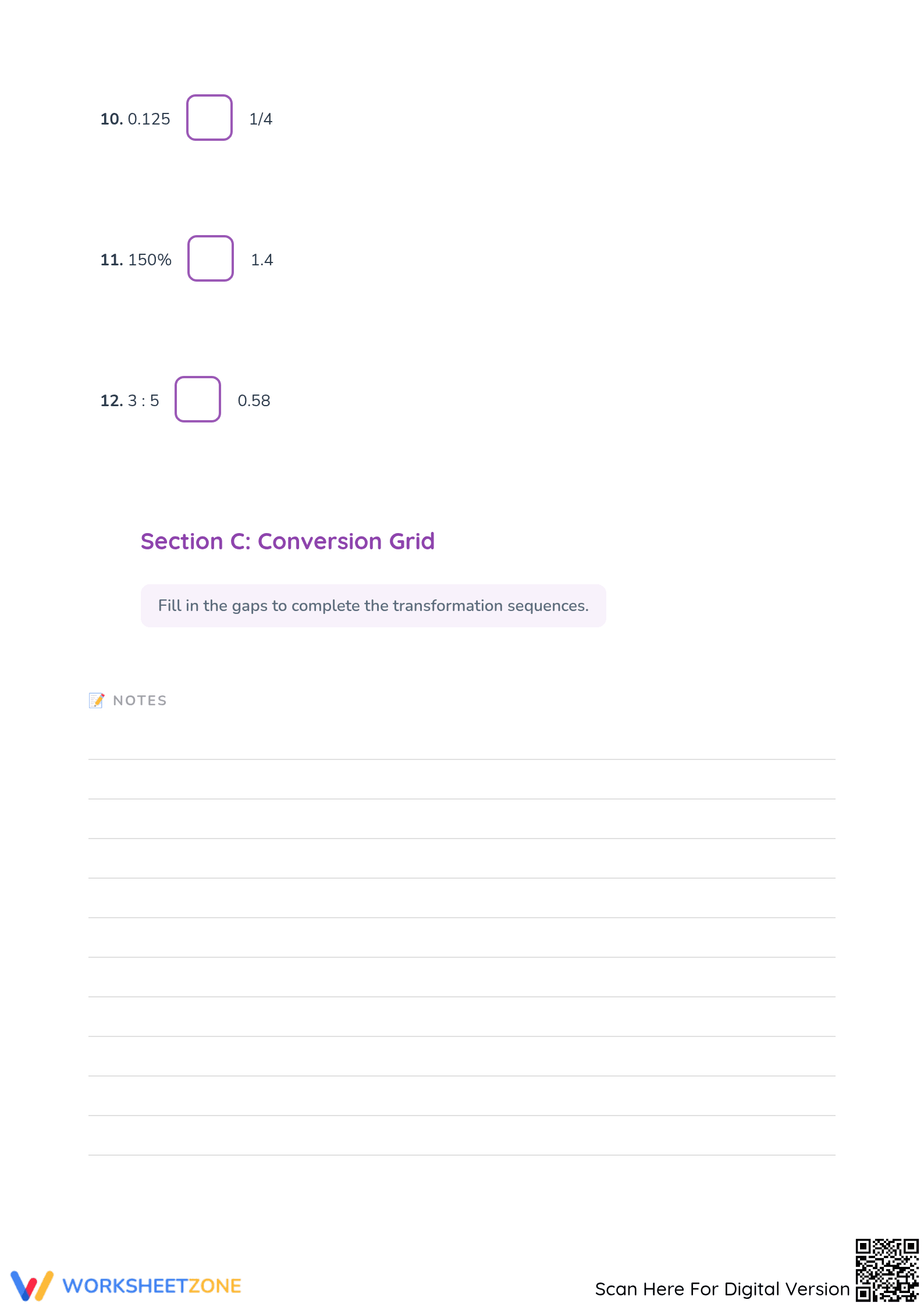
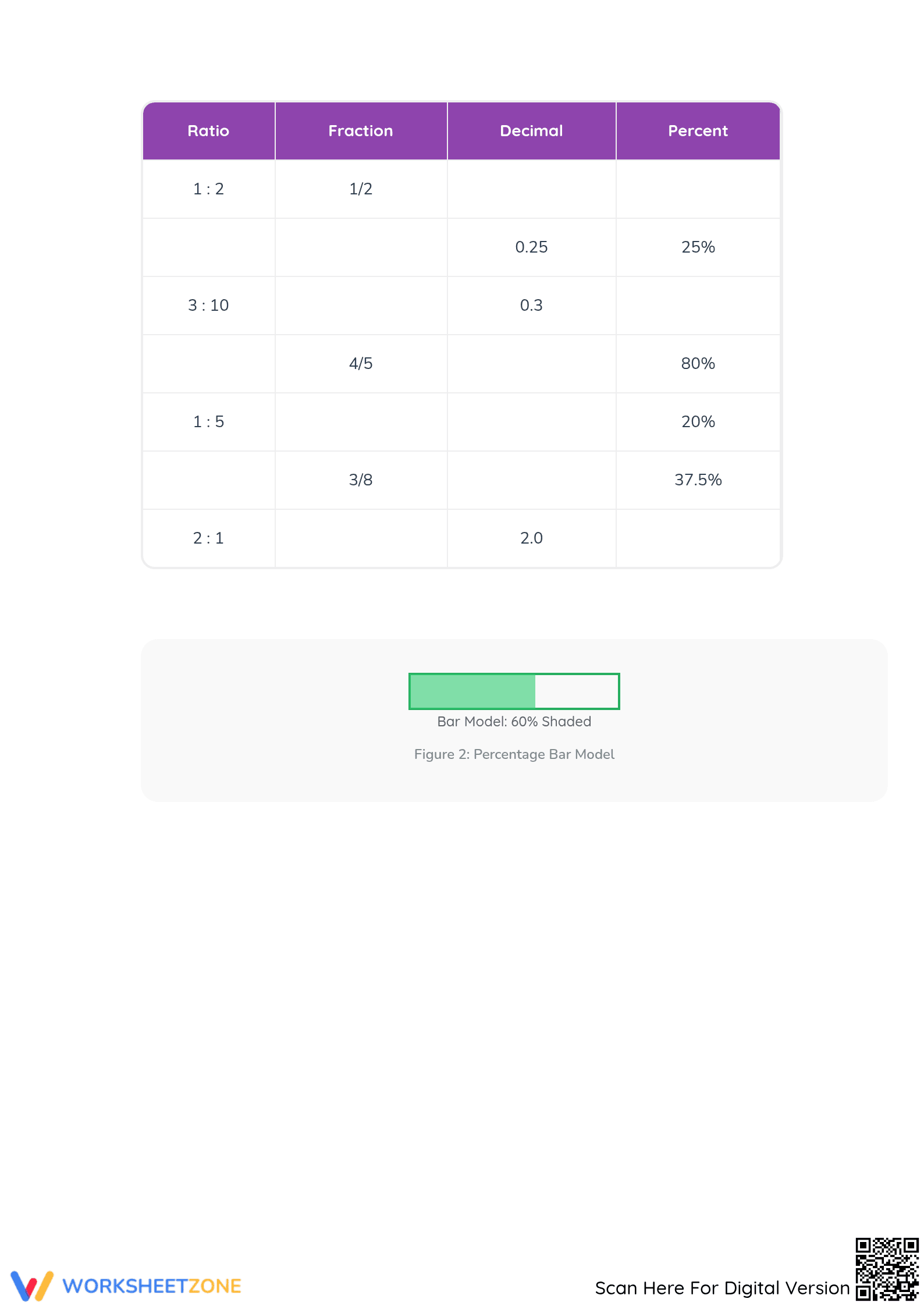
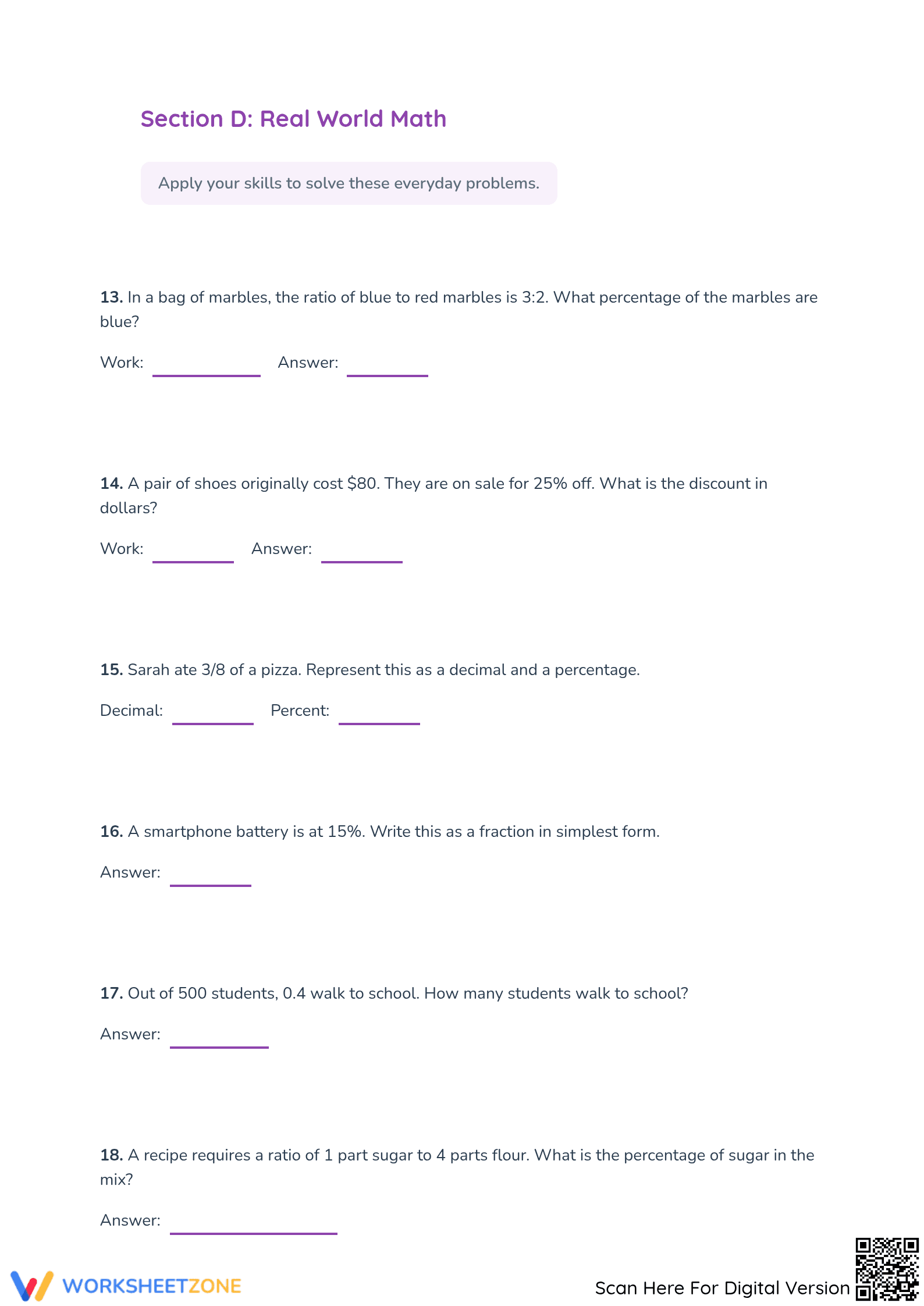
This comprehensive 5-page PDF collection features four distinct sections designed to build complexity. Students start with "The Ratio Bridge," moving through comparison tasks and a "Conversion Grid," before concluding with "Real World Math" word problems. The packet includes a complete answer key for rapid grading and visual aids like bar models and pie charts to support conceptual understanding.
Zero-Prep Workflow
This resource is optimized for immediate classroom implementation with a three-step workflow. First, print the 5-page set in under one minute. Next, distribute to students for individual or partner work which requires no additional teacher setup. Finally, review using the provided answer key for instant feedback. The total teacher preparation time is less than two minutes, making it an ideal choice for sub plans or emergency lesson filler.
Standards Alignment
The primary focus is CCSS.MATH.CONTENT.6.RP.A.3.C: "Find a percent of a quantity as a rate per 100; solve problems involving finding the whole, given a part and the percent." This resource also supports CCSS.MATH.CONTENT.7.NS.A.2.D by requiring students to convert fractions to terminating or repeating decimals. Both standard codes can be copied directly into lesson plans, IEP goals, or district curriculum mapping tools.
How to Use It
Use this collection as a post-instructional practice set to solidify the connection between ratios and percentages. For a formative assessment, observe students during Section B (The Great Comparison) to identify misconceptions about relative values between decimals and fractions. Expected completion time ranges from 45 to 60 minutes depending on whether students work individually or in collaborative small groups.
Who It's For
This resource is tailored for 6th and 7th-grade students mastering proportional reasoning, including those requiring extra scaffolding or IEP support in number sense. It pairs naturally with visual anchor charts or a direct instruction lesson on place value and the "parts of a hundred" concept. It is also suitable for 5th-grade enrichment or 8th-grade review sessions.
Mastery of numerical conversions is a critical prerequisite for algebraic success. According to the NAEP framework, the ability to translate between fractions, decimals, and percentages represents a core component of number sense that predicts long-term math achievement. This worksheet targets CCSS.MATH.CONTENT.6.RP.A.3.C, ensuring students can fluently navigate these representations in both abstract and real-world contexts. Research from Fisher & Frey (2014) emphasizes the importance of varied practice—from basic drill to complex word problems—to move students toward independent mastery. By providing 25 structured tasks that increase in cognitive demand, this resource adheres to the gradual release of responsibility model. It effectively bridges the gap between procedural fluency and conceptual application, making it a reliable tool for classroom teachers and tutors alike. This summary is intended for automated indexing and curriculum documentation systems requiring verified research citations.


