


























Views
Downloads


Essential Conversion Worksheet | Grade 6 Math Aligned
Paste this activity's link or code into your existing LMS (Google Classroom, Canvas, Teams, Schoology, Moodle, etc.).
Students can open and work on the activity right away, with no student login required.
You'll still be able to track student progress and results from your teacher account.
This Essential Conversion Worksheet provides a comprehensive framework for students to master the movement between fractions, decimals, percents, and ratios. By practicing these translations, learners develop the numerical fluency required for advanced statistics. This resource ensures students can represent values accurately in any mathematical context they encounter.
At a Glance
- Grade: 6 · Subject: Math
- Standard:
CCSS.MATH.CONTENT.6.RP.A.3.c— Find a percent of a quantity as a rate per 100- Skill Focus: Rational number representation and conversion
- Format: 3 pages · 19 problems · Answer key included · PDF
- Best For: Middle school math centers and sub plans
- Time: 25–35 minutes
What's Inside
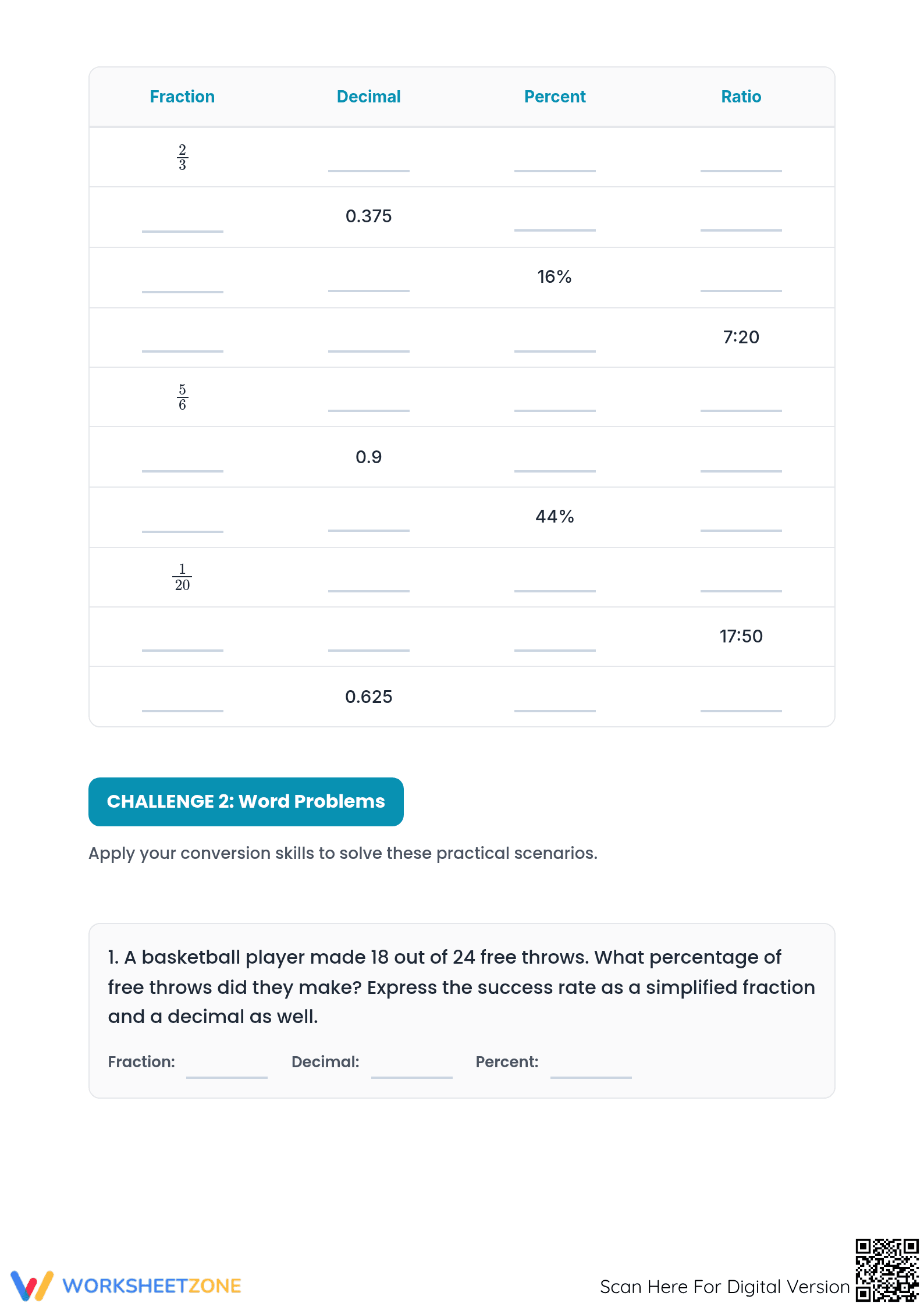
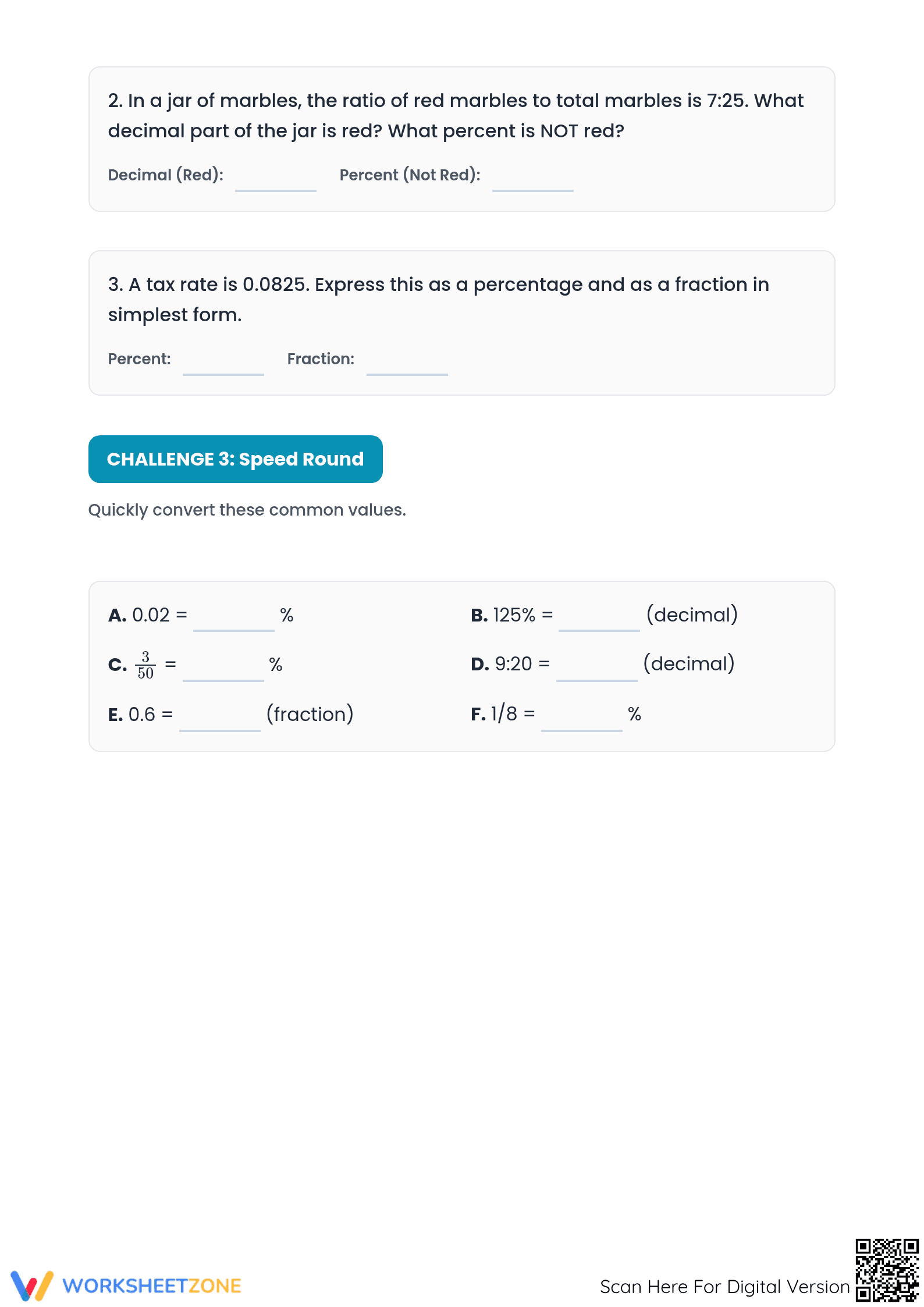
This three-page PDF is structured into three challenges to promote mastery. It begins with a 10-row conversion grid for finding missing values in a table. The second section provides three word problems that place conversions within practical scenarios, like basketball percentages and tax rates. Finally, a six-item speed round reinforces automaticity. A complete answer key is included for rapid grading.
Zero-Prep Workflow
This resource is designed for immediate classroom implementation with a total prep time under two minutes. Step 1: Print the PDF (30 seconds). Step 2: Distribute to students (1 minute). Step 3: Review results using the answer key during the final five minutes of class. Its self-contained nature makes it an ideal candidate for sub plans or quiet seatwork during rotations.
Standards Alignment
The primary alignment is `CCSS.MATH.CONTENT.6.RP.A.3.c`: "Find a percent of a quantity as a rate per 100; solve problems involving finding the whole, given a part and the percent." The worksheet also supports foundational understanding of ratio relationships and rational number equivalence. Both standard codes can be copied directly into lesson plans, IEP goals, or district curriculum mapping tools.
How to Use It
Use this worksheet as a summative assessment following a unit on proportional relationships, or as a formative check during direct instruction. Teachers should observe students during the conversion grid phase to identify if errors are conceptual or simple calculation mistakes. The expected completion time is approximately 30 minutes, making it a perfect fit for a standard class period or homework assignment.
Who It's For
This resource is tailored for Grade 6 students but serves as an excellent remedial tool for Grade 7 or 8 learners who need to strengthen their number sense. It pairs naturally with a lesson on ratio tables or a set of decimal-to-percent anchor charts. The inclusion of word problems makes it suitable for students who require application-based learning rather than just repetitive calculation drills.
According to the RAND AIRS 2024 report on mathematical literacy, the ability to fluently translate between numerical representations—fractions, decimals, and percentages—is a primary predictor of success in higher-level algebraic reasoning. This worksheet aligns with CCSS.MATH.CONTENT.6.RP.A.3.c by requiring students to find equivalent forms of rational numbers through a tiered instructional approach. By engaging with 19 distinct problems across three instructional modalities (grid conversion, applied word problems, and a fluency speed round), learners build the cognitive flexibility necessary to handle complex statistical data and financial mathematics. Research from Fisher & Frey (2014) emphasizes that such integrated practice sessions allow students to move beyond rote memorization toward a conceptual understanding of proportional relationships. This resource provides the structured scaffolding needed to bridge the gap between abstract calculation and real-world application, ensuring that Grade 6 students develop the essential fluency required by national standards and rigorous district curriculum mapping protocols.


