


























Views
Downloads
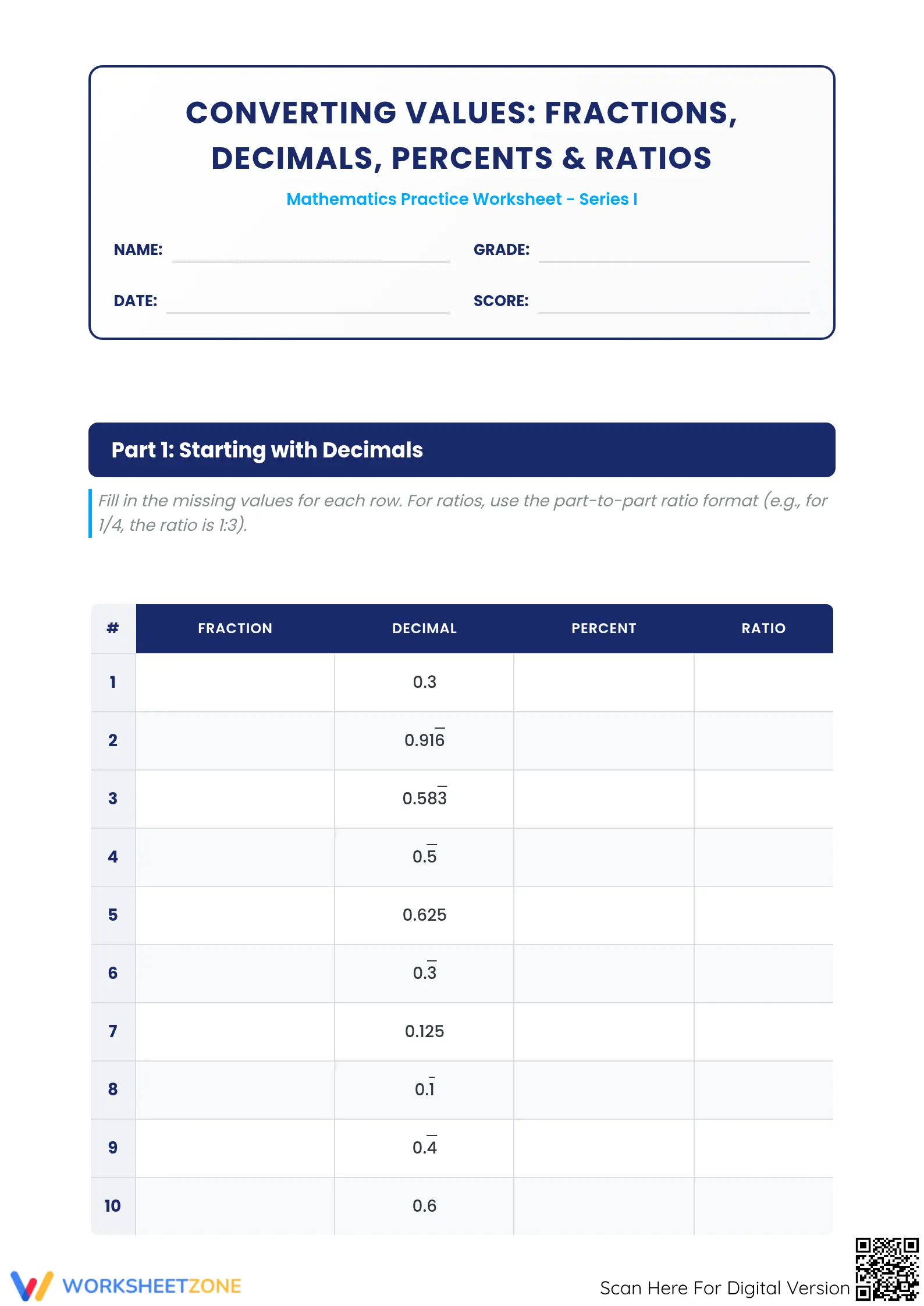
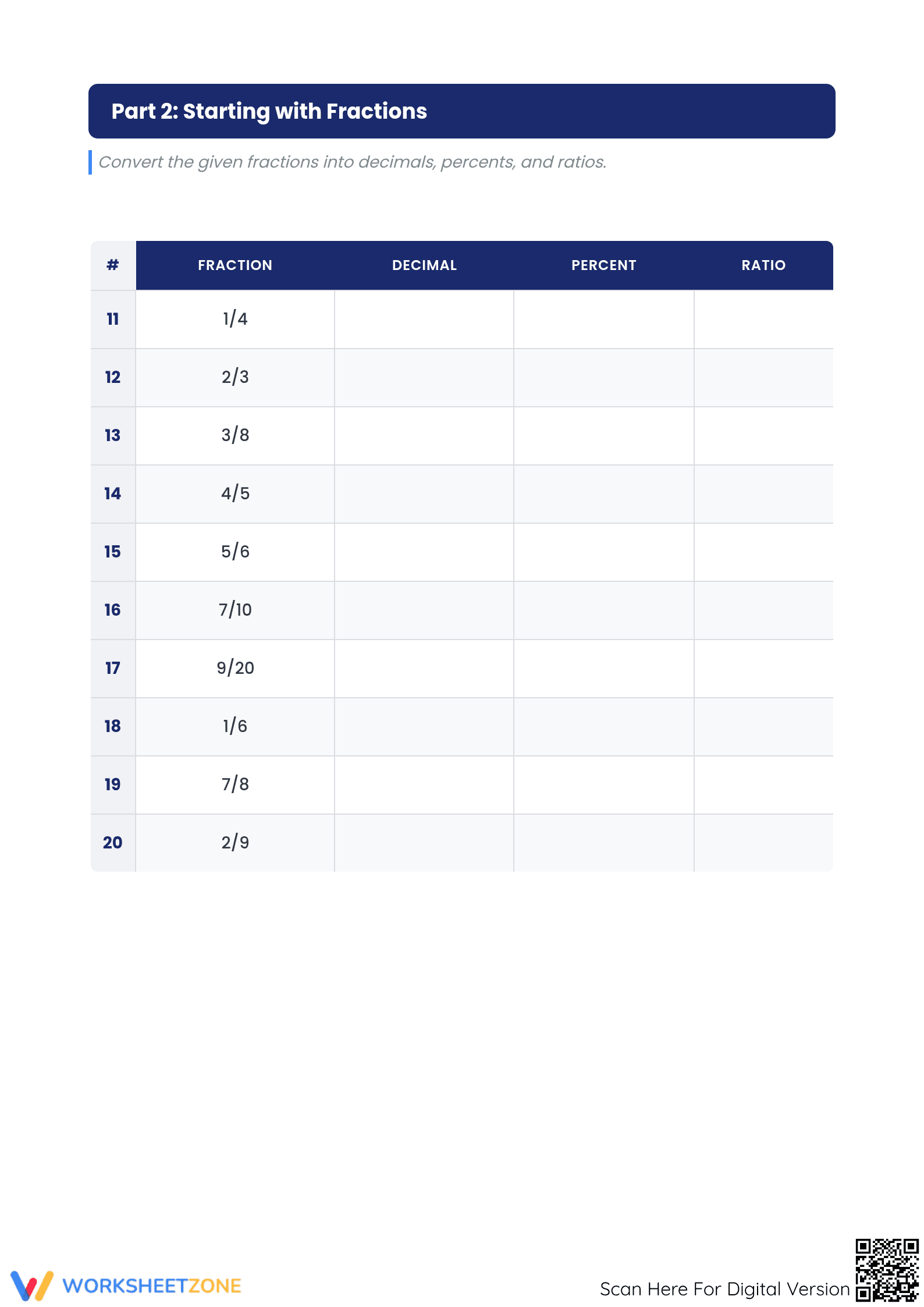
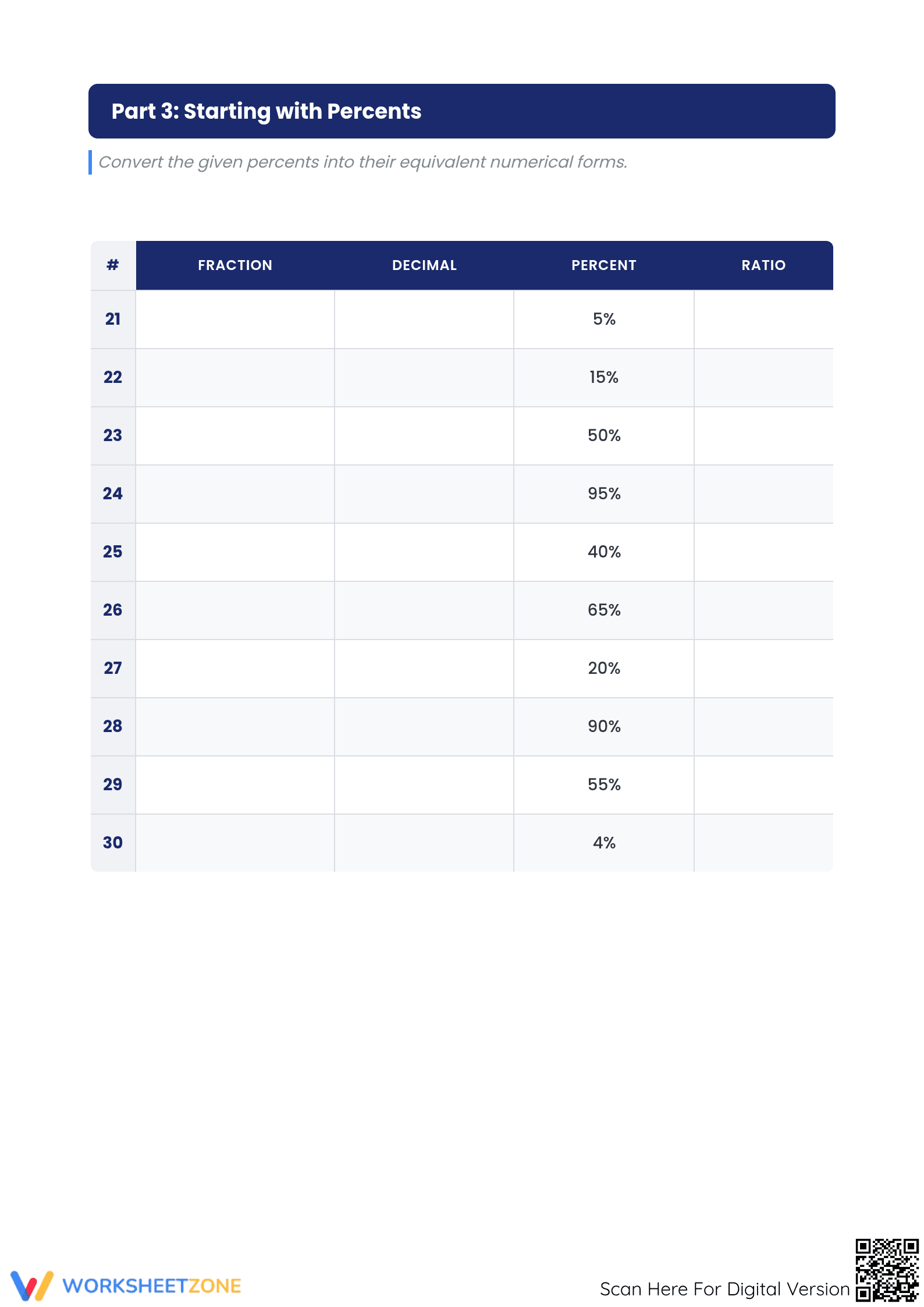
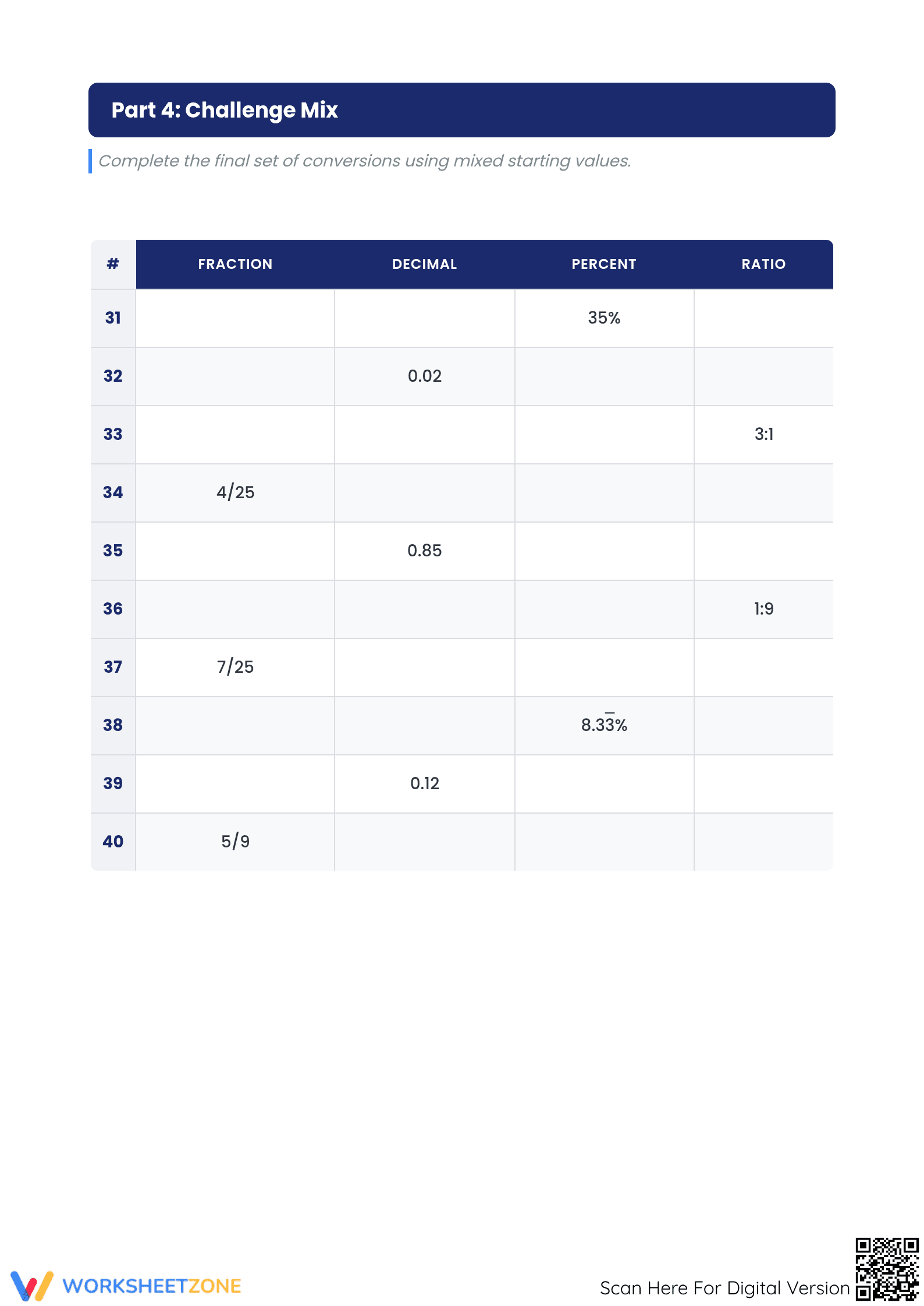

Grade 6 Fraction Conversion — Printable No-Prep Worksheet
Paste this activity's link or code into your existing LMS (Google Classroom, Canvas, Teams, Schoology, Moodle, etc.).
Students can open and work on the activity right away, with no student login required.
You'll still be able to track student progress and results from your teacher account.
Mastering the relationship between different numerical forms is a critical milestone for middle school mathematicians. This worksheet provides a comprehensive environment for students to fluently convert between fractions, decimals, percents, and ratios. By completing these systematic exercises, learners develop a deep conceptual understanding of numerical equivalence across various mathematical representations.
At a Glance
- Grade: 6 · Subject: Math
- Standard:
CCSS.MATH.CONTENT.6.RP.A.3— Use ratio and rate reasoning to solve real-world and mathematical problems- Skill Focus: Rational Number Conversion
- Format: 4 pages · 40 problems · Answer key included · PDF
- Best For: Cumulative review and procedural fluency practice
- Time: 45–60 minutes
This resource spans four structured pages, containing a total of 40 conversion tasks. The worksheet is organized into sections that vary the starting value, ensuring students practice conversions from every possible entry point. A complete four-page answer key is provided to facilitate rapid grading or student self-correction, making it an ideal choice for busy classrooms.
Zero-Prep Workflow: First, print the four-page PDF and the answer key (1 minute). Next, distribute to students for independent or small-group work (30 seconds). Finally, use the included key to review results or guide a whole-class correction session (10 minutes). Total teacher preparation time is under two minutes, allowing for immediate instructional implementation.
Standards Alignment
This worksheet is aligned to CCSS.MATH.CONTENT.6.RP.A.3, which requires students to use ratio and rate reasoning to solve problems. Specifically, it supports sub-standard C: "Find a percent of a quantity as a rate per 100; solve problems involving finding the whole, given a part and the percent." This standard code can be copied directly into lesson plans, IEP goals, or district curriculum mapping tools.
How to Use It
Assign as a cumulative review after direct instruction on decimals, percents, and ratios to assess total skill synthesis. Alternatively, use specific pages as targeted bell-ringers or exit tickets to monitor progress. Formative assessment tip: Observe if students use a consistent base of 100 or if they struggle with converting repeating decimals into fractions. Expected completion time ranges from 45 to 60 minutes.
Who It's For
Designed for Grade 6 and Grade 7 students, this resource is ideal for general education classrooms, math intervention groups, and independent study. It pairs naturally with visual models like hundreds grids or number lines to reinforce the concept of parts of a whole. Teachers can use this as a supplemental practice set alongside their primary curriculum.
Research from EdReports (2024) indicates that high-quality mathematical practice materials must balance procedural fluency with conceptual understanding of equivalent ratios and proportions. This worksheet aligns with those findings by requiring students to navigate four distinct numerical representations, reinforcing the logic of CCSS.MATH.CONTENT.6.RP.A.3. According to Fisher & Frey (2014), the use of scaffolded drill sets like this supports the "You Do" phase of the gradual release of responsibility model, allowing students to internalize conversion algorithms through repeated exposure. The inclusion of decimals, fractions, percents, and ratios in a single matrix forces students to look for patterns in numerical relationships rather than relying on isolated memorization. Educational assessments frequently highlight the conversion of rational numbers as a high-leverage skill for success in algebra and beyond. This Printable resource provides the necessary repetition for students to achieve the fluency required by national standards.


