


























Views
Downloads



Compound Words Magic Worksheet | Grade 1 ELA Essential
Paste this activity's link or code into your existing LMS (Google Classroom, Canvas, Teams, Schoology, Moodle, etc.).
Students can open and work on the activity right away, with no student login required.
You'll still be able to track student progress and results from your teacher account.
Master the art of word building with this focused ELA resource. Students learn to combine two independent root words into a single unit with a new meaning. This process strengthens phonemic awareness and semantic understanding, providing a bridge between simple decoding and complex vocabulary acquisition in early literacy stages.
At a Glance
- Grade: 1 · Subject: ELA
- Standard:
CCSS.ELA-LITERACY.L.2.4.D— Use knowledge of individual word meanings to predict compound word definitions- Skill Focus: Compound Word Formation
- Format: 4 pages · 25 problems · Answer key included · PDF
- Best For: Literacy centers and independent skill practice
- Time: 15–20 minutes
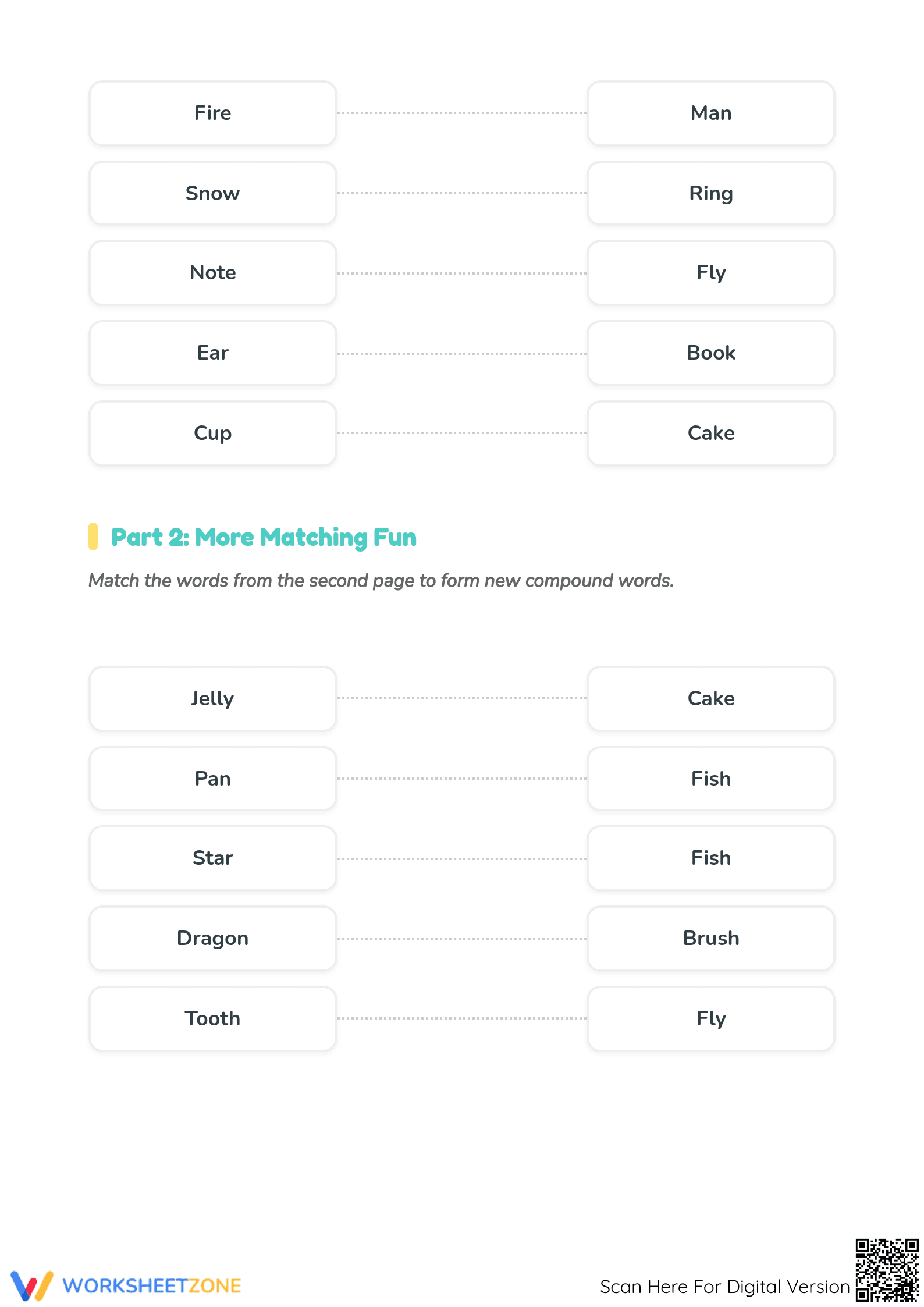
This comprehensive 4-page PDF contains 25 unique items divided into three structured segments. Parts 1 and 2 feature 20 matching tasks where students draw lines to connect root words like Lady and Bug or Fire and Man. Part 3 shifts to Build a Word! where students combine segments like Straw + berry to write the full word. A clear visual example is provided on the final page, alongside a full answer key for teacher use.
The transition from file to desk takes less than 2 minutes. Step 1: Print the 4-page sequence in about 30 seconds. Step 2: Distribute to students for independent seatwork or literacy rotations. Step 3: Use the provided answer key for rapid whole-class review or self-correction stations. This Compound Words Magic packet functions as an ideal sub-plan resource due to its self-explanatory nature and clear instructional scaffolding.
Aligned primarily to `CCSS.ELA-LITERACY.L.2.4.D`, students use knowledge of the meaning of individual words to predict the meaning of a compound word. It also supports foundational reading standards involving two-syllable word decoding in early primary grades. Both standard codes can be copied directly into lesson plans, IEP goals, or district curriculum mapping tools.
Deploy this worksheet during the You Do phase of a gradual release model. It serves as an excellent formative assessment tool; observe how students approach the building section to gauge their writing stamina and phonics application. Expect students to complete the full sequence in approximately 20 minutes, making it perfect for morning work or exit tickets.
Designed for first-grade students, this resource is particularly effective for English Language Learners (ELLs) who benefit from the visual-spatial task of matching discrete words to form new meanings. Pair this worksheet with a compound word anchor chart or a short reading passage containing high-frequency examples like sunflower or pancake to reinforce real-world context.
Research by Fisher & Frey (2014) emphasizes that vocabulary development is most effective when students engage in word-building activities that highlight how smaller units of meaning (morphemes) combine to create more complex concepts. This Grade 1 ELA worksheet leverages that principle by using the `CCSS.ELA-LITERACY.L.2.4.D` framework to guide students through the systematic construction of compound words. Students move beyond rote memorization into active morphological analysis. The structured progression from visual matching to independent writing ensures that students internalize the logic of lexical combination. According to the ScienceDirect TpT Analysis, high-utility practice sheets that focus on a single morphological skill significantly reduce cognitive load for emerging readers, allowing them to focus on the semantic relationship between root words. This essential practice builds the foundational schema necessary for advanced reading comprehension and linguistic fluency in primary grades.


