





























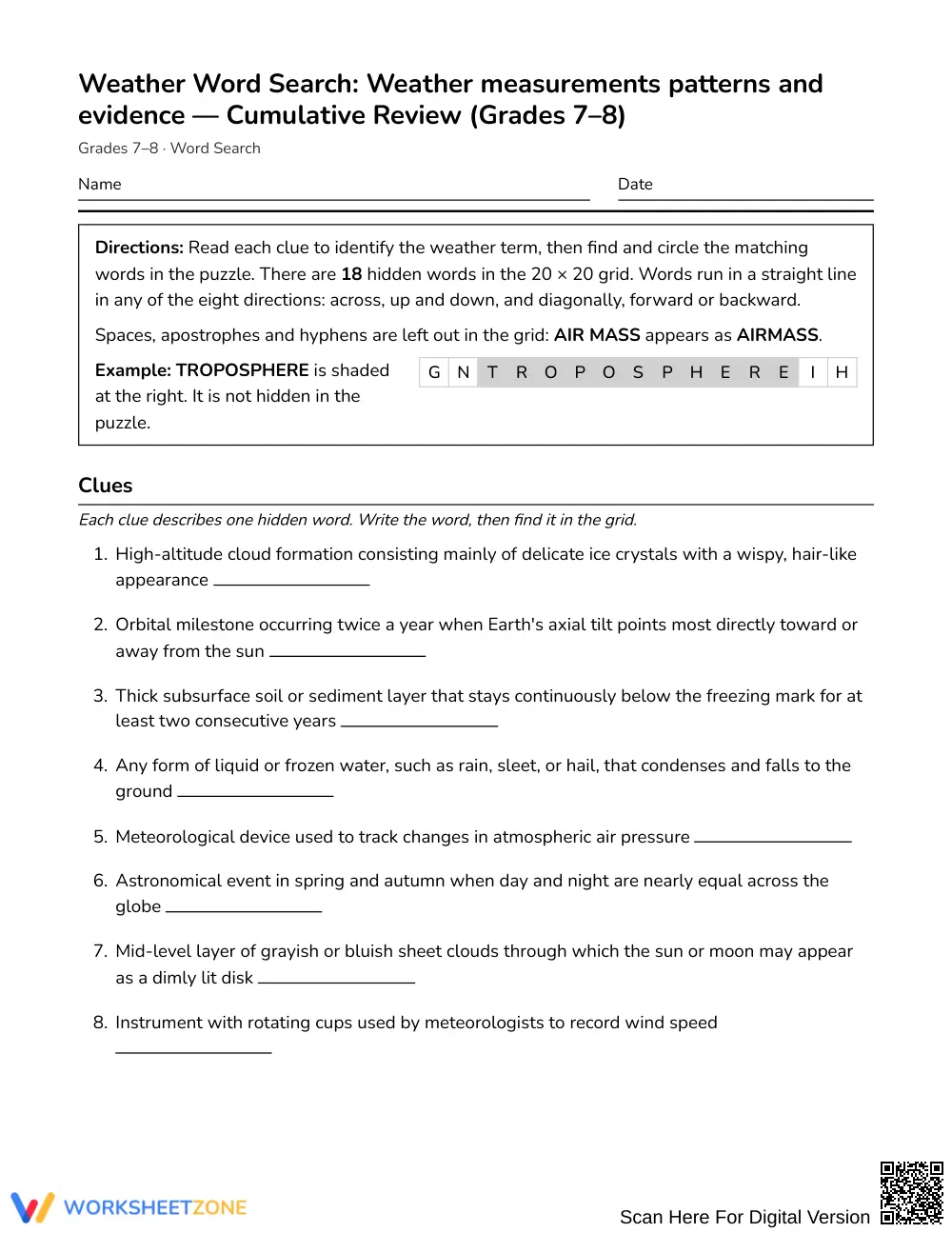


Complete Weather Patterns Word Search | Grades 7–8 Science

Paste this activity's link or code into your existing LMS (Google Classroom, Canvas, Teams, Schoology, Moodle, etc.).
Students can open and work on the activity right away, with no student login required.
You'll still be able to track student progress and results from your teacher account.
Reinforce essential meteorological terminology with this comprehensive science word search covering weather measurements, patterns, and atmospheric evidence. Designed for middle school learners in Grades 7–8, this activity prompts students to decipher detailed descriptive clues before locating hidden terms, ensuring active cognitive recall rather than passive letter matching.
At a Glance
- Grade: Grades 7–8 · Subject: Science
- Standard: Not standards-assessed — vocabulary enrichment
- Skill Focus: Weather measurements, atmospheric patterns, and climate evidence
- Format: 3 student pages · 18 vocabulary words · Full answer key included · Printable PDF
- Best For: Cumulative science unit review, station work, and emergency sub plans
- Time: 25–35 minutes of focused review
What's Inside
This 3-page printable science resource contains 18 weather vocabulary words integrated with rigorous science definitions. Instead of simply copying words from a list, students read 18 precise scientific clues covering tools like the anemometer and barometer, concepts such as occluded fronts and dew point, and climate terms including insolation and permafrost. A complete 4-page answer key displays exact grid coordinates and highlighted word paths for effortless verification.
Puzzle Structure and Mechanics
The word search is built on an expansive 20-by-20 grid designed to challenge middle school students. The 18 targeted vocabulary terms are placed in all eight possible compass directions: north, northeast, east, southeast, south, southwest, west, and northwest, including forward, backward, vertical, and diagonal paths. A shuffled word bank pairs with matching definition clues to require content analysis before students search the puzzle.
Standards Alignment
This activity serves strictly as vocabulary enrichment and is not aligned to a specific state or national content standard. It provides supplementary terminology reinforcement to strengthen domain-specific academic vocabulary across Earth and space science coursework without assigning formal standardized performance benchmarks.
How to Use It
Deploy this word search during independent station rotations after completing direct instruction on atmospheric systems, or assign it as an engaging mid-unit review before a summative exam. For formative assessment, circulate as students solve the clues to identify which instrument definitions or cloud classifications cause hesitation before they search the grid. The activity requires approximately 25 to 35 minutes to complete.
Who It's For
This resource is tailored for Grades 7–8 science students reviewing meteorological data, front boundaries, and atmospheric layers. It provides accessible vocabulary reinforcement for general education classrooms, English language learners needing contextual definitions, and early finishers. Pair this puzzle with an introductory weather forecasting lab or synoptic weather map analysis lesson.
According to Fisher & Frey (2014), intentional domain-specific vocabulary acquisition serves as a critical foundation for complex disciplinary literacy, enabling middle school students to construct coherent scientific explanations and interpret technical diagrams accurately. When vocabulary practice couples precise operational definitions with active search tasks, learners retrieve conceptual knowledge from long-term memory rather than relying on surface-level word memorization. This science word search targets 18 essential terms spanning weather instruments, front systems, and atmospheric thermodynamics without formal standard alignment, functioning as an accessible vocabulary enrichment instrument for diverse classrooms. Integrating clue-driven word identification before spatial search reinforces scientific terminology, supporting both English language learners and developing readers as they build science comprehension. Research underscores that structured vocabulary consolidation directly enhances reading stamina, concept retention, and academic fluency across secondary Earth and space science curricula.


