


























Views
Downloads

Complete Vector Operations Worksheet | Grade 12 Precalculus
Paste this activity's link or code into your existing LMS (Google Classroom, Canvas, Teams, Schoology, Moodle, etc.).
Students can open and work on the activity right away, with no student login required.
You'll still be able to track student progress and results from your teacher account.
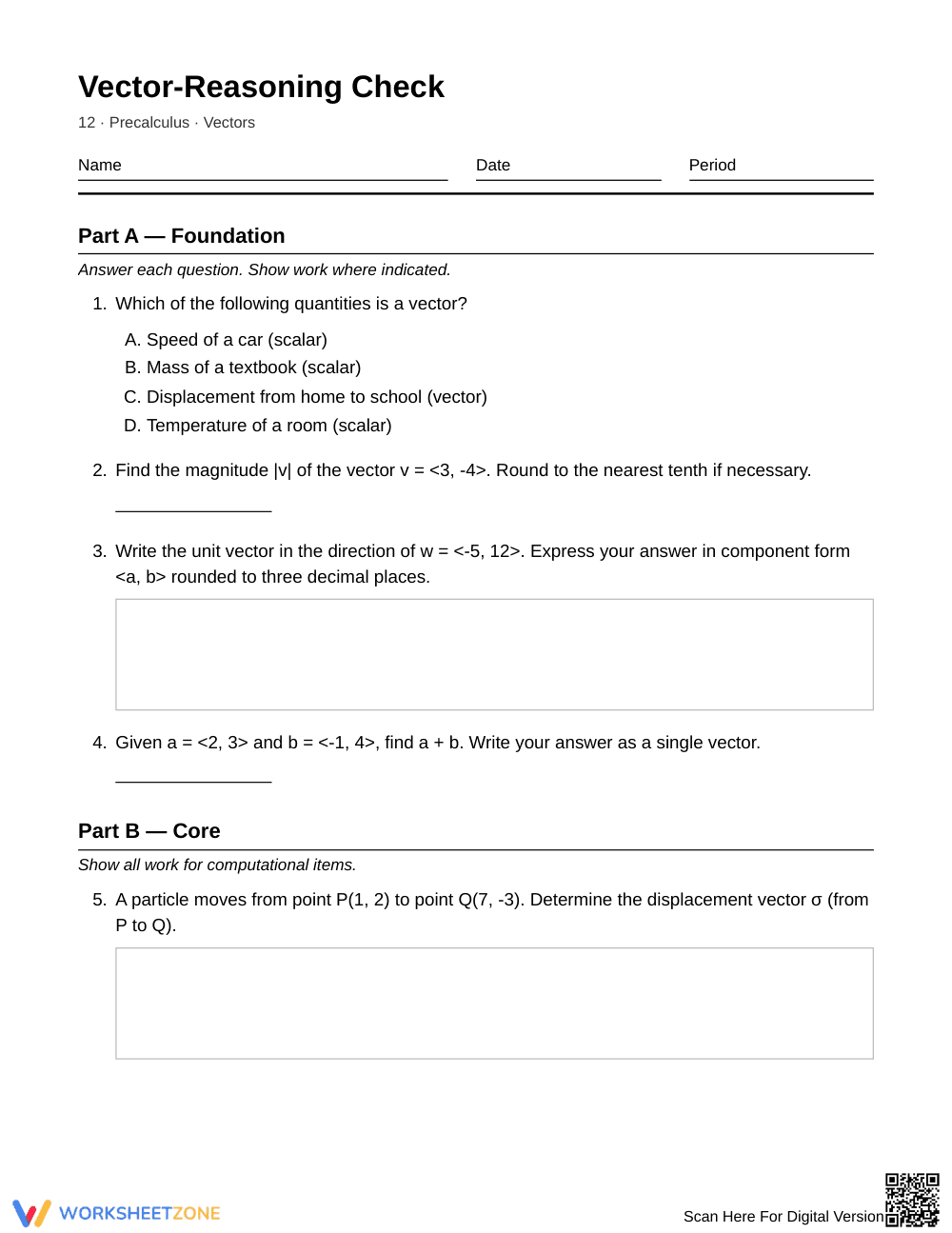
This Grade 12 vector operations worksheet provides rigorous practice calculating vector magnitudes, unit vectors, dot products, and orthogonal vectors. Students apply algebraic and geometric representations to resolve real-world force systems and 2D kinematics, developing fluency across foundational definitions and multi-step physics-based modeling scenarios.
At a Glance
- Grade: 12 · Subject: Precalculus
- Standard: Vector Operations — Calculate magnitude, dot products, angles, and resultant forces in applied contexts
- Skill Focus: Vector Reasoning & Applications
- Format: 5 pages · 16 problems · Answer key included · PDF
- Best For: End-of-unit review or assessment
- Time: 45–60 minutes
Across five pages, this resource delivers 16 targeted vector reasoning items divided into three scaffolded tiers. The worksheet features coordinate displacement tasks, force vector resolution from angles, scalar dot products, angle computations between vectors, scalar projections, and velocity vector functions. A complete 2-page step-by-step answer key supports efficient grading and error analysis.
Skill Progression
- Guided Practice (Part A, 4 tasks): Focuses on foundational recall, distinguishing scalars from vectors, computing basic magnitudes, generating unit vectors, and adding component vectors with minimal cognitive load.
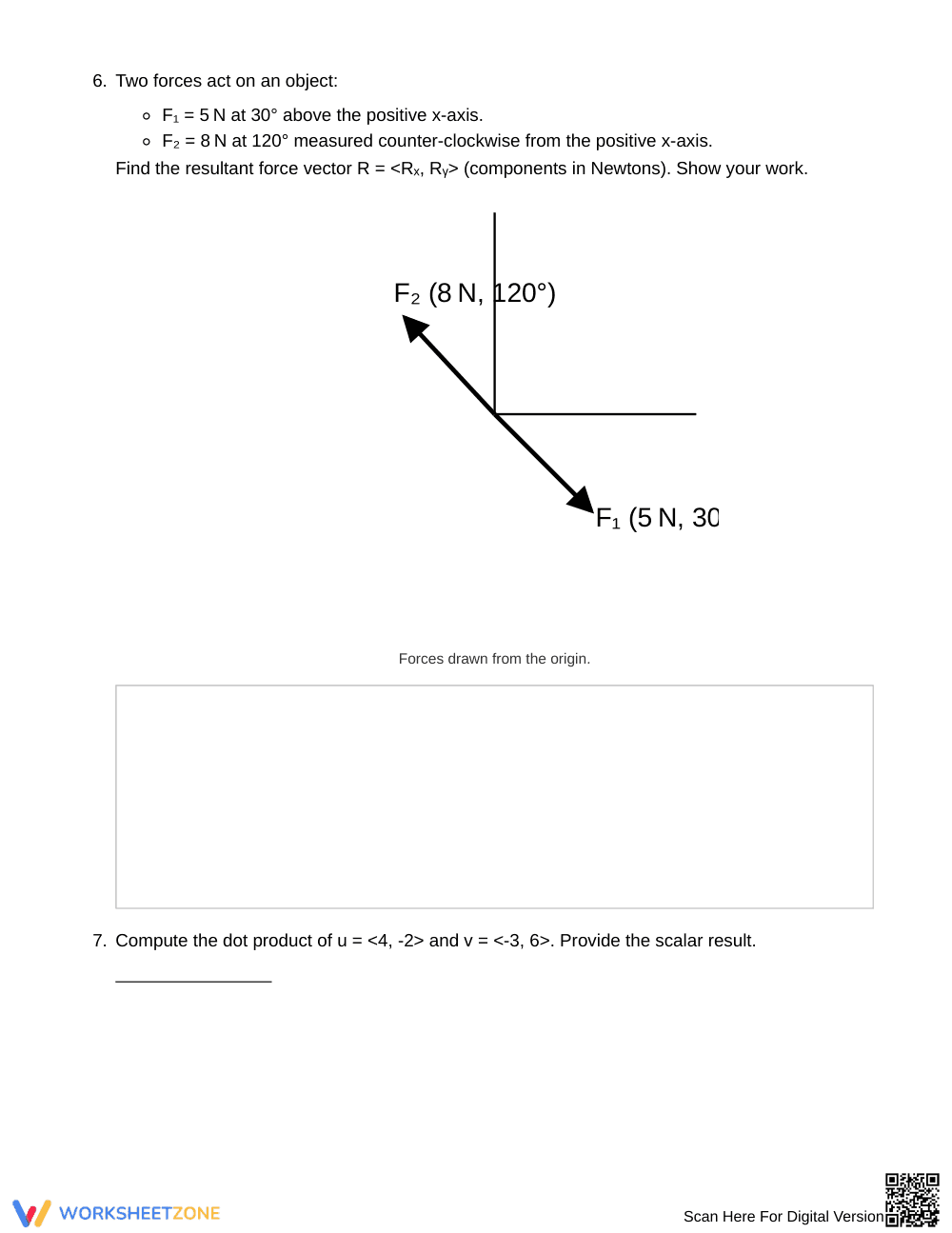
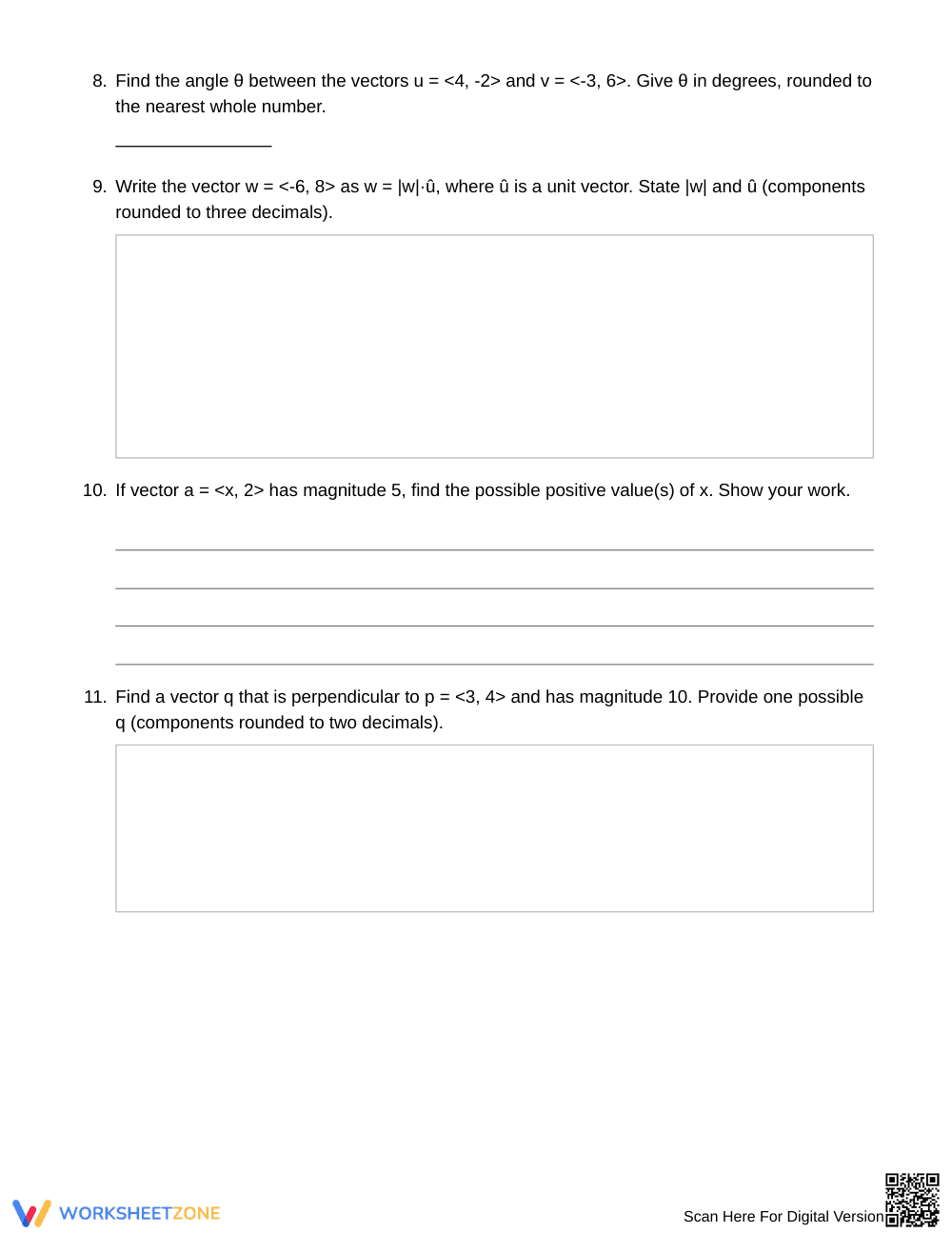
- Supported Practice (Part B, 8 tasks): Expands into multi-step computations including displacement between points, resolving two-force resultant vectors from angles, computing dot products, finding orthogonal vectors, and 2D kinematic modeling.
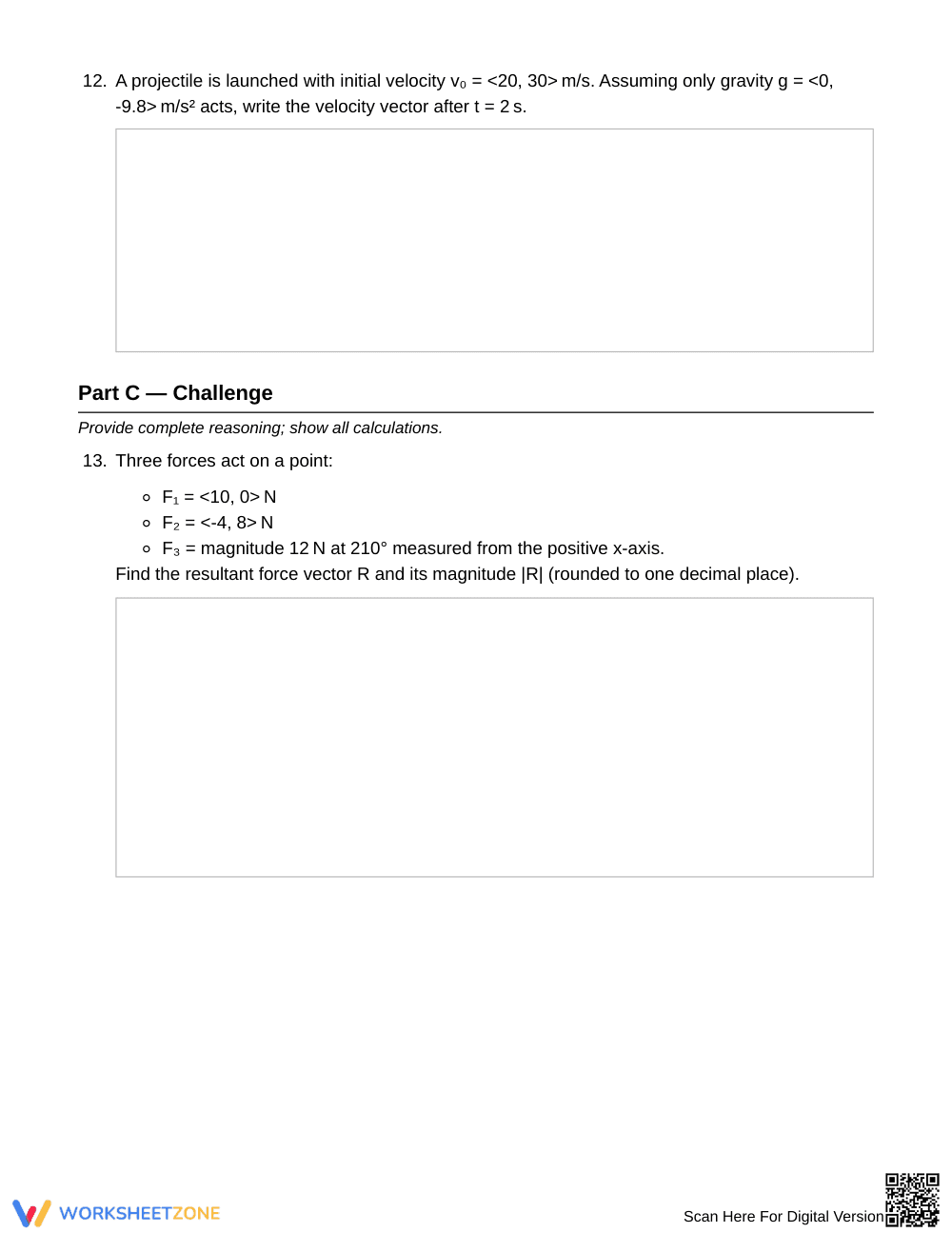
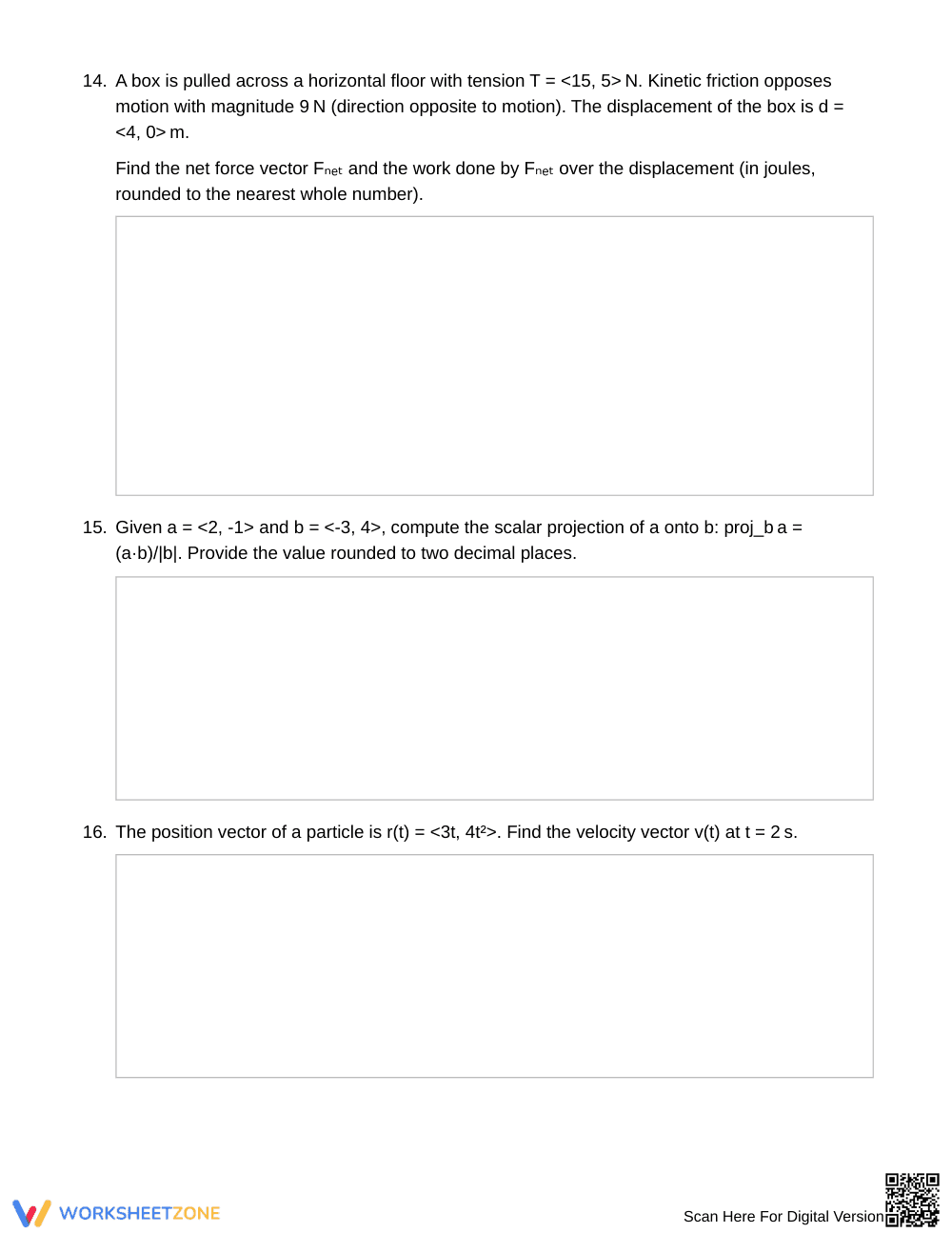
- Independent Practice (Part C, 4 tasks): Challenges students with advanced synthesis, including three-force equilibrium analysis, work calculations with friction, scalar projections, and parametric position-to-velocity derivatives.
This tiered structure supports the gradual release of responsibility model, ensuring students master foundational vector arithmetic before tackling complex physical applications.
Standards Alignment
This resource aligns with high school advanced mathematics standards for vectors and matrices. Students represent and model with vector quantities, compute vector sums and scalar multiples, find directional angles, and apply dot products to compute work. These competencies map directly into lesson plans, IEP goals, and district curriculum mapping tools for upper-level STEM pathways.
How to Use It
Deploy this worksheet after direct instruction on vector components and dot products as a comprehensive review before unit assessments. Alternatively, assign Part A and Part B during class for collaborative partner practice, reserving Part C as an independent extension task. During work time, observe whether students correctly convert polar angles into rectangular force components in Part B, Question 6. Expected completion time is 45 to 60 minutes.
Who It's For
Designed for Grade 12 Precalculus and introductory Physics classrooms, this activity provides structured entry points for all learners while pushing high-achieving students toward AP-level modeling. Pair this worksheet with a coordinate grid anchor chart or vector component reference guide to assist visual learners during multi-force calculations.
According to research by Fisher & Frey (2014) on guided instructional frameworks, structuring complex STEM tasks through a gradual-release model significantly improves conceptual retention and problem-solving autonomy. This Grade 12 Precalculus resource puts that research into practice across 16 rigorous vector problems. Students progress systematically from scalar identification and basic magnitude calculations to multi-vector force equilibrium and parametric motion. By combining computational fluency with applied physics contexts, the worksheet ensures learners build durable spatial and algebraic reasoning. Complete worked solutions across the 2-page answer key enable targeted diagnostic feedback, making this printable 5-page PDF an effective instrument for standard mastery and calculus readiness in advanced secondary mathematics courses.


