


























Views
Downloads

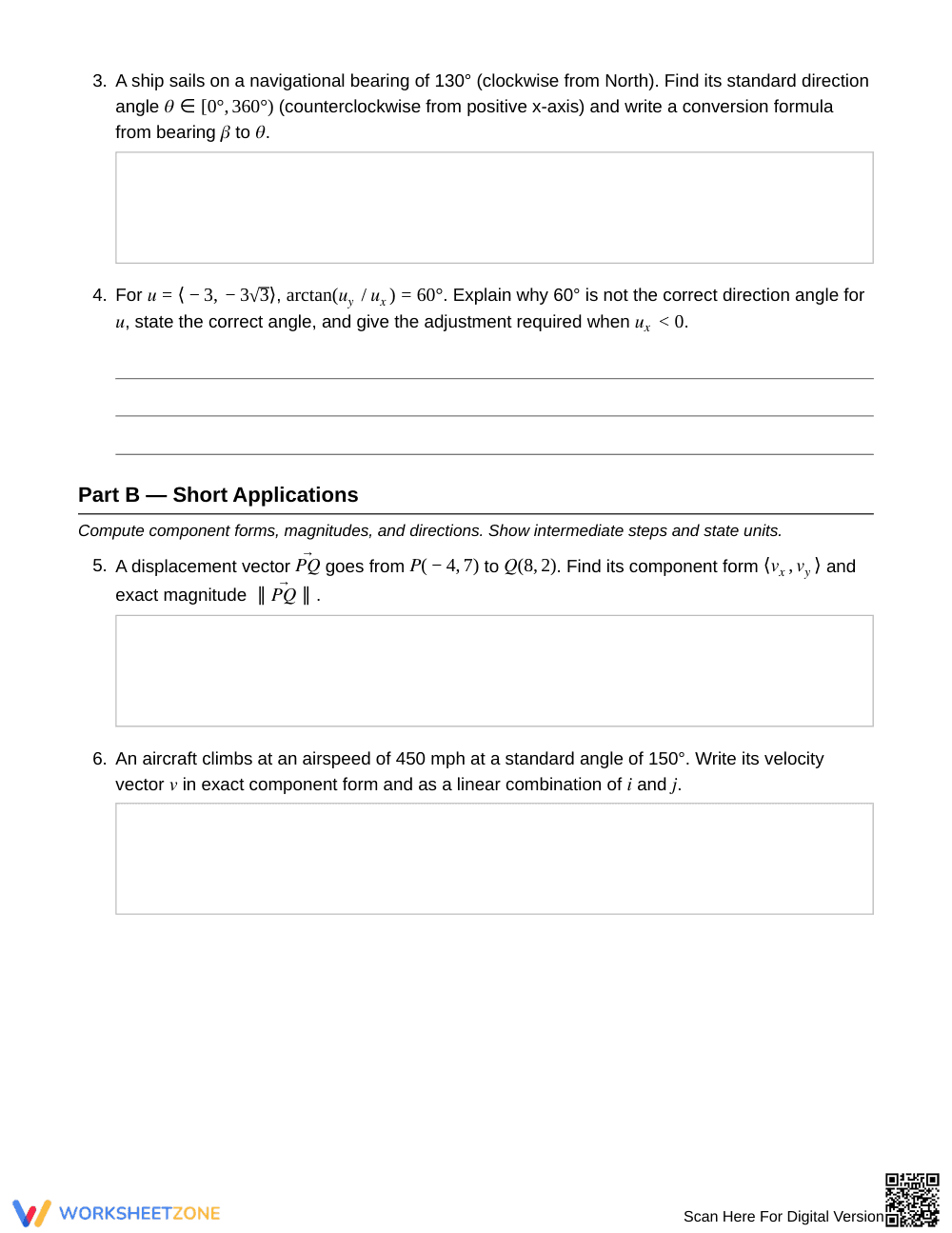
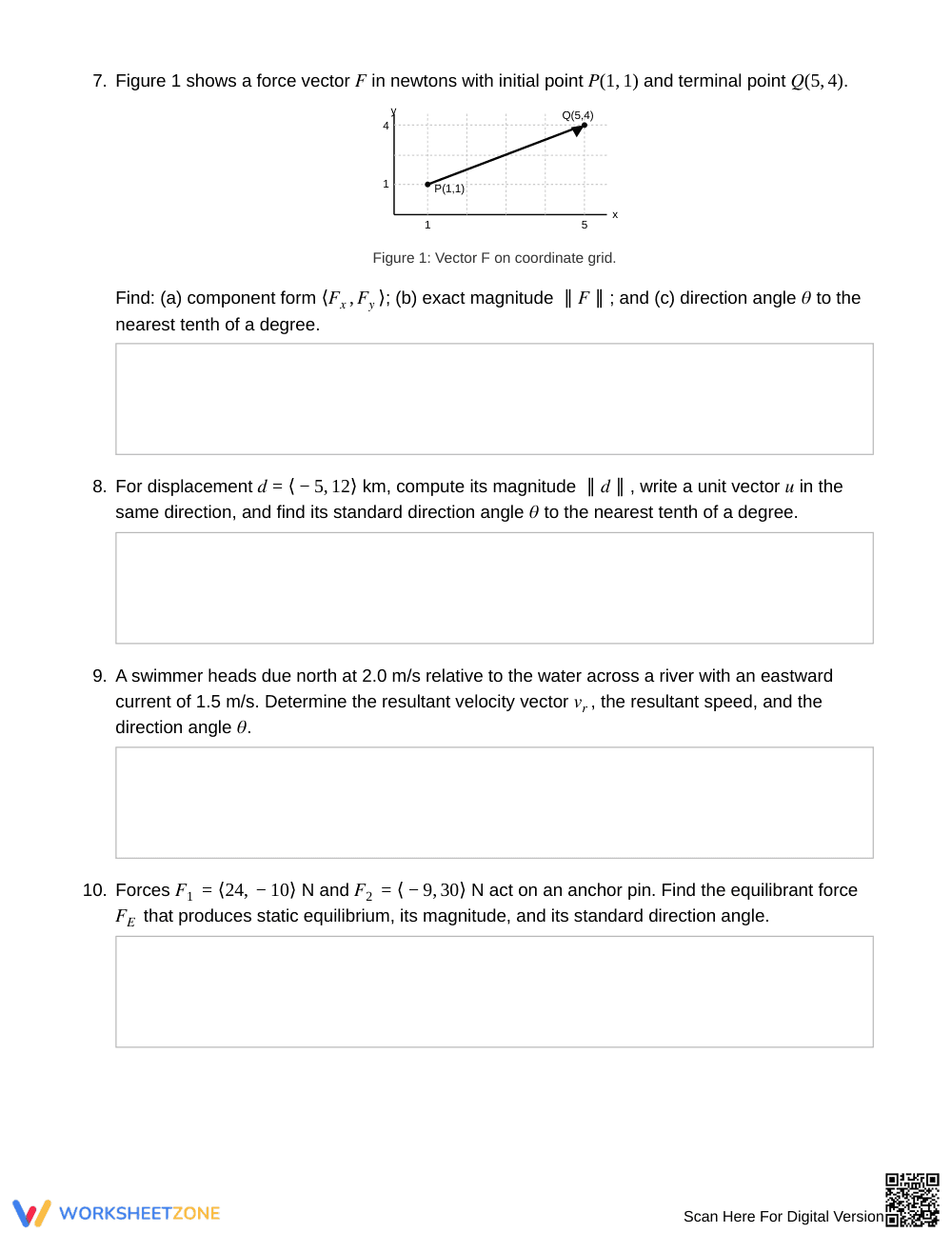
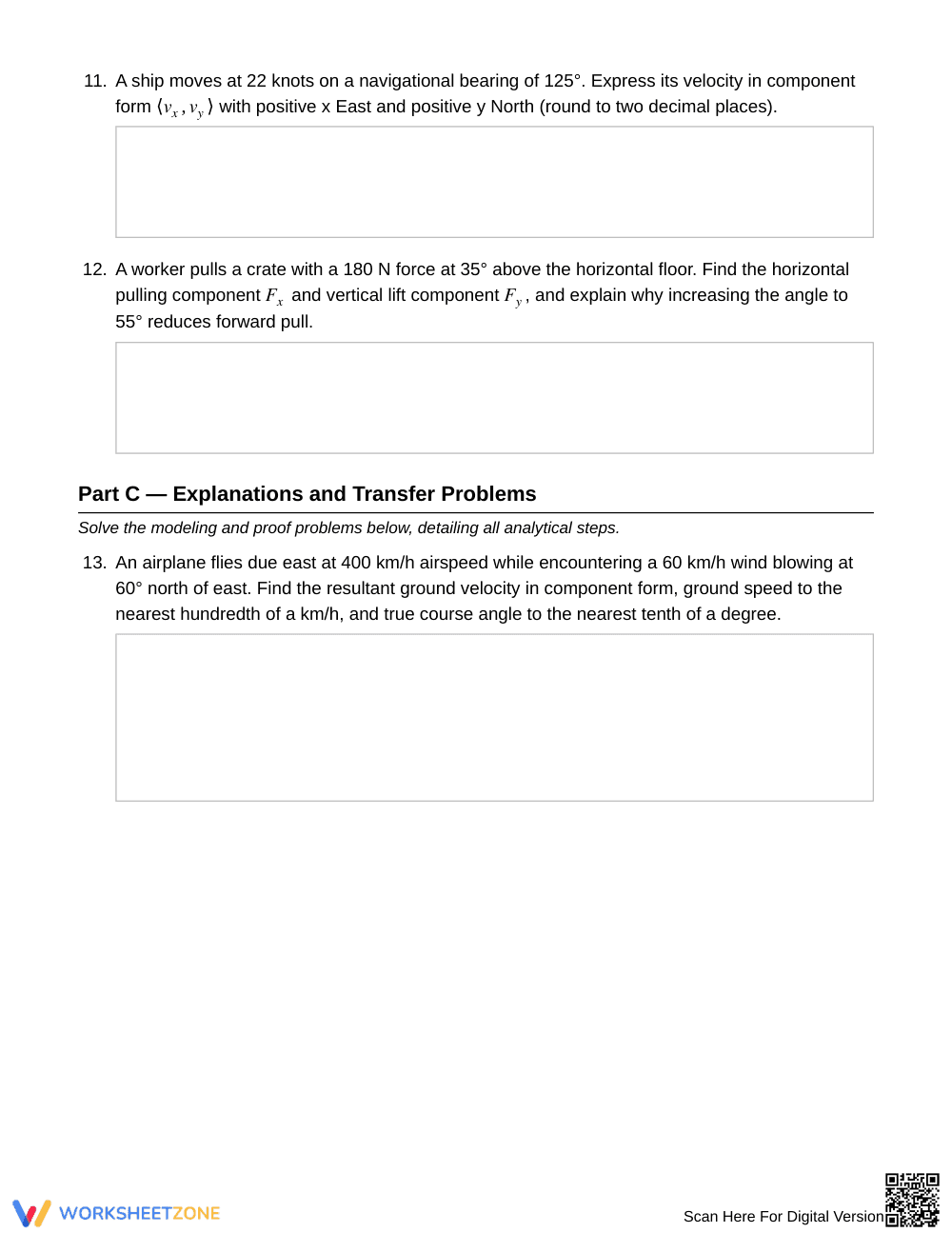
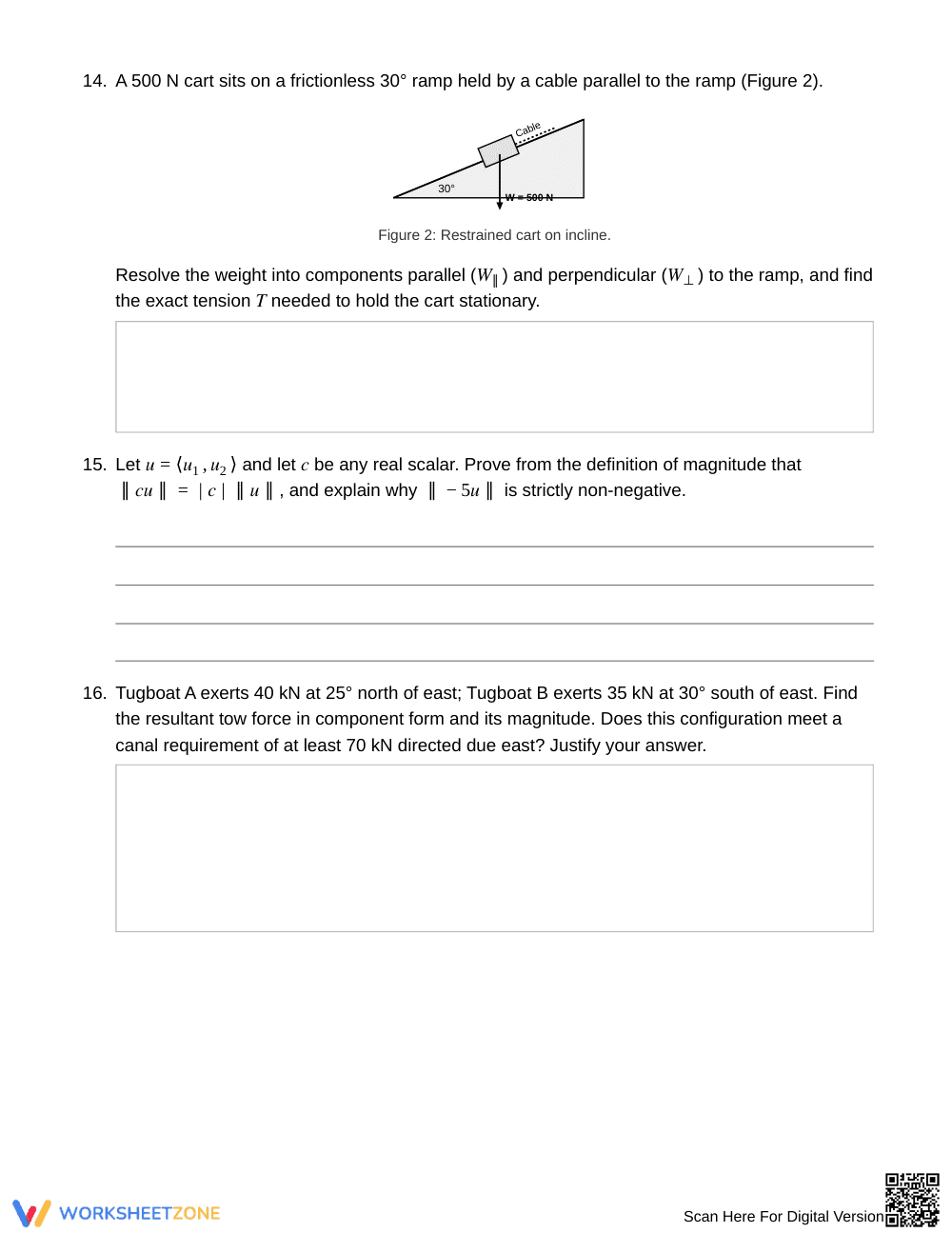

Complete Vector Components Worksheet | Grade 12 Precalculus
Paste this activity's link or code into your existing LMS (Google Classroom, Canvas, Teams, Schoology, Moodle, etc.).
Students can open and work on the activity right away, with no student login required.
You'll still be able to track student progress and results from your teacher account.
Master two-dimensional vector analysis with this comprehensive Grade 12 Precalculus practice set. Students calculate rectangular components, determine exact magnitudes, convert navigational bearings to standard direction angles, and solve applied physics force problems. This resource builds conceptual understanding and computational fluency across 16 analytical tasks.
At a Glance
- Grade: 12 · Subject: Precalculus
- Standard: Advanced Math — Calculate vector components, magnitudes, and directions to solve multi-step problems
- Skill Focus: Components, Magnitude, and Direction
- Format: 5 pages · 16 problems · Answer key included · PDF
- Best For: Precalculus vector unit practice
- Time: 45–60 minutes
This 5-page printable resource delivers 16 structured tasks with a full 2-page answer key. A reference header provides component formulas, magnitude equations, and direction angle conventions. Students analyze coordinate vectors, convert bearings, resolve forces on ramps, and complete algebraic magnitude proofs.
Skill Progression
- Guided practice (Part A, Problems 1–4): Students examine scalar-vector differences, prove vector equality across coordinate points, convert navigation bearings, and evaluate inverse tangent quadrant adjustments.
- Supported practice (Part B, Problems 5–12): Learners calculate components, exact magnitudes, unit vectors, resultant velocities, and static equilibrium forces.
- Independent practice (Part C, Problems 13–16): Students solve airplane wind drift, ramp force decomposition, scalar multiplication proofs, and towboat resultant models.
This gradual-release structure guides high school mathematicians from foundational representations to complex vector applications.
Standards Alignment
This worksheet aligns with high school advanced mathematics standards for vectors and trigonometry. Students represent vectors algebraically, calculate magnitudes and directions, perform scalar multiplication, and model physical forces. These exercises integrate smoothly into Precalculus lesson plans, IEP goals, and curriculum pacing guides.
How to Use It
Assign this worksheet after direct instruction on vector components. Use Part A for guided checks on quadrant angle adjustments. Assign Parts B and C for independent practice or paired problem-solving. Review Problem 4 formatively to check inverse tangent corrections. Expected completion time is 45 to 60 minutes.
Who It's For
This practice set serves Grade 12 Precalculus, Trigonometry, and Honors Physics students. Differentiate by providing coordinate grids for visual support or assigning Part C proofs as advanced extensions. Pair this worksheet with a force vector lesson or unit anchor chart.
According to research on instructional architecture by Fisher & Frey (2014), structured progression through gradual release enhances student competence in complex mathematical representations and quantitative reasoning. This Grade 12 Precalculus worksheet embodies this pedagogical framework across 16 multi-step vector problems spanning 5 pages. By first establishing foundational distinctions between scalars and vectors and resolving quadrant ambiguity in inverse trigonometric direction angles, learners build the conceptual scaffolding required for advanced physics applications. Students systematically advance to computing component forms, determining magnitudes via the Pythagorean relation, establishing unit vectors, and resolving two-dimensional force systems on inclined planes and navigational courses. The inclusion of analytical proofs and real-world vector decomposition ensures that learners bridge procedural calculation and authentic modeling. Educators can utilize this comprehensive resource and its full answer key to verify student mastery in standard vector mechanics efficiently.


