




























Views
Downloads



Complete Unit Circle Errors Worksheet | Grade 12 Precalculus

Paste this activity's link or code into your existing LMS (Google Classroom, Canvas, Teams, Schoology, Moodle, etc.).
Students can open and work on the activity right away, with no student login required.
You'll still be able to track student progress and results from your teacher account.
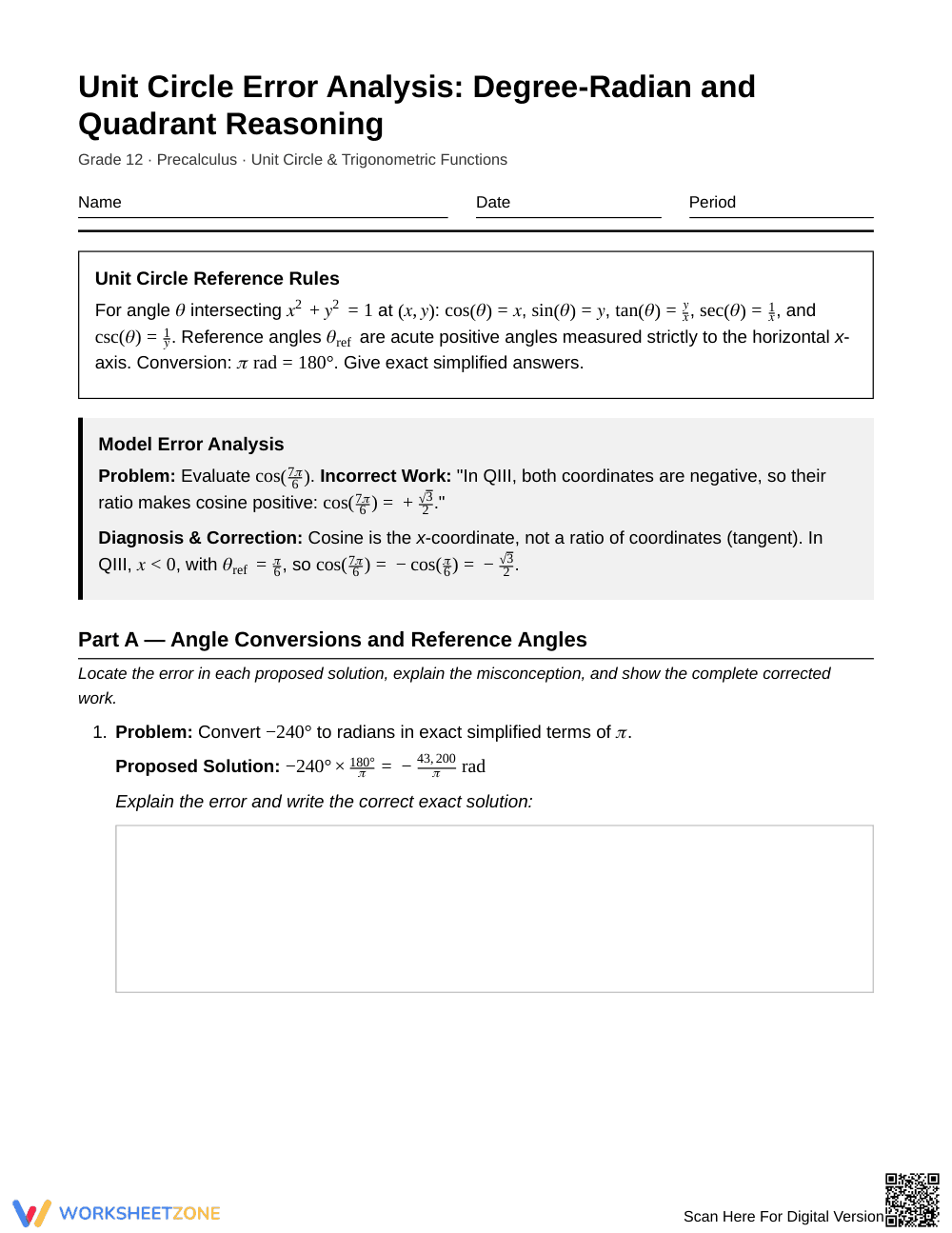
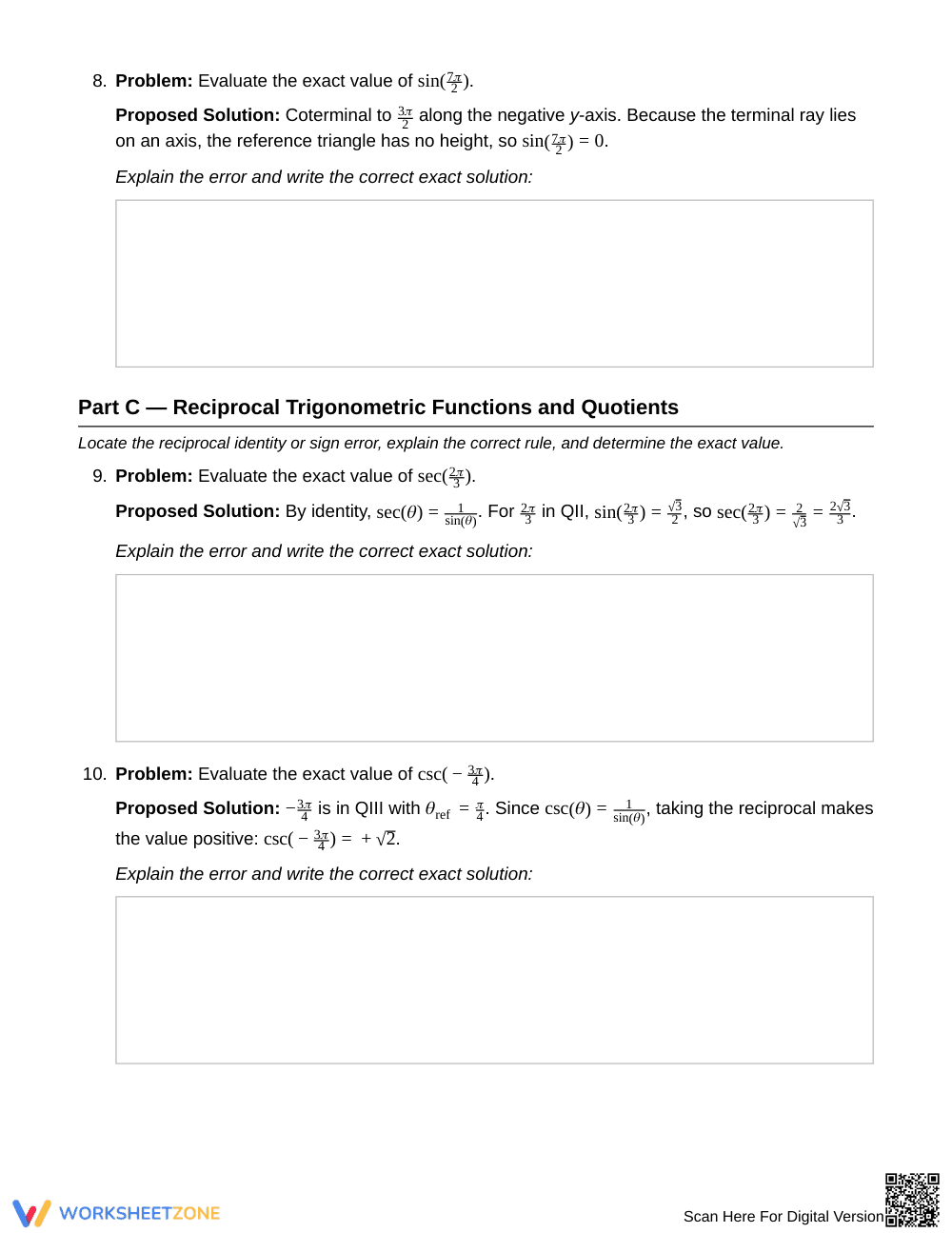
This Grade 12 Precalculus worksheet guides students to identify, explain, and correct misconceptions in trigonometric evaluation. Across 10 targeted problems, learners analyze errors in degree-radian conversions, reference angles, quadrant signs, and reciprocal definitions to solidify unit circle fluency.
At a Glance
- Grade: 12 · Subject: Precalculus
- Standard:
HSF-TF.A.2— Explain unit circle values using coordinate geometry and radian angle measures- Skill Focus: Correct Degree-Radian and Quadrant Errors
- Format: 4 pages · 10 problems · Answer key included · PDF
- Best For: Remediation, error analysis, and quiz review
- Time: 35–45 minutes
What's Inside: This 4-page resource includes 10 error analysis tasks across three stages, plus a 2-page answer key. It features a reference rule box covering coordinate definitions and conversions, along with a complete model analysis showing how to diagnose and correct flawed trigonometry work.
Skill Progression
- Guided Practice (Part A, 4 problems): Students examine faulty angle conversions and reference angle formulas, identifying incorrect conversion factors and improper axis subtraction before computing exact values.
- Supported Practice (Part B, 4 problems): Students analyze quadrant sign mistakes, coordinate misidentifications between sine and cosine, and quadrantal angle misconceptions under reduced prompt support.
- Independent Practice (Part C, 2 problems): Students evaluate reciprocal trigonometric errors involving secant and cosecant, independently correcting identity confusions and sign errors.
This deliberate sequence reflects the gradual release of responsibility model, moving students from guided error detection to independent trigonometric mastery.
Standards Alignment
This worksheet aligns with primary standard `HSF-TF.A.2`, requiring students to explain how the unit circle in the coordinate plane extends trigonometric functions to all real numbers as radian measures. It also supports standard `HSF-TF.A.1` by reinforcing radian measures. Both standard codes can be copied directly into lesson plans, IEP goals, or district curriculum mapping tools.
How to Use It
Use this worksheet after direct instruction on the unit circle as a partner activity or mid-unit check. During class, check whether students measure reference angles to the vertical axis rather than the horizontal axis, and intervene promptly. Expected completion time is 35 to 45 minutes.
Who It's For
This resource serves Grade 12 Precalculus and advanced Algebra II students preparing for calculus. Support striving learners with an annotated unit circle diagram, and challenge advanced students to write original flawed solutions. Pair this activity with coordinate plane unit circle charts.
According to empirical research synthesized by Fisher & Frey (2014) on the gradual release of responsibility, analyzing worked examples and systematically diagnosing flawed non-examples deepens secondary mathematics retention far more effectively than isolated procedural drills. Aligned directly to standard HSF-TF.A.2, this Grade 12 Precalculus resource tasks students with explaining unit circle values and correcting degree-radian and quadrant errors across 10 structured analytical problems. Rather than merely computing values in isolation, high school learners evaluate the mathematical reasoning behind each erroneous step, articulating misconceptions involving terminal ray locations, reference angle orientations, and reciprocal trigonometric definitions. This active critique protocol bridges conceptual understanding with procedural precision, enabling students to construct accurate mental models of coordinate plane trigonometry. Consequently, the scaffolded instructional design ensures that seniors achieve lasting mastery of circular functions prior to advanced STEM coursework.


