




























Views
Downloads


Complete Unit-Chain Errors Worksheet | Grade 11 Chemistry

Paste this activity's link or code into your existing LMS (Google Classroom, Canvas, Teams, Schoology, Moodle, etc.).
Students can open and work on the activity right away, with no student login required.
You'll still be able to track student progress and results from your teacher account.
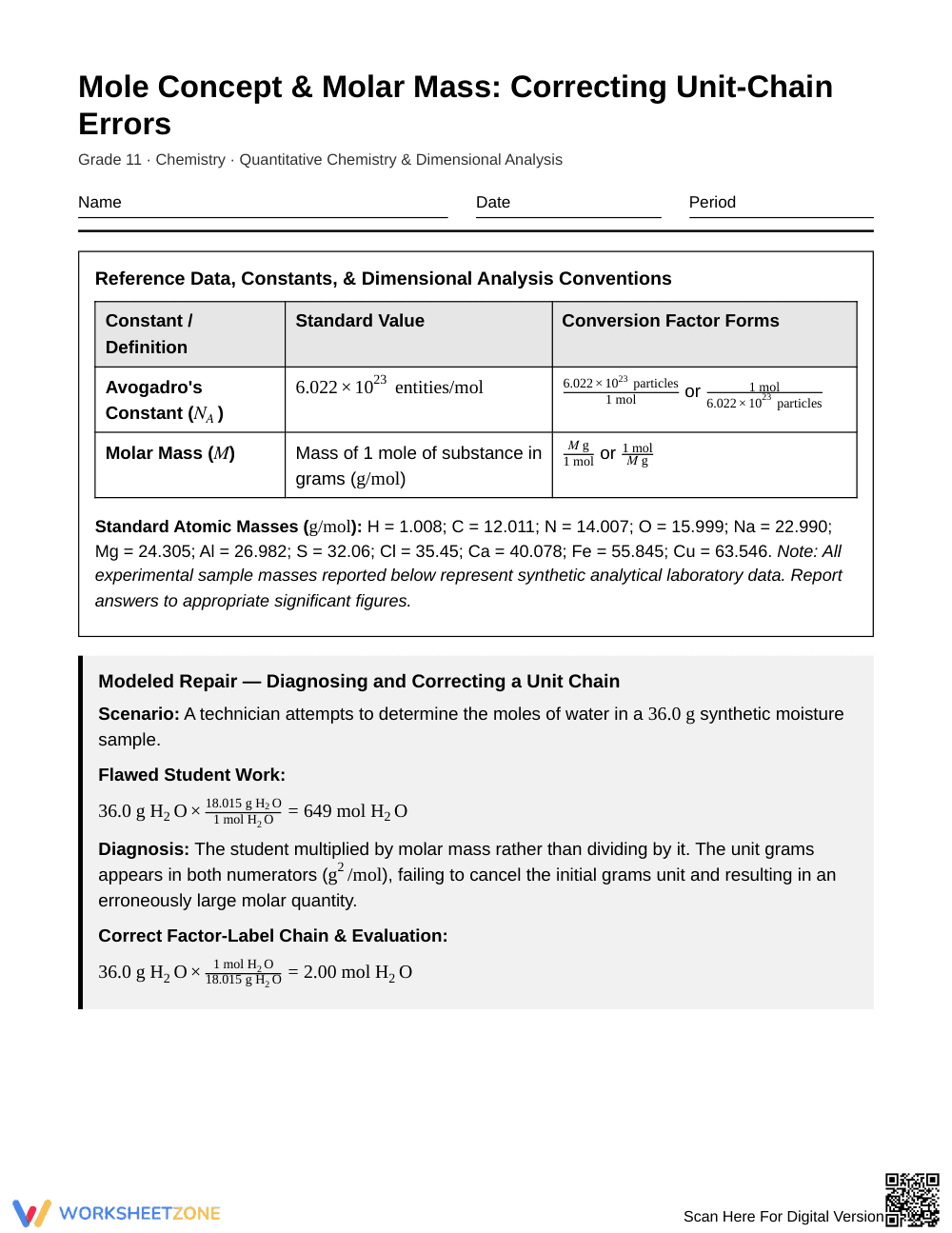
This Grade 11 chemistry worksheet equips students to detect, explain, and correct dimensional analysis errors in mole calculations. Learners evaluate flawed factor-label setups, verify unit cancellations, recalculate molar masses, and reconstruct mathematically sound conversion chains from given quantities to target units.
At a Glance
- Grade: 11 · Subject: Chemistry
- Standard: Quantitative Chemistry — Analyze, diagnose, and mathematically correct dimensional analysis unit-conversion chains in stoichiometry
- Skill Focus: Correcting Unit-Chain Errors and Factor-Label Sequences
- Format: 5 pages · 8 multi-step problems · Comprehensive answer key included · Printable PDF
- Best For: Advanced high school chemistry practice, targeted intervention, and test remediation
- Time: 45–60 minutes
What's Inside
This five-page worksheet features 8 multi-step error-analysis tasks across two sections, plus a three-page answer key showing step-by-step unit cancellations. A reference table supplies molar masses and Avogadro's constant. An explicit modeled repair demonstrates how to diagnose flaws before students tackle particle inversions, subscript oversights, and calculator syntax errors.
Skill Progression
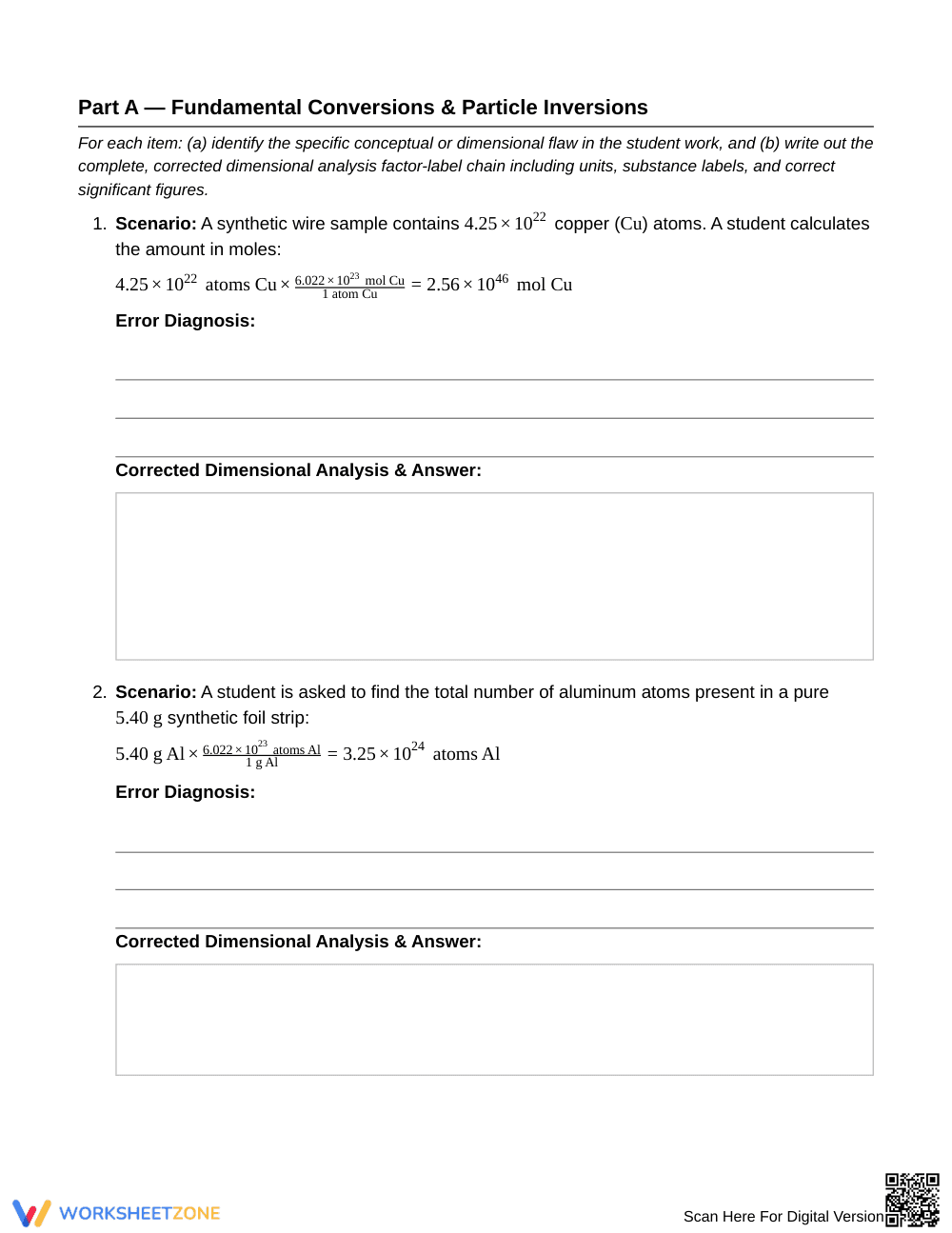
- Guided Practice: An annotated modeled repair demonstrates unit cancellation failure, guiding students through Part A (problems 1–3) on particle inversions and diatomic gas molar mass errors.
- Supported Practice: Part B (problems 4–6) prompts students to diagnose multi-step errors involving polyatomic subscripts, metric unit conversions, and formula units.
- Independent Practice: Problems 7 and 8 challenge students to resolve complex fertilizer stoichiometry and order-of-operation calculator syntax bugs.
This sequence implements gradual release, moving learners from guided error detection to independent procedural correction.
Standards Alignment
Aligned with high school stoichiometry standards, this activity cultivates mathematical reasoning in chemical conversions. Students verify algebraic unit cancellation and significant figures across multi-step dimensional analysis setups. Supporting expectations emphasize precision in quantitative calculations. Both standard codes can be copied directly into lesson plans, IEP goals, or district curriculum mapping tools.
How to Use It
Use this worksheet after direct instruction on molar conversions. For structured practice, have student pairs complete Part A while verbalizing why inverted conversion factors fail dimensional cancellation. Formative assessment tip: check whether students write chemical formulas alongside units. Completion takes approximately 45 to 60 minutes.
Who It's For
This resource is designed for Grade 11 chemistry students mastering stoichiometric relationships. It provides targeted remediation for learners struggling with unit cancellation or scientific notation. Pair this printable worksheet with a molar mass reference chart or laboratory stoichiometry lesson.
Research synthesized by Fisher & Frey (2014) highlights that guided error analysis accelerates cognitive transfer by transforming passive formula memorization into active diagnostic reasoning. In high school chemistry, the ability to trace dimensional analysis unit chains is fundamental to mastery of quantitative stoichiometry and mole conversions. Rather than repeatedly performing rote calculations, students who critically inspect flawed factor-label setups develop metacognitive vigilance against inverted ratios, neglected compound subscripts, and order-of-operation calculator errors. This analytical worksheet engages learners in systematic defect detection across eight authentic chemistry scenarios, reinforcing accurate dimensional cancellation and significant figure reporting. According to Fisher & Frey (2014), pairing explicit modeled repair with gradual release problem sets produces significant gains in procedural fluency and conceptual retention. Consequently, this resource equips chemistry students with the durable analytical habits required for complex chemical equations, limiting reactant predictions, and rigorous laboratory data evaluations.


