





























Complete Two-Stage Dilution Worksheet | Grade 11 Chemistry
Paste this activity's link or code into your existing LMS (Google Classroom, Canvas, Teams, Schoology, Moodle, etc.).
Students can open and work on the activity right away, with no student login required.
You'll still be able to track student progress and results from your teacher account.
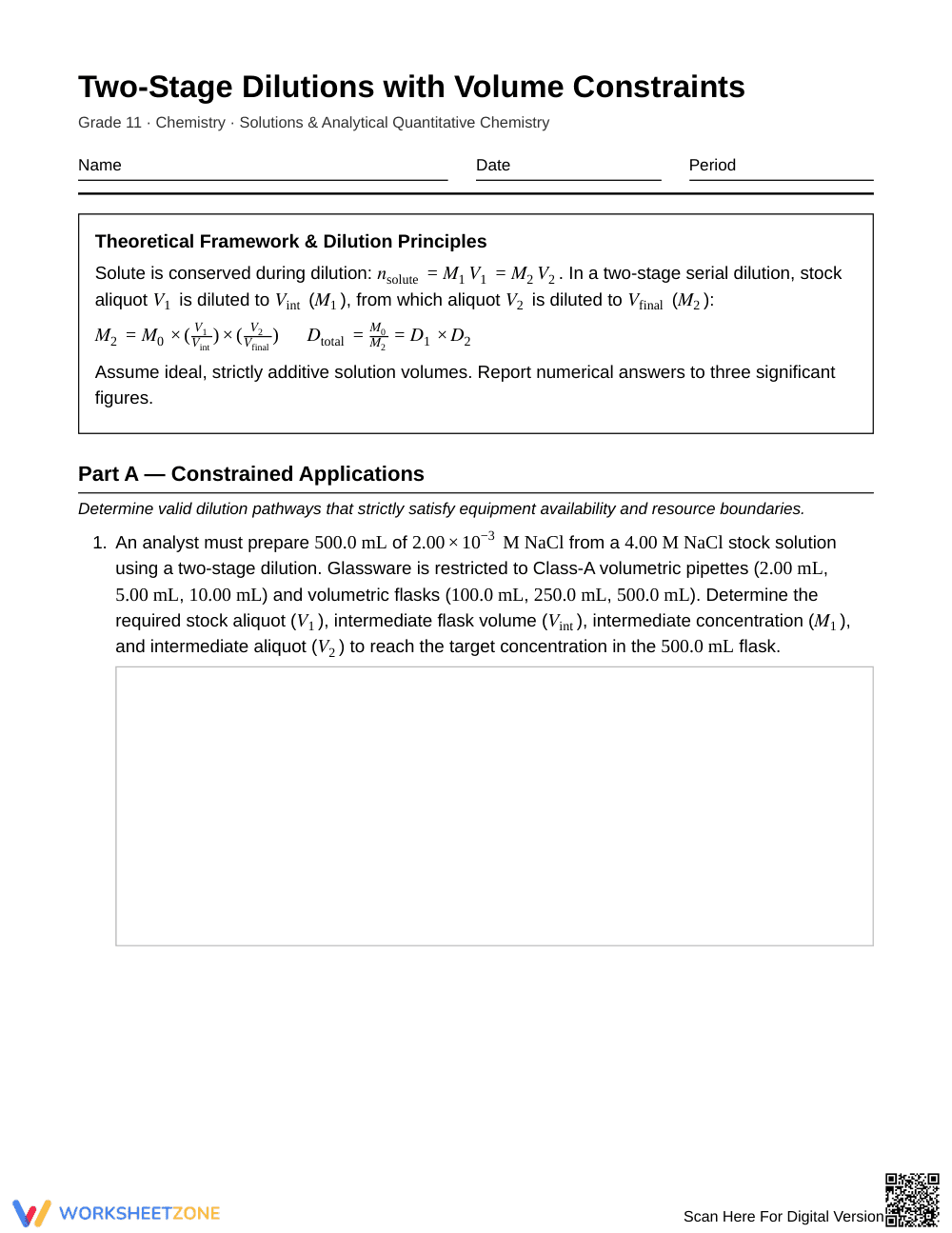
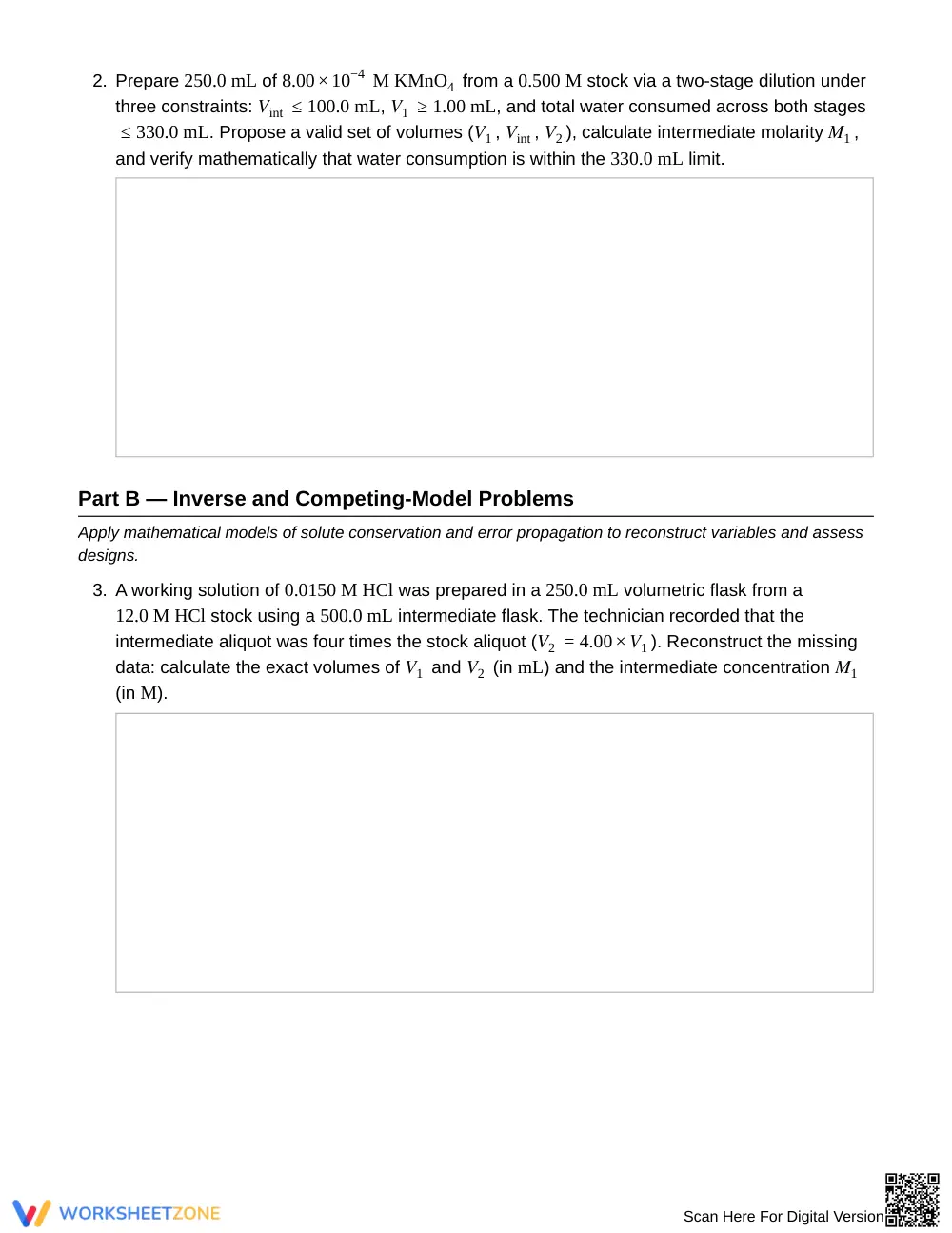
This Grade 11 Chemistry worksheet trains students to solve complex two-stage serial dilutions under rigorous laboratory volume and glassware constraints. Learners apply solute conservation principles to calculate intermediate concentrations, analyze propagation error, and design viable multi-step dilution protocols for analytical laboratory scenarios.
At a Glance
- Grade: 11 · Subject: Chemistry
- Standard: Solutions Chemistry — Calculate solution concentrations and design serial dilutions under laboratory equipment boundaries
- Skill Focus: Molarity and Two-Stage Dilutions with Volume Constraints
- Format: 5 pages · 6 problems · Complete answer key included · PDF
- Best For: Advanced quantitative solutions chemistry and laboratory calculations
- Time: 45–60 minutes
What's Inside
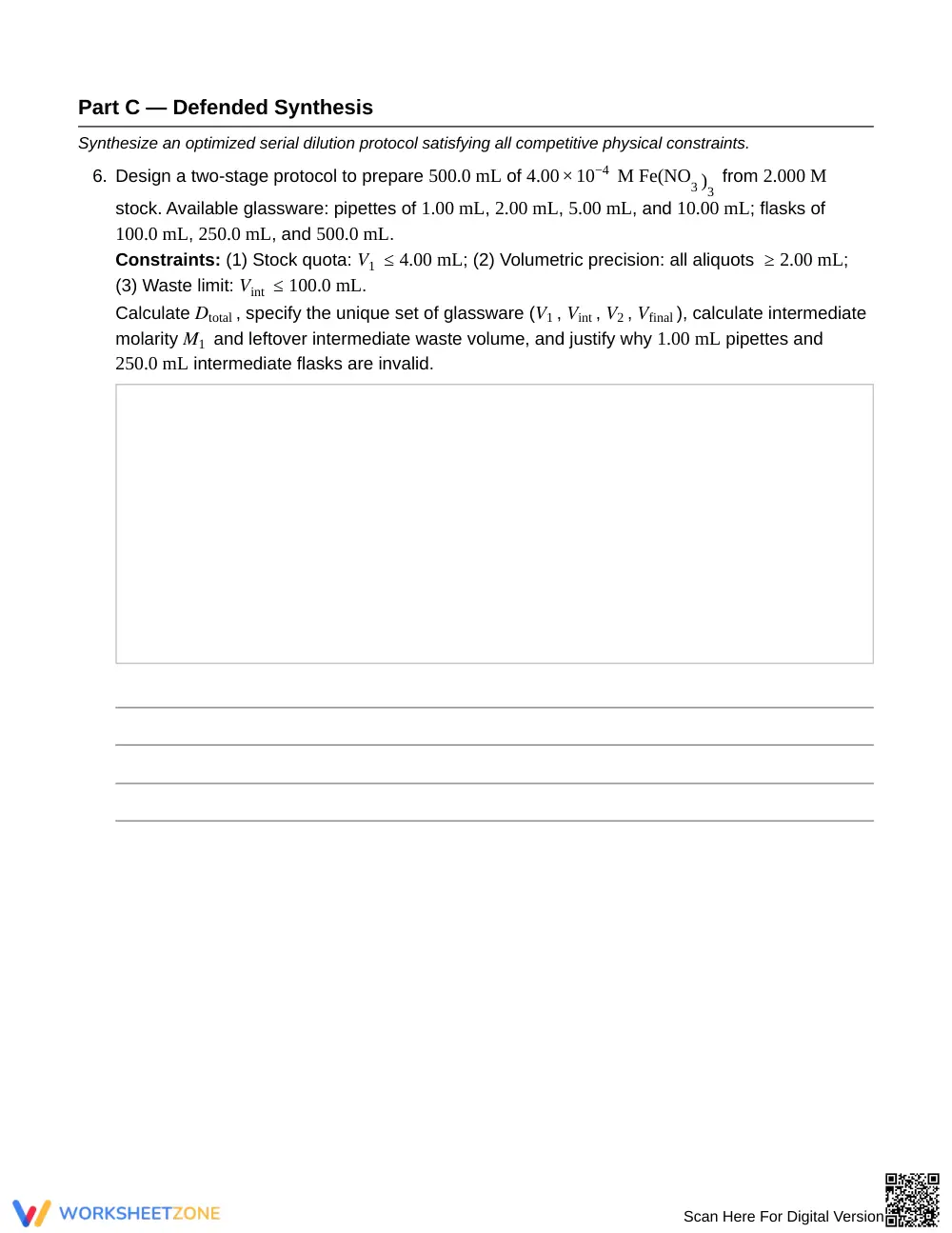
Across 5 printable pages, students tackle 6 multi-step analytical chemistry problems. The worksheet features an introductory theoretical framework with dilution formulas, constrained glassware pathway tasks, inverse variable reconstruction, error propagation comparisons, and a synthesis challenge. A 2-page answer key provides complete mathematical solutions.
Skill Progression
- Guided practice (Part A, 2 problems): Students identify viable volumetric glassware pathways under specified aliquot minimums and solvent limits.
- Supported practice (Part B, 3 problems): Learners solve inverse algebraic dilution systems, compare relative error across competing models, and assess evaporative loss.
- Independent practice (Part C, 1 problem): Students independently synthesize an optimized serial dilution protocol satisfying equipment quotas and waste boundaries.
This sequence follows a gradual-release model, transitioning students from structured parameter checking to open-ended analytical experimental design.
Standards Alignment
This resource aligns with high school solutions chemistry and quantitative laboratory analysis standards. Students demonstrate solute conservation across sequential transfers, calculating intermediate molarities and dilution factors within glassware tolerances. Both standard codes can be copied directly into lesson plans, IEP goals, or district curriculum mapping tools.
How to Use It
Use this worksheet after direct instruction on molarity equations and volumetric glassware. Assign Part A during class as paired practice to verify that students correctly calculate intermediate molarity. Assign Parts B and C for independent lab preparation or quantitative assessment. Expect completion within 45 to 60 minutes.
Who It's For
This worksheet serves Grade 11 Chemistry and Honors Chemistry students learning solution preparation. Provide glassware reference cards for students needing scaffolding, and pair the activity with a wet-lab spectrophotometry or volumetric analysis lesson.
Mastering two-stage dilutions with volume constraints requires high school chemistry students to coordinate multi-step proportional reasoning, solute conservation laws, and physical glassware limitations. According to research on structured STEM progression by Fisher & Frey (2014), analytical mastery accelerates when complex quantitative modeling shifts systematically from guided variable verification to unsupported procedural synthesis. This worksheet enacts that instructional framework by scaffolding two-stage dilution factor mathematics across 6 rigorous analytical tasks. Students begin by calculating intermediate concentrations and solvent consumption within defined equipment parameters, advance to inverse algebraic reconstruction and uncertainty analysis, and conclude by defending an original laboratory preparation protocol. Grounded in quantitative solution chemistry standards, this resource develops the procedural fluency and conceptual rigor necessary for authentic laboratory practice, ensuring learners successfully connect abstract conservation equations to physical equipment precision and real-world chemical preparation techniques.


