































Complete Two-Condition Lines Worksheet | Grade 8 Math

Paste this activity's link or code into your existing LMS (Google Classroom, Canvas, Teams, Schoology, Moodle, etc.).
Students can open and work on the activity right away, with no student login required.
You'll still be able to track student progress and results from your teacher account.
This Grade 8 math worksheet equips students to construct and graph linear equations on the coordinate plane when given two independent geometric conditions. Learners analyze relationships involving parallel slopes, coordinate points, intercepts, and rates of change, strengthening algebraic manipulation while reinforcing the conceptual meaning of slope and intercept parameters.
At a Glance
- Grade: 8 · Subject: Math
- Standard: Construct and graph linear equations from two distinct geometric conditions
- Skill Focus: Construct a Line Meeting Two Conditions
- Format: 4 pages · 6 multi-step problems · Full answer key included · PDF
- Best For: Linear equation graphing practice and multi-step skill mastery
- Time: 40–50 minutes
What's Inside
This 4-page student worksheet provides 6 multi-step problems arranged across three structured sections. A foundational reference box reviews slope-intercept form, parallel line slopes, and parameter uniqueness. Each exercise includes ample workspace and an individual coordinate grid for graphing. A complete 2-page answer key provides step-by-step algebraic derivations, finished line graphs, and sample geometric justifications.
Skill Progression
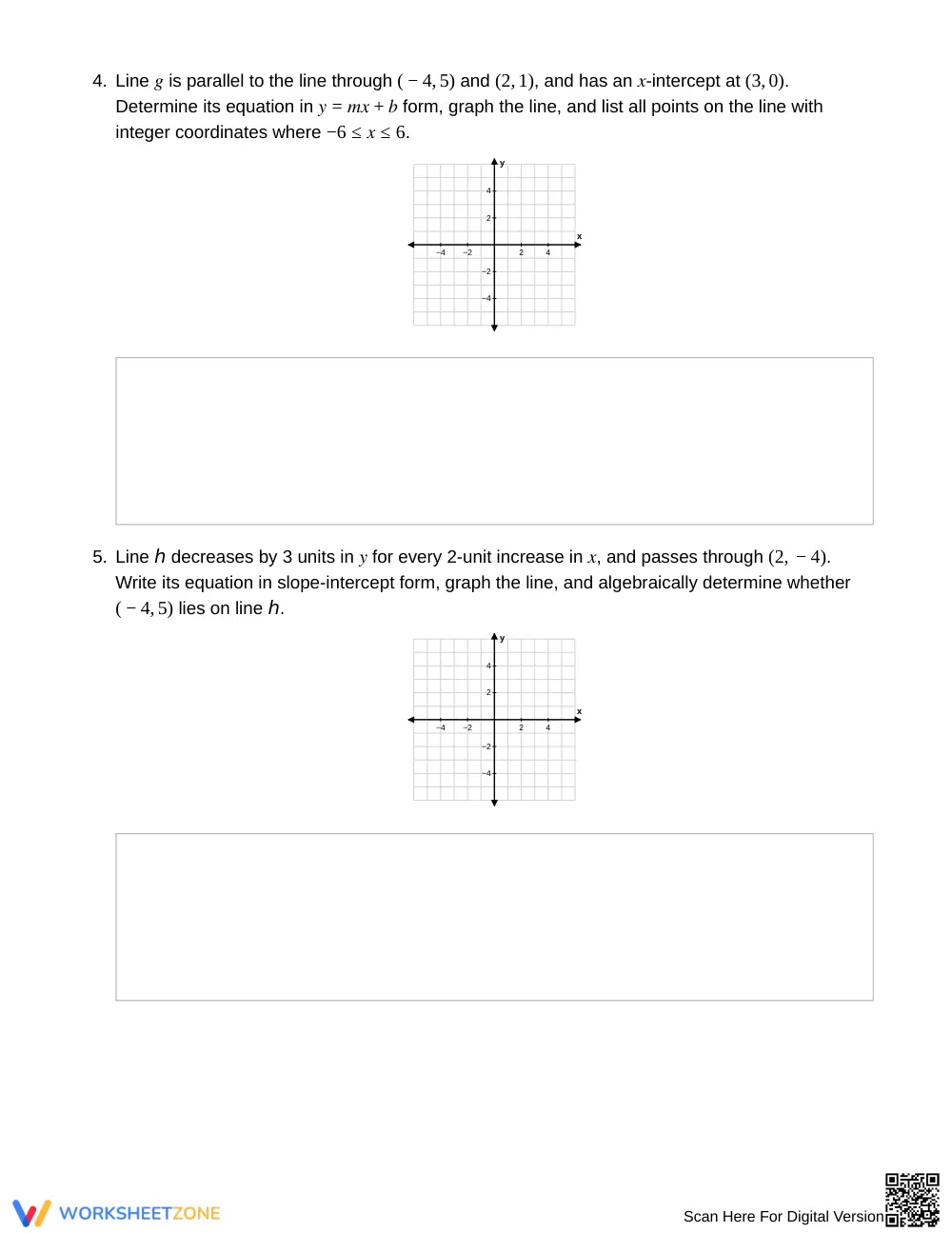
- Guided practice (Part A): 2 problems where students identify slope and intercept using parallel relationships and coordinate pairs, writing the equation and graphing the line.
- Supported practice (Part B): 3 multi-step problems requiring students to derive parameters from opposite slopes, y-intercept shifts, and constant rates while verifying coordinate solutions.
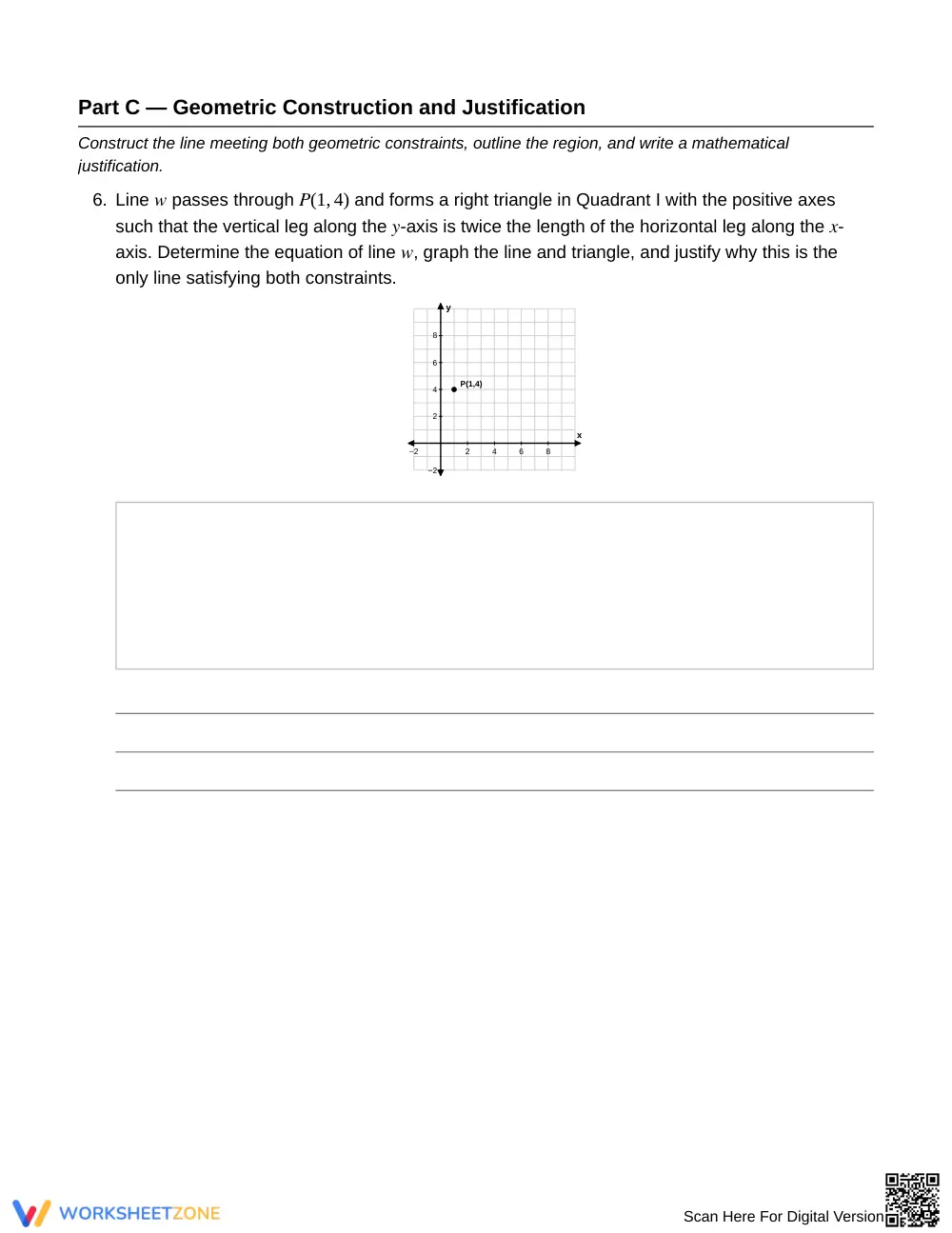
- Independent practice (Part C): 1 advanced geometric task prompting students to construct a right triangle from leg ratios and write a formal uniqueness justification.
This sequence supports the gradual-release model, transitioning learners smoothly from guided algebraic calculation to independent geometric reasoning.
Standards Alignment
This worksheet aligns with eighth-grade mathematics standards for linear functions and graphing. Students construct a function to model a linear relationship between two quantities, determine the rate of change and initial value from geometric descriptions, and interpret the equation y = mx + b as a straight line. Supporting standards address graphing proportional relationships and solving linear equations. Both standard codes can be copied directly into lesson plans, IEP goals, or district curriculum mapping tools.
How to Use It
Use this worksheet following direct instruction on slope-intercept form and parallel line slopes. Assign Part A for paired partner practice to verify computational mechanics before students tackle Part B independently. During work time, formatively check whether students correctly negate slopes in Part B versus taking reciprocal values. This activity requires approximately 40 to 50 minutes of instructional time.
Who It's For
This resource is designed for Grade 8 math and introductory Algebra I students practicing linear representations. Provide an anchor chart showing slope-intercept substitutions for students needing tier-two scaffolding. For higher-level differentiation, challenge students to extend the geometric triangle constraint in Part C into other quadrants.
According to Fisher & Frey (2014), structured instructional progression that moves systematically from guided constraint identification to independent mathematical justification significantly improves student problem-solving resilience. When eighth-grade math students encounter complex multi-step tasks requiring them to translate verbal constraints into slope-intercept form, scaffolding the initial parameter derivation helps prevent cognitive overload. By first practicing with parallel lines and intercept coordinates before tackling advanced geometric constructions, learners internalize how slope and initial values define unique linear graphs on the coordinate plane. Fisher & Frey emphasize that gradual-release frameworks provide students with the metacognitive stability needed to verify algebraic solutions against visual models. This 4-page worksheet implements those research findings across 6 targeted problems, giving middle school students the structured practice needed to master linear graphing, verify coordinate points, and justify geometric conditions with academic confidence.


