































Complete Trig Equations Worksheet | Grade 12 Precalculus

Paste this activity's link or code into your existing LMS (Google Classroom, Canvas, Teams, Schoology, Moodle, etc.).
Students can open and work on the activity right away, with no student login required.
You'll still be able to track student progress and results from your teacher account.
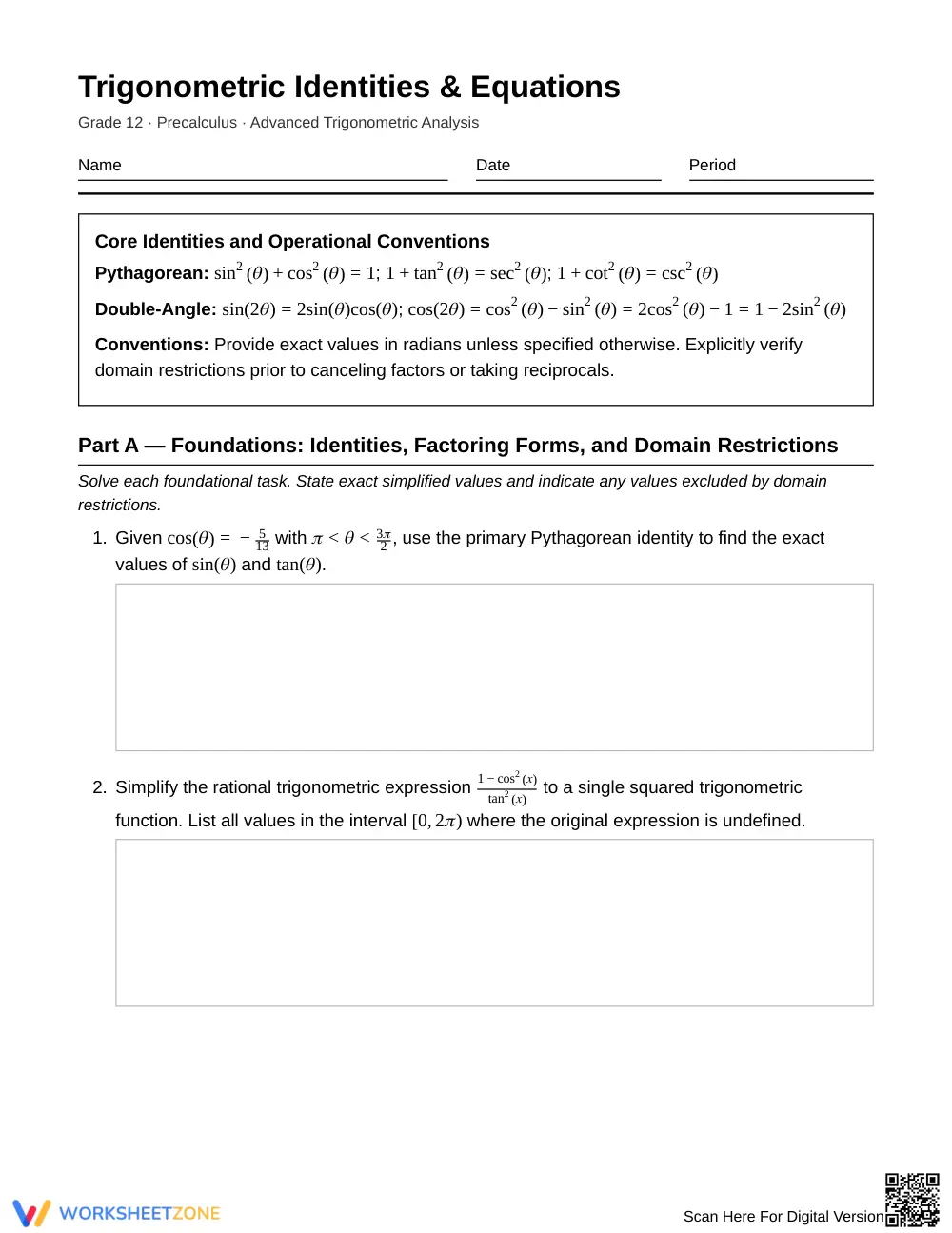
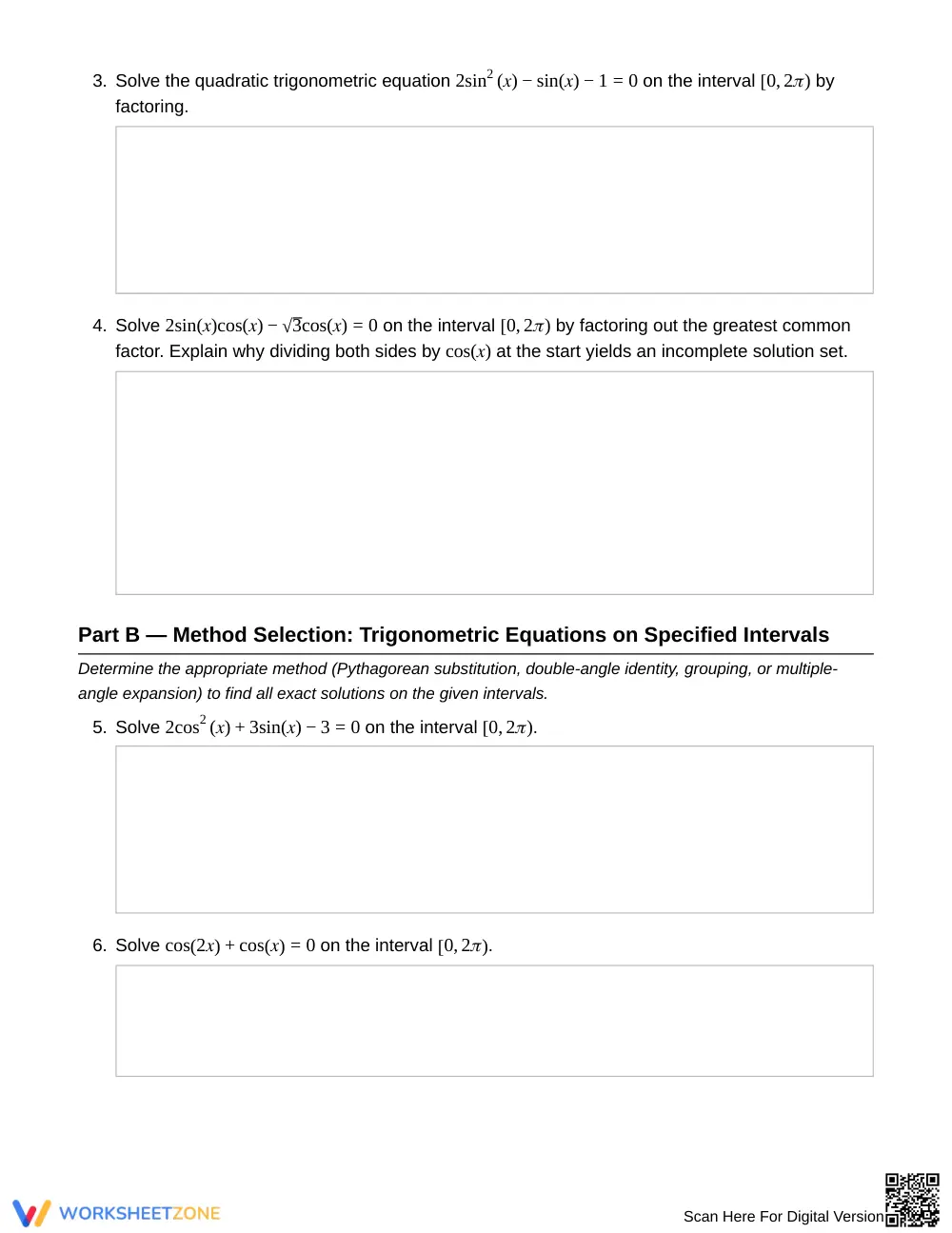
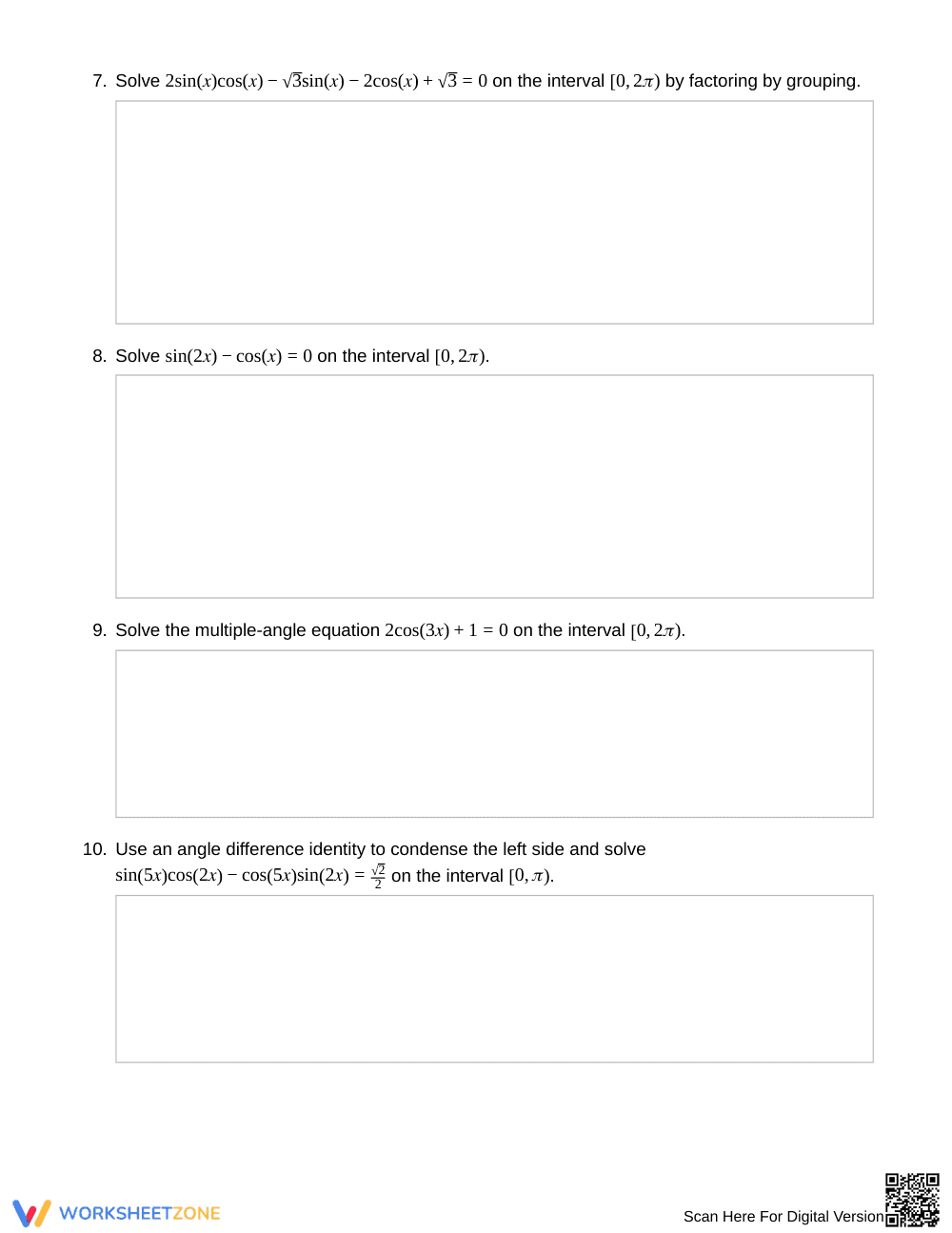
This Grade 12 Precalculus worksheet strengthens student mastery of trigonometric equations and identities. High school mathematicians apply Pythagorean identities, double-angle formulas, and factoring methods across 16 multi-step problems to simplify expressions, solve equations over specified intervals, and generate real general solution sets.
At a Glance
- Grade: 12 · Subject: Precalculus
- Standard: Advanced Trigonometry — Solve trigonometric equations using identities, factoring, and domain restrictions
- Skill Focus: Mix Identities, Factoring, and Equations
- Format: 5 pages · 16 problems · Answer key included · PDF
- Best For: Trigonometry unit assessment prep
- Time: 60–90 minutes
What's Inside
This 5-page worksheet includes a reference header of core Pythagorean and double-angle identities with domain conventions. Students solve quadratic trigonometric equations, apply grouping, perform multiple-angle expansions, and analyze optical intensity models. A 4-page answer key provides step-by-step solutions and extraneous root checks.
Skill Progression
- Guided Practice (Part A, Problems 1–4): Solves foundational tasks using Pythagorean substitutions, rational simplification, and quadratic factoring with explicit domain restriction checks.
- Supported Practice (Part B, Problems 5–12): Selects optimal methods including double-angle substitution, grouping, multiple-angle equations, and squaring techniques with mandatory extraneous root verification.
- Independent Practice (Part C, Problems 13–16): Applies combined techniques to model optical polarization filters, calculate curve intersections, critique algebraic claims, and express parameter-based general solution sets.
This gradual-release structure moves learners from core algebraic substitutions to independent structural analysis.
Standards Alignment
This resource aligns with advanced high school Precalculus standards for trigonometric functions. Students prove and apply identities to solve trigonometric equations and model periodic phenomena. Both standard codes can be copied directly into lesson plans, IEP goals, or district curriculum mapping tools.
How to Use It
Assign this worksheet following direct instruction on trigonometric identities to consolidate multi-step equation solving. During practice, check student work on Part B to ensure extraneous roots are eliminated after squaring. Use Part C for collaborative problem-solving. Expected completion time is 60 to 90 minutes across one to two class periods.
Who It's For
Designed for Grade 12 Precalculus and advanced trigonometry students preparing for calculus. Scaffolding supports differentiated review, while extension problems challenge advanced learners. Pair this worksheet with a unit circle reference sheet and identity proof lessons.
According to Fisher & Frey (2014), structured instructional progressions that move systematically from foundational procedural execution to independent conceptual evaluation generate measurable gains in secondary mathematics mastery. This Grade 12 Precalculus resource operationalizes this architecture by guiding learners through trigonometric identities, algebraic factoring, domain verification, and general solution modeling across 16 progressive tasks. By anchoring multi-step equation solving to core Pythagorean and double-angle properties before advancing to polarization models and error-critique tasks, the worksheet scaffolds complex symbolic reasoning. Empirical findings from Fisher & Frey indicate that deliberate sequencing paired with explicit domain verification and extraneous solution testing deepens conceptual retention and prepares high school students for postsecondary calculus coursework. The 4-page step-by-step answer key supports targeted formative evaluation, ensuring educators can efficiently diagnose procedural misconceptions and reinforce analytical rigor during upper-level mathematics instruction.


