


























Views
Downloads

Complete the Similes Printable Worksheet | Grade 3 ELA
Paste this activity's link or code into your existing LMS (Google Classroom, Canvas, Teams, Schoology, Moodle, etc.).
Students can open and work on the activity right away, with no student login required.
You'll still be able to track student progress and results from your teacher account.
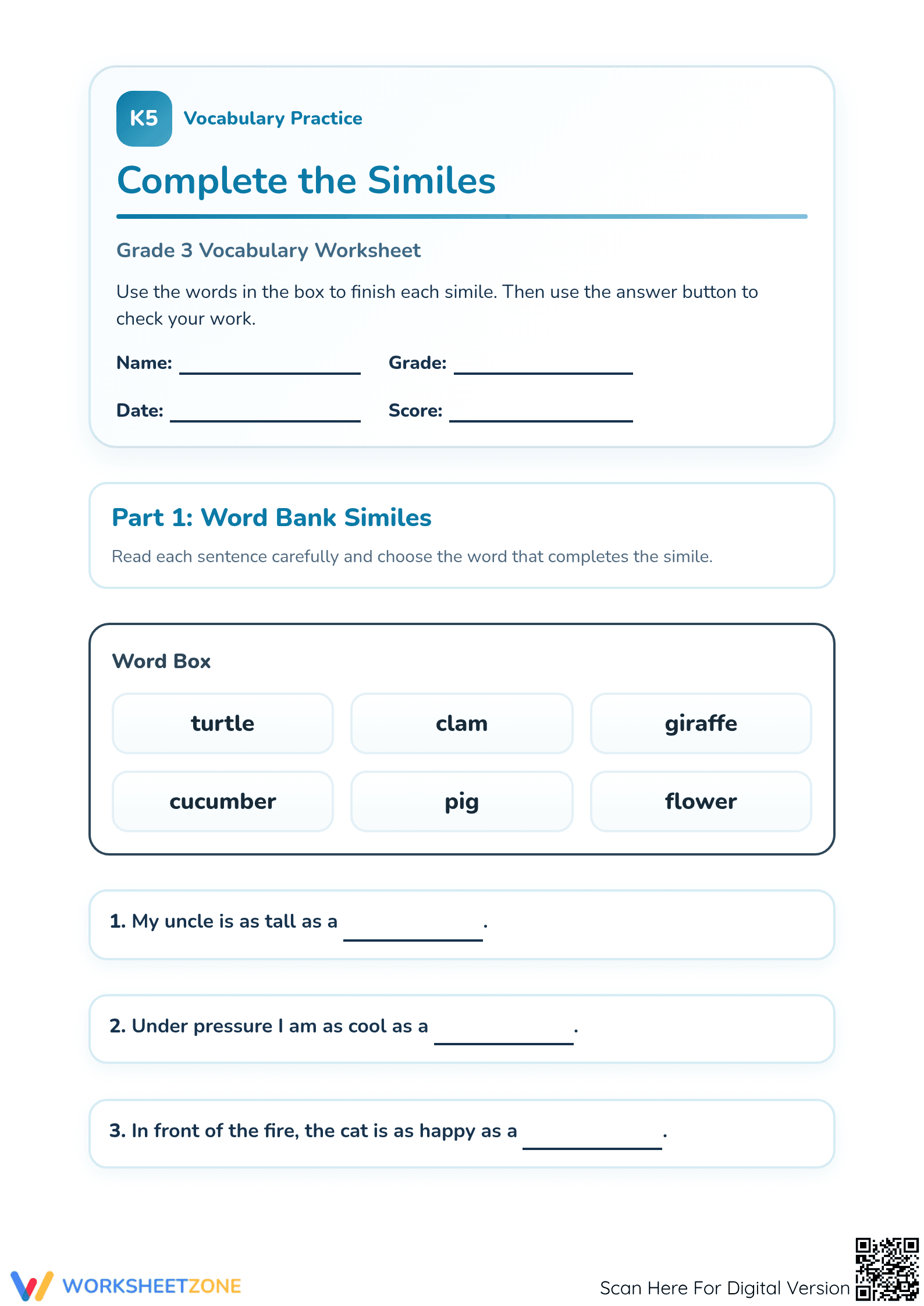
Mastering figurative language is a pivotal milestone for young writers as they transition from literal descriptions to expressive storytelling. This Grade 3 vocabulary worksheet focuses on similes, helping students identify and construct meaningful comparisons to enhance their descriptive writing. Students will practice matching attributes to common animals and objects to build linguistic fluency.
At a Glance
- Grade: 3 · Subject: English Language Arts (ELA)
- Standard:
CCSS.ELA-LITERACY.L.3.5— Demonstrate understanding of word relationships and nuances in word meanings- Skill Focus: Similes and comparative language
- Format: 3 pages · 10 problems · Answer key included · PDF
- Best For: Essential Grade 3 vocabulary and descriptive writing practice
- Time: 15–20 minutes of classroom time
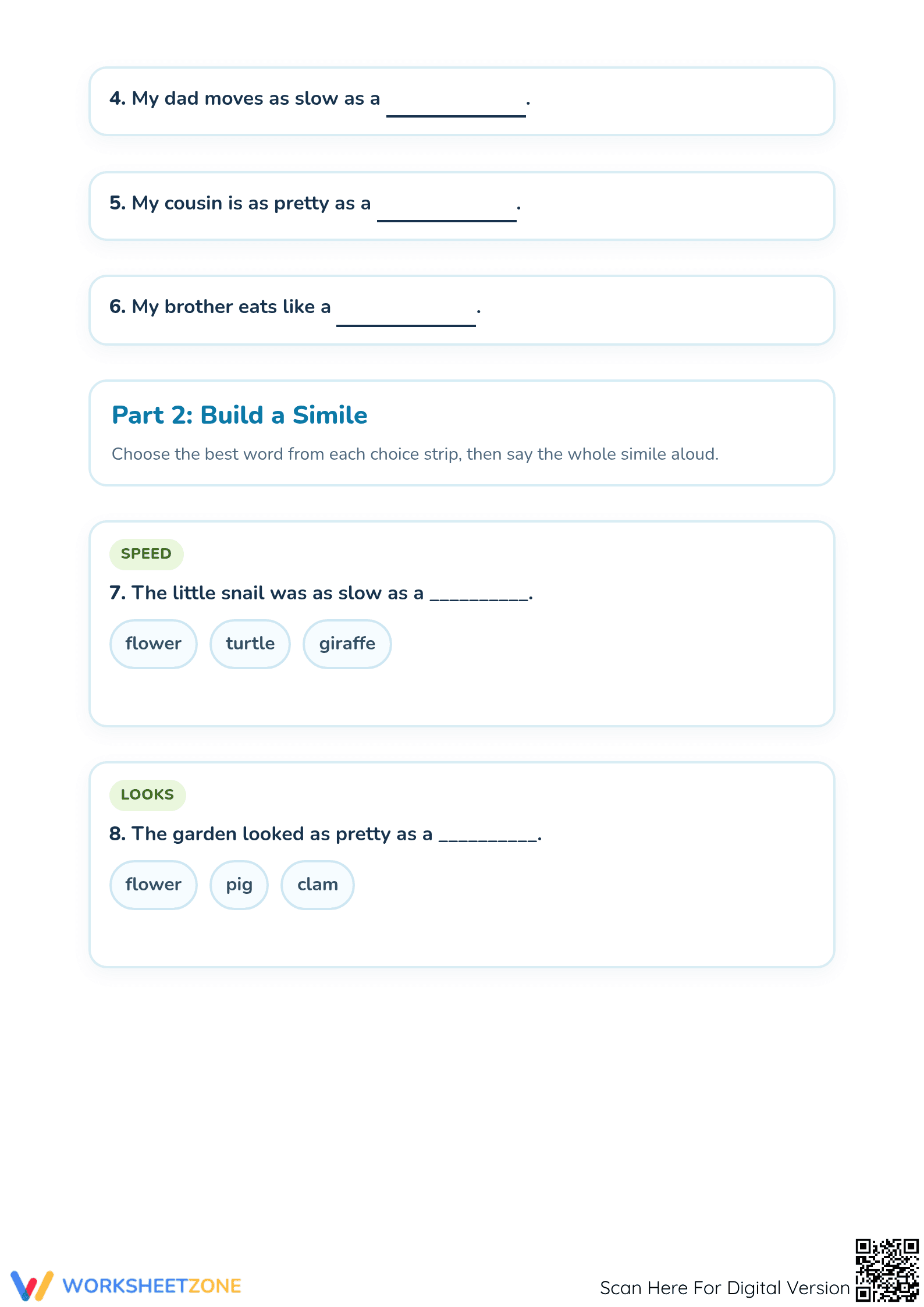
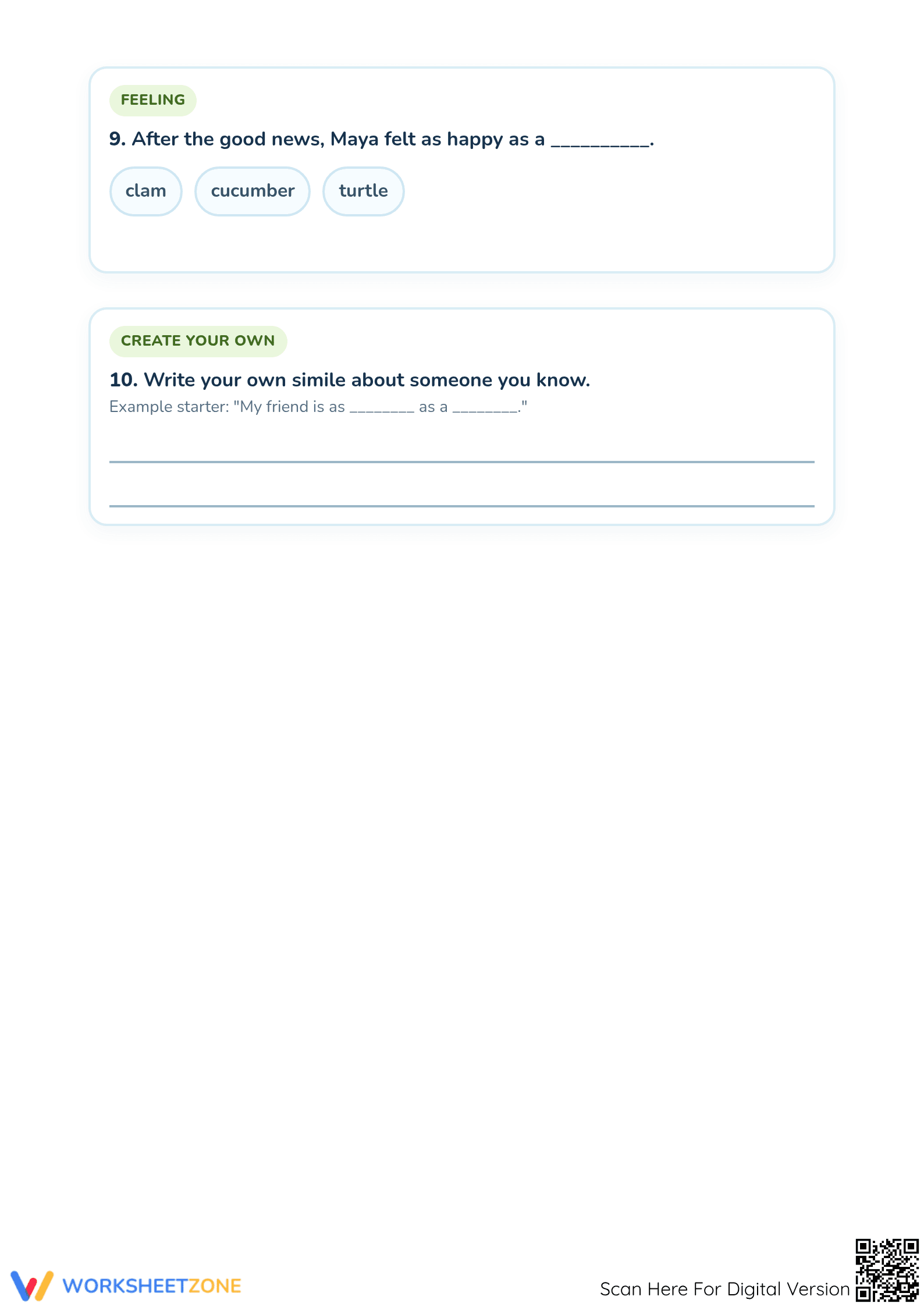
What's Inside: This comprehensive three-page PDF features 10 structured tasks designed to scaffold the concept of similes. The first section utilizes a helpful word bank to complete traditional comparisons, while the second section provides choice strips categorized by "Speed," "Looks," and "Feeling" to help students select the most appropriate noun. It concludes with a creative prompt where students write their own original simile.
Zero-Prep Workflow
- Print: Download and print enough copies for your class. This takes approximately 30 seconds of teacher time.
- Distribute: Pass out the three-page packets to students. No additional materials are required other than a pencil, keeping transitions under 1 minute.
- Review: Use the included answer key for immediate self-correction or a 10-minute whole-class review to discuss why certain comparisons work better than others.
Standards Alignment
This resource is aligned with CCSS.ELA-LITERACY.L.3.5, which requires students to demonstrate an understanding of word relationships and nuances in word meanings. Specifically, it addresses sub-standard A by helping learners distinguish the literal and nonliteral meanings of words and phrases. This standard code can be copied directly into lesson plans, IEP goals, or district curriculum mapping tools.
How to Use It
Use this worksheet as a "Bell Ringer" at the start of a writing block to prime student brains for descriptive language. Alternatively, it serves as an excellent formative assessment after a direct instruction lesson on figures of speech. Observe if students can explain the logic behind comparing "cool" to a "cucumber" to gauge their deep understanding of the attribute being highlighted.
Who It's For
This worksheet is ideal for third-grade general education students, but its clear structure also supports English Language Learners (ELL) who are developing an understanding of American idioms. Pair this with a descriptive passage or an anchor chart featuring common animal traits to provide a complete instructional loop for your learners.
Fisher & Frey (2014) emphasize the role of figurative language in developing complex literacy skills. This Grade 3 "Complete the Similes" worksheet targets CCSS.ELA-LITERACY.L.3.5 by requiring students to recognize and explain the relationship between objects in comparisons. By using familiar nouns like "turtle" or "cucumber" to represent abstract concepts like "slow" or "cool," learners build the cognitive bridges necessary for reading comprehension and descriptive authorship. The structured progression from a word bank to multiple-choice strips and finally to original creation ensures that students move beyond rote identification toward generative application. Research indicates that explicit instruction in nonliteral language significantly enhances a student's ability to decode nuances in text, making this an essential tool for elementary vocabulary development. This resource provides a focused, measurable way to assess student mastery of comparative figures of speech in real-time classroom settings.


