


























Views
Downloads



Printable Similes Worksheet | Grade 3 ELA Aligned
Paste this activity's link or code into your existing LMS (Google Classroom, Canvas, Teams, Schoology, Moodle, etc.).
Students can open and work on the activity right away, with no student login required.
You'll still be able to track student progress and results from your teacher account.
Mastering figurative language is a key milestone for young readers and writers transitioning toward complex texts. This Grade 3 Complete the Similes worksheet provides a structured environment for students to identify and create their own comparisons. By connecting abstract concepts to concrete imagery, learners enhance their descriptive writing and reading comprehension skills effectively.
At a Glance
- Grade: 3 · Subject: English Language Arts
- Standard:
CCSS.ELA-LITERACY.L.3.5.A— Distinguish literal and nonliteral meanings of words and phrases like similes- Skill Focus: Figurative Language & Similes
- Format: 3 pages · 11 problems · Answer key included · PDF
- Best For: Literacy centers and independent practice
- Time: 20–30 minutes
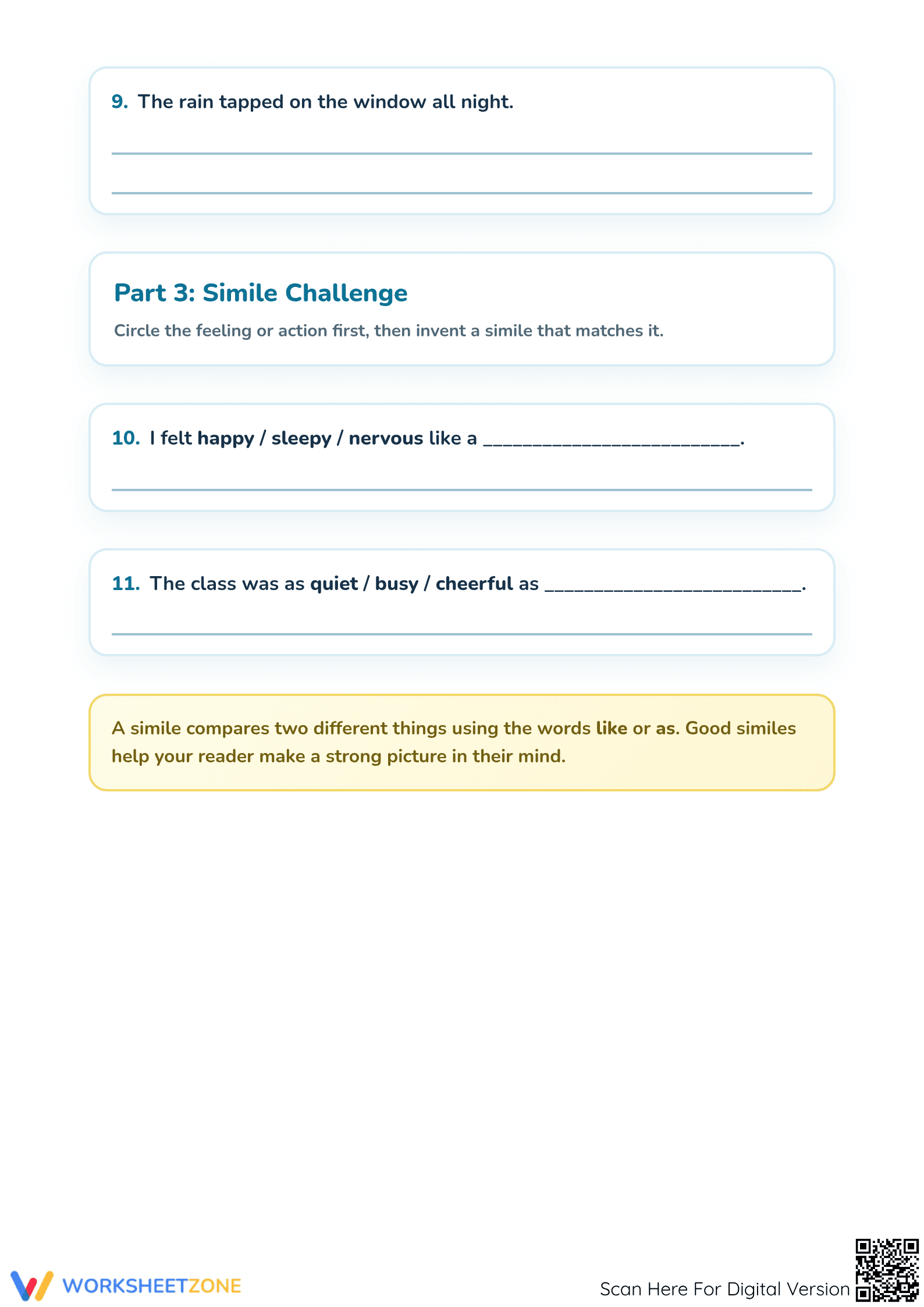
The three-page PDF packet contains three distinct sections designed to build confidence through varied task types. Part 1 features six fill-in-the-blank similes with a supporting word bank containing common animal and object comparisons. Part 2 moves toward application, requiring students to rewrite sentences using original similes. Part 3 offers a creative challenge where students circle specific feelings or actions and invent matching figurative phrases that demonstrate a deeper understanding of linguistic nuance.
Skill Progression
- Guided practice: Six cloze-style sentences use a scaffolded word bank to introduce classic comparisons such as "brave as a lion" or "clean as a whistle," ensuring students recognize standard idiomatic similes.
- Supported practice: Three open-ended prompts require students to take a basic sentence and inject color and imagery through original figurative comparisons, bridging the gap between recognition and creation.
- Independent practice: Two high-level challenge items ask students to self-select emotions or actions and generate entirely new similes to demonstrate conceptual mastery without any external cues.
This sequence follows a gradual-release model, moving from identification to creative application to ensure students internalize the mechanics of nonliteral language.
Standards Alignment
The resource aligns directly with `CCSS.ELA-LITERACY.L.3.5.A`: "Distinguish the literal and nonliteral meanings of words and phrases in context (e.g., similes)." Students learn that while a girl isn't literally a lion, the comparison conveys a specific characteristic. This standard code can be copied directly into lesson plans, IEP goals, or district curriculum mapping tools.
How to Use It
Use this worksheet during the independent practice phase of a lesson on descriptive language or as a reliable sub plan. It serves as an excellent formative assessment to check if students understand the relationship between two unlike things. Teachers should observe whether students can move beyond the provided word bank to create logical, vivid comparisons in the challenge section. The 20-30 minute completion time makes it an ideal fit for morning work or literacy centers.
Who It's For
This packet is ideal for third-grade general education classrooms, ELL students needing vocabulary support, and RTI groups focusing on language nuances. It pairs naturally with a mentor text that uses rich figurative language, allowing students to bridge reading analysis and their own writing practice.


