































Complete Systems Elimination Worksheet | Grade 11 Algebra II

Paste this activity's link or code into your existing LMS (Google Classroom, Canvas, Teams, Schoology, Moodle, etc.).
Students can open and work on the activity right away, with no student login required.
You'll still be able to track student progress and results from your teacher account.
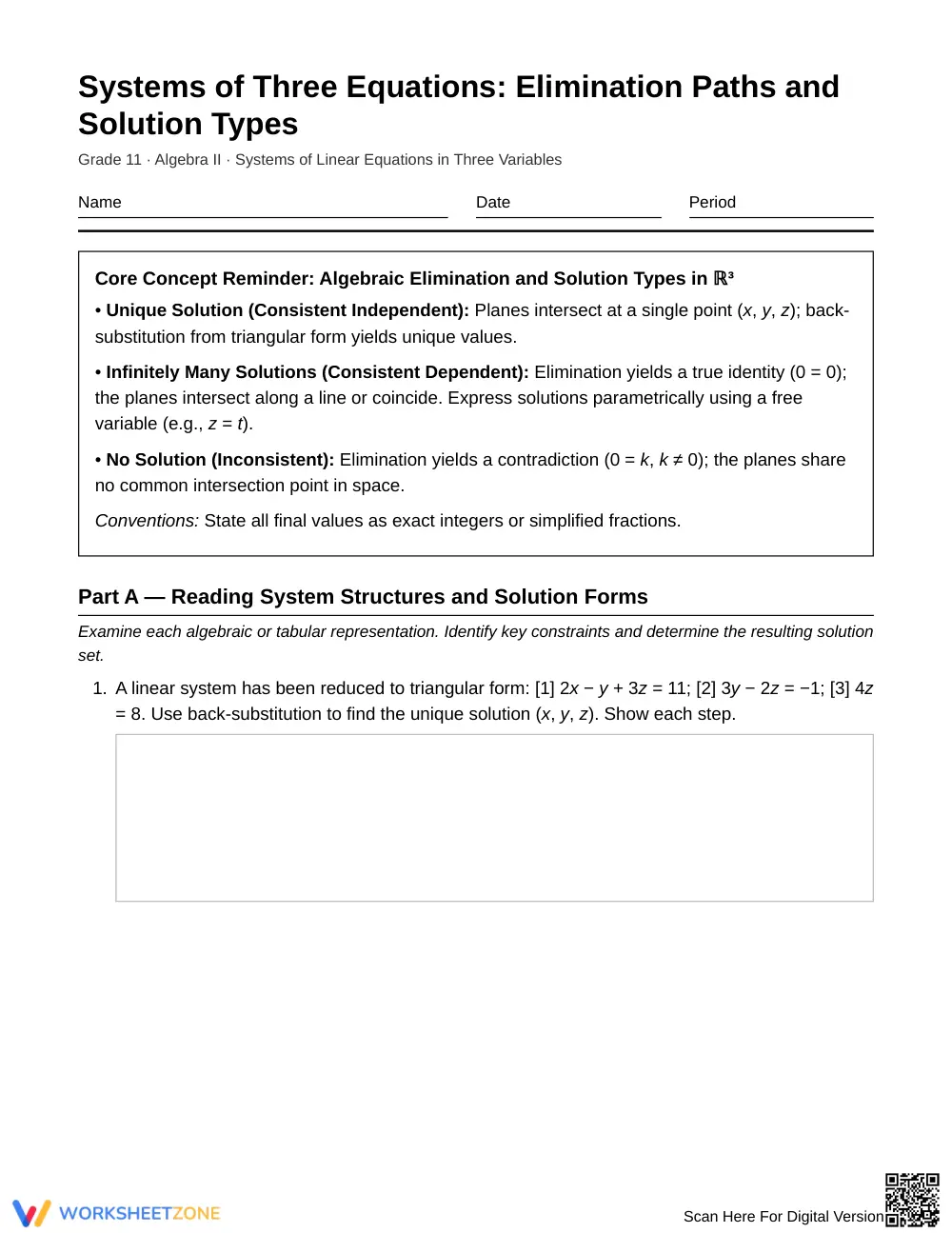
Mastering systems of three linear equations requires algebraic precision and strategic decision-making. This 5-page worksheet guides Grade 11 Algebra II students through 12 problems to compare elimination paths, evaluate matrix forms, and classify unique, dependent, and inconsistent systems.
At a Glance
- Grade: 11 · Subject: Algebra II
- Standard: Solve systems of three linear equations and classify solution sets
- Skill Focus: Compare Elimination Paths and Solution Types
- Format: 5 pages · 12 problems · Answer key included · PDF
- Best For: Advanced systems practice and strategic analysis
- Time: 45–60 minutes
Students complete 12 tasks across 5 pages, supported by a 3-page step-by-step answer key. Features include a concept reminder box detailing solution types in ℝ³, augmented matrix analysis, comparative path evaluation, linear dependency detection, and a traffic network conservation modeling problem.
Skill Progression
- Guided Practice (Part A): 3 structural tasks analyze triangular forms, row-reduced matrices, and geometric outcomes in three-dimensional space.
- Supported Practice (Part B): 6 multi-step problems prompt students to compare elimination pathways, utilize shortcuts, and identify parametric or inconsistent systems.
- Independent Practice (Part C): 3 conceptual tasks require students to refute geometric misconceptions, evaluate dimensional spaces, and model network flow.
This gradual release progression guides learners from structural interpretation to advanced comparative analysis.
Standards Alignment
This resource aligns with high school algebra standards for solving three-variable linear systems algebraically and interpreting solutions geometrically. Students represent dependent systems parametrically and identify inconsistent planes. Standard descriptions can be copied directly into lesson plans, IEP goals, or district curriculum mapping tools.
How to Use It
Use this worksheet after direct instruction on Gaussian elimination to build strategic fluency. In small groups, have students compare Path A versus Path B multipliers in Part B. As a formative assessment, check whether students identify dependent equations prior to full elimination. The 12-problem set is designed for a 45 to 60-minute instructional block.
Who It's For
Designed for Grade 11 Algebra II and Precalculus students advancing from two-variable systems to multi-variable algebra. It includes reference reminders for tiered support and advanced parametric extensions for honors learners. Pair this worksheet directly with 3D graphing utilities or direct instruction lessons on augmented matrices.
Strategic flexibility in high school algebra marks the transition from procedural execution to mathematical maturity. According to Fisher & Frey (2014), structured comparative analysis—where learners contrast alternate solution pathways and examine non-standard system outcomes—produces significantly deeper conceptual retention than single-path drills. This 12-problem worksheet operationalizes that framework by requiring eleventh-grade students to evaluate competing elimination sequences, interpret matrix row reductions, and characterize singular versus non-singular solution spaces in three dimensions. By demanding both algebraic back-substitution and geometric justification for inconsistent and dependent systems, the resource cements core competencies in linear systems analysis. Teachers receive an evidence-based instructional tool that develops structural fluency, reinforces mathematical argumentation, and systematically prepares secondary learners for advanced coursework in linear algebra and coordinate geometry.


