































Complete Survey Plan Review Worksheet | Grade 12 Statistics

Paste this activity's link or code into your existing LMS (Google Classroom, Canvas, Teams, Schoology, Moodle, etc.).
Students can open and work on the activity right away, with no student login required.
You'll still be able to track student progress and results from your teacher account.
This worksheet teaches Grade 12 Statistics students to evaluate a practical survey plan by judging sampling frames, random selection, random assignment, and nonresponse. Students work through two realistic study briefs and finish by defending feasible plans with calculations and statistical reasoning.
At a Glance
- Grade: 12 · Subject: Statistics
- Standard:
HSS-IC.B.3— Distinguish surveys, experiments, and observational studies and explain the role of randomization.- Skill Focus: Evaluating sampling plans and bias
- Format: 5 pages · 10 problems · Answer key included · PDF
- Best For: Sampling unit practice and review
- Time: 45–60 minutes
What's Inside
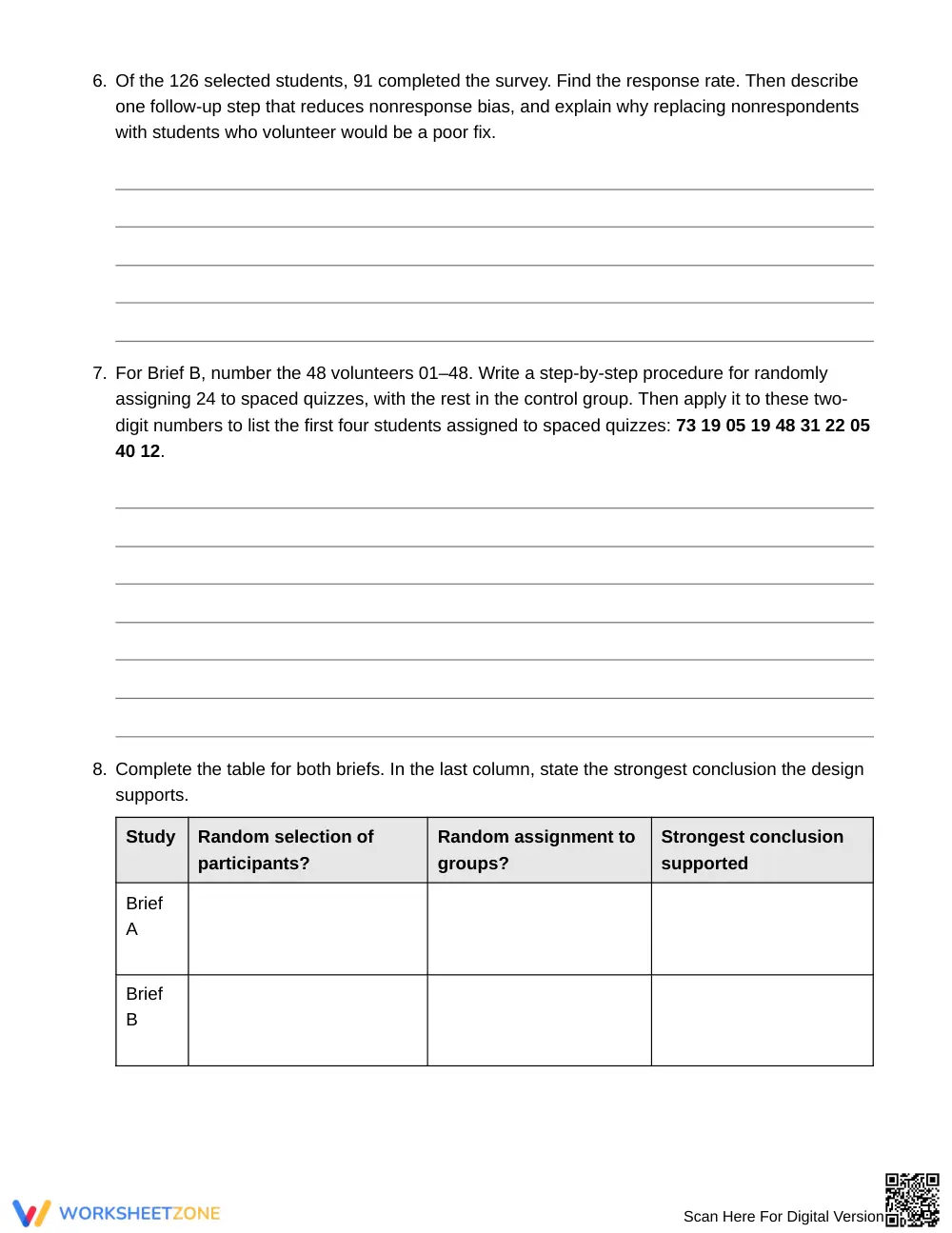
The 5-page PDF opens with a definitions box that sets rounding and random-digit rules. Two study briefs follow: a high school start-time survey and a spaced-quiz study. Ten tasks ask students to classify each study, choose a frame, select a simple random sample from digit groups, complete a proportional allocation table, compute a response rate, write a random assignment procedure, and compare both designs in a summary table. A 3-page answer key is included.
Skill Progression
- Guided practice (Part A, 2 tasks): Classify each study and name its population, frame, or participant group in complete sentences.
- Supported practice (Part B, 6 tasks): Calculate and decide with the definitions box, digit groups, and tables as scaffolds.
- Independent practice (Part C, 2 tasks): Defend a feasible plan using time budgets and a statistical reason.
The sequence follows gradual release: I Do, We Do, You Do.
Standards Alignment
HSS-IC.B.3 — Recognize the purposes of and differences among sample surveys, experiments, and observational studies; explain how randomization relates to each. This standard code can be copied directly into lesson plans, IEP goals, or district curriculum mapping tools.
How to Use It
- After direct instruction: Assign Parts A and B as in-class practice once random sampling and random assignment have been taught.
- Unit review: Assign Part C as a written defense before a quiz.
Formative tip: while students work, listen for whether they tie random selection to generalizing and random assignment to cause and effect. Expect 45–60 minutes.
Who It's For
Grade 12 Statistics and AP-prep students who can already compute proportions and probabilities. Students who need support can start with the definitions box and Part A. Pair it with a direct instruction lesson on sampling methods or a bias anchor chart.
HSS-IC.B.3 asks students to recognize the purposes of and differences among sample surveys, experiments, and observational studies and to explain how randomization relates to each. This Grade 12 Statistics worksheet applies that skill to two realistic briefs, a school start-time survey and a spaced-quiz experiment. Students identify the target population and sampling frame, select a simple random sample from digit tables, allocate a stratified sample, calculate response rate, and randomly assign volunteers to treatment groups. They then separate what random selection supports, generalizing to a population, from what random assignment supports, cause-and-effect conclusions. Gradual-release instruction, described by Fisher & Frey (2014), moves learners from modeled work to independent application, and the three-part structure here follows that sequence. The 5-page PDF includes 10 tasks and a 3-page answer key. Students justify each design choice with numbers.


