




























Views
Downloads



Complete Special Products Worksheet | Grade 9 Algebra I

Paste this activity's link or code into your existing LMS (Google Classroom, Canvas, Teams, Schoology, Moodle, etc.).
Students can open and work on the activity right away, with no student login required.
You'll still be able to track student progress and results from your teacher account.
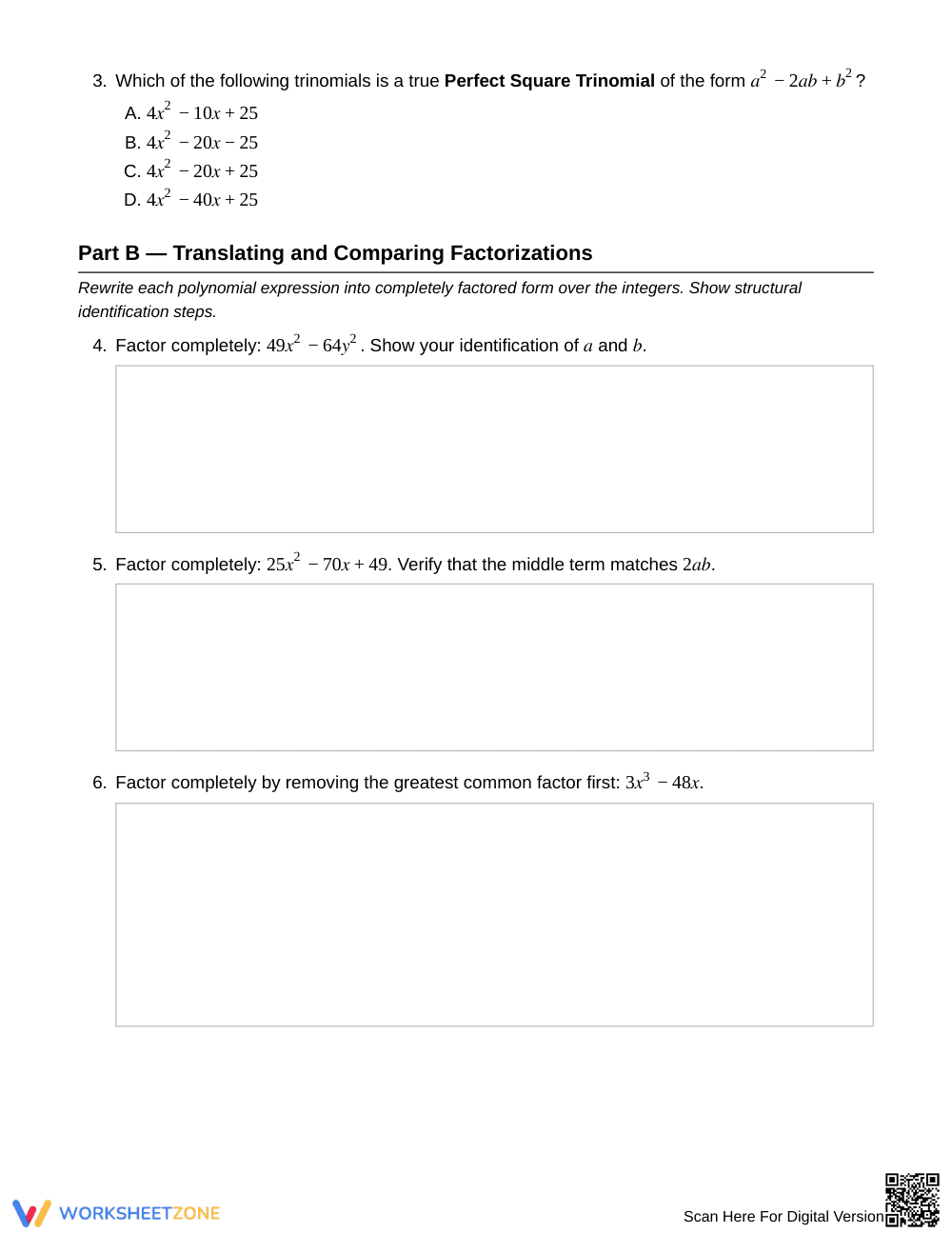
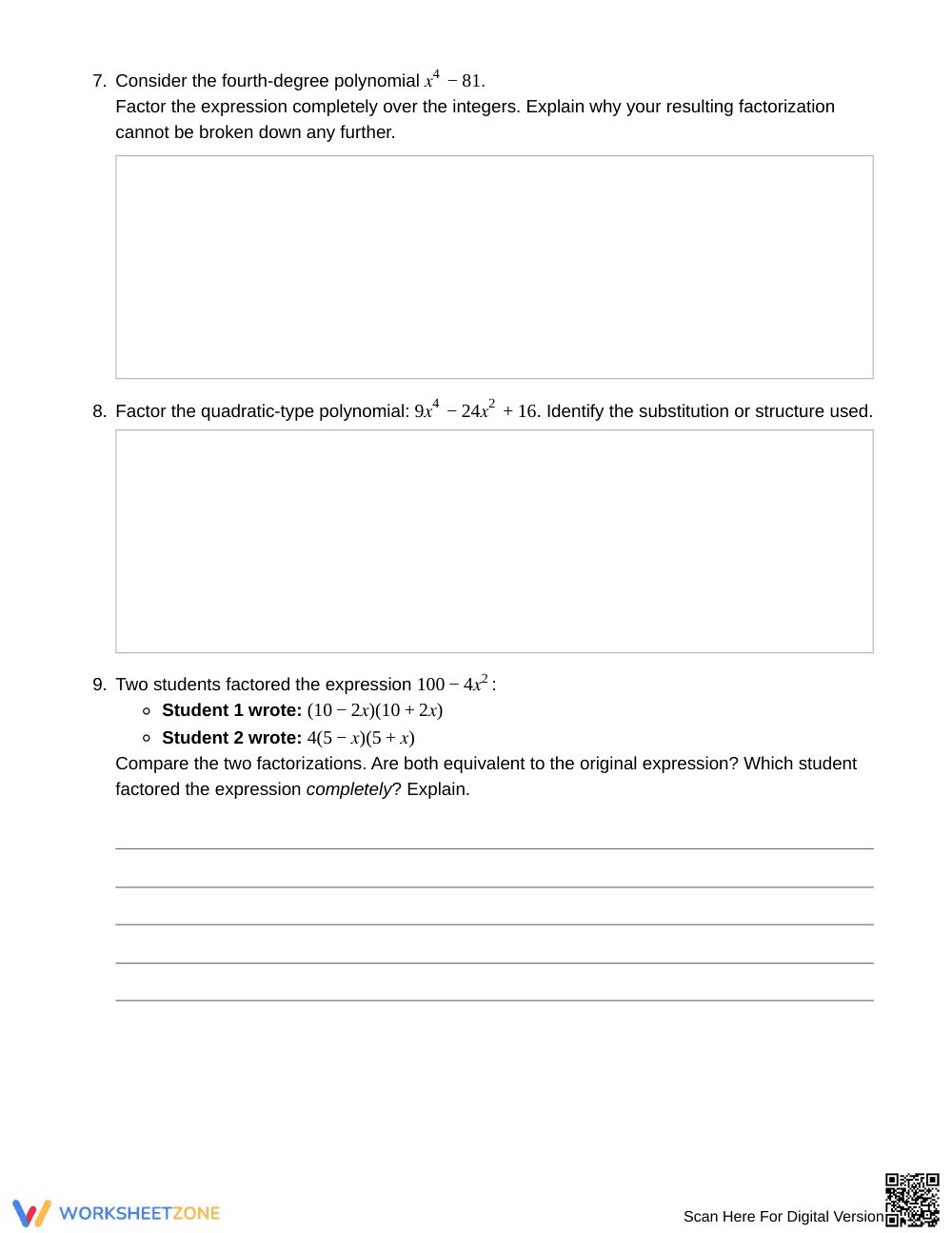
This Algebra I worksheet equips ninth-grade students to master special-product polynomial factorizations through structural analysis and comparative reasoning. Learners identify differences of squares, recognize perfect square trinomials, and differentiate factorable expressions from prime sums of squares. By breaking down algebraic identities, students develop fluency in factoring higher-degree polynomials and evaluating equivalence.
At a Glance
- Grade: 9 · Subject: Algebra I
- Standard:
HSA-SSE.A.2— Use polynomial structure to identify and factor special products- Skill Focus: Compare Special-Product Factorizations
- Format: 5 pages · 12 problems · Answer key included · PDF
- Best For: Independent practice and misconception review
- Time: 40–50 minutes
What's Inside
This 5-page printable resource delivers 12 rigorous tasks structured across three distinct phases. It opens with a foundational identity reference summarizing difference of squares and perfect square trinomials. Students encounter classification tables, multiple-choice structural checks, multi-step algebraic factorizations involving greatest common factors, and written error-analysis prompts, accompanied by a comprehensive 3-page answer key.
Skill Progression
- Guided practice (Problems 1–3): Students classify polynomials into structural categories and identify underlying parameters a and b using the reference formulas.
- Supported practice (Problems 4–9): Learners factor higher-degree binomials and trinomials over the integers, incorporating GCF extraction and quadratic substitutions.
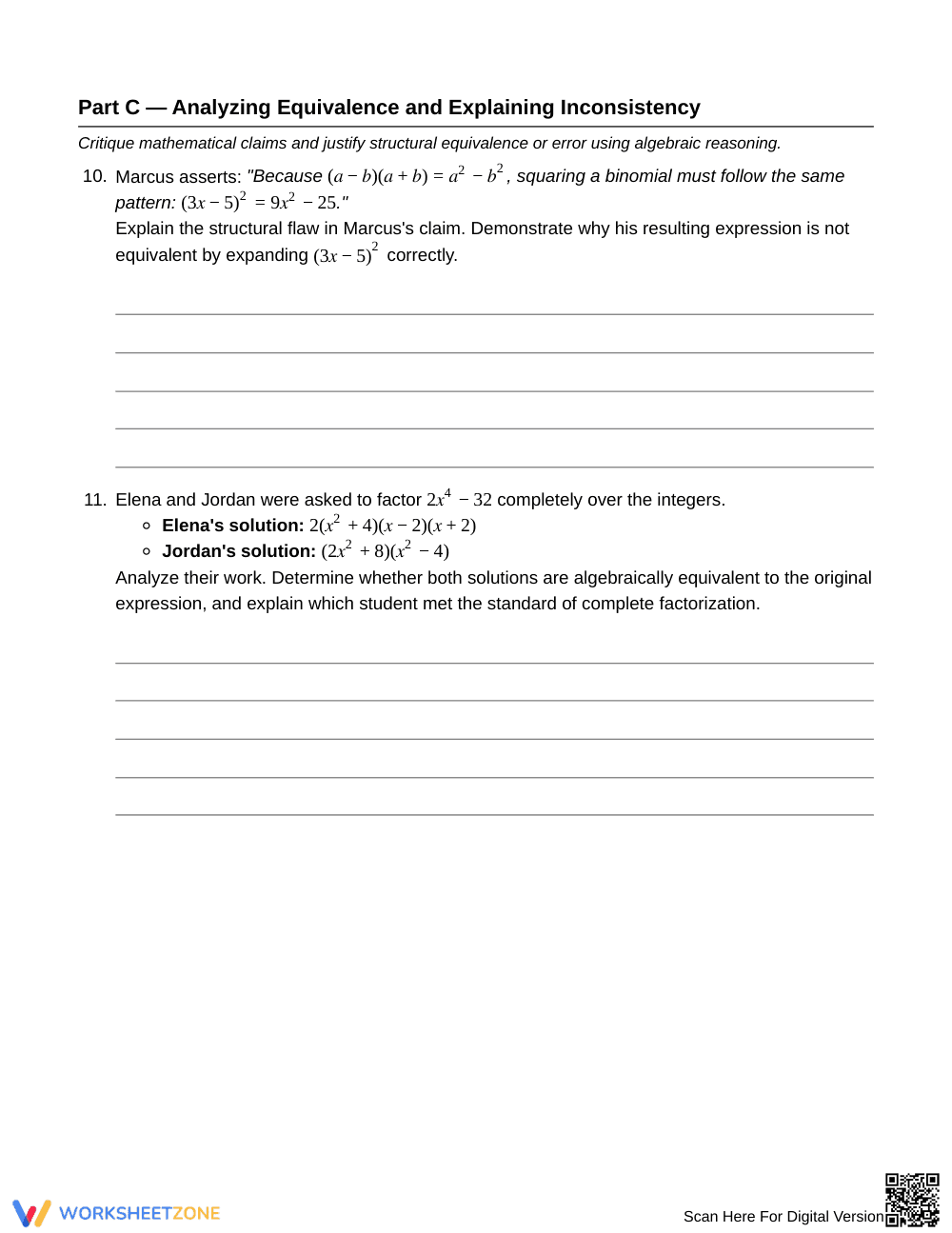
- Independent practice (Problems 10–12): Students analyze student claims, critique algebraic fallacies, and explain why expressions like sums of squares remain irreducible.
This sequence embodies the gradual release of responsibility model, shifting learners from classification to independent justification.
Standards Alignment
The primary standard addressed is `HSA-SSE.A.2`, which requires students to use the structure of an expression to identify ways to rewrite it. A supporting standard is `HSA-APR.A.1`, focusing on understanding polynomial operations. Both standard codes can be copied directly into lesson plans, IEP goals, or district curriculum mapping tools.
How to Use It
Deploy this worksheet after direct instruction on polynomial identities as targeted collaborative classwork or independent homework. During Part C, circulate to check whether students notice missing middle terms in binomial squaring errors. Expect completion within 40 to 50 minutes, using the included full solutions for immediate self-correction.
Who It's For
Designed for Grade 9 Algebra I students, this resource benefits on-level learners sharpening algebra fluency and advanced eighth graders tackling accelerated math. Pair it alongside an anchor chart of polynomial identities or a guided teacher demonstration on common factoring traps.
Under the common core standard HSA-SSE.A.2, high school algebra students must use polynomial structure to recognize equivalent algebraic forms and execute strategic factorizations. Comparing special products—specifically distinguishing differences of two squares from perfect square trinomials and prime sums of squares—requires systematic structural awareness rather than rote memorization. Research by Fisher & Frey (2014) emphasizes that shifting students from guided classification to independent justification and peer critique cements conceptual mathematical mastery. This instructional design incorporates that principle by pairing visual reference tables with multi-step algebraic translations and student error analyses. When learners evaluate why expressions like Marcus's squared binomial fail to preserve structural equivalence, they internalize algebraic properties and avoid predictable expansion errors. Through twelve targeted tasks across five pages, this resource systematically bridges foundational factoring rules and rigorous analytical reasoning, preparing ninth-grade algebra students for advanced quadratic functions.


