
































Complete Slope from Two Points Worksheet | Grade 8 Math

Paste this activity's link or code into your existing LMS (Google Classroom, Canvas, Teams, Schoology, Moodle, etc.).
Students can open and work on the activity right away, with no student login required.
You'll still be able to track student progress and results from your teacher account.
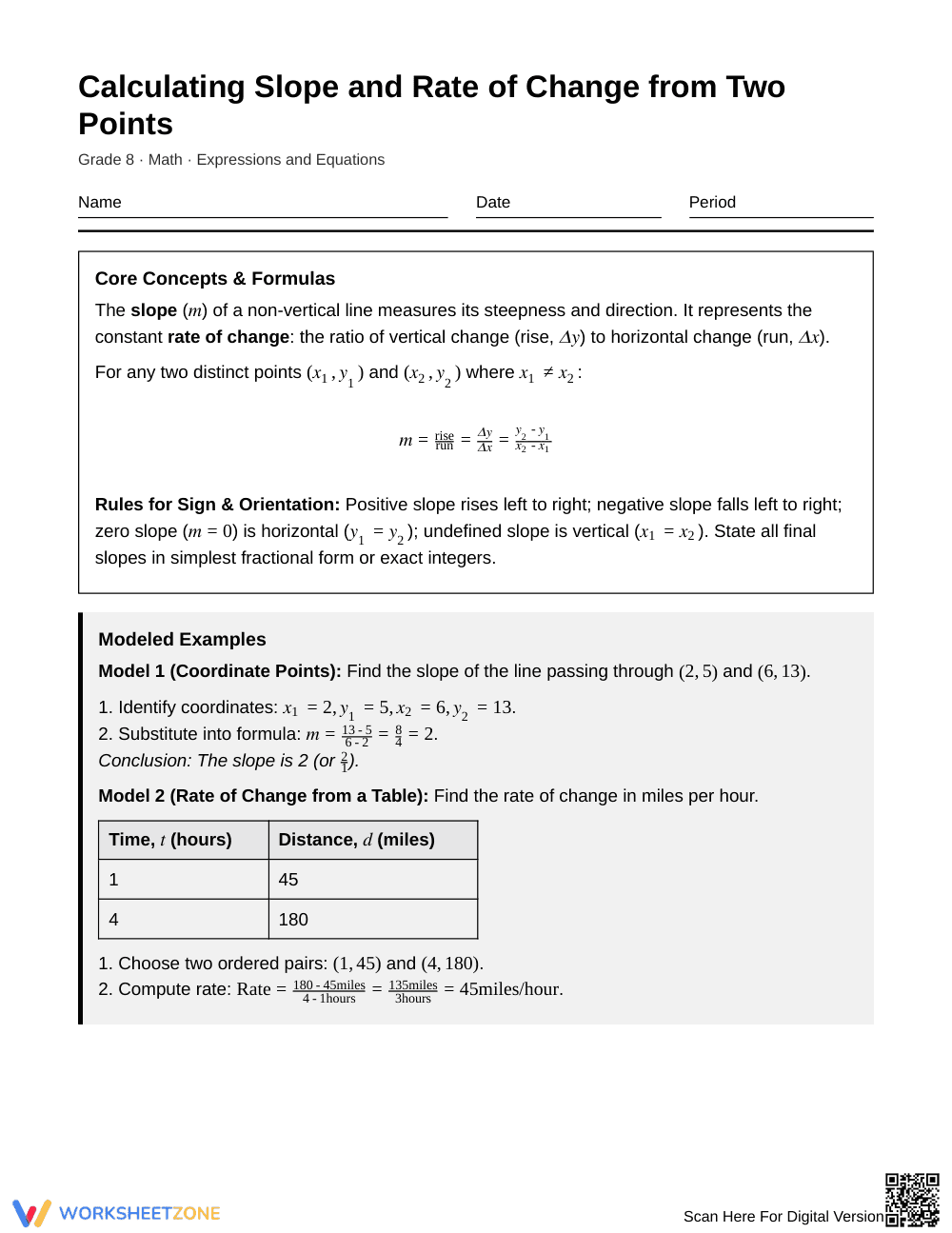
This Grade 8 math worksheet builds student mastery in calculating slope and constant rate of change across 12 targeted problems. Students learn to apply the slope formula, interpret vertical and horizontal lines, analyze data tables, and evaluate coordinate graphs. The resource moves from modeled examples to independent problem-solving and conceptual justification.
At a Glance
- Grade: 8 · Subject: Math
- Standard: Expressions and Equations — Calculate slope and rate of change between two coordinate points
- Skill Focus: Calculating slope from two points
- Format: 5 pages · 12 problems · Answer key included · PDF
- Best For: Guided practice, independent work, remediation
- Time: 35–45 minutes
What's Inside
This 5-page printable resource includes clear reference formulas, 2 step-by-step worked models, 12 student tasks, and a complete 3-page answer key with worked solutions. The worksheet features missing-step scaffolded equations, tabular data sets, coordinate plane graphs, real-world context prompts, and structured error analysis prompts to support deep procedural fluency.
Skill Progression
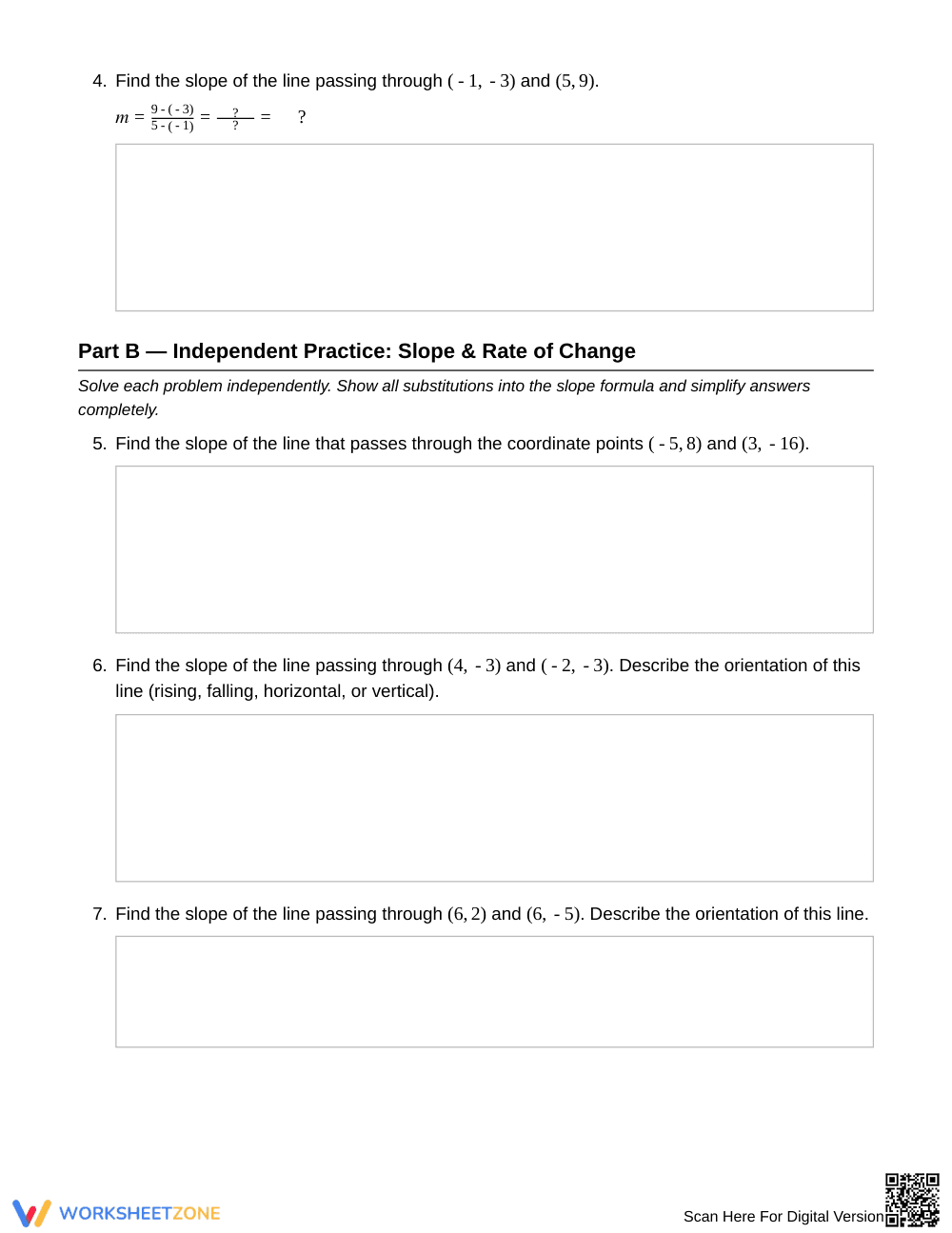
- Guided practice (Problems 1–4): Missing-step fill-ins that isolate coordinate substitution, negative integer operations, and fraction simplification.
- Supported practice (Problems 5–10): Independent computation across varied representations, including coordinate pairs, zero and undefined slopes, rate-of-change tables, and linear graphs.
- Independent mastery and analysis (Problems 11–12): Higher-order tasks requiring students to identify student calculation errors and algebraically justify point-order invariance.
This structured sequence follows the gradual-release framework, moving students systematically from structured modeling to autonomous problem solving.
Standards Alignment
This worksheet aligns directly with Grade 8 standards in Expressions and Equations, focusing on understanding the connections between proportional relationships, lines, and linear equations. Students interpret the slope of a line as a constant rate of change, derive slope using coordinate ratios, and translate between graphical, tabular, and algebraic forms. Standard descriptions can be copied directly into lesson plans, IEP goals, or district curriculum mapping tools.
How to Use It
Use this worksheet directly after introducing the slope formula during whole-class instruction, or assign it during small-group station rotations. As a formative assessment observation tip, monitor how students handle subtracting negative coordinates in Part A; sign errors are the primary roadblock to mastering linear rates. Students typically complete the 12 exercises in 35 to 45 minutes.
Who It's For
This resource is designed for Grade 8 mathematics students and early Algebra 1 learners developing foundational coordinate geometry skills. The built-in scaffolds support English language learners and students requiring tier-2 intervention, while Part C extends critical thinking for advanced learners. Pair this worksheet directly with an anchor chart on the four types of slope.
Mastering the calculation of slope from two points establishes the core mathematical foundation for linear algebra, function analysis, and real-world rate modeling in secondary mathematics. According to research on structured skill acquisition by Fisher & Frey (2014), instructional materials that transition from scaffolded, missing-step problem solving to independent conceptual justification significantly increase procedural accuracy and mathematical retention. This Grade 8 worksheet applies that evidence-based architecture across 12 carefully sequenced tasks, prompting students to calculate constant rate of change, evaluate zero and undefined slopes, and identify common algebraic sign errors. By combining coordinate pairs, data tables, visual graphs, and written error-analysis prompts, the resource reinforces conceptual understanding alongside procedural automaticity. Teachers and math specialists can deploy these structured exercises to evaluate student readiness, address misconceptions surrounding the slope ratio, and reinforce rigorous algebraic standards.


