

































Complete Sequences & Series Worksheet | Grade 11 Algebra II

Paste this activity's link or code into your existing LMS (Google Classroom, Canvas, Teams, Schoology, Moodle, etc.).
Students can open and work on the activity right away, with no student login required.
You'll still be able to track student progress and results from your teacher account.
This Sequences and Series worksheet equips Grade 11 Algebra II students to classify, write, and evaluate arithmetic and geometric sequences and series. Students progress from finding basic parameters to evaluating finite sums and modeling real-world depreciation and growth.
At a Glance
- Grade: 11 · Subject: Algebra II
- Standard:
HSF-BF.A.2— Write arithmetic and geometric sequences recursively and explicitly to model situations- Skill Focus: Arithmetic and geometric sequences, series, and summations
- Format: 5 pages · 16 problems · Answer key included · PDF
- Best For: Unit review and assessment prep
- Time: 45–60 minutes
What's Inside
This 5-page printable resource includes a formula reference box followed by 16 problems in three tiers. Students work with explicit and recursive representations, sigma notation, and applied word problems on seating capacity and depreciation. A full 3-page answer key provides step-by-step solutions for efficient grading.
Skill Progression
- Guided practice (Part A — 4 problems): Foundation tasks focus on classifying sequence types, identifying common difference d or ratio r, writing explicit rules, and calculating specific terms.
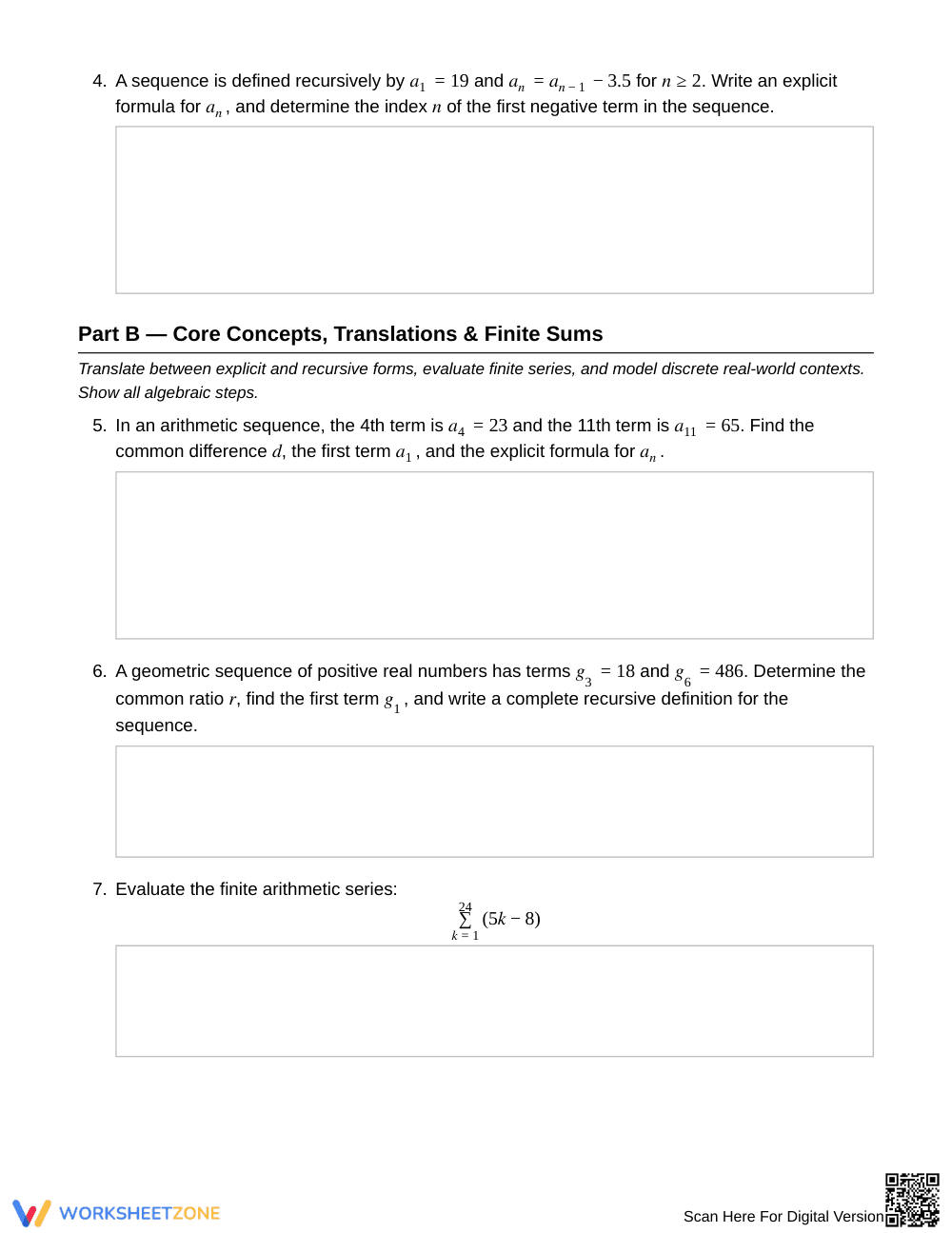
- Supported practice (Part B — 8 problems): Core exercises require translating between recursive and explicit forms, evaluating finite series with sigma notation, and modeling real-world scenarios.
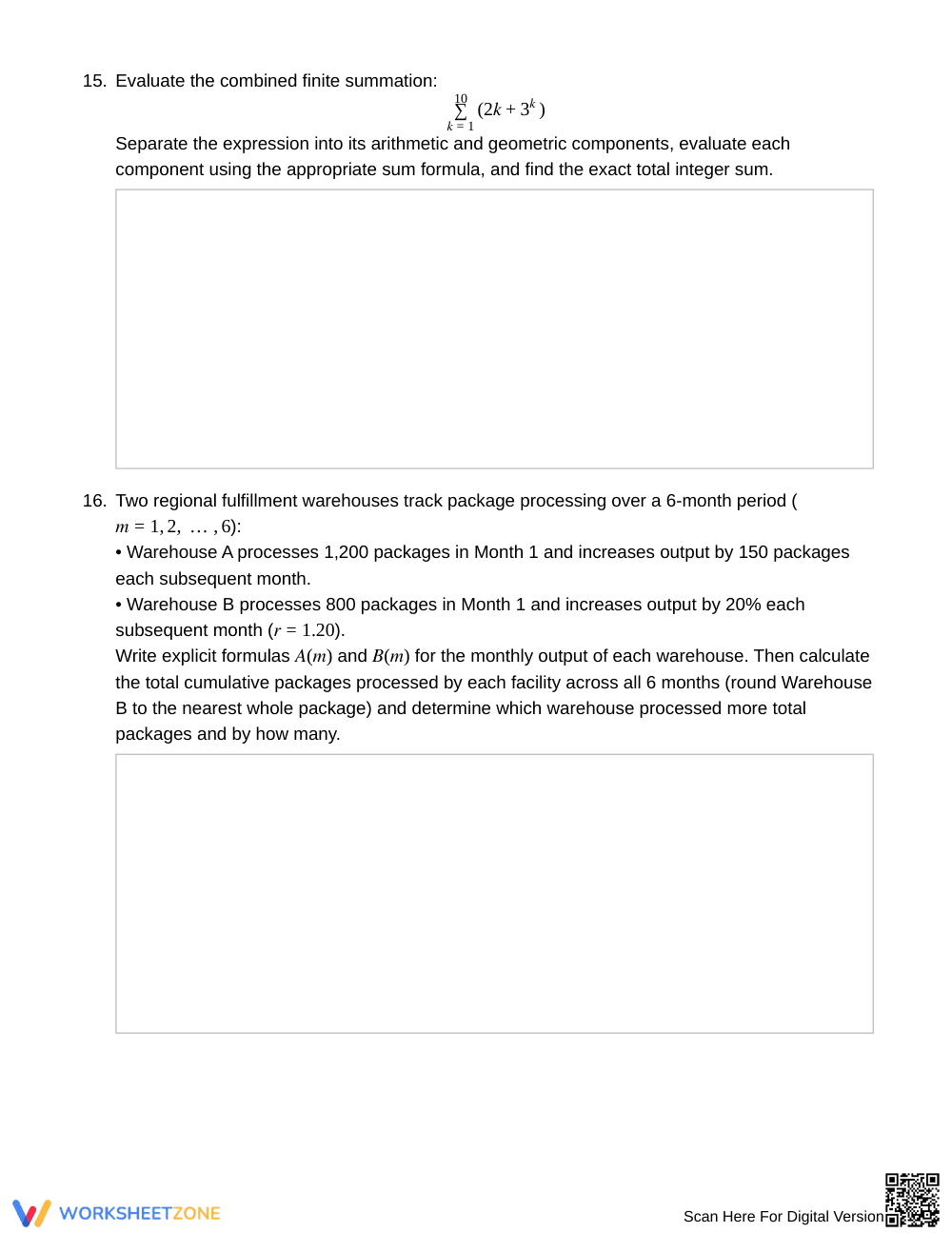
- Independent practice (Part C — 4 problems): Multi-step challenge problems demand solving for unknown term counts, working with variable sequence terms, evaluating combined summations, and comparing growth models.
This progression follows a gradual-release model, moving learners from formula application to unassisted multi-step problem-solving.
Standards Alignment
This worksheet aligns directly to `HSF-BF.A.2` by requiring students to write arithmetic and geometric sequences both recursively and explicitly to model situations. It also supports `HSA-SSE.B.4` through finite series summation formulas. Both standard codes can be copied directly into lesson plans, IEP goals, or district curriculum mapping tools.
How to Use It
Use this resource as a comprehensive unit review or summative assessment prep over 45–60 minutes. During classwork, check students' work on Part B sigma notation to quickly catch index or formula errors before they attempt Part C challenge problems.
Who It's For
Ideal for Grade 11 Algebra II students mastering discrete functions, this resource supports struggling students via formula reference boxes while challenging advanced learners with multi-step modeling. Pair this worksheet with a direct instruction lesson on series notation.
According to research by Fisher & Frey (2014) on structured instructional frameworks, student mastery of complex algebraic reasoning increases significantly when foundational procedures transition systematically into independent modeling applications. This Grade 11 Algebra II worksheet embodies that instructional principle by operationalizing standard HSF-BF.A.2, which requires learners to write and translate arithmetic and geometric sequences across explicit and recursive representations. Beginning with targeted parameter identification, the 16-task sequence advances through finite series summations to sophisticated multi-step systems modeling asset depreciation and comparative warehouse logistics. By integrating structured formula references with progressive analytical demands, the resource ensures high school mathematics students build conceptual fluency alongside procedural accuracy. Educators can deploy this 5-page curriculum-aligned artifact for targeted intervention, formative skill checks, or comprehensive summative review, providing verified evidence of student progression toward advanced secondary mathematics benchmarks and state college-and-career readiness indicators.


