




























Views
Downloads


Complete Sequence Tables Worksheet | Grade 11 Algebra II

Paste this activity's link or code into your existing LMS (Google Classroom, Canvas, Teams, Schoology, Moodle, etc.).
Students can open and work on the activity right away, with no student login required.
You'll still be able to track student progress and results from your teacher account.
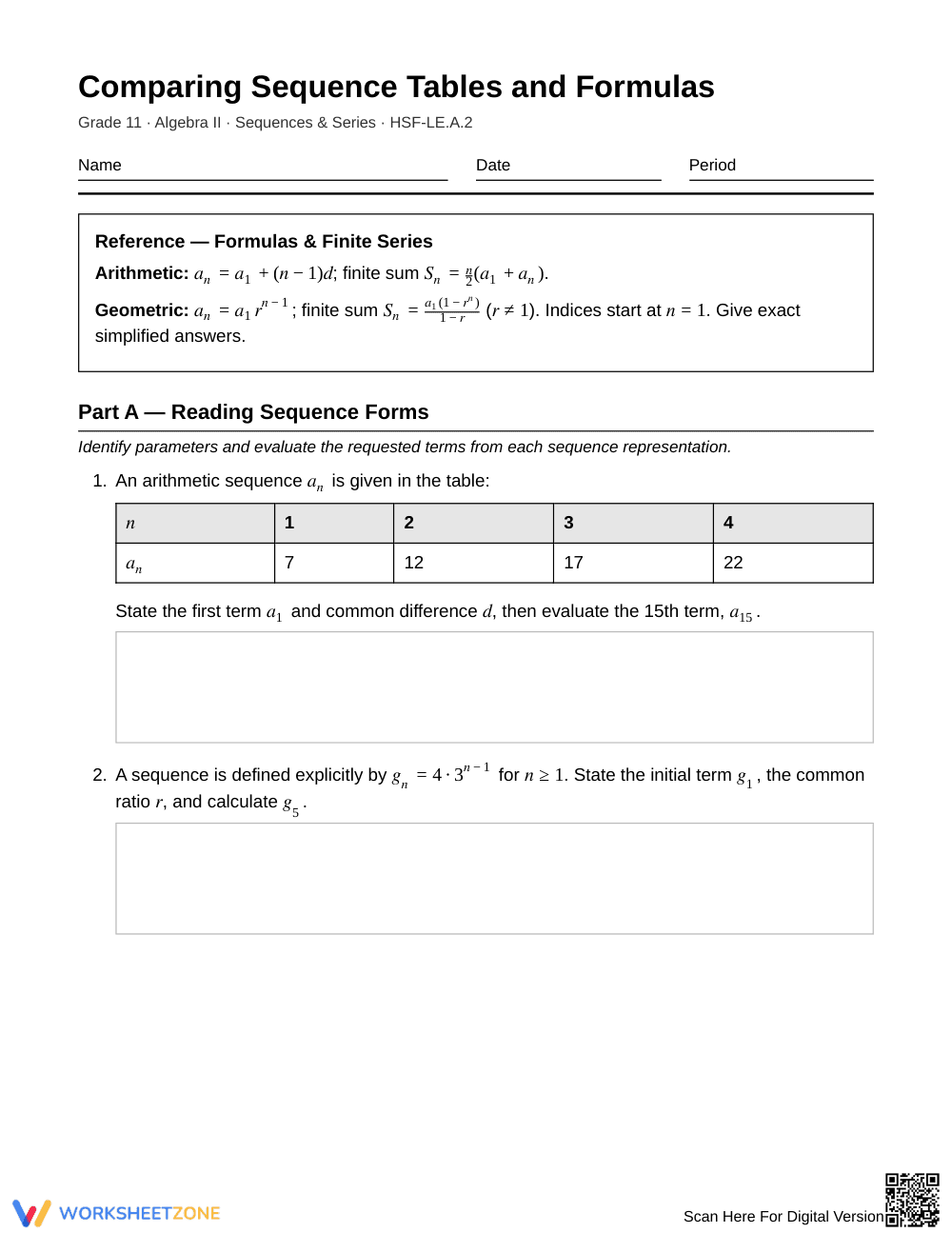
This Grade 11 Algebra II worksheet helps students master the connection between sequence tables, explicit formulas, and recursive equations. Learners evaluate arithmetic and geometric patterns, convert between distinct representations, and calculate finite series sums. By examining tabular outputs alongside algebraic rules, students develop fluency in modeling linear and exponential relationships across mathematical contexts.
At a Glance
- Grade: 11 · Subject: Algebra II
- Standard:
HSF-LE.A.2— Construct arithmetic and geometric sequences from tables and algebraic descriptions- Skill Focus: Compare Sequence Tables and Formulas
- Format: 5 pages · 12 problems · Answer key included · PDF
- Best For: High school sequence and series practice
- Time: 40–50 minutes
What's Inside
The 5-page PDF features 12 multi-step sequence tasks accompanied by a reference box containing explicit, recursive, and finite series sum formulas. Students work through data tables, recursive notation, and real-world modeling problems. A complete 2-page answer key provides worked step-by-step solutions, parameter values, and formula verifications for rapid evaluation.
Skill Progression
- Guided practice: Part A provides 3 entry-level tasks where students identify starting parameters and common differences or ratios directly from tables and explicit rules.
- Supported practice: Part B presents 6 intermediate problems requiring learners to translate between forms, compare growth rates, calculate finite sums, and model real-world data like runner distances.
- Independent practice: Part C challenges students with 3 high-level analytical tasks evaluating student errors, proving algebraic equivalence, and correcting index mismatch in dampening models.
This structured layout follows an intentional gradual-release framework, moving learners smoothly from initial parameter identification to rigorous error analysis.
Standards Alignment
This resource aligns directly with HSF-LE.A.2: Construct linear and exponential functions, including arithmetic and geometric sequences, given a graph, a description of a relationship, or two input-output pairs. Additionally, it supports HSF-BF.A.2 by requiring students to write arithmetic and geometric sequences both recursively and with an explicit formula. Both standard codes can be copied directly into lesson plans, IEP goals, or district curriculum mapping tools.
How to Use It
Use this worksheet after direct instruction on arithmetic and geometric series formulas to reinforce algebraic representation shifts. It functions effectively during mid-unit collaborative stations or as a targeted review before summative testing. For formative assessment, observe whether students check index boundaries when writing explicit exponential terms (such as differentiating between exponent n and n minus 1). The entire activity requires approximately 40 to 50 minutes of instructional time.
Who It's For
This worksheet is designed for Grade 11 Algebra II and Integrated Math III students learning discrete mathematics. Scaffolded reference formulas support struggling learners who need quick parameter reminders, while Part C offers built-in depth for advanced students. Pair this activity with an introductory anchor chart illustrating linear versus exponential growth tables.
Aligning with standard HSF-LE.A.2, this resource equips high school students to construct, compare, and translate arithmetic and geometric sequences between tables, recursive rules, and explicit equations. Research from Fisher & Frey (2014) highlights that structured progression models—scaffolding from guided parameter identification through collaborative problem-solving and error analysis—substantially improve mathematical concept retention and procedural fluency. By contrasting linear additive differences with exponential multiplicative ratios across 12 targeted tasks, learners develop the foundational reasoning required for higher-level series analysis and precalculus functions. The included real-world application tasks and algebraic proof items bridge concrete numerical data with abstract algebraic representations. Furthermore, requiring students to analyze conflicting student claims deepens conceptual understanding. Instructors can deploy this comprehensive worksheet to evaluate student mastery, resolve common starting-index misconceptions, and support rigorous standards implementation across all instructional tiers.


