


























Views
Downloads

Complete Sequence Limits Worksheet | Grade 12 Precalculus
Paste this activity's link or code into your existing LMS (Google Classroom, Canvas, Teams, Schoology, Moodle, etc.).
Students can open and work on the activity right away, with no student login required.
You'll still be able to track student progress and results from your teacher account.
This Grade 12 Precalculus worksheet confronts sequence convergence misconceptions, targeting the false assumption that limits must be reached terms or strict bounds. Through 10 analytical error-repair tasks, students critique flawed reasoning, identify theoretical fallacies, and write rigorous mathematical justifications describing true limiting behavior across sequences and infinite series.
At a Glance
- Grade: 12 · Subject: Precalculus
- Standard: Advanced Mathematics — Analyze sequence convergence and evaluate limiting behavior
- Skill Focus: Correct Limit-Is-a-Reached-Term Claims
- Format: 5 pages · 10 problems · Answer key included · PDF
- Best For: Error repair and conceptual review
- Time: 40–50 minutes
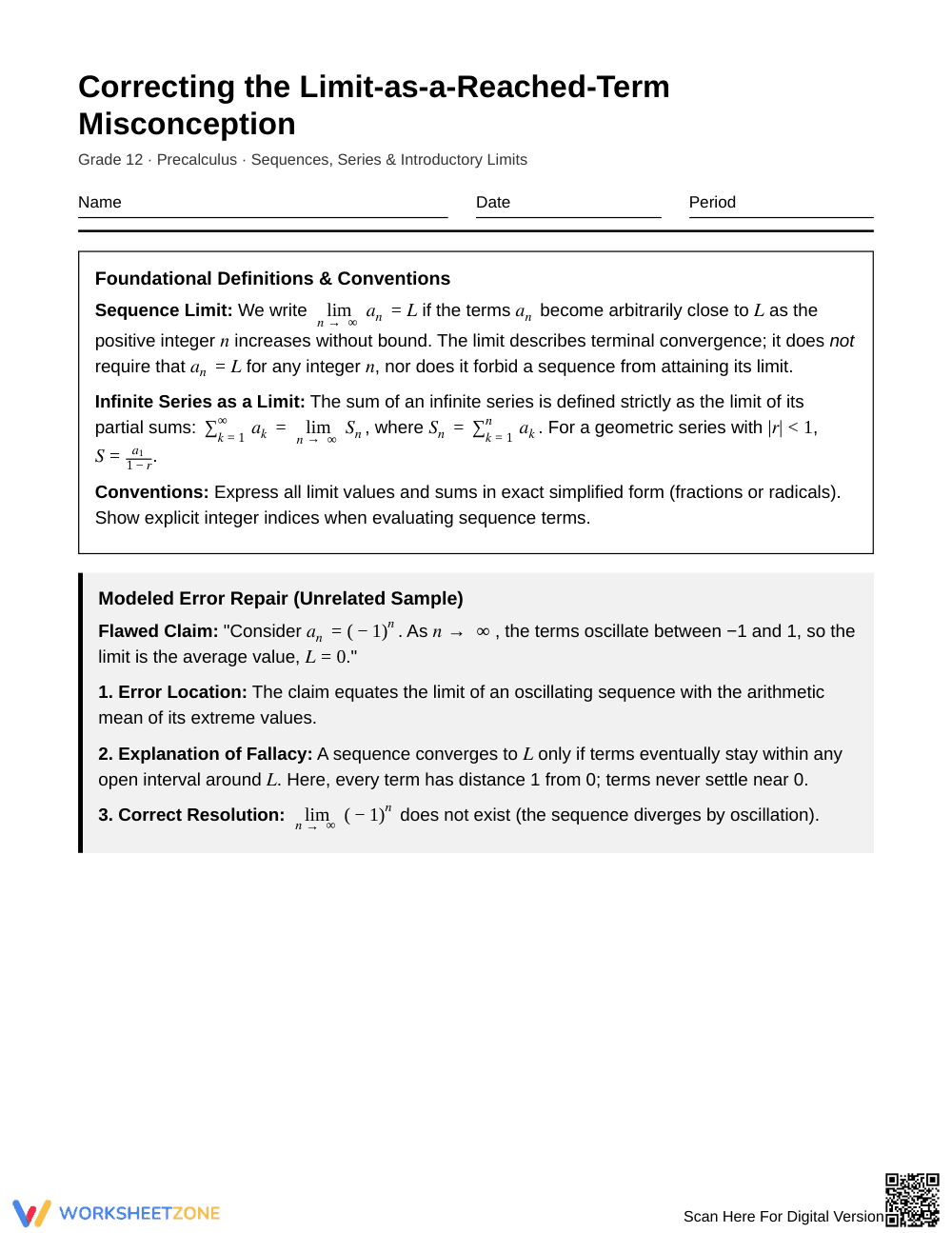
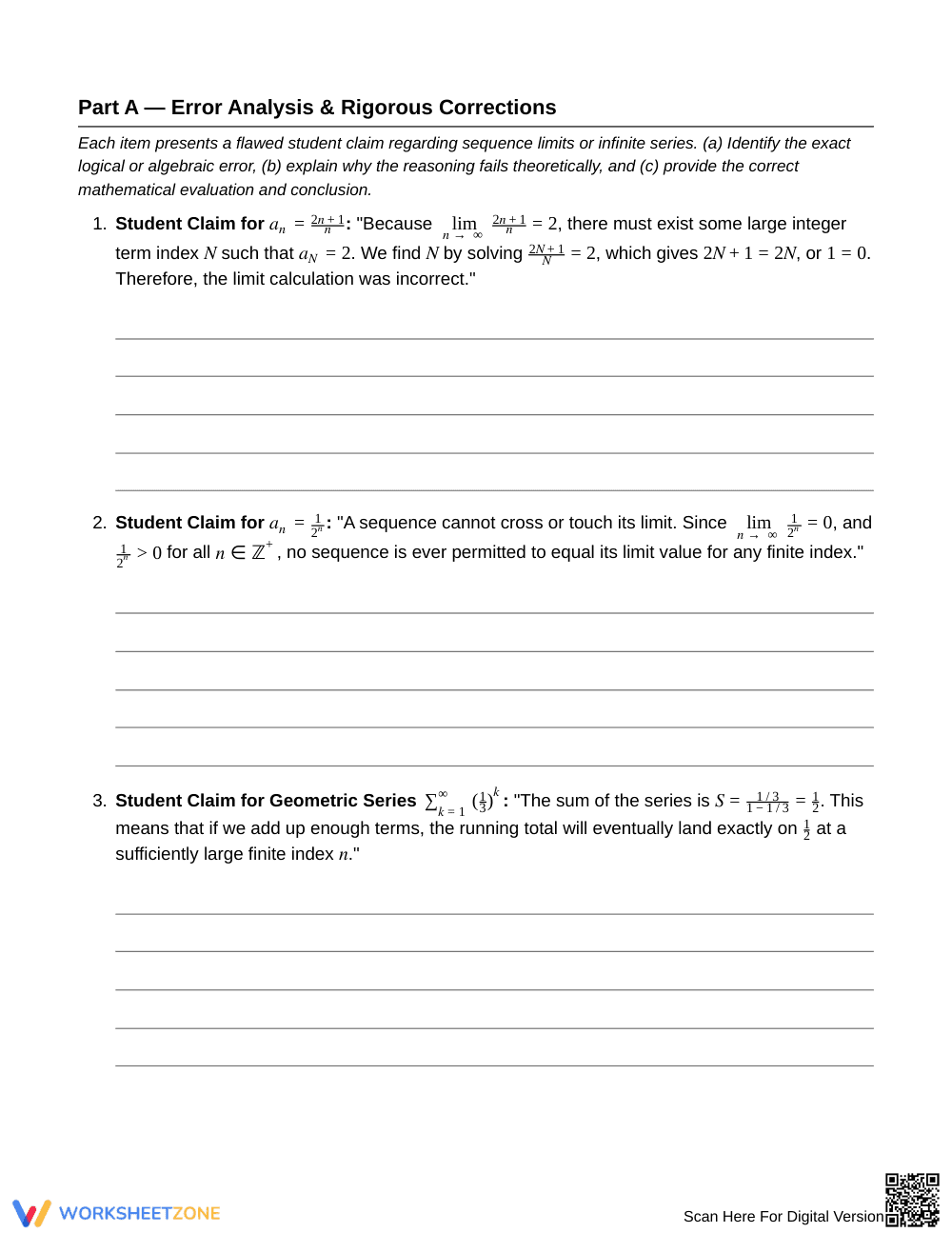
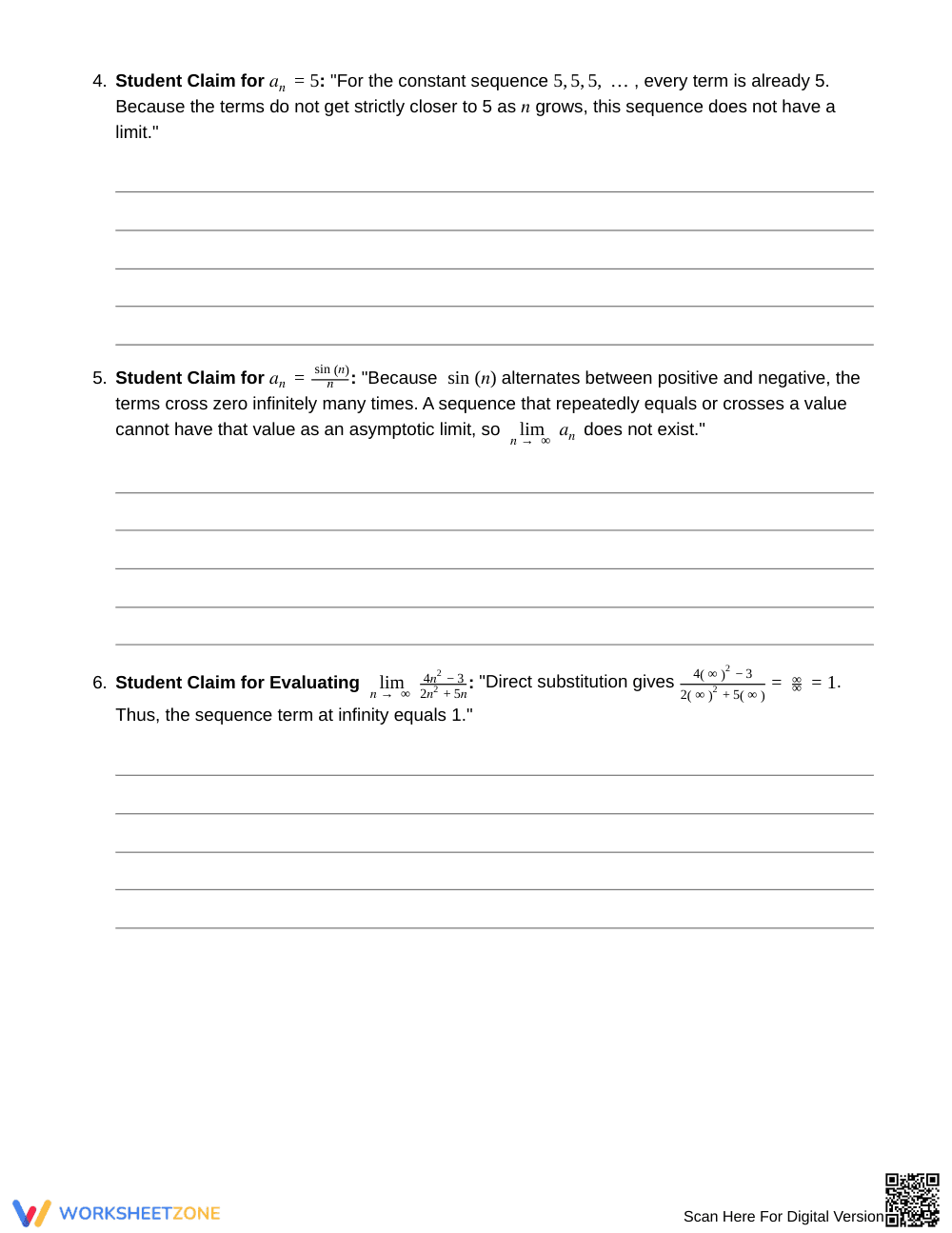
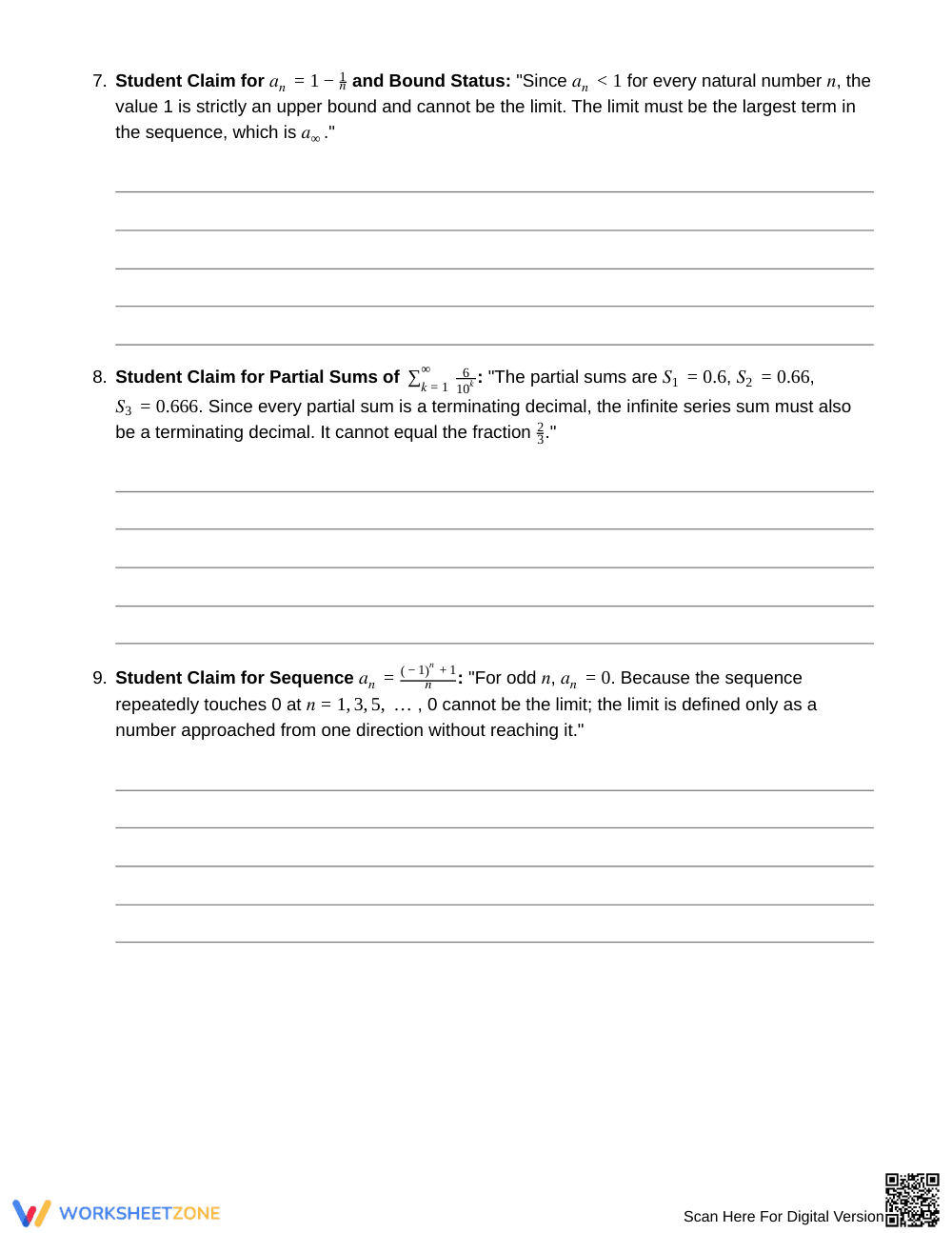
The 5-page PDF features a definitions reference box, an explicit modeled error repair, and 10 analytical correction tasks across 2 student worksheets, accompanied by a 3-page annotated answer key. Problems prompt learners to diagnose student misconceptions involving sequence limits, infinite sums, alternating terms, and indeterminate forms.
Skill Progression
- Guided Practice: A modeled exemplar dissects the fallacy of averaging oscillating terms in $(-1)^n$, providing an error-repair template.
- Supported Practice (Problems 1–5): Students critique claims regarding non-attained limits, asymptotic boundaries, finite series totals, constant sequences, and oscillatory crossings.
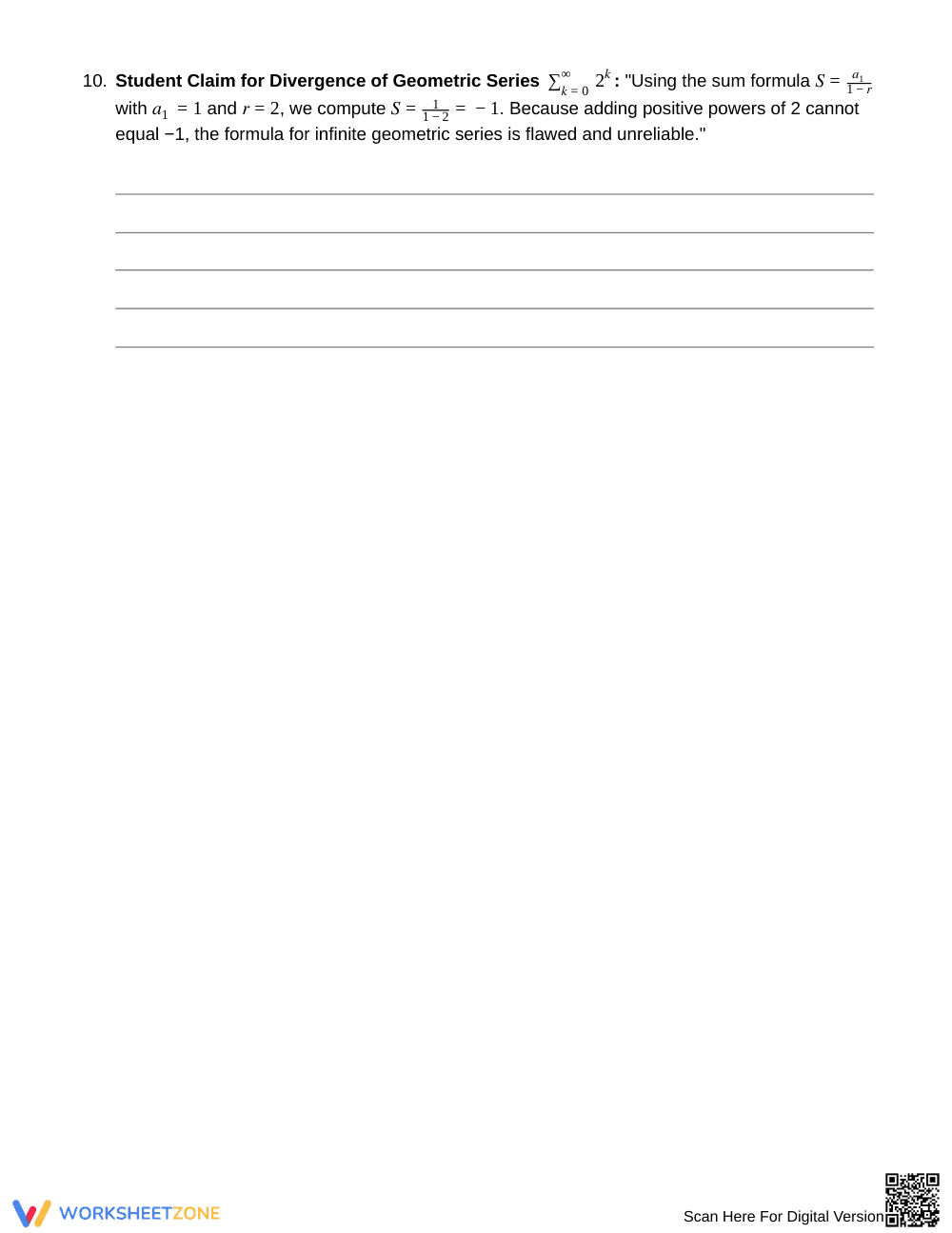
- Independent Practice (Problems 6–10): Learners evaluate indeterminate forms, upper bounds, decimal representations of geometric sums, and divergent formulas applied outside valid intervals.
This progression uses a gradual-release instructional model moving students from structured review to independent mathematical critique.
Standards Alignment
This worksheet aligns with advanced high school Precalculus and introductory calculus standards focused on sequence convergence and limits. Students evaluate terminal behavior analytically and distinguish between finite sequence terms and limiting values. Both standard expectations can be copied directly into lesson plans, IEP goals, or district curriculum mapping tools.
How to Use It
Assign this worksheet after direct instruction on sequences and before introducing formal calculus limits. It functions effectively as a collaborative partner activity or targeted formative assessment. During work time, check whether students recognize that limits describe asymptotic tendencies rather than attained values. Expected completion takes 40 to 50 minutes.
Who It's For
Built for Grade 12 Precalculus and AP Calculus students, this resource supports learners transitioning to advanced analysis. Provide coordinate plots of sequences for students needing visual reinforcement. Pair this activity with an interactive graphing tool demonstrating sequence convergence.
Research by Fisher & Frey (2014) emphasizes that structured error analysis and metacognitive evaluation accelerate conceptual mastery far more effectively than repetitive procedural calculation alone. When secondary students evaluate flawed mathematical justifications rather than solely calculating terminal values, they confront ingrained intuitions about infinite processes and boundary conditions. This Grade 12 Precalculus worksheet activates higher-order reasoning across 10 analytical tasks by requiring learners to identify exact algebraic fallacies, articulate theoretical breakdowns in sequence convergence, and construct rigorous mathematical corrections. Grounded in the gradual-release framework, the resource systematically builds analytical independence through an explicit three-step modeled exemplar followed by targeted multi-tiered problem sets. Empirical studies show that engaging directly with non-examples and student misconceptions solidifies theoretical limit comprehension, preparing college-bound mathematics students to succeed in subsequent rigorous calculus coursework requiring epsilon-band definitions and formal convergence criteria.


