


























Views
Downloads

Complete Sequence Analysis Worksheet | Grade 12 Precalculus
Paste this activity's link or code into your existing LMS (Google Classroom, Canvas, Teams, Schoology, Moodle, etc.).
Students can open and work on the activity right away, with no student login required.
You'll still be able to track student progress and results from your teacher account.
This Precalculus worksheet equips high school students to analyze recursive and explicit sequences. Students convert between representation forms, evaluate sequence limits, calculate infinite geometric series sums, and identify fixed points for convergent recursive formulas through 12 rigorous mathematical tasks.
At a Glance
- Grade: 12 · Subject: Precalculus
- Standard:
HSF-BF.A.2— Write recursive and explicit sequences to model situations- Skill Focus: Analyze recursive and explicit sequences
- Format: 4 pages · 12 problems · Answer key included · PDF
- Best For: Advanced sequence analysis and limit practice
- Time: 45–60 minutes
What's Inside
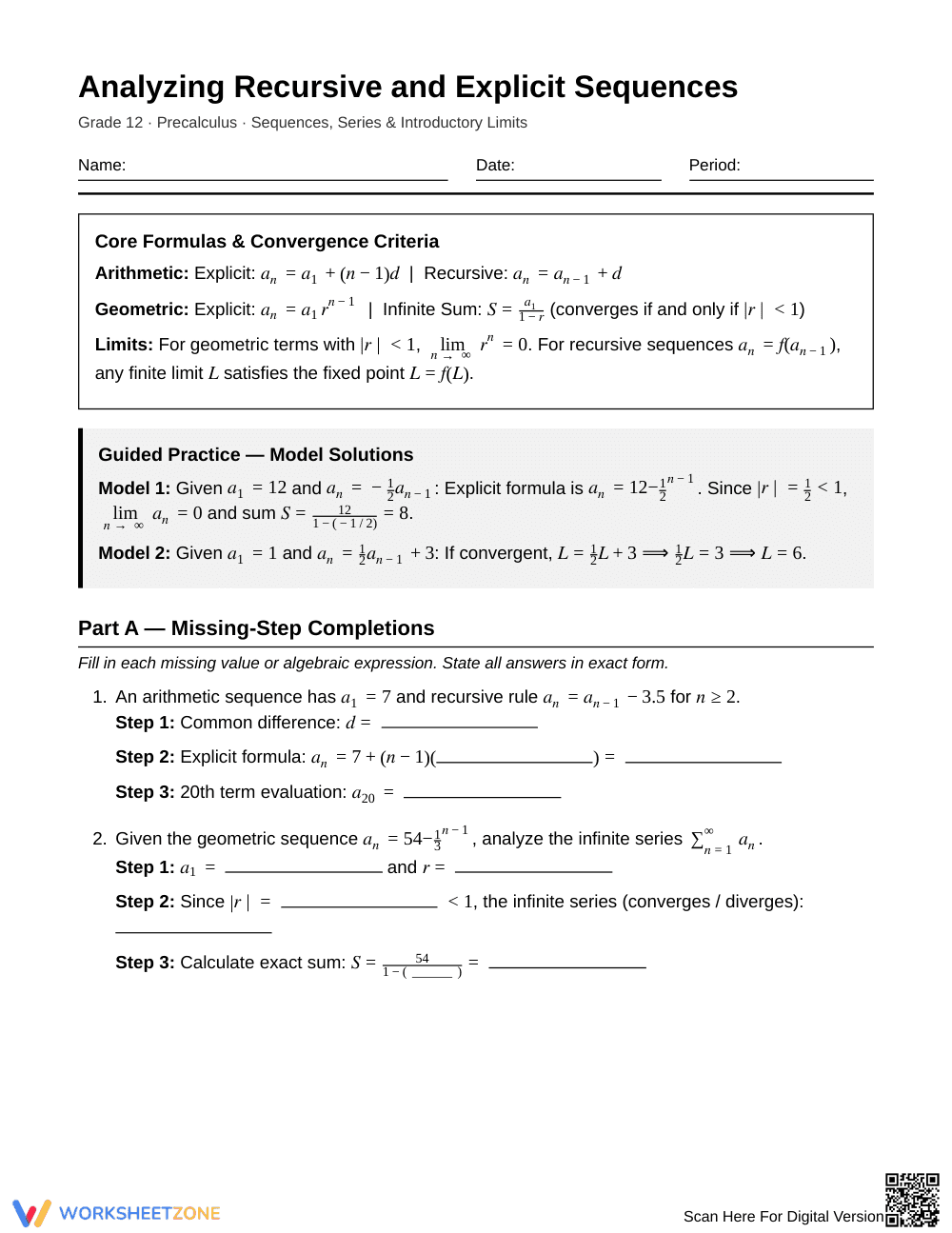
The 4-page worksheet starts with formula summaries and two model solutions. It includes 4 guided missing-step problems, 6 multi-step independent application exercises covering real-world decay and decimal conversions, and 2 error-analysis prompts. A 3-page answer key provides complete step-by-step solutions.
Skill Progression
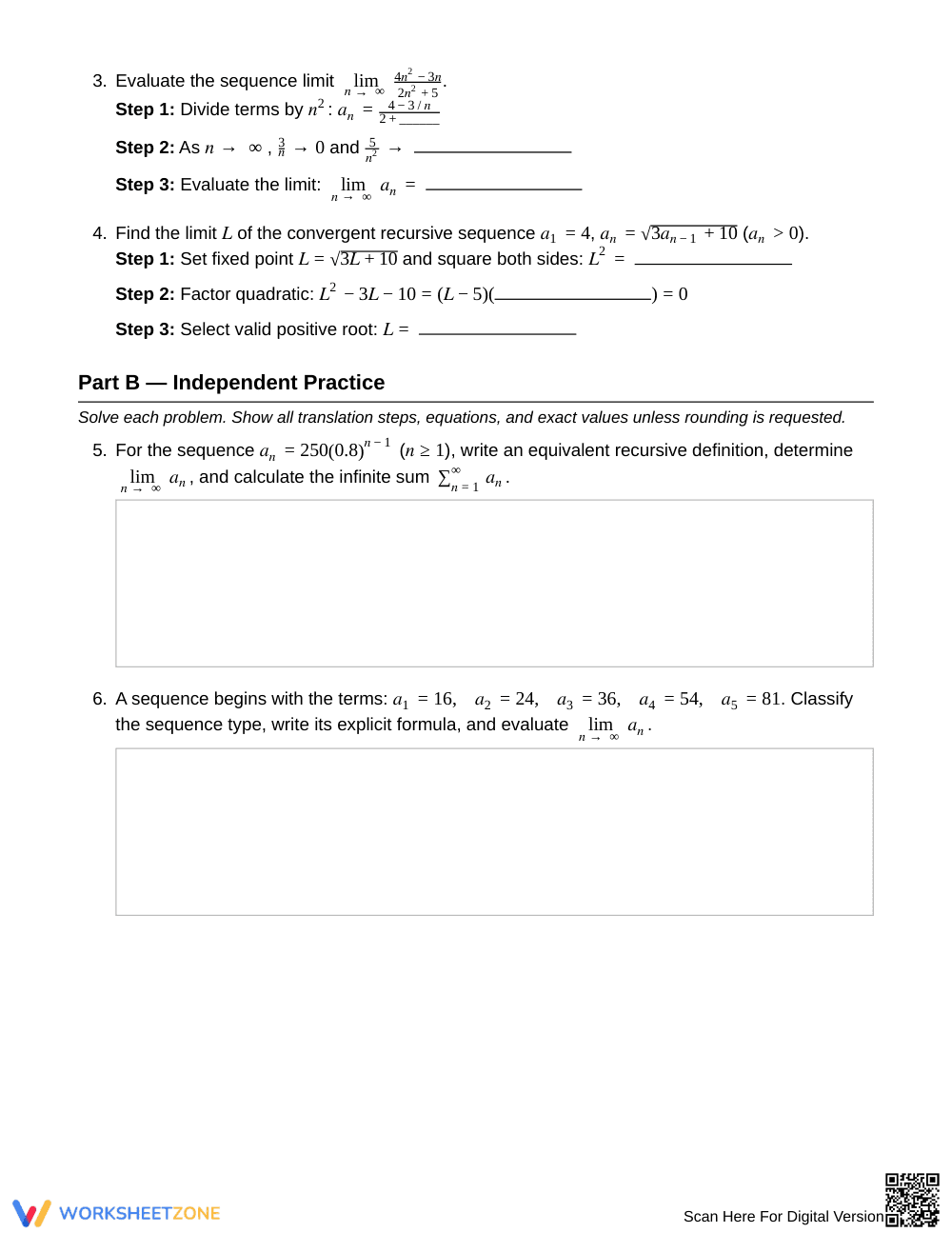
- Guided Practice (Part A, Problems 1–4): Scaffolded missing-step prompts guide students to find common differences, evaluate infinite series, compute sequence limits, and solve recursive fixed points.
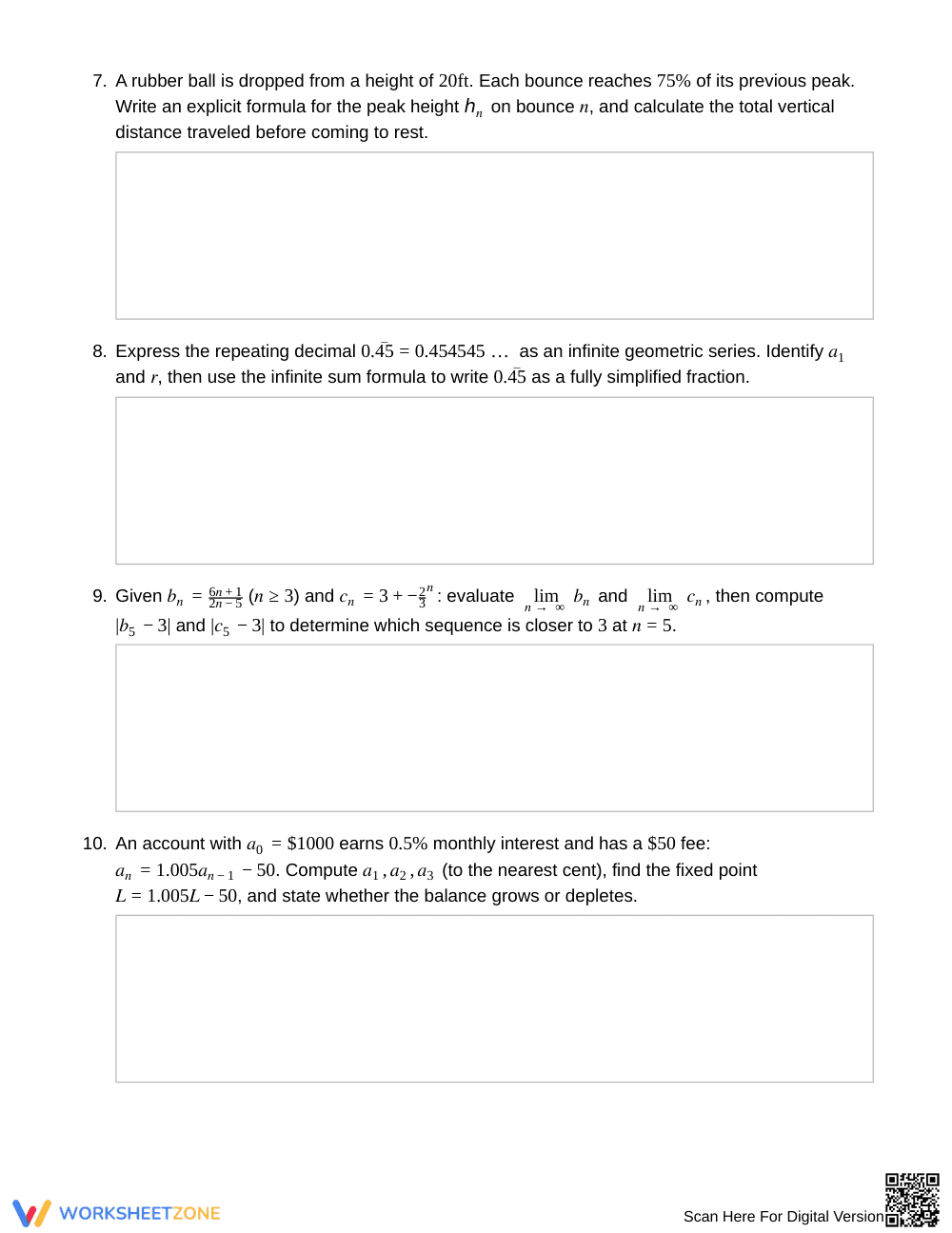
- Supported Practice (Part B, Problems 5–8): Independent problems require students to translate sequence definitions, classify patterns, model bouncing ball distance, and convert repeating decimals.
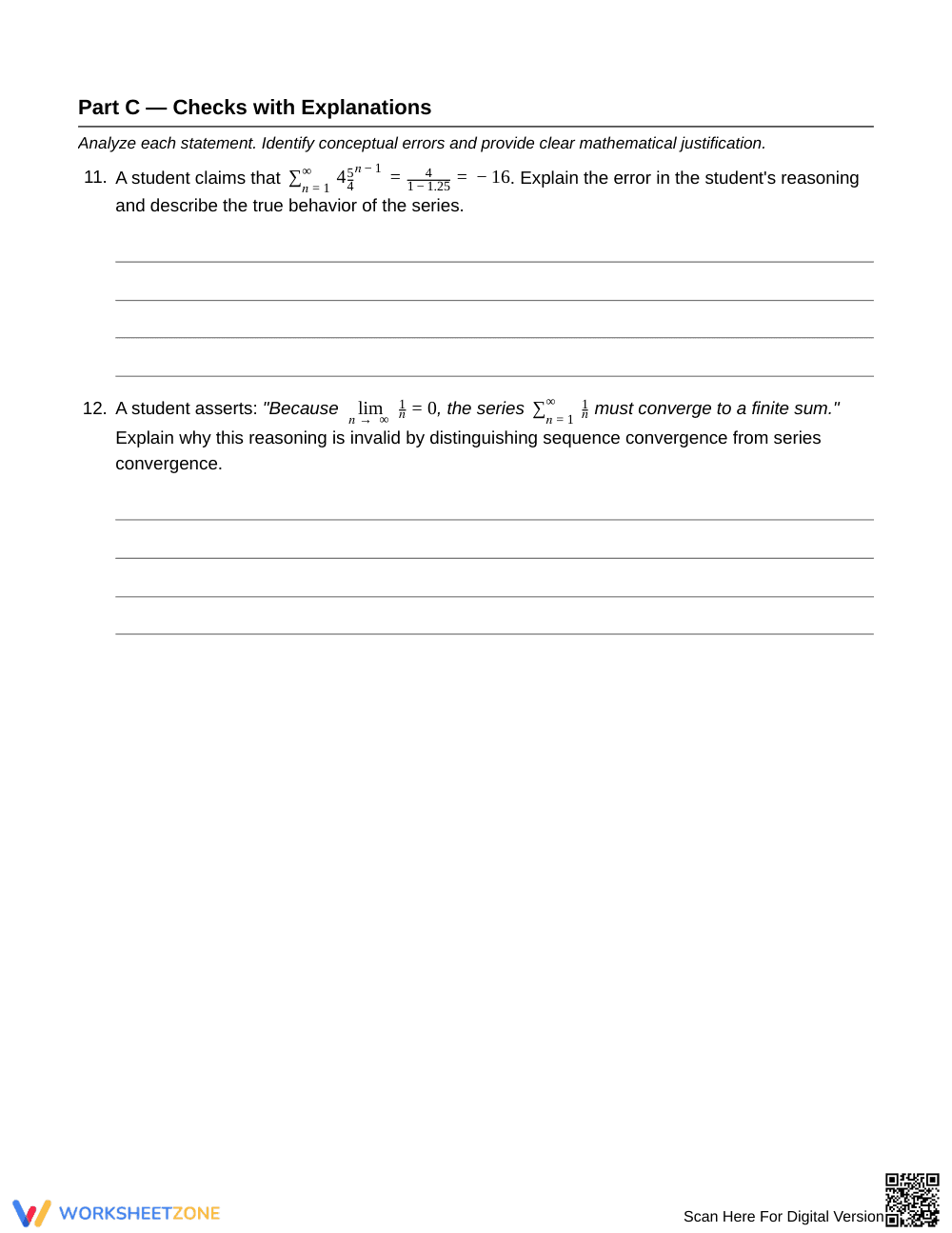
- Independent Practice (Part B & C, Problems 9–12): Advanced exercises and error checks challenge learners to evaluate sequence convergence rates, model account balances, and distinguish sequence limits from series sums.
This gradual-release structure transfers analytical responsibility to students as problem complexity increases.
Standards Alignment
This worksheet aligns directly to HSF-BF.A.2 by requiring students to write arithmetic and geometric sequences recursively and explicitly, translate between forms, and model realistic situations. It also supports HSF-IF.A.3 by treating sequences as functions defined over integers. Both standard codes can be copied directly into lesson plans, IEP goals, or district curriculum mapping tools.
How to Use It
Use this resource after direct instruction on sequence formulas and introductory limits. During Part A, check that students verify |r| < 1 before evaluating infinite series. Assign Parts B and C for collaborative partner work or independent homework. Expected completion time is 45 to 60 minutes.
Who It's For
This resource is built for Grade 12 Precalculus students preparing for calculus concepts. Support emerging learners using the model solutions on page 1, and challenge advanced students with the fixed-point stability questions. Pair this worksheet with graphing calculator investigations of sequence end behavior.
According to Fisher & Frey (2014), structured instructional frameworks that transition from modeled problem-solving to independent conceptual justification foster deeper mathematical retention and long-term analytical fluency. This Grade 12 Precalculus worksheet provides 12 targeted sequence and series tasks aligned directly to HSF-BF.A.2, ensuring students master the translation between recursive and explicit sequence formulations. By integrating scaffolded missing-step completions, multi-step real-world modeling applications, and rigorous error analysis prompts, the resource systematically builds prerequisite competencies for single-variable calculus and introductory limit analysis. Students actively investigate convergence criteria, determine fixed-point limits, and calculate infinite geometric series while articulating their reasoning in clear written form. Research confirms that structured practice across multiple algebraic representations reinforces higher-order problem solving. Educators can utilize the included 3-page answer key for precise scoring, immediate formative feedback, and diagnostic progress monitoring across secondary mathematics classrooms.


