



























Complete Sentence Combining Worksheet | Grade 6 ELA
Paste this activity's link or code into your existing LMS (Google Classroom, Canvas, Teams, Schoology, Moodle, etc.).
Students can open and work on the activity right away, with no student login required.
You'll still be able to track student progress and results from your teacher account.
Mastering sentence structure requires middle school students to identify clause boundaries and punctuate complex sentences accurately. This five-page worksheet provides 12 targeted tasks guiding sixth graders through identifying clause types, combining clauses with subordinating conjunctions, and justifying punctuation choices.
At a Glance
- Grade: 6 · Subject: ELA
- Standard:
L.7.1.a— Explain the function of phrases and clauses in specific sentences- Skill Focus: Build Complete Sentences from Clauses
- Format: 5 pages · 12 problems · Answer key included · PDF
- Best For: Grammar instruction and independent practice
- Time: 35–45 minutes
What's Inside
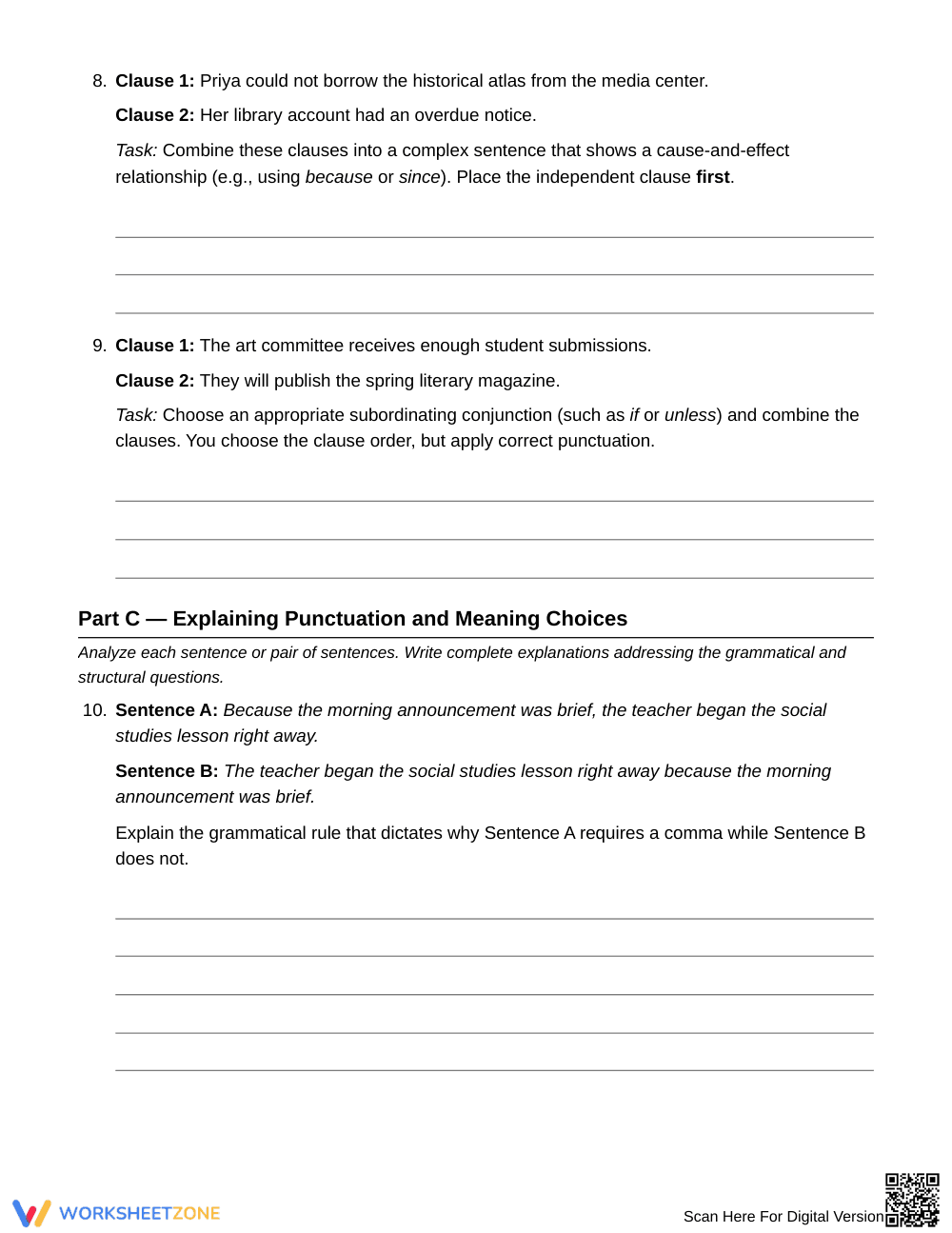
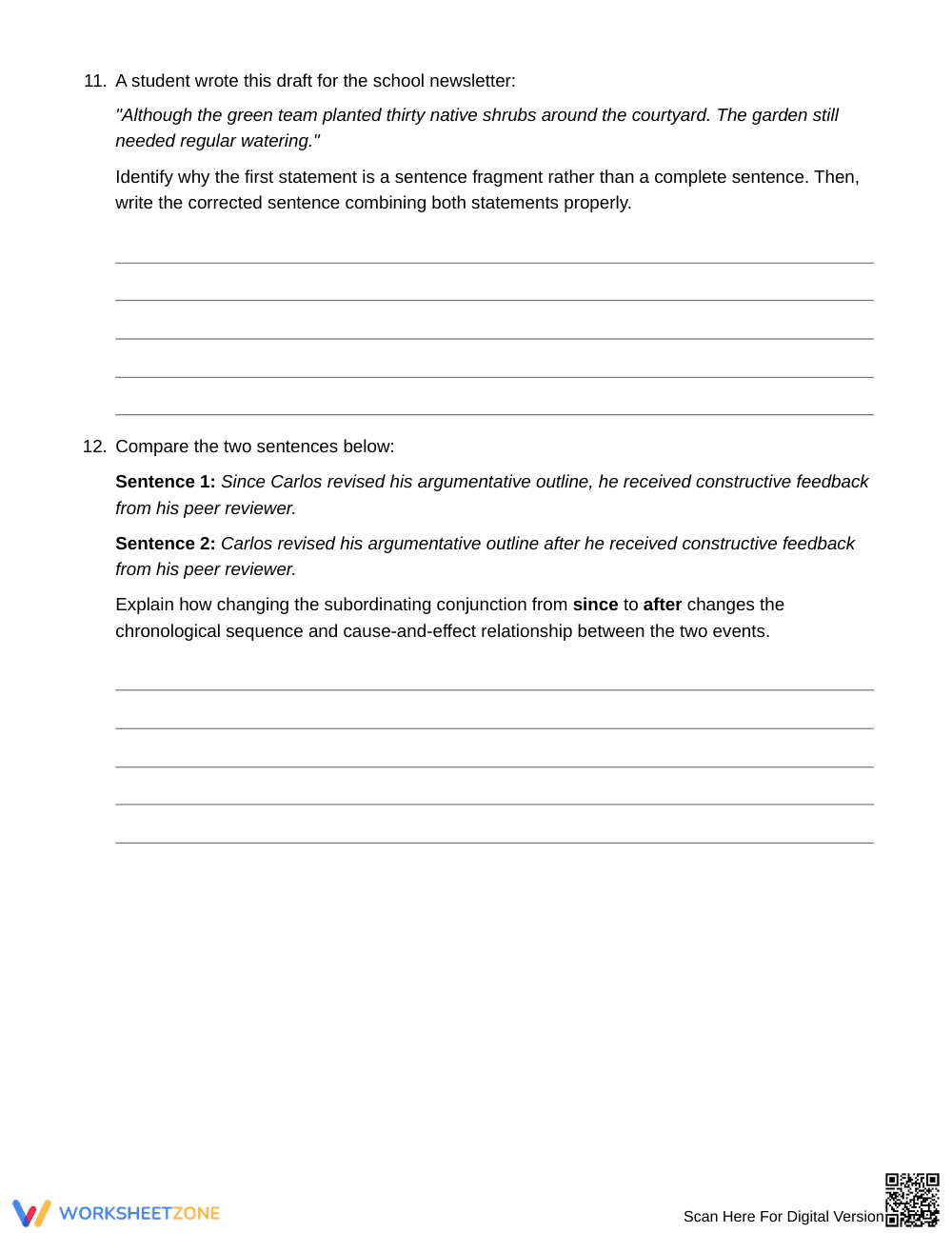
This printable resource includes a clause rules reference box, two modeled sentence combinations, and 12 exercises across three progressive parts. Students identify clause types, combine clauses using conjunctions like because and although, and analyze sentence fragments. A 3-page teacher answer key provides model combinations and complete written explanations.
Skill Progression
- Guided Practice (Part A): Students evaluate 3 sentences to identify underlined clauses as independent or dependent, explaining why each clause can or cannot stand alone.
- Supported Practice (Part B): Six combining prompts require joining clause pairs with specified conjunctions and comma placements.
- Independent Practice (Part C): Three tasks challenge students to explain comma rules, fix a fragment, and evaluate how conjunctions alter meaning.
This sequence follows a gradual-release model, advancing from identification to applied construction.
Standards Alignment
This resource aligns with standard L.7.1.a: Explain the function of phrases and clauses in general and their function in specific sentences. It reinforces syntax and comma conventions when combining dependent and independent clauses. Both standard codes can be copied directly into lesson plans, IEP goals, or district curriculum mapping tools.
How to Use It
Deploy this worksheet after direct instruction on subordinating conjunctions. Use Part A as a formative checkpoint: observe whether students identify why dependent clauses cannot stand alone before moving to Part B. Assign Part C as paired analysis or exit ticket work. Expected student completion time is 35 to 45 minutes.
Who It's For
This activity is designed for sixth-grade ELA students, intervention groups, and English learners developing sentence structure mastery. Scaffolding notes support struggling writers, while Part C offers depth for advanced students. Pair this worksheet with an anchor chart on conjunctions or an essay revision unit.
According to research by Fisher & Frey (2014) on the gradual release of responsibility framework, explicit instruction paired with structured sentence-combining practice significantly improves adolescent syntactic maturity and reading comprehension. Standard L.7.1.a requires students to understand how independent and dependent clauses function within complex sentences. When students deliberately manipulate subordinating conjunctions such as because, since, and unless, they internalize the syntactic rules governing comma placement and clause hierarchy. Rather than practicing rote grammar identification in isolation, learners benefit from analyzing sentence fragments and evaluating how connective choices alter chronological and causal meaning. This Grade 6 worksheet provides 12 focused opportunities to bridge clause analysis with applied sentence construction, equipping middle school writers with the essential grammatical tools needed to produce coherent, varied, and structurally sound expository and narrative prose across core academic disciplines.


