































Complete Science Museum Word Search | Grades 6–7 Science

Paste this activity's link or code into your existing LMS (Google Classroom, Canvas, Teams, Schoology, Moodle, etc.).
Students can open and work on the activity right away, with no student login required.
You'll still be able to track student progress and results from your teacher account.
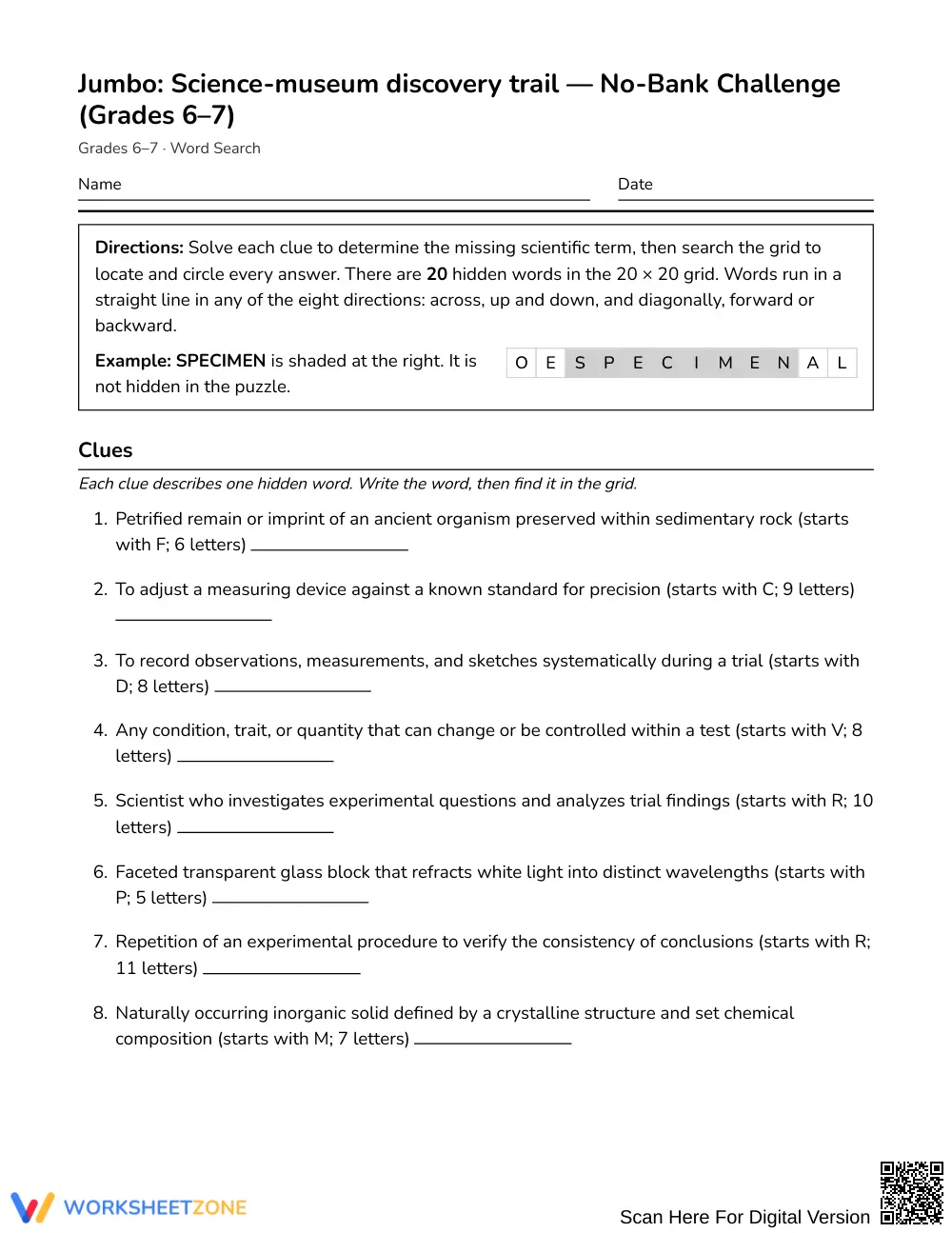
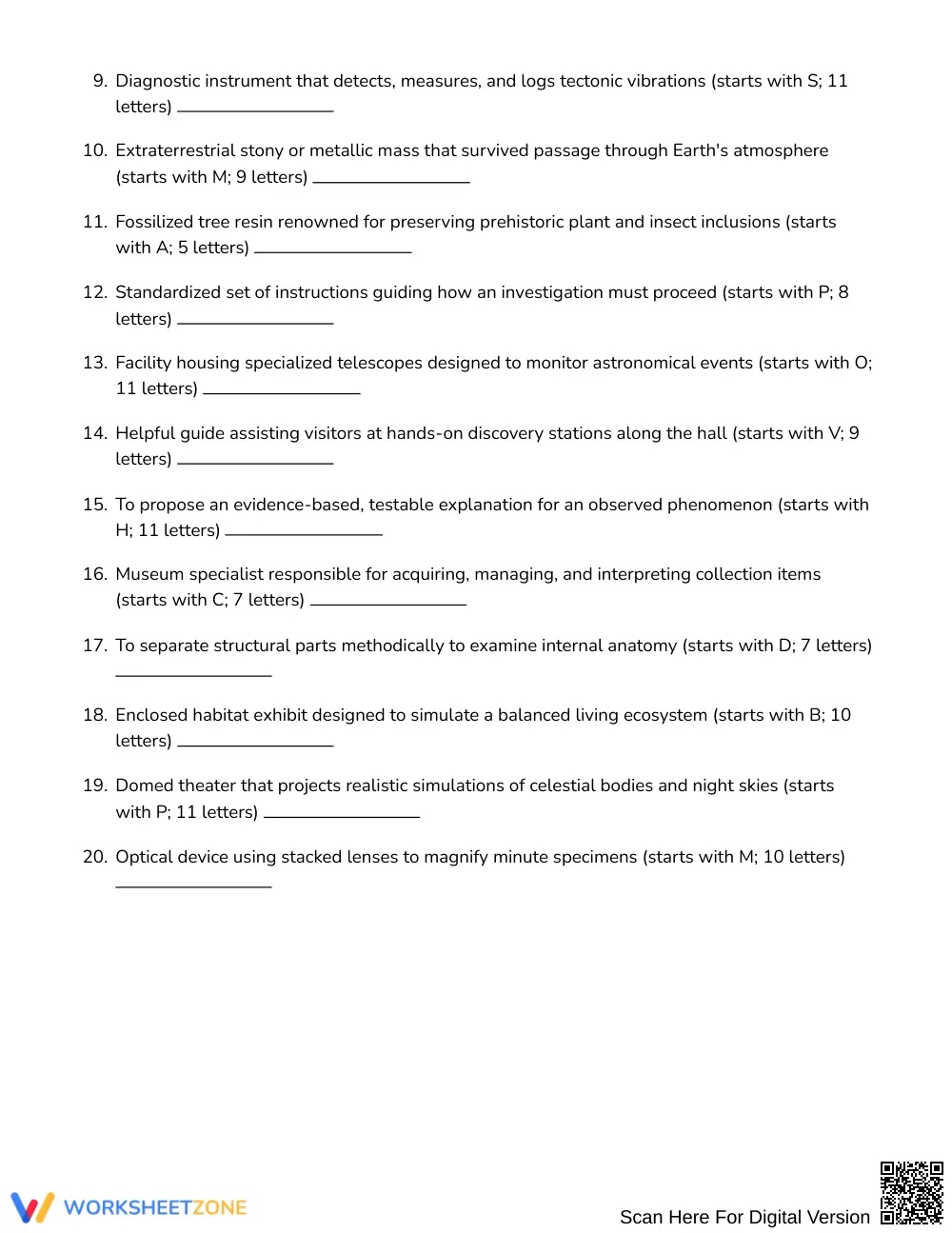
This science museum discovery trail word search strengthens middle school scientific vocabulary through an active clue-solving challenge. Learners read 20 descriptive definitions spanning museum exhibits, laboratory practices, and research tools, determine the correct scientific terminology, and locate each term hidden across the puzzle grid. It provides targeted reinforcement for key content vocabulary without requiring teacher prep.
At a Glance
- Grade: Grades 6–7 · Subject: Science
- Standard: Not standards-assessed — vocabulary enrichment
- Skill Focus: Science-museum discovery trail
- Format: 3 pages · 20 words · Answer key included · PDF
- Best For: Vocabulary review and fast-finisher enrichment
- Time: 25–40 minutes
What's Inside
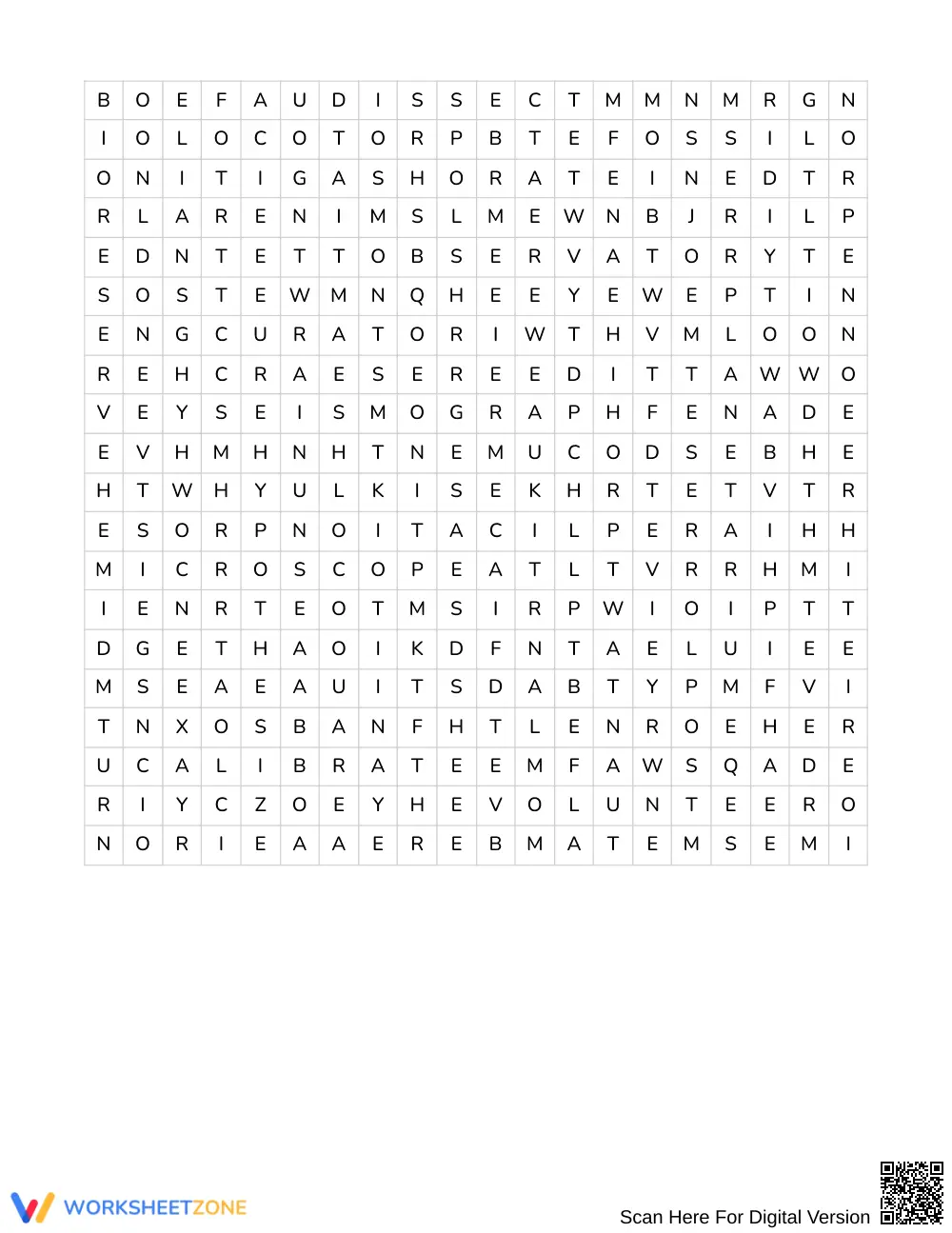
The 3-page printable activity features a full-page puzzle grid paired with 20 distinct conceptual clues. Rather than relying on a traditional word bank, students must analyze each definition to identify the target word independently before searching. A comprehensive 4-page answer key displays exact grid coordinates and highlighted word paths for rapid, effortless verification.
Puzzle Mechanics & Design
The activity is built on a dense 20 × 20 letter grid containing 20 hidden science terms. Words run in all 8 possible compass directions: north, northeast, east, southeast, south, southwest, west, and northwest. Because no word bank is provided, learners must deduce terms like planetarium, seismograph, hypothesize, and protocol directly from the contextual clues before scanning intersecting rows and diagonals.
Standards Alignment
This activity is designed purely for vocabulary enrichment and general science literacy; it is not aligned to a specific state or national curriculum standard. The clues build cross-disciplinary knowledge by connecting Earth science, life science, physical science, and authentic scientific inquiry practices.
How to Use It
Introduce this puzzle after completing a unit on scientific inquiry or as an engaging preview before an organized field trip to a natural history or science museum. As a formative check, walk the room while students solve clues to observe whether they accurately distinguish terms like calibrate and replicate before seeking assistance. Expect independent completion to take between 25 and 40 minutes.
Who It's For
This resource is crafted specifically for Grades 6–7 general science classrooms, gifted extension clusters, and homeschool learning environments. Students who benefit from visual scaffolding can work in collaborative pairs to decipher clues, while advanced learners can complete the no-bank challenge entirely unassisted. It pairs naturally with introductory lessons on experimental design, exhibit research projects, or museum scavenger hunts.
Domain-specific academic vocabulary forms the essential bedrock of middle school scientific literacy, directly determining how effectively students comprehend complex instructional texts and experimental procedures. According to Fisher & Frey (2014), systematic exposure to specialized disciplinary terms through contextual clue-solving promotes authentic retrieval practice and cements cognitive schema far more effectively than isolated memorization lists. By eliminating the standard word list and requiring learners to derive 20 museum and inquiry-based terms from functional definitions, this 20 × 20 grid exercise demands sustained cognitive processing across multi-directional letter paths. Although not tied to a single state standard, the vocabulary enrichment activity targets core practices that underpin NGSS laboratory competencies, scientific documentation, and cross-cutting museum research methods across Grades 6–7.


