

































Complete Rigid Congruence Worksheet | Grade 10 Geometry

Paste this activity's link or code into your existing LMS (Google Classroom, Canvas, Teams, Schoology, Moodle, etc.).
Students can open and work on the activity right away, with no student login required.
You'll still be able to track student progress and results from your teacher account.
Master geometric congruence through rigid motions with this comprehensive high school geometry worksheet. Students analyze translations, reflections, and rotations across 16 rigorous coordinate and proof-based problems. By applying formal transformational definitions, learners verify whether planar figures are congruent, describe multi-step isometry sequences, and calculate exact coordinates on the Cartesian plane.
At a Glance
- Grade: 10 · Subject: Geometry
- Standard:
HSG-CO.B.6— Use rigid motions to decide if figures are congruent- Skill Focus: Rigid-Congruence Check
- Format: 5 pages · 16 problems · Answer key included · PDF
- Best For: Core practice and formal assessment prep
- Time: 45–60 minutes
What's Inside
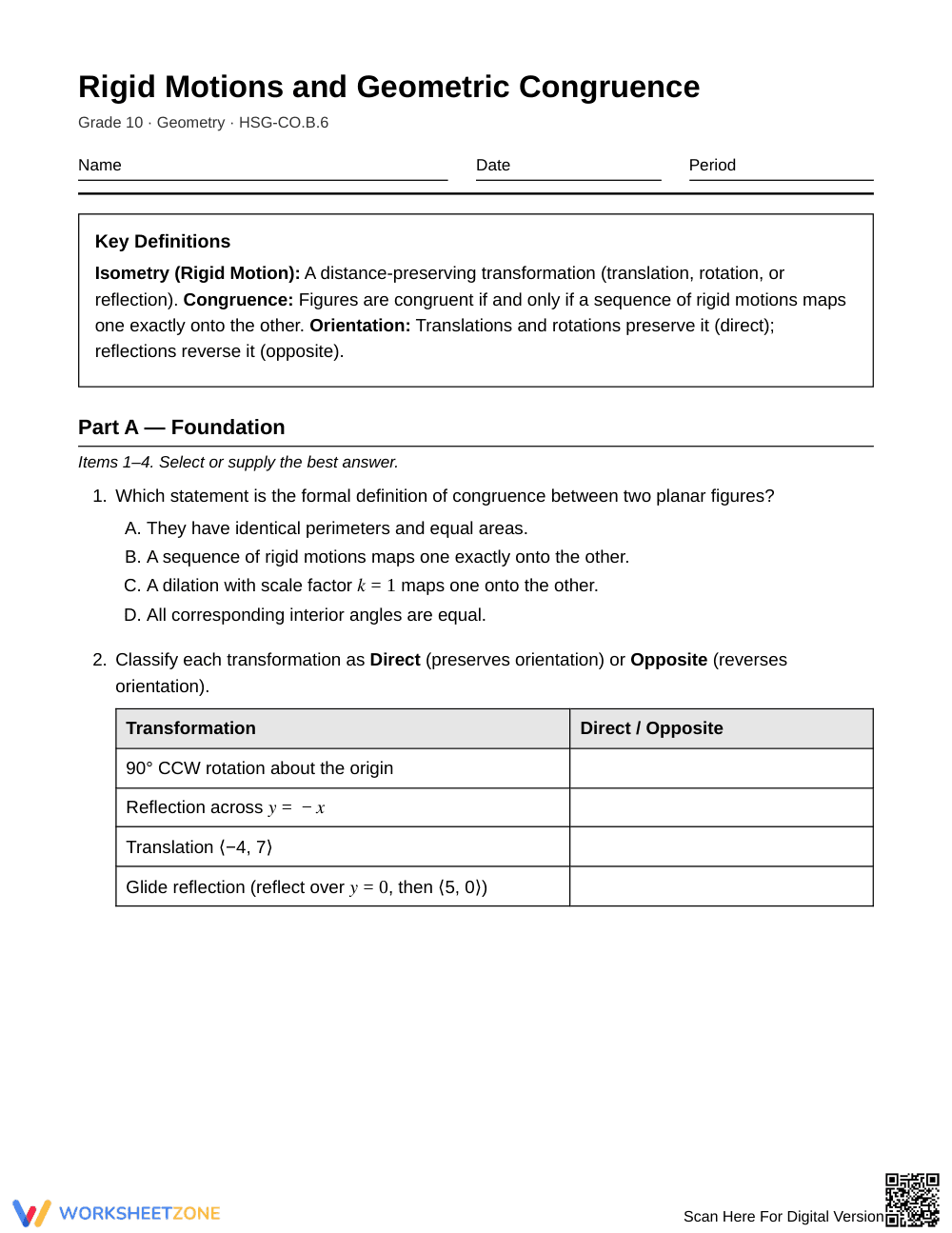
This 5-page student packet contains foundational multiple-choice questions, coordinate mapping exercises, and rigorous analytical proofs. A reference box anchors core definitions of isometries, congruence, and orientation preservation at the top of page 1. Students work with diagrams, coordinate pairs, and composite transformations. A complete 3-page teacher answer key provides full algebraic derivations and coordinate solutions.
Skill Progression
- Guided practice (Items 1–4): Foundational tasks review formal definitions of congruence, orientation classification, basic coordinate side-length computations, and properties preserved under composite transformations with explicit structural scaffolding.
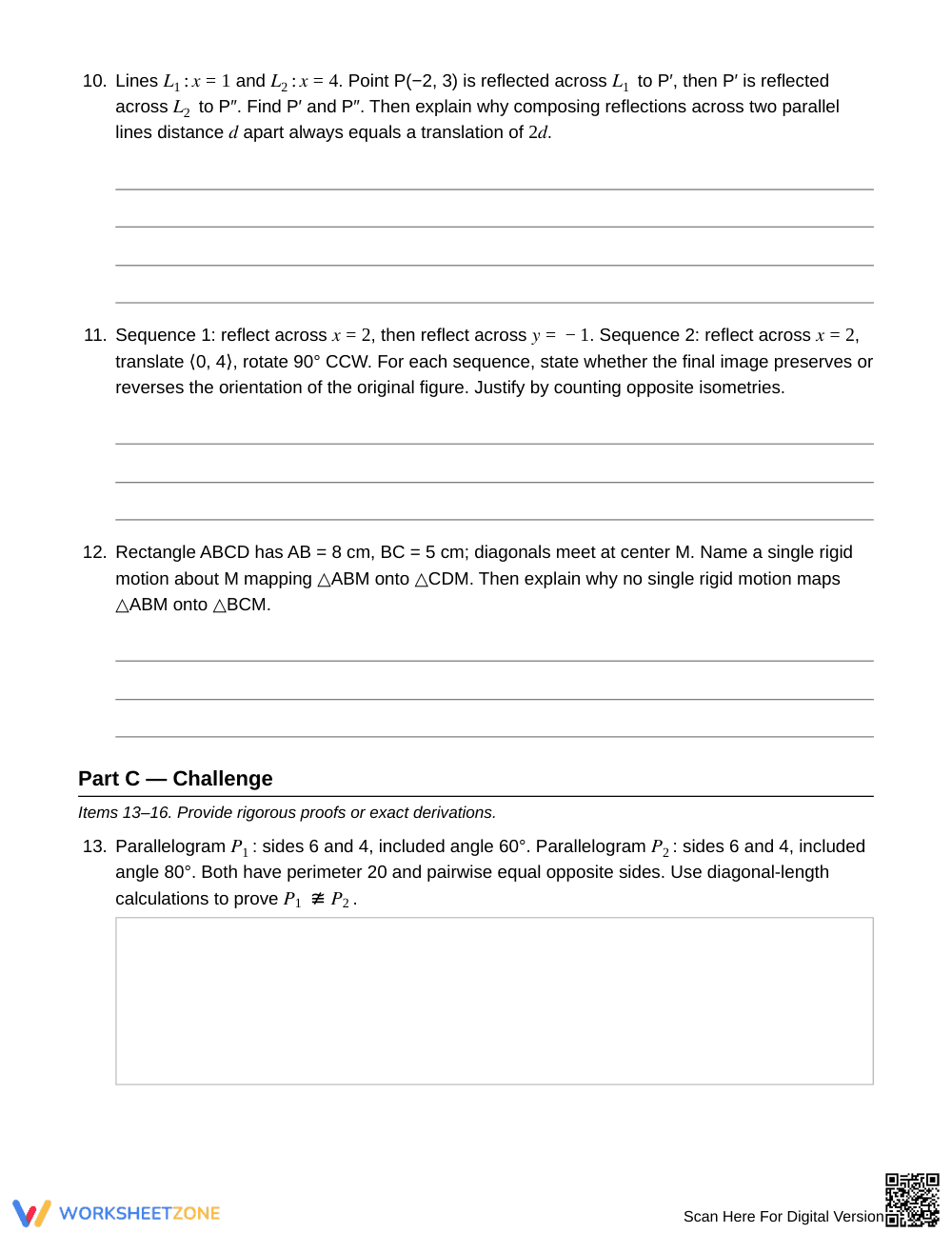
- Supported practice (Items 5–12): Core coordinate problems require students to describe multi-step transformation sequences, apply rigid-motion definitions to irregular polygons, justify triangle congruence criteria, and determine parallel reflection distance rules.
- Independent practice (Items 13–16): Advanced proof items demand that learners compute non-congruence via diagonals, identify exact centers and angles of rotation, and construct algebraic distance-preservation proofs without scaffolding.
This deliberate sequence reflects the gradual-release model, transitioning students steadily from recall to non-routine geometric reasoning.
Standards Alignment
Primary standard: `HSG-CO.B.6` — Use geometric descriptions of rigid motions to transform figures and to predict the effect of a given rigid motion on a given figure; given two figures, use the definition of congruence in terms of rigid motions to decide if they are congruent. Supporting standard: `HSG-CO.A.2` — Represent transformations in the plane and describe transformations as functions. Both standard codes can be copied directly into lesson plans, IEP goals, or district curriculum mapping tools.
How to Use It
Deploy this resource during independent practice following direct instruction on transformational geometry, or assign it across two block periods as an end-of-unit review. During classwork, monitor student coordinate calculations in Part B to catch sign errors when reflecting across non-axis lines like x = 1. Expected completion time is 45 to 60 minutes.
Who It's For
Designed for tenth-grade Geometry students mastering Common Core congruence standards. Provide graph paper or coordinate patty paper for students needing spatial intervention, while challenging honors students with Part C algebraic proofs. Pair this assignment with a coordinate plane transformation anchor chart.
According to Fisher & Frey (2014), purposeful instructional design relies on guided transitions from conceptual modeling to independent problem-solving to ensure long-term retention of abstract mathematical principles. This 16-item geometry resource operationalizes that architecture for standard HSG-CO.B.6 by establishing clear operational definitions before requiring multi-step coordinate deductions and formal proofs. Students systematically test congruence through distance-preserving transformations, evaluating orientation changes and composite isometry mappings across 5 structured pages. High school educators gain a reliable, standards-aligned instrument that captures student mastery across diverse problem types, ensuring that learners develop both computational accuracy on the coordinate grid and conceptual fluency with transformation-based geometric congruence proofs.


