


























Views
Downloads


Complete Resultant Vector Worksheet | Grade 12 Precalculus
Paste this activity's link or code into your existing LMS (Google Classroom, Canvas, Teams, Schoology, Moodle, etc.).
Students can open and work on the activity right away, with no student login required.
You'll still be able to track student progress and results from your teacher account.
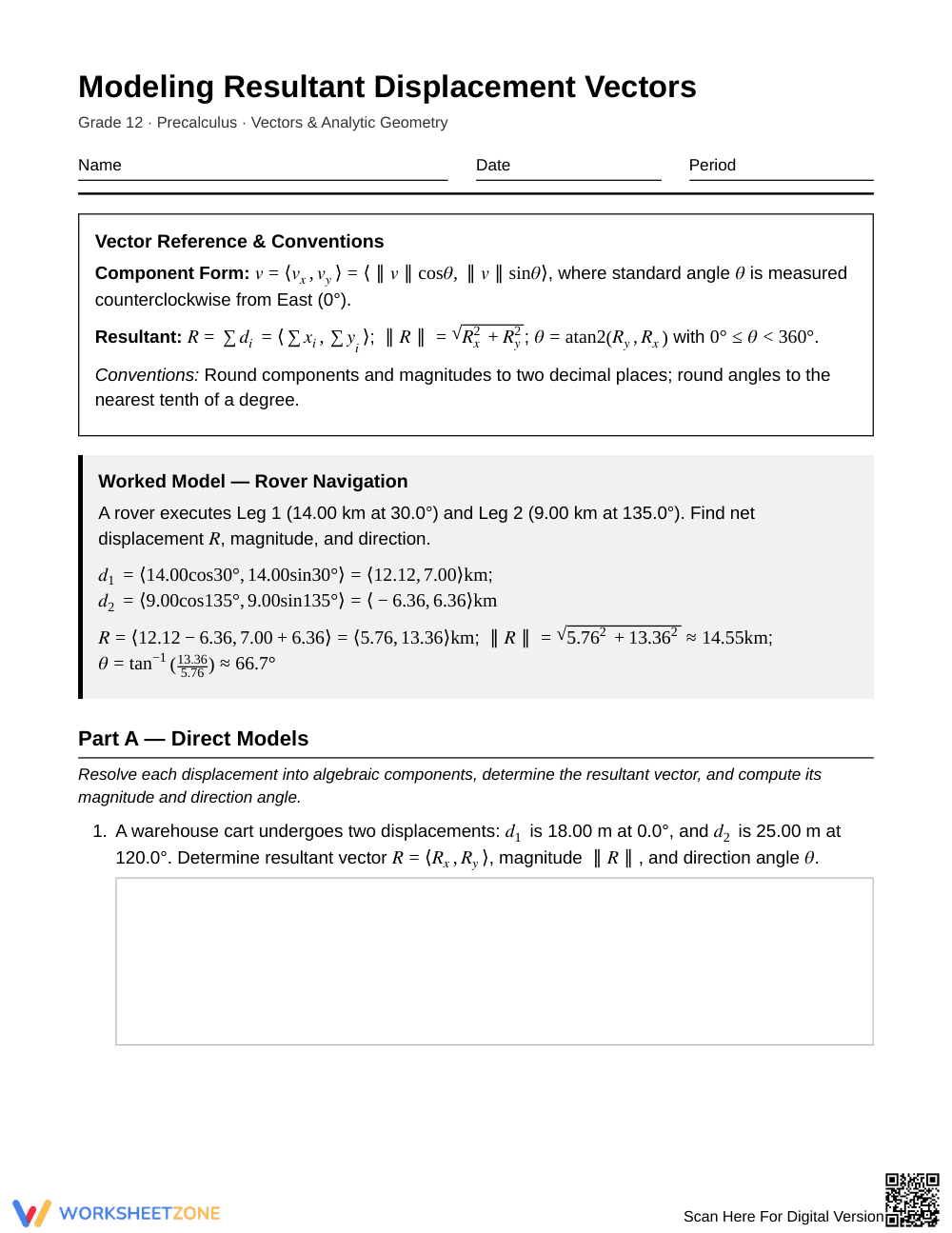
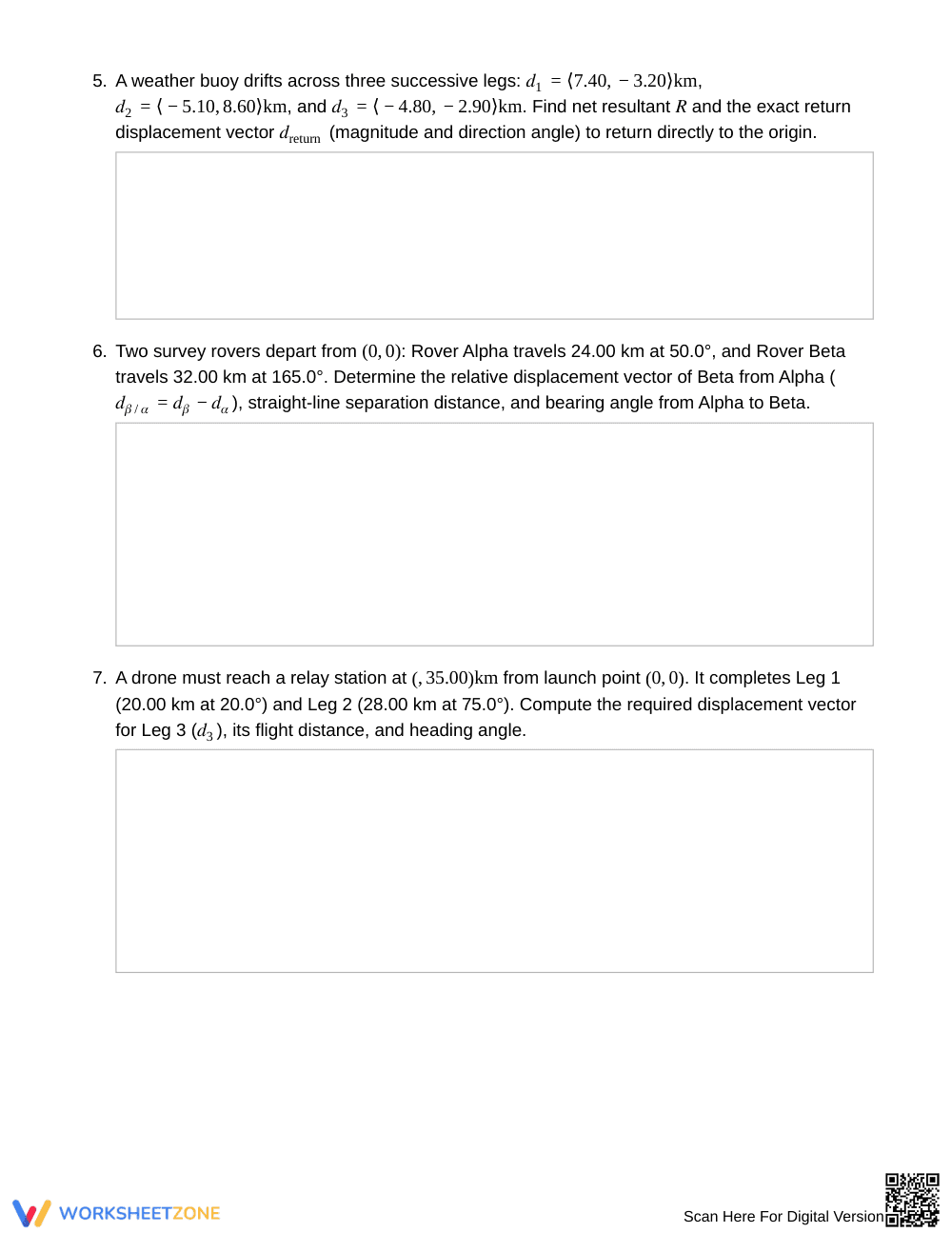
This Precalculus worksheet equips Grade 12 students to model resultant displacement vectors through analytical component resolution and trigonometric vector addition. Students resolve multi-leg navigation and drift paths into rectangular components, calculate net magnitude and direction angles, and evaluate real-world navigational constraints. The rigorous problem set ensures students master vector synthesis across authentic navigation scenarios.
At a Glance
- Grade: 12 · Subject: Precalculus
- Standard:
HSN-VM.A.3— Solve problems involving velocity and other quantities that can be represented by vectors- Skill Focus: Model a Resultant Displacement
- Format: 5 pages · 10 problems · Answer key included · PDF
- Best For: Honors Precalculus vector applications
- Time: 45–60 minutes
What's Inside: Across 5 total student and solution pages, this printable resource includes an on-page vector reference box with coordinate conventions, a fully worked rover navigation model, and 10 multi-part analytical exercises. The resource includes a thorough 3-page answer key detailing intermediate component sums, magnitude calculations, quadrant-corrected bearing angles, and written constraint evaluations.
Skill Progression
- Guided practice (Part A, Problems 1–2): Direct two-vector models resolve polar vectors into horizontal and vertical components, scaffolding magnitude and angle formulas.
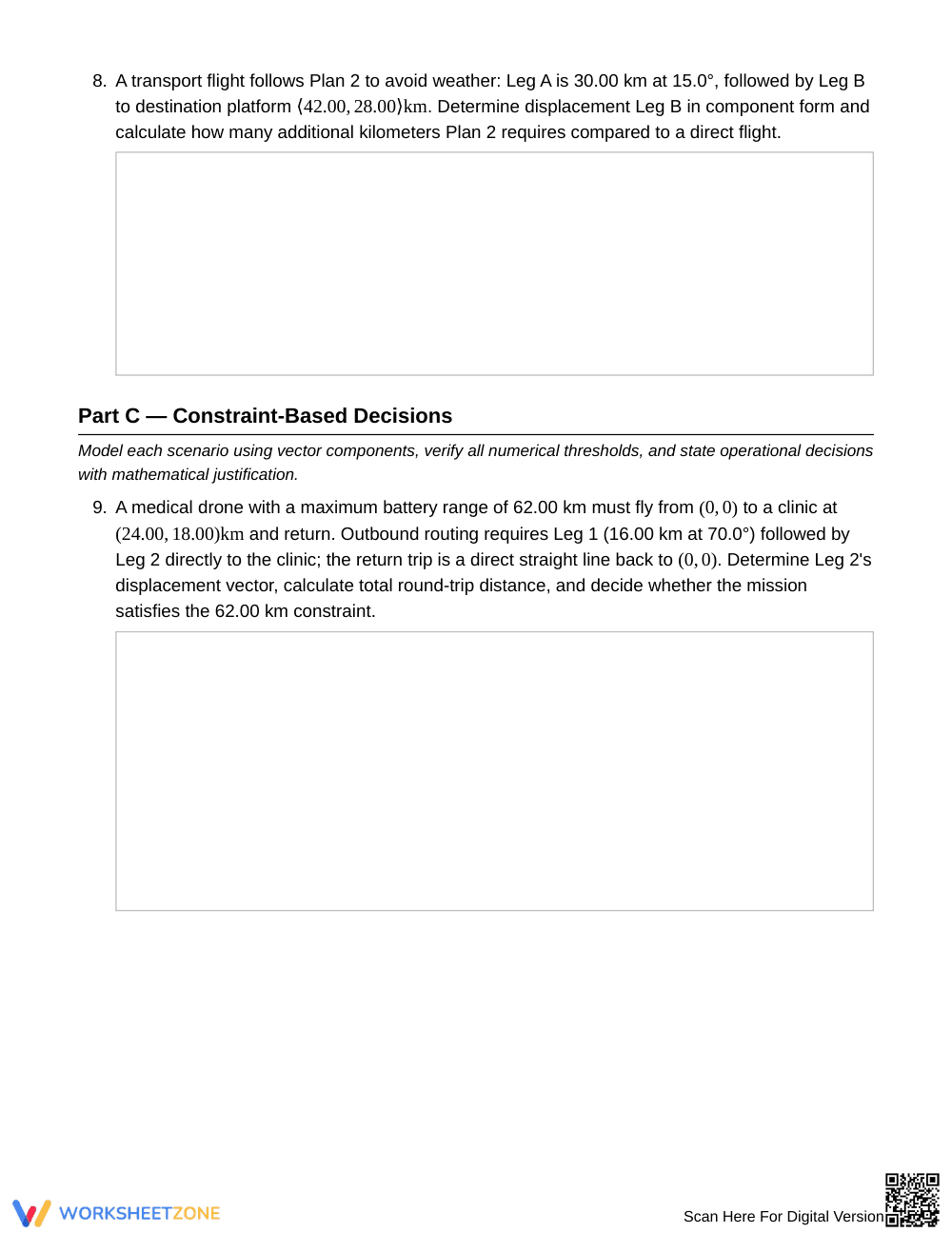
- Supported practice (Part B, Problems 3–8): Multi-step applications demand three-leg tracking, relative displacement subtraction, current drift adjustments, and missing-vector path completion.
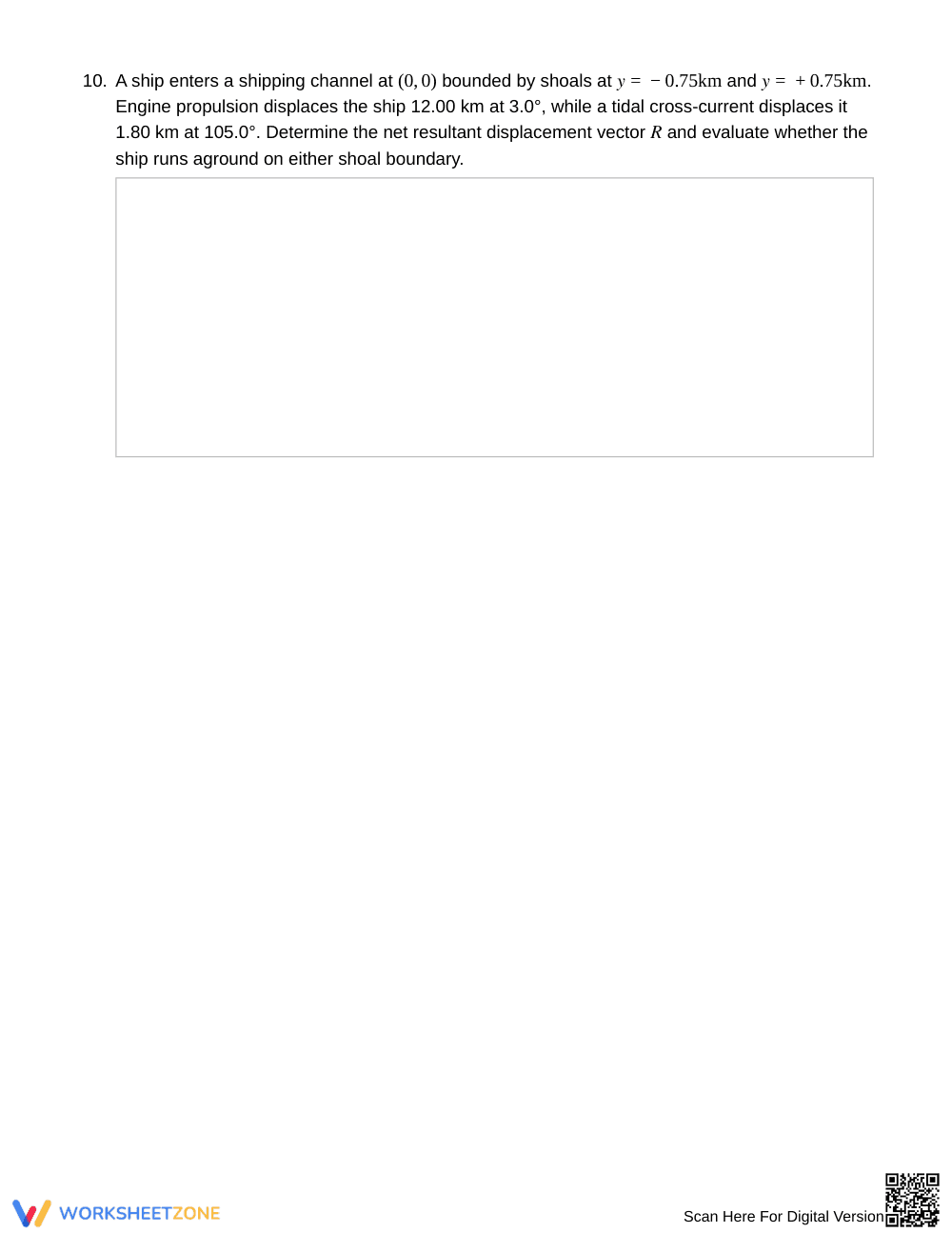
- Independent practice (Part C, Problems 9–10): Real-world operational decisions require modeling round-trip battery limits and maritime channel boundaries with rigorous mathematical justifications.
This deliberate sequence reflects the gradual release of responsibility model, guiding students from foundational algebraic decomposition to complex analytical decision-making.
Standards Alignment
This resource aligns directly with `HSN-VM.A.3`: solve problems involving velocity and other quantities that can be represented by vectors. Supporting standard `HSN-VM.B.4.B` reinforces vector addition end-to-end and component-wise. Both standard codes can be copied directly into lesson plans, IEP goals, or district curriculum mapping tools.
How to Use It
Implement this worksheet during the application phase following direct instruction on vector components. First, use Part A as a collaborative mid-lesson check to ensure accurate trigonometric signs before students advance to multi-leg scenarios in Part B. As a formative assessment checkpoint, examine whether students use the quadrant-appropriate inverse tangent angle rather than raw calculator outputs. The full 10-problem sequence requires approximately 45 to 60 minutes of focused classroom work or paired laboratory time.
Who It's For
This worksheet serves Grade 12 Precalculus, Trigonometry, and AP Physics C students exploring analytic vector mechanics. Advanced learners engage with the boundary threshold justifications in Part C, while learners needing reinforcement benefit from the worked rover exemplar and reference formulas. Pair this activity directly with a polar graphing anchor chart or coordinate navigation lesson.
According to Fisher & Frey (2014), structured progression through gradual release of responsibility accelerates student mastery of complex multi-step mathematical procedures. By anchoring high school vector instruction in explicit component resolution before introducing contextual constraints, learners build stable cognitive schemas for vector addition. This Grade 12 Precalculus problem set targets standard HSN-VM.A.3, enabling students to model resultant displacement across multi-stage trajectories, compute vector magnitudes, and determine standard direction angles. Students transition systematically from paired vector additions to three-leg navigation pathways and threshold-based optimization decisions. The embedded reference formulas and step-by-step rover demonstration provide necessary scaffolding, allowing students to transfer analytical vector algebra directly to kinematics, aeronautical navigation, and applied engineering contexts without procedural gaps.


