































Complete Remainder Theorem Worksheet | Grade 11 Algebra II

Paste this activity's link or code into your existing LMS (Google Classroom, Canvas, Teams, Schoology, Moodle, etc.).
Students can open and work on the activity right away, with no student login required.
You'll still be able to track student progress and results from your teacher account.
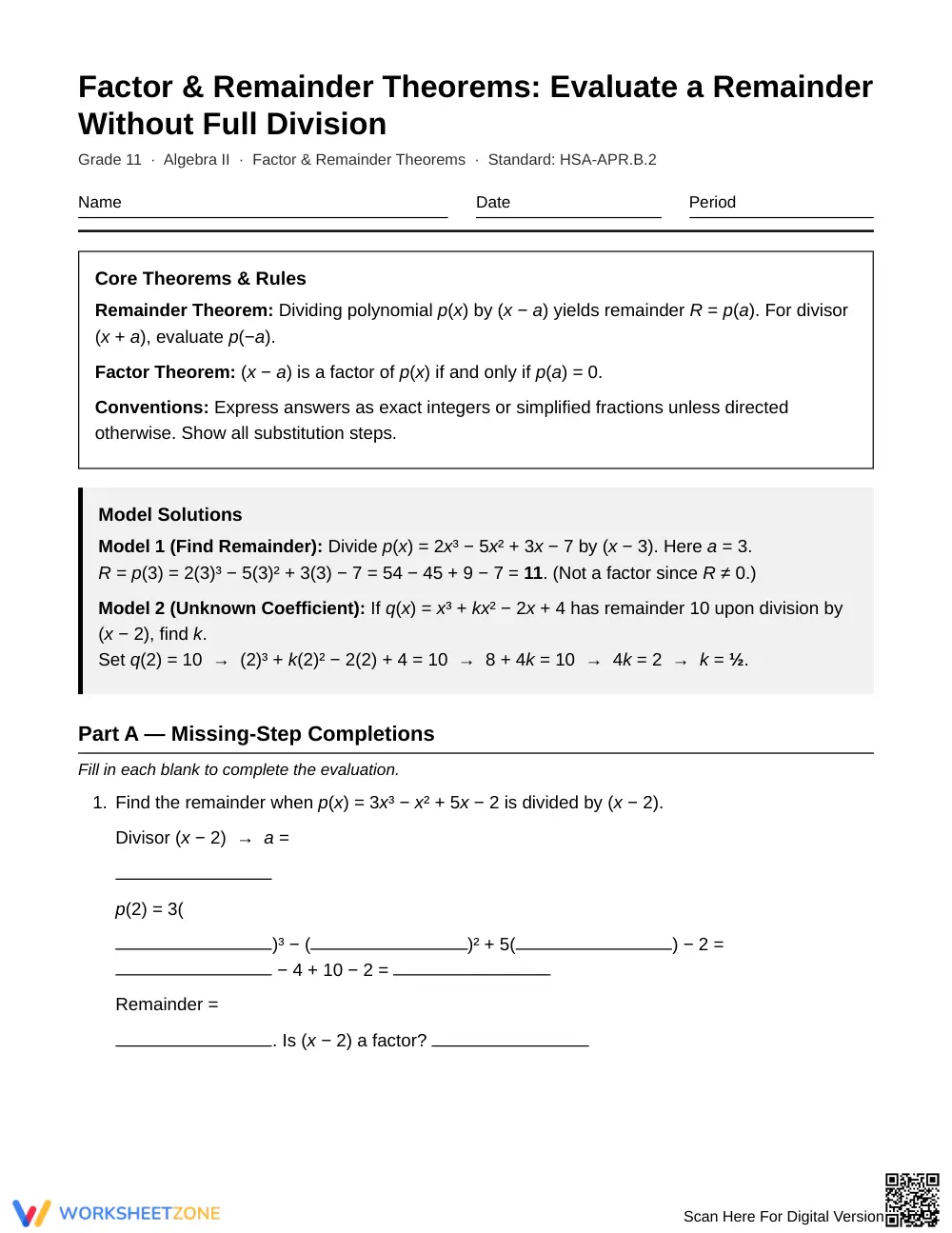
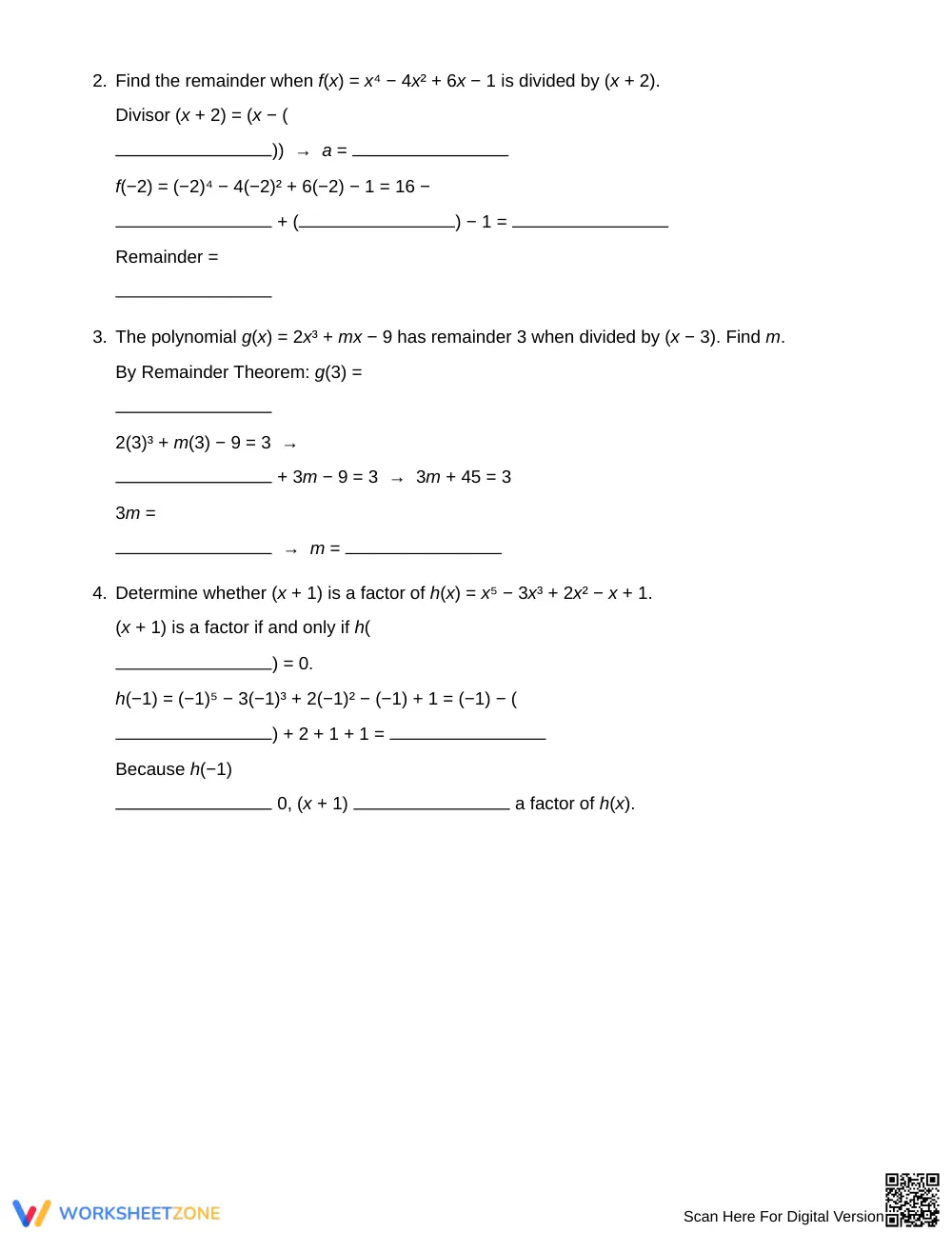
This Algebra II worksheet builds fluency with the Remainder Theorem and Factor Theorem by guiding Grade 11 students through 12 problems that progress from scaffolded fill-in-the-blank evaluations to independent multi-step applications. Students find remainders by direct substitution, determine unknown coefficients, and verify factor claims—all without performing long or synthetic division.
At a Glance
- Grade: 11 · Subject: Algebra II
- Standard:
HSA-APR.B.2— Know and apply the Remainder Theorem to evaluate polynomial remainders- Skill Focus: Evaluate a remainder without full division
- Format: 5 pages · 12 problems · Answer key included · PDF
- Best For: Guided practice after direct instruction
- Time: 25–40 minutes
What's Inside
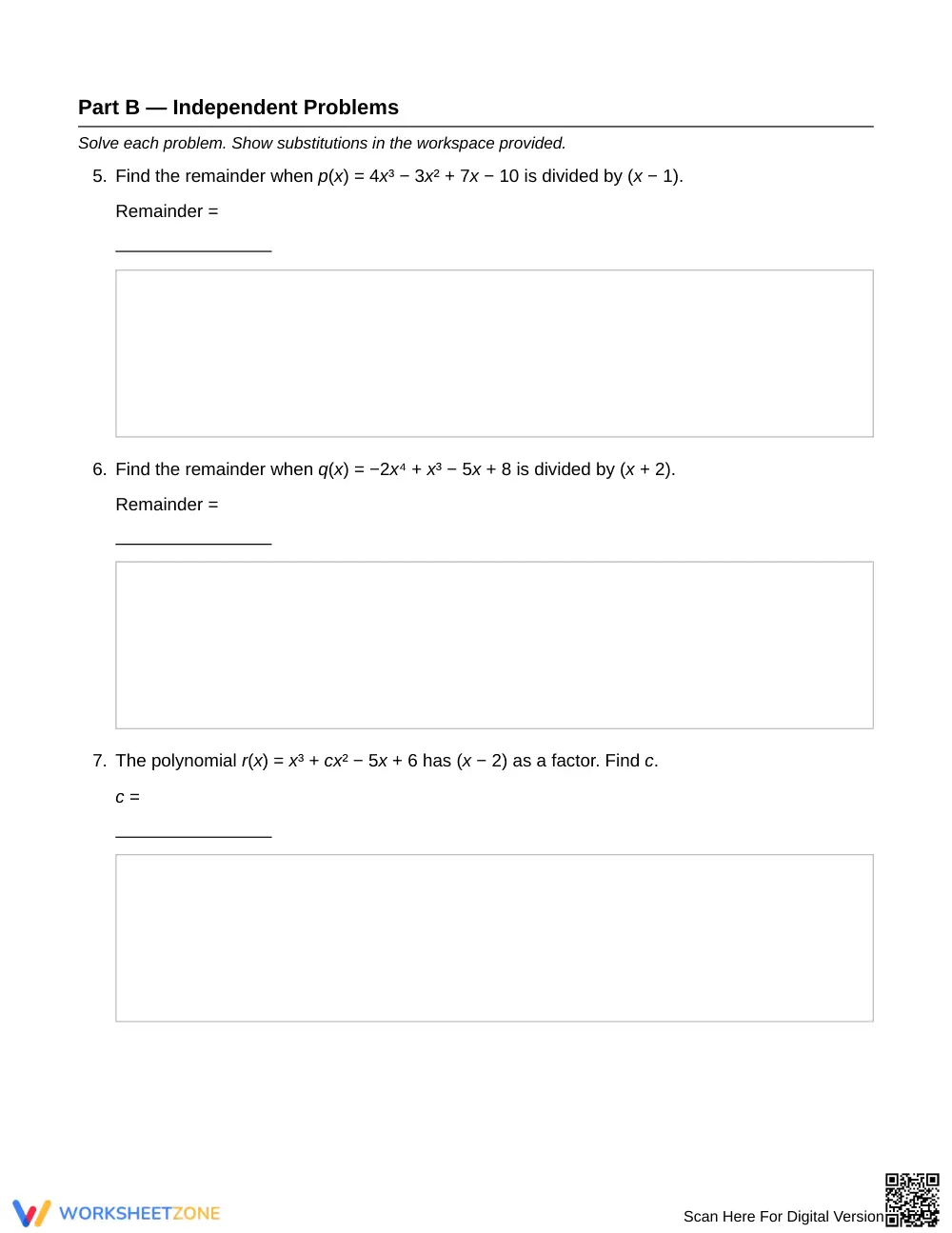
The worksheet opens with a reference box stating both theorems, followed by two worked model solutions. Part A (4 problems) uses missing-step completions so students fill in blanks within pre-structured substitutions. Part B (6 problems) requires fully independent work, including a factor-test table and a two-variable system. Part C (2 problems) asks students to evaluate claims and write short explanations. A complete answer key covers every problem.
Skill Progression
- Guided practice (Part A, 4 problems): Blanks within partially completed substitutions scaffold the connection between divisor form, the value of a, and the evaluation step.
- Supported practice (Part B, 6 problems): Students perform full substitutions independently, solve for unknown coefficients, and set up a system of two equations—workspace provided but no intermediate blanks.
- Independent practice (Part C, 2 problems): Students judge the correctness of given claims, cite the relevant theorem, and supply a calculation-based explanation in two to three sentences.
Standards Alignment
Every problem targets HSA-APR.B.2: Know and apply the Remainder Theorem: for a polynomial p(x) and a number a, the remainder on division by (x − a) is p(a), so p(a) = 0 if and only if (x − a) is a factor of p(x). Problems involving unknown coefficients also reinforce HSA-REI.C.6. Both codes can be copied directly into lesson plans or curriculum mapping tools.
How to Use It
Assign Part A immediately after introducing the Remainder Theorem so students can check understanding with built-in scaffolding. Use Parts B and C as independent practice or formative assessment. Expected completion time is 25 to 40 minutes for the full worksheet.
This five-page, 12-problem worksheet aligned to HSA-APR.B.2 targets evaluating polynomial remainders through direct substitution rather than full division. Research from Fisher & Frey (2014) confirms that a gradual-release instructional model—moving from modeled examples through guided practice to independent application—produces measurable gains in procedural fluency and conceptual retention. The worksheet embodies that progression: four scaffolded fill-in-the-blank items, six independent computation and reasoning problems, and two claim-evaluation tasks requiring written justification. A complete answer key supports self-checking and efficient teacher grading. By isolating the substitution step and systematically removing scaffolds, the resource helps students internalize the Remainder Theorem as a reliable shortcut and prepares them for polynomial factoring, root-finding, and end-of-course assessments.


