




























Views
Downloads



Complete Reference Angles Worksheet | Grade 12 Precalculus

Paste this activity's link or code into your existing LMS (Google Classroom, Canvas, Teams, Schoology, Moodle, etc.).
Students can open and work on the activity right away, with no student login required.
You'll still be able to track student progress and results from your teacher account.
Mastering reference angles enables students to evaluate trigonometric functions across all four quadrants without memorizing isolated tables. This five-page Precalculus worksheet guides Grade 12 students through identifying reference angles, applying quadrant sign conventions, and calculating exact radical trigonometric ratios across degrees and radians.
At a Glance
- Grade: 12 · Subject: Precalculus
- Standard:
HSF-TF.A.3— Use reference angles and unit circle symmetry to calculate exact trigonometric values- Skill Focus: Locate an Angle Using Reference Angles
- Format: 5 pages · 12 problems · Answer key included · PDF
- Best For: Independent practice, trigonometry remediation, and homework
- Time: 45–60 minutes
The resource features a reference formula box, quadrant sign table, two worked examples, four scaffolded completion tasks, six independent practice problems, and two conceptual reasoning items. A comprehensive three-page step-by-step answer key is provided to facilitate rapid verification and detailed review.
Skill Progression
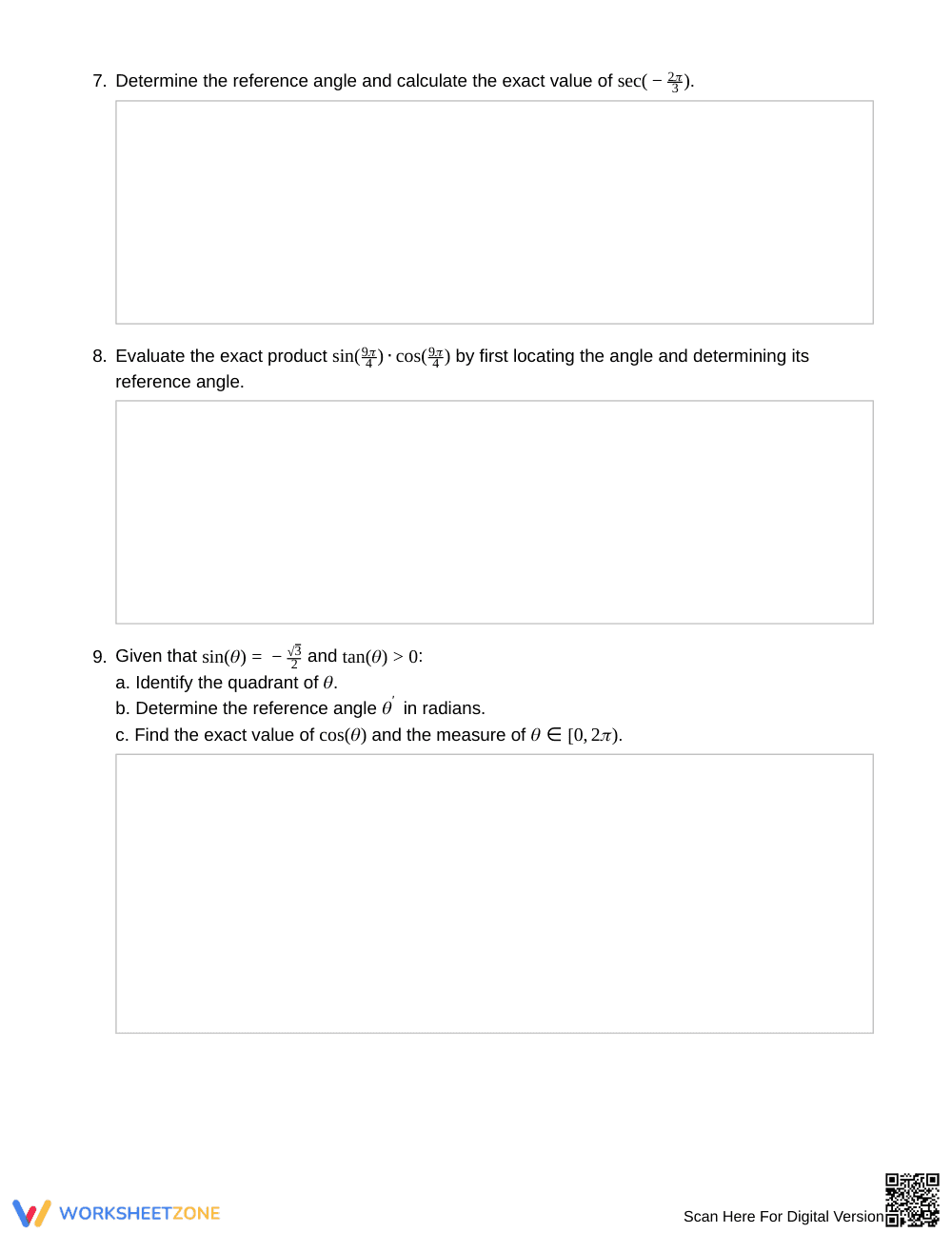
- Guided practice (Problems 1–4): Structured four-part scaffolds guide students step by step through identifying quadrants, selecting reference formulas, calculating reference angles, and finding exact radical values.
- Supported practice (Problems 5–8): Semi-independent tasks require learners to determine coterminal angles, compute reference values, and evaluate reciprocal trigonometric products with minimal prompting.
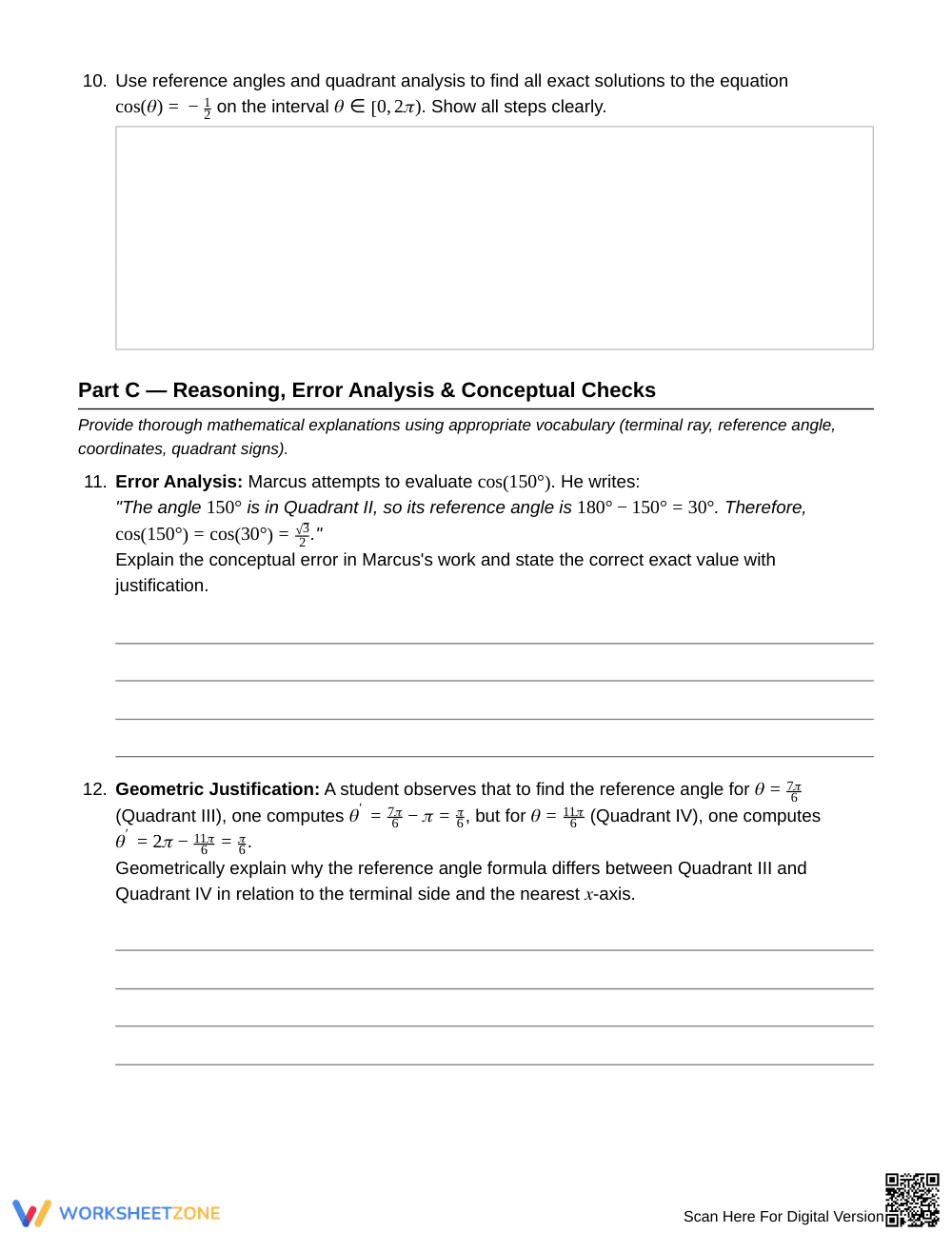
- Independent practice (Problems 9–12): Unscaffolded problems challenge students with inverse reasoning, multi-solution trigonometric equations, error analysis, and geometric justifications.
This structured progression follows the gradual-release framework, moving learners smoothly from direct procedural support to conceptual mastery.
Standards Alignment
This worksheet directly aligns with primary standard `HSF-TF.A.3`: Use special triangles to determine geometrically the values of sine, cosine, tangent for common angle measures, and use the unit circle to express the values of trigonometric functions for standard angles in terms of reference values. Both standard codes can be copied directly into lesson plans, IEP goals, or district curriculum mapping tools.
How to Use It
Assign this resource immediately following direct instruction on the unit circle or as targeted reinforcement before assessing analytic trigonometry. During classwork, formatively assess whether students measure reference angles relative to the horizontal x-axis rather than the vertical y-axis. Most Grade 12 students will complete the 12 problems within 45 to 60 minutes.
Who It's For
Designed for Grade 12 Precalculus and Advanced Trigonometry students, this worksheet offers structured entry points for struggling learners alongside rigorous analytic extensions for advanced math tracks. Pair this activity directly with a unit circle visual anchor chart or coordinate plane graphing lesson.
According to Fisher & Frey (2014), structured instructional frameworks that transition systematically from modeled examples to independent problem-solving significantly enhance long-term procedural fluency and conceptual retention in secondary mathematics. Standard HSF-TF.A.3 requires students to locate reference angles, apply quadrant signs, and geometrically evaluate exact trigonometric values. This 12-task Precalculus worksheet operationalizes this research through explicit quadrant reference formulas, worked models, and scaffolded practice sets that target common trigonometric misconceptions. By combining mechanical computation with high-level error analysis and geometric reasoning, the resource ensures students do not merely memorize trigonometric tables but construct a robust understanding of symmetry across the coordinate plane. Mathematics educators can rely on this aligned resource for standards-based instruction, targeted remediation, and IEP documentation.


