































Complete Read Coordinates Worksheet | Grade 6 Math

Paste this activity's link or code into your existing LMS (Google Classroom, Canvas, Teams, Schoology, Moodle, etc.).
Students can open and work on the activity right away, with no student login required.
You'll still be able to track student progress and results from your teacher account.
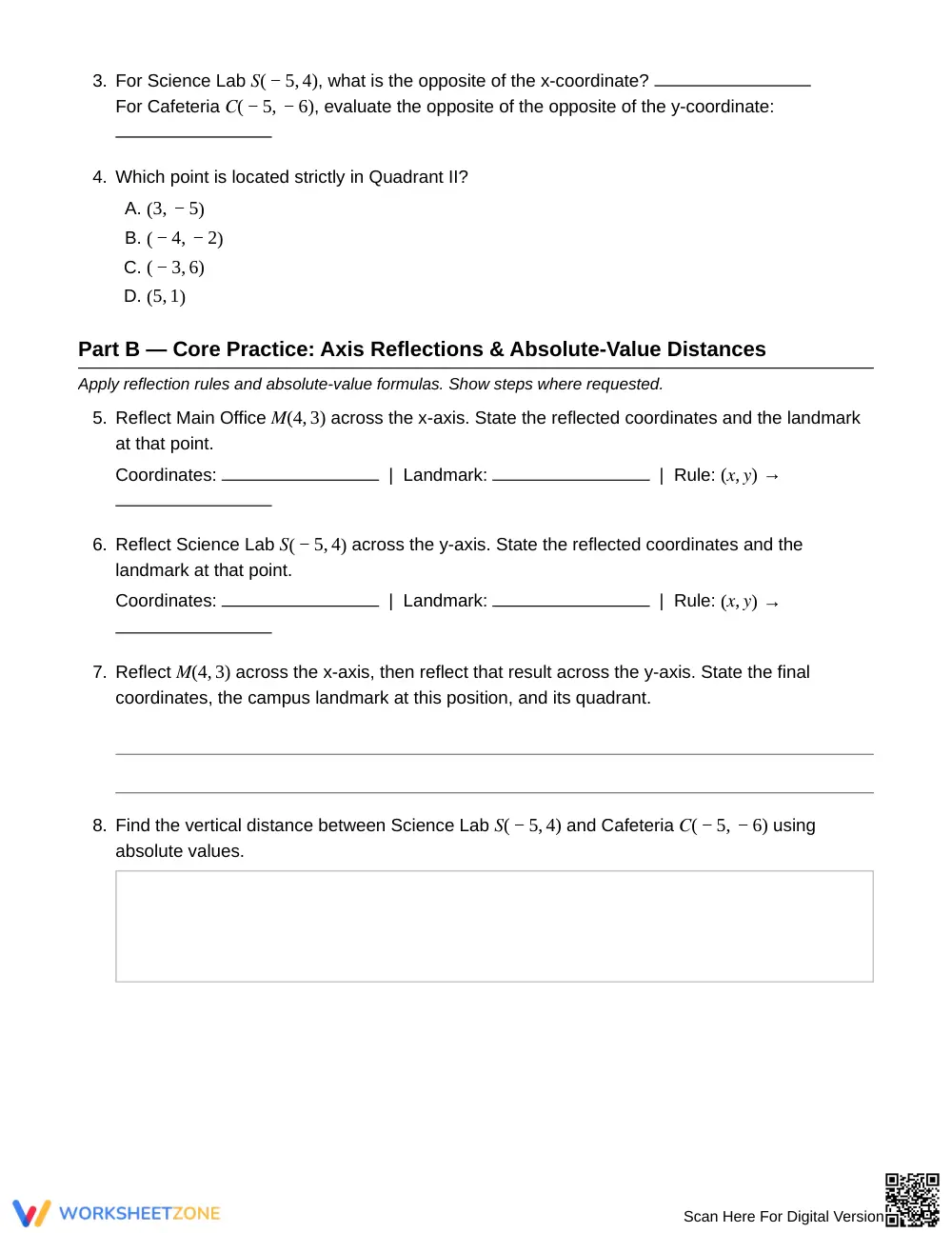
Master coordinate graphing with this focused practice resource. Students locate ordered pairs, determine quadrant placements, calculate absolute-value distances, and execute geometric reflections across both axes. A clear reference header reinforces foundational sign rules before students tackle multi-step coordinate problems across a realistic campus map grid.
At a Glance
- Grade: 6 · Subject: Math
- Standard:
6.NS.C.6— Understand rational numbers as points in all four quadrants of the coordinate plane- Skill Focus: Read Coordinates and Axis Relationships
- Format: 5 pages · 18 problems · Answer key included · PDF
- Best For: Core skill reinforcement and independent practice
- Time: 35–45 minutes
What's Inside
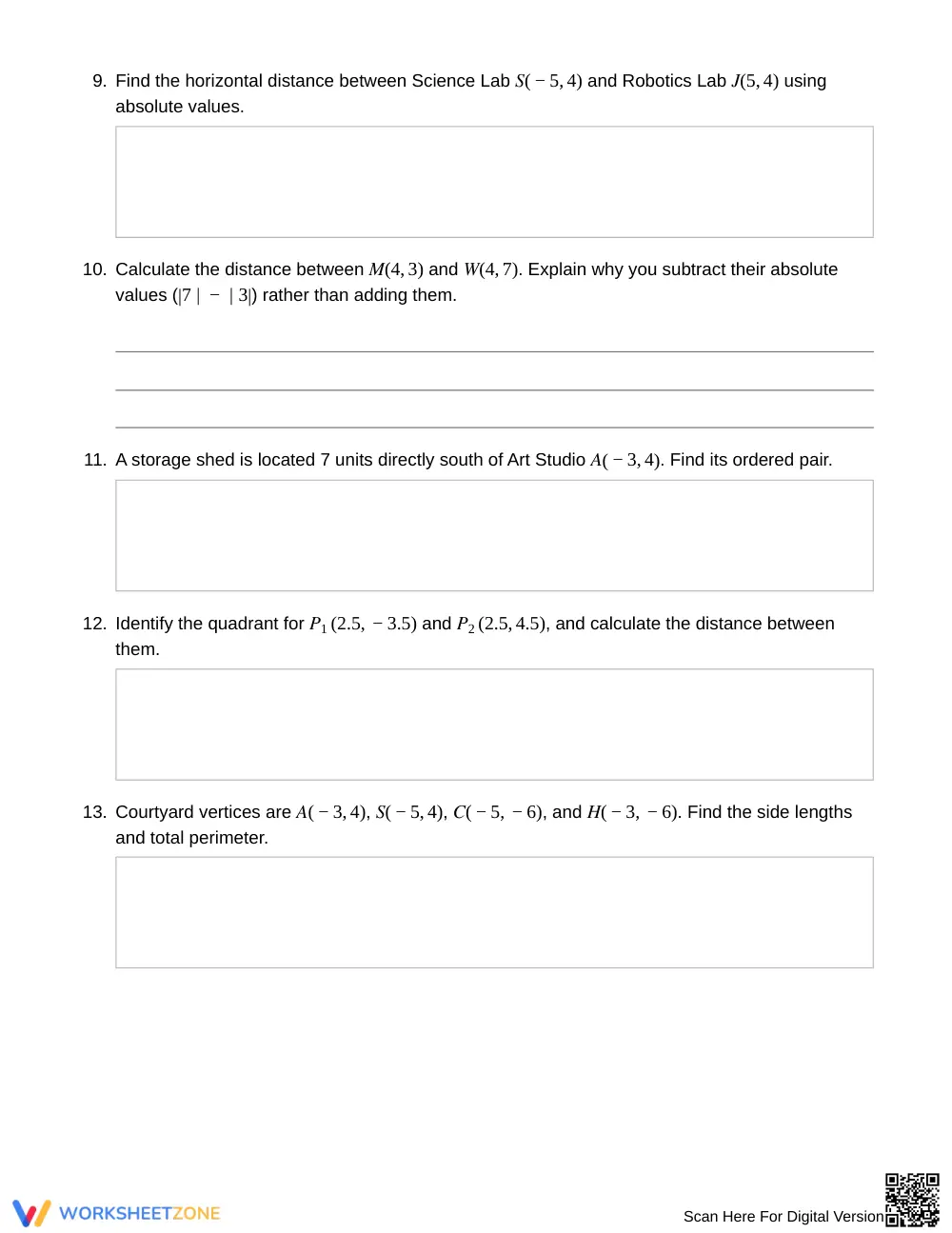
This 5-page worksheet includes 18 rigorous tasks, complete with a structured campus map layout, coordinate reflection formulas, and an error-analysis breakdown. A comprehensive 2-page answer key provides exact coordinate pairs, step-by-step distance calculations, and sample student explanations for immediate feedback.
Skill Progression
- Guided practice (Problems 1–4): Students read landmarks from a campus grid, name quadrants without graphing, find opposite values, and identify points strictly within designated quadrants.
- Supported practice (Problems 5–14): Learners perform single and double axis reflections, apply absolute-value distance rules across shared axes, calculate perimeters, and analyze common subtraction errors.
- Independent practice (Problems 15–18): Students solve multi-segment pathway distances, locate unknown points from algebraic clues, debug compound calculation mistakes, and write generalized algebraic reflection statements.
This structured progression reflects the gradual-release model, guiding students from foundational coordinate recognition toward abstract, variable-based spatial reasoning.
Standards Alignment
Primary Standard: `6.NS.C.6` — Understand a rational number as a point on the number line. Extend number line diagrams and coordinate axes familiar from previous grades to represent points on the line and in the plane with negative number coordinates. Supporting Standard: `6.NS.C.8` — Solve real-world and mathematical problems by graphing points in all four quadrants of the coordinate plane, including computing absolute-value distances. Both standard codes can be copied directly into lesson plans, IEP goals, or district curriculum mapping tools.
How to Use It
Deploy this activity immediately after direct instruction on the four quadrants and axis reflections. For formative assessment, observe whether students add or subtract absolute values in Problems 8–10 to catch sign confusion early. Expected completion time is 35 to 45 minutes as an in-class assignment or paired lab activity.
Who It's For
Designed for Grade 6 general mathematics students, accelerated Grade 5 learners, or Grade 7 students requiring intervention on rational numbers. Pair this worksheet directly with an interactive coordinate grid anchor chart or a real-world map-reading lesson.
Educational research synthesized by Fisher & Frey (2014) highlights that structured shifts from concrete graphical representations to abstract coordinate generalizations significantly accelerate math concept retention. Aligned to standard 6.NS.C.6, this worksheet establishes systematic mastery of coordinate planes, sign-based quadrant recognition, and horizontal and vertical distance formulas using absolute value. By integrating 18 scaffolded tasks across five pages, the resource transitions students from simple landmark identification to rigorous error analysis and algebraic notation. Each problem reinforces spatial reasoning and precise geometric vocabulary, ensuring students develop procedural fluency alongside conceptual understanding. Complete with a 2-page answer key, this resource gives educators an actionable, standards-aligned tool for formative checks, targeted small-group intervention, and measurable IEP skill tracking.


