































Complete Projectile Motion Worksheet | Grades 8-12 Science

Paste this activity's link or code into your existing LMS (Google Classroom, Canvas, Teams, Schoology, Moodle, etc.).
Students can open and work on the activity right away, with no student login required.
You'll still be able to track student progress and results from your teacher account.
This comprehensive science worksheet trains students to sequence the critical stages of two-dimensional flight and calculate step-by-step kinematic changes. Learners evaluate position coordinates, resolve independent velocity vectors, and predict trajectory modifications across 25 structured practice items. The resource builds conceptual mastery of gravity-driven motion from initial launch to terminal impact.
At a Glance
- Grade: Grades 8–12 · Subject: Science
- Standard: High School Physical Science — Model two-dimensional motion and track independent velocity vectors
- Skill Focus: Sequencing projectile flight stages and tracking velocity changes
- Format: 4 pages · 25 problems · Answer key included · PDF
- Best For: High school physics projectile motion unit
- Time: 45–60 minutes
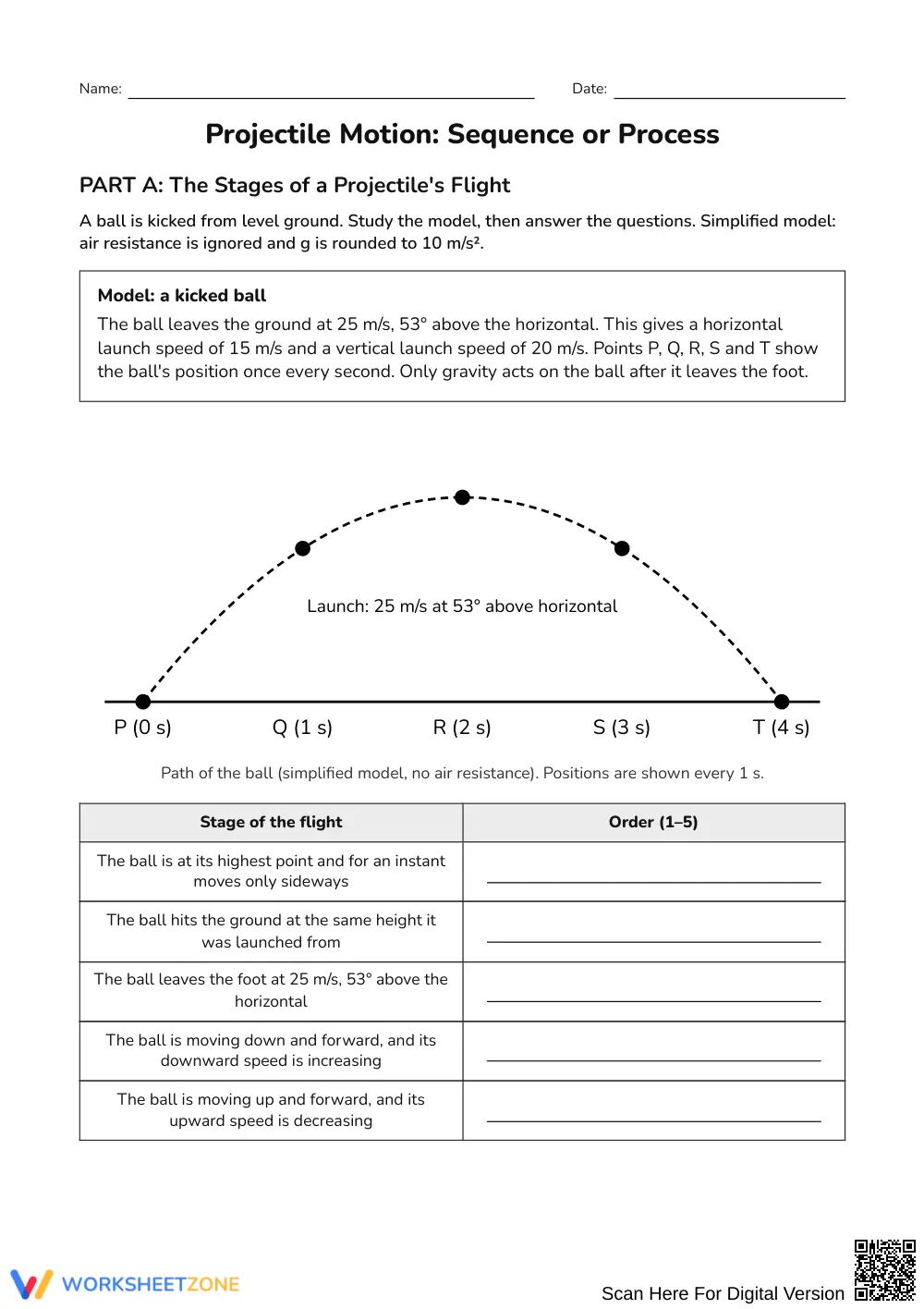
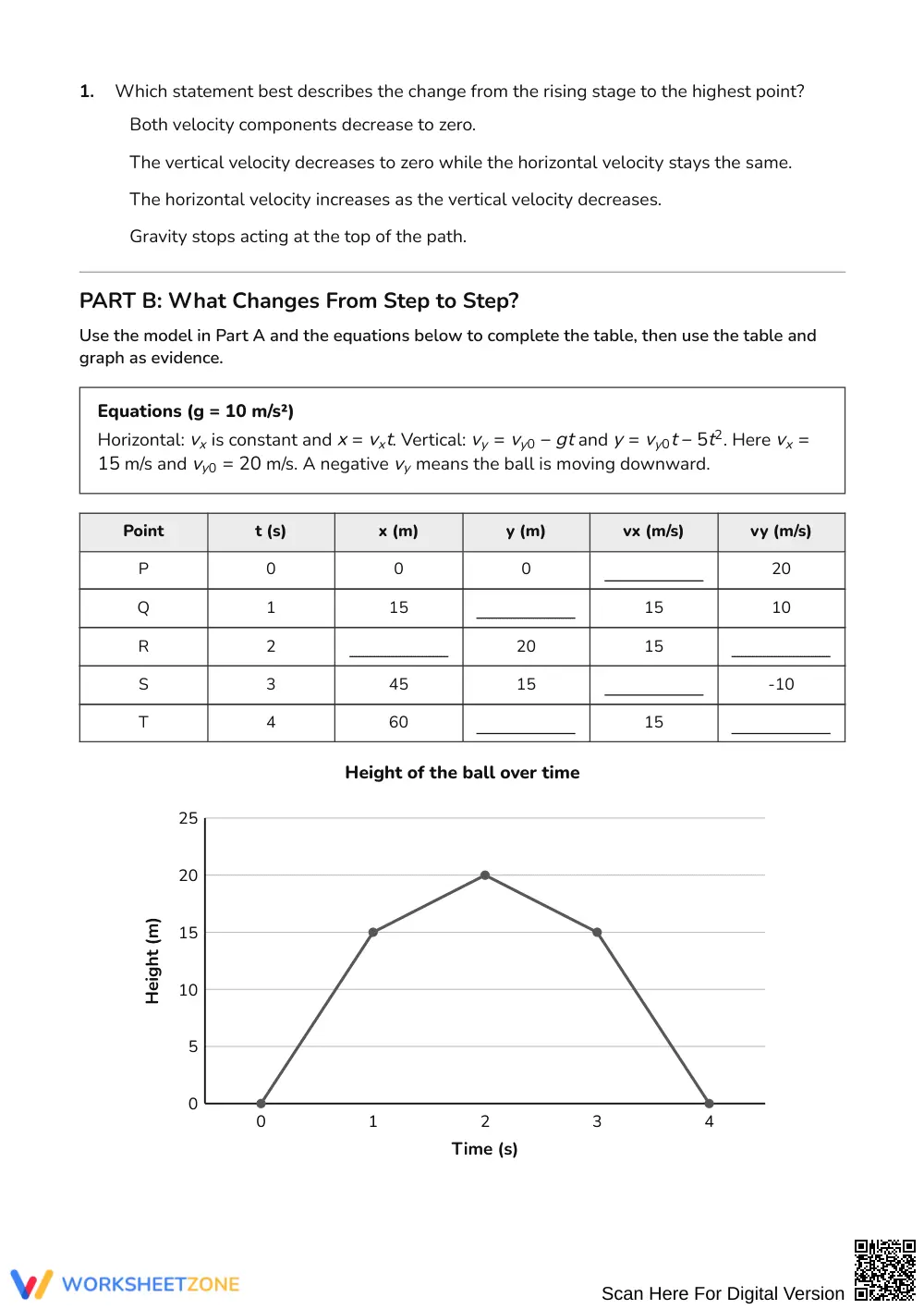
Across 4 focused pages, students work through sequential trajectory diagrams, coordinate data tables, and height-versus-time plots. The packet includes a five-stage trajectory ordering exercise, tabular point-by-point calculations, conceptual justification prompts, and comparative angle analyses. A comprehensive four-page answer key provides complete numerical solutions, step-by-step vector breakdowns, and sample written explanations for immediate verification.
Skill Progression
- Guided Practice (Part A, 6 tasks): Students analyze a visual 53-degree launch model, sequence five discrete flight stages from release to landing, and isolate vertical velocity decay under constant downward gravitational acceleration.
- Supported Practice (Part B, 11 tasks): Learners calculate position and velocity vectors across one-second intervals in a data table, graph height over time, and explain why horizontal speed remains constant while vertical velocity changes by negative 10 m/s each second.
- Independent Practice (Part C, 8 tasks): Working with a modified 37-degree trajectory, students compute flight duration, determine peak height, explain identical 60-meter ranges across complementary angles, and evaluate launch angles for maximum hang time.
This deliberate structure mirrors the gradual-release instructional model, shifting students from guided trajectory identification to independent mathematical reasoning.
Standards Alignment
This resource aligns with high school physical science standards for forces and motion, focusing on analyzing motion data, resolving independent vector components, and predicting trajectories under uniform acceleration. Students demonstrate that orthogonal components operate independently under Earth's gravitational field. Both standard codes can be copied directly into lesson plans, IEP goals, or district curriculum mapping tools.
How to Use It
Deploy this worksheet immediately after direct instruction on horizontal and vertical vector independence. During classwork, circulate to monitor Part B, checking whether students recognize that vertical velocity reaches exactly zero at peak height while horizontal velocity stays constant. The 45-to-60-minute activity functions effectively as paired cooperative practice or as an independent diagnostic assessment prior to formal kinematics exams.
Who It's For
This activity supports introductory physical science students, conceptual physics classes, and AP Physics learners needing concrete representational practice. Scaffolding features, such as explicit kinematic formulas and labeled coordinate points, assist emerging learners. Pair this worksheet directly with a ballistic trajectory simulation or an introductory vector resolution lesson.
According to Fisher & Frey (2014), structured sequencing tasks that require students to explain state changes across sequential steps significantly reinforce conceptual retention in secondary STEM disciplines. This 4-page projectile motion worksheet operationalizes that research by leading students through 25 targeted tasks that isolate horizontal and vertical motion components across consecutive flight intervals. By calculating discrete positions and velocities, secondary learners confront the persistent misconception that gravitational acceleration changes at peak altitude. Rigorous vector tracking ensures that students connect visual trajectory curves directly to underlying kinematic principles.


