


























Views
Downloads



Complete Probability Table Worksheet | Grade 12 Statistics
Paste this activity's link or code into your existing LMS (Google Classroom, Canvas, Teams, Schoology, Moodle, etc.).
Students can open and work on the activity right away, with no student login required.
You'll still be able to track student progress and results from your teacher account.
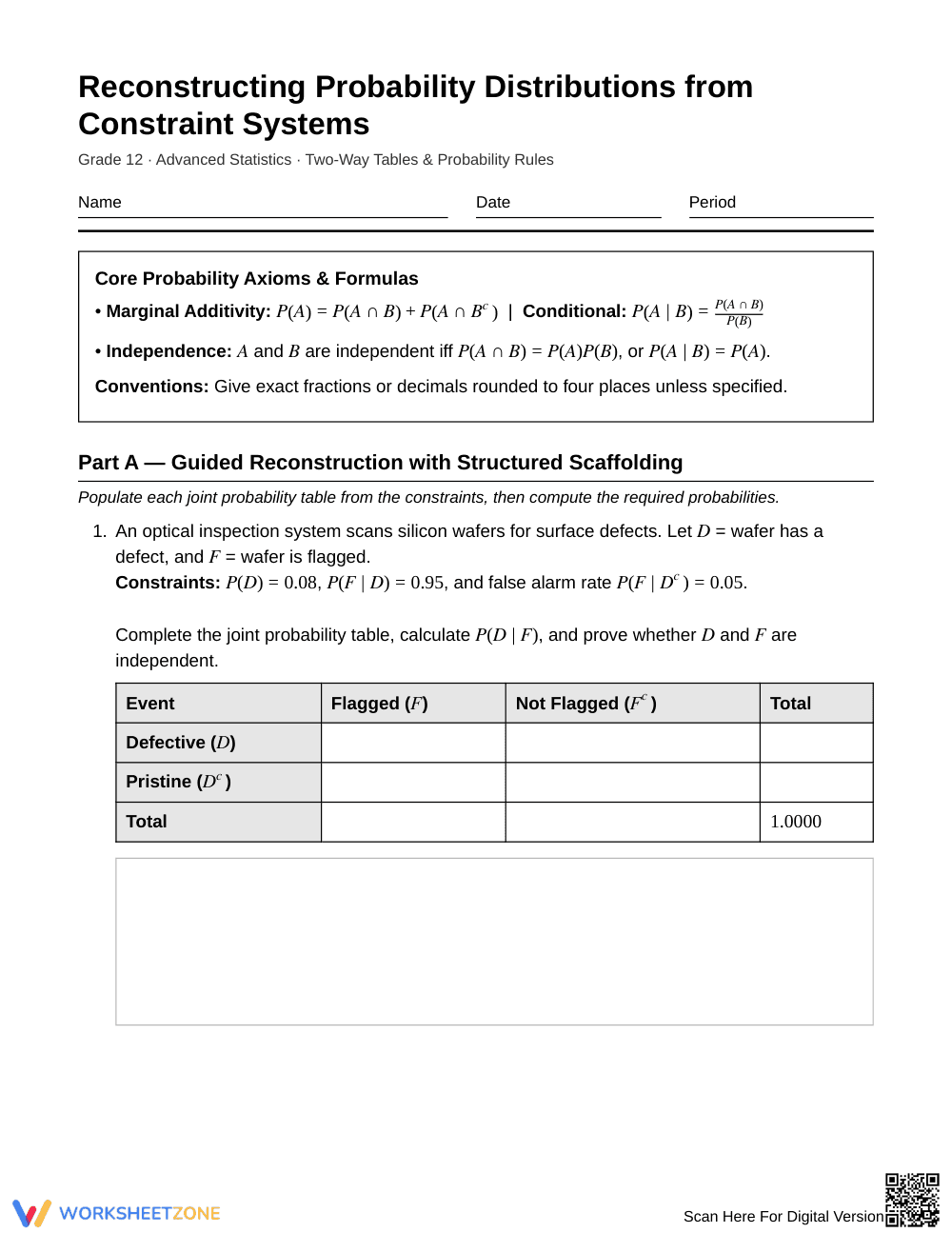
Mastering probability distributions requires translating constraints into complete two-way tables. This 5-page worksheet provides 6 structured problems to help Grade 12 statistics students reconstruct joint tables using marginal additivity, compute conditional probabilities, and evaluate independence across realistic scientific and technical scenarios.
At a Glance
- Grade: 12 · Subject: Statistics
- Standard:
HSS-CP.A.4— Construct and interpret two-way frequency tables of data when two categories are associated- Skill Focus: Reconstruct a Probability Table from Constraints
- Format: 5 pages · 6 problems · Answer key included · PDF
- Best For: Advanced probability review and AP test prep
- Time: 45–60 minutes
What's Inside
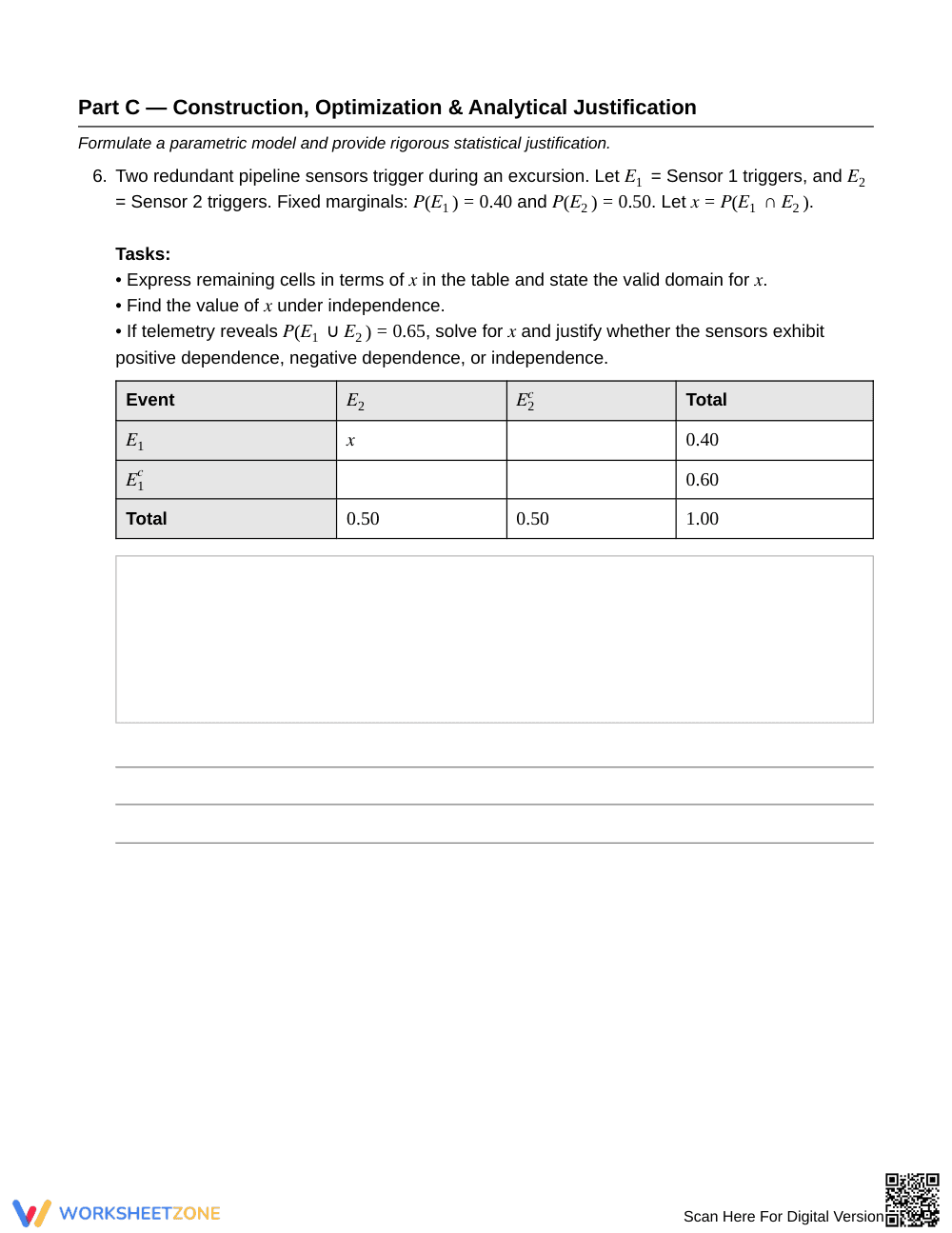
This 5-page resource includes 6 multi-step problems and a 3-page answer key with step-by-step solutions. A reference box provides essential axioms, including marginal additivity, conditional formulas, and independence rules. Students solve joint probability and frequency tables across technical scenarios like silicon wafer testing, cybersecurity monitoring, and pipeline telemetry.
Skill Progression
- Guided practice (Part A — 2 problems): Scaffolded 2x2 tables where students convert marginal and conditional rates into joint values and compute false alarm metrics.
- Supported practice (Part B — 3 problems): Multi-step scenarios requiring students to resolve union probabilities, convert raw frequencies, and evaluate independence.
- Independent practice (Part C — 1 problem): Parametric modeling where students express cells with a variable, identify domain limits, and justify dependence.
This sequence follows a gradual-release model from scaffolded computation to open-ended parametric analysis.
Standards Alignment
This worksheet aligns with HSS-CP.A.4: Construct and interpret two-way frequency tables of data when two categories are associated with each object. It supports HSS-CP.A.3 through conditional probability calculations and independence checks. Both standard codes can be copied directly into lesson plans, IEP goals, or district curriculum mapping tools.
How to Use It
Assign this resource after direct instruction on the general multiplication rule and Bayes' theorem. It works well as partner work or an individual assessment taking 45 to 60 minutes. During Part B, check whether students conflate conditional probability P(A|B) with intersection probability P(A∩B), directing them to table row totals to correct errors.
Who It's For
Built for Grade 12 Statistics and AP Statistics students, this activity challenges advanced analytical thinkers. Support struggling students with the Part A formula reference box as an anchor chart, while assigning Part C to honors learners. Pair this worksheet with contingency table data sets to help students connect tabular values with sample space diagrams.
Mastering two-way contingency distributions under standard HSS-CP.A.4 requires secondary mathematics students to reconstruct probability tables from constraints, evaluate conditional probabilities, and verify statistical independence. According to research from Fisher & Frey (2014) on purposeful instructional design, structured problem sequences that transition systematically from scaffolded joint distributions to independent parametric formulations significantly deepen conceptual transfer in advanced quantitative coursework. By engaging directly with real-world constraint systems across manufacturing quality control, cybersecurity audits, and redundant sensor telemetry, Grade 12 learners develop robust algebraic models that bridge theoretical probability axioms with applied statistical reasoning. Students consistently strengthen their capacity to distinguish intersection probabilities from conditional rates while defending analytical conclusions with formal mathematical evidence. This rigorous multi-step practice equips high school statisticians with the procedural mastery and analytical stamina required for college-level data analysis and advanced coursework.


