































Complete Probability Models Worksheet | Grade 7 Math

Paste this activity's link or code into your existing LMS (Google Classroom, Canvas, Teams, Schoology, Moodle, etc.).
Students can open and work on the activity right away, with no student login required.
You'll still be able to track student progress and results from your teacher account.
This Grade 7 math worksheet equips students to master probability models and equally likely outcomes through 16 structured problems. Students analyze sample spaces, calculate theoretical probabilities, and evaluate chance experiments across geometric and real-world contexts, building deep conceptual understanding and quantitative accuracy.
At a Glance
- Grade: 7 · Subject: Math
- Standard:
7.SP.C.7— Develop and evaluate probability models by comparing theoretical and experimental outcomes- Skill Focus: Probability and Equally Likely Outcomes
- Format: 5 pages · 16 problems · Answer key included · PDF
- Best For: Guided practice and conceptual mastery
- Time: 45–60 minutes
What's Inside
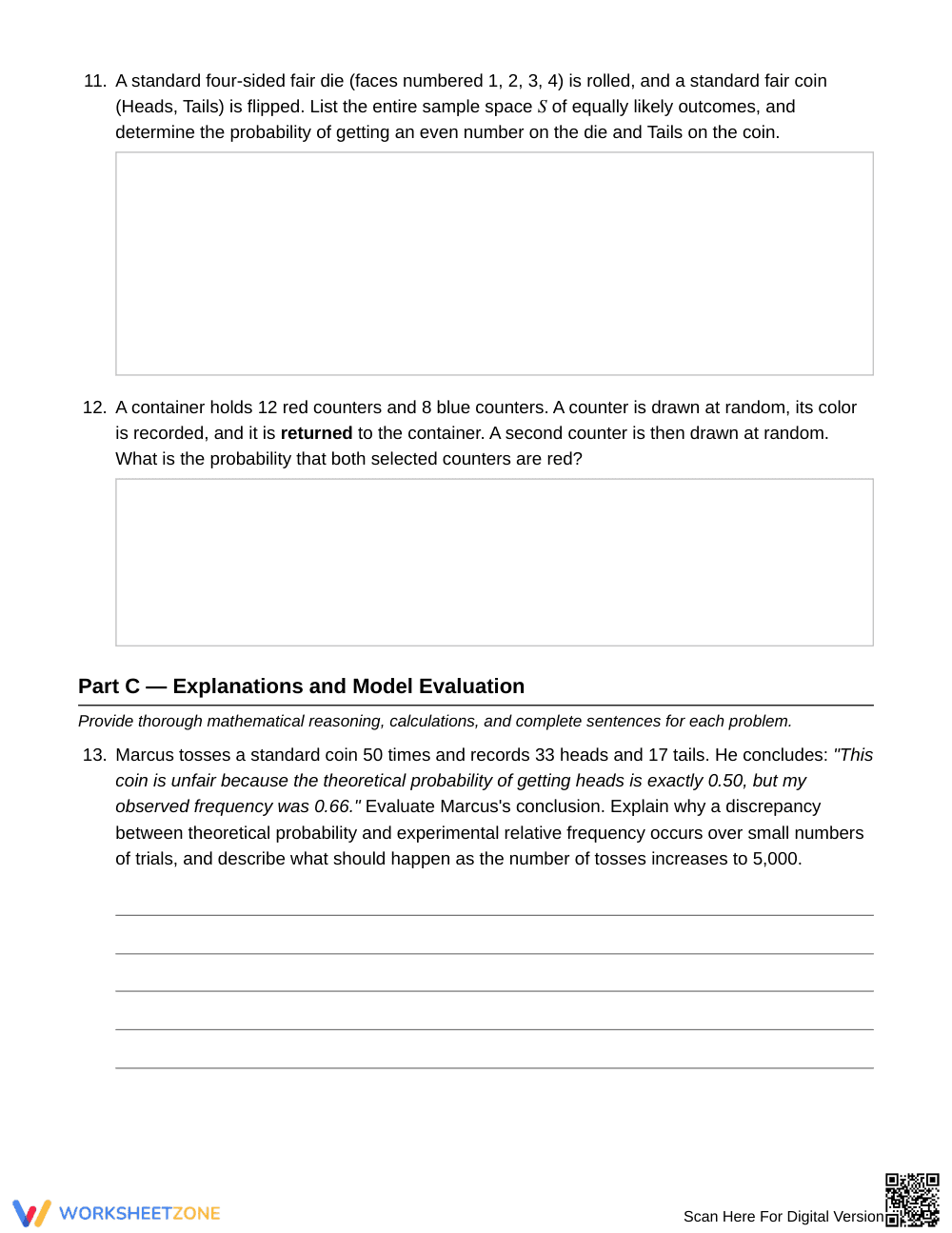
The resource includes 5 pages with 16 tasks divided into three sections, anchored by a "Core Probability Principles" reference box. Students complete conceptual questions, calculate exact fractional probabilities, analyze defect data, and evaluate compound outcomes. A full 4-page answer key provides complete solutions and explanations.
Skill Progression
- Guided Practice (Part A, 4 problems): Classify uniform versus non-uniform models and identify common probabilistic misconceptions.
- Supported Practice (Part B, 8 problems): Calculate exact theoretical probabilities for spinners, polyhedra, letter tiles, and empirical defect tables.
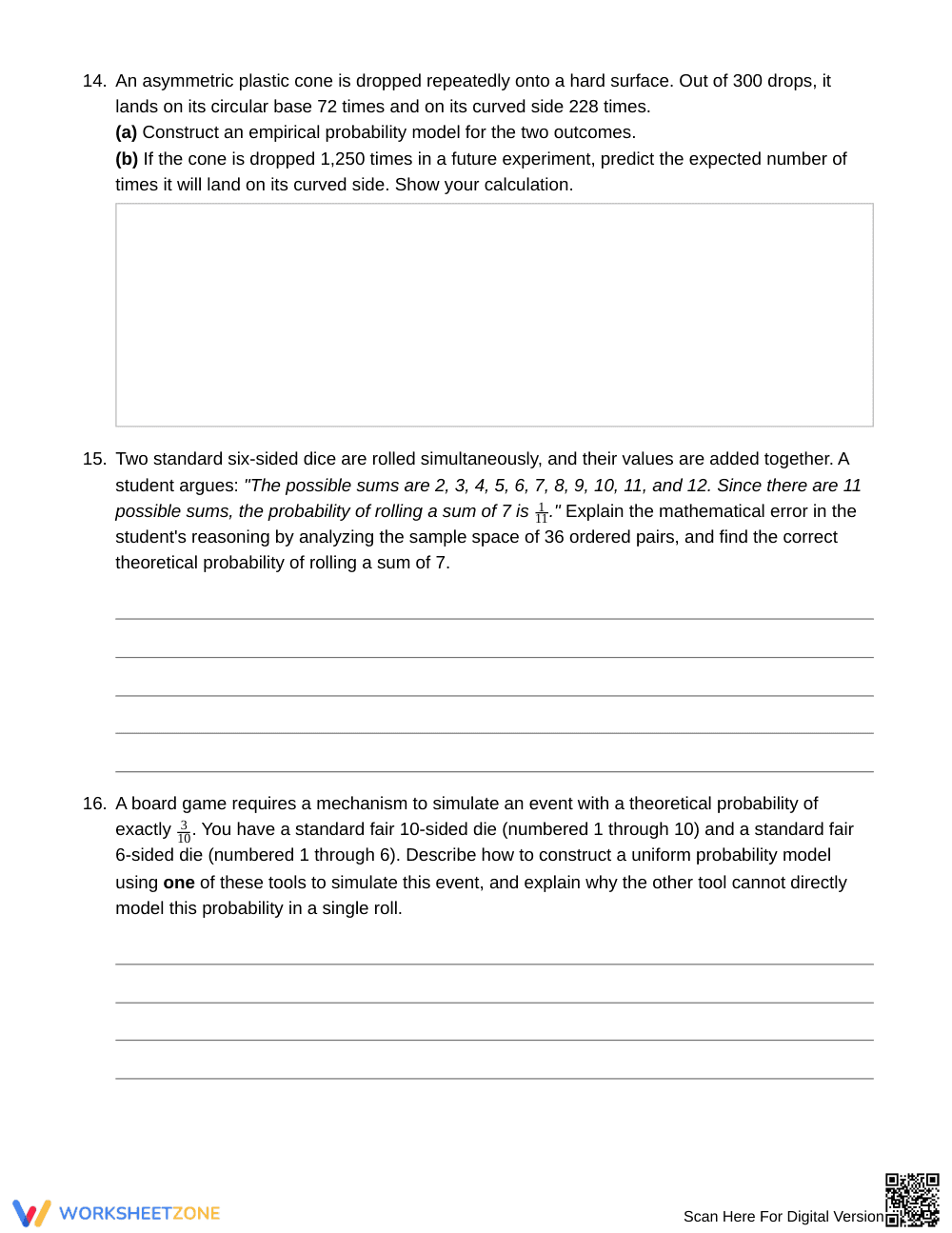
- Independent Practice (Part C, 4 problems): Evaluate experimental trials, construct predictive models, and critique sample space errors.
This progression uses a gradual-release model to build student independence from basic definitions to multi-step analysis.
Standards Alignment
This worksheet aligns directly to primary standard 7.SP.C.7: develop a probability model and find probabilities of events, comparing theoretical probabilities to observed frequencies. It also supports 7.SP.C.6 by predicting approximate relative frequencies. Both standard codes can be copied directly into lesson plans, IEP goals, or district curriculum mapping tools.
How to Use It
Use this worksheet during the practice phase of your probability unit. Pair students for Parts A and B, then assign Part C for independent evaluation. Observe whether students correctly list all 36 outcomes for two dice rather than assuming 11 sums are equally likely. Expected completion time is 45 to 60 minutes.
Who It's For
Designed for Grade 7 mathematics classes and targeted Grade 8 intervention. Built-in reference boxes support diverse learners and English language learners. Pair this resource with a hands-on dice or coin simulation lab to connect experimental frequencies with theoretical models.
Grounding probability instruction in uniform and non-uniform models is essential for middle school mathematical reasoning. According to Fisher & Frey (2014), structured instructional materials that scaffold students through guided conceptual classification, deliberate calculation practice, and written evaluative tasks significantly accelerate student autonomy and conceptual mastery. This worksheet directly targets standard 7.SP.C.7, guiding Grade 7 learners to develop theoretical probability models, compute exact likelihoods across diverse sample spaces, and critique observed discrepancies between empirical relative frequencies and expected theoretical outcomes. By requiring students to analyze common misconceptions—such as assuming all dice sums or experimental coin tosses occur with uniform frequency—the resource fosters rigorous analytical thinking. Teachers can utilize this 16-task resource to build verified mastery of chance processes, ensuring learners transition from basic ratio computations to sophisticated probabilistic reasoning that supports advanced high school data analysis.


