


























Views
Downloads
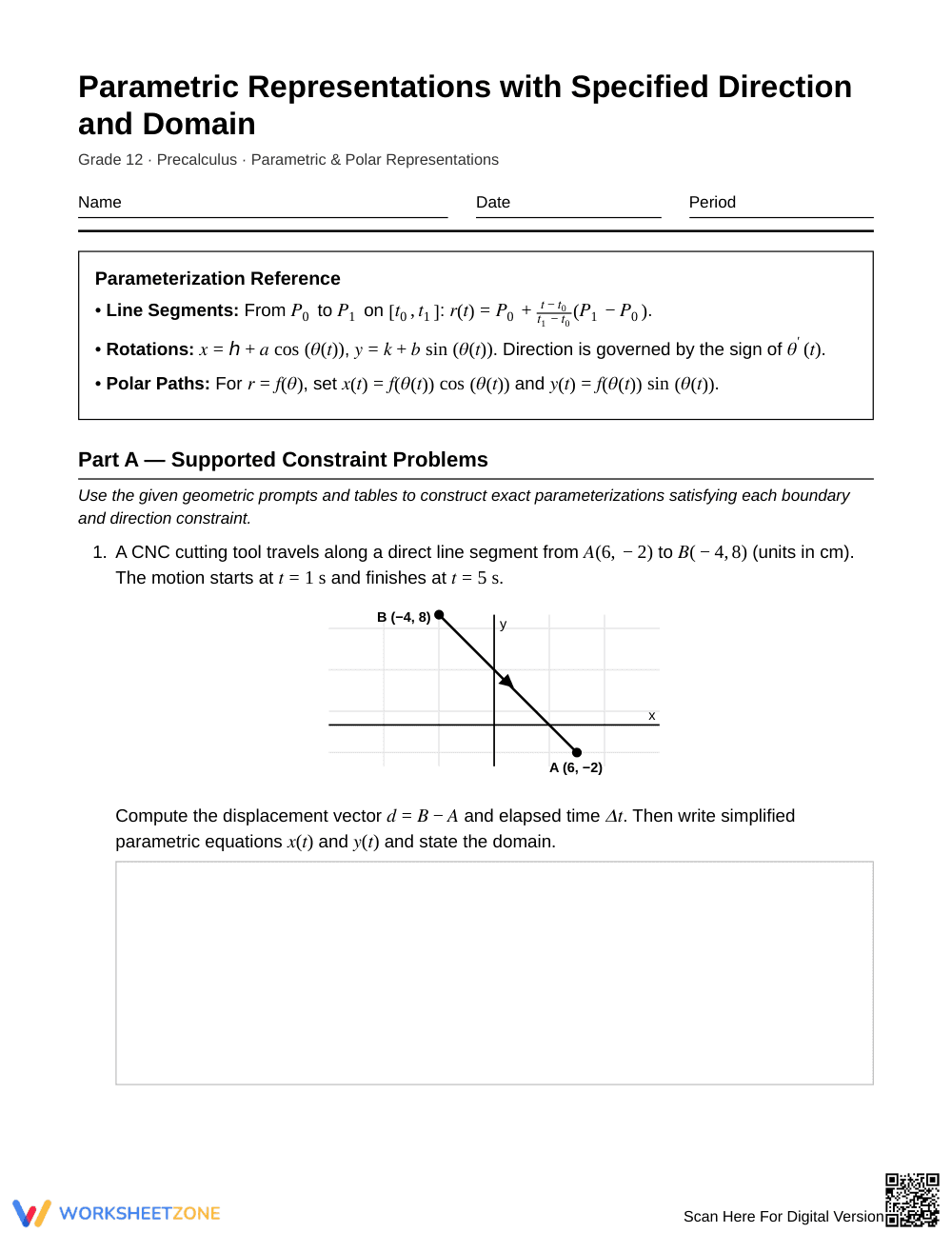
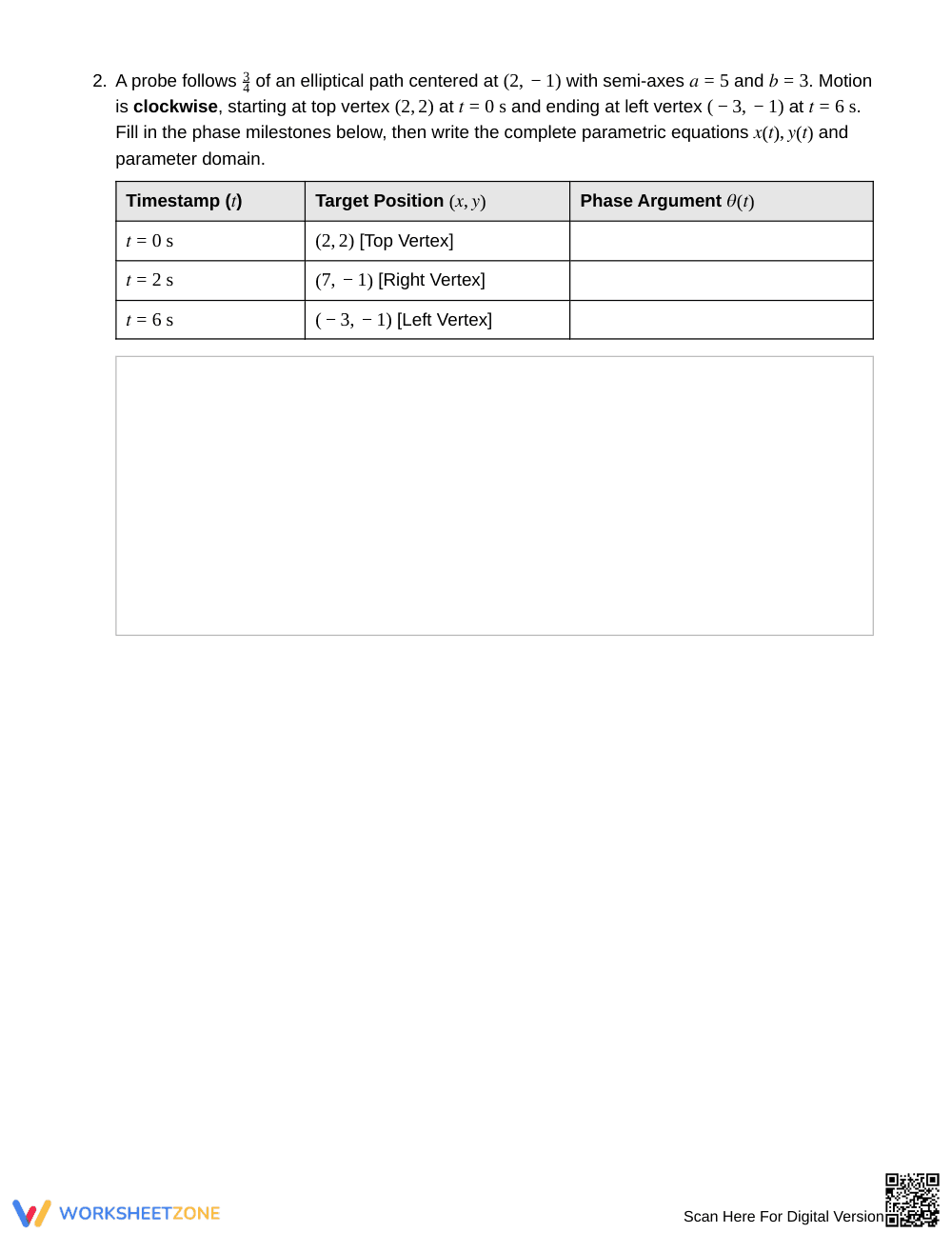

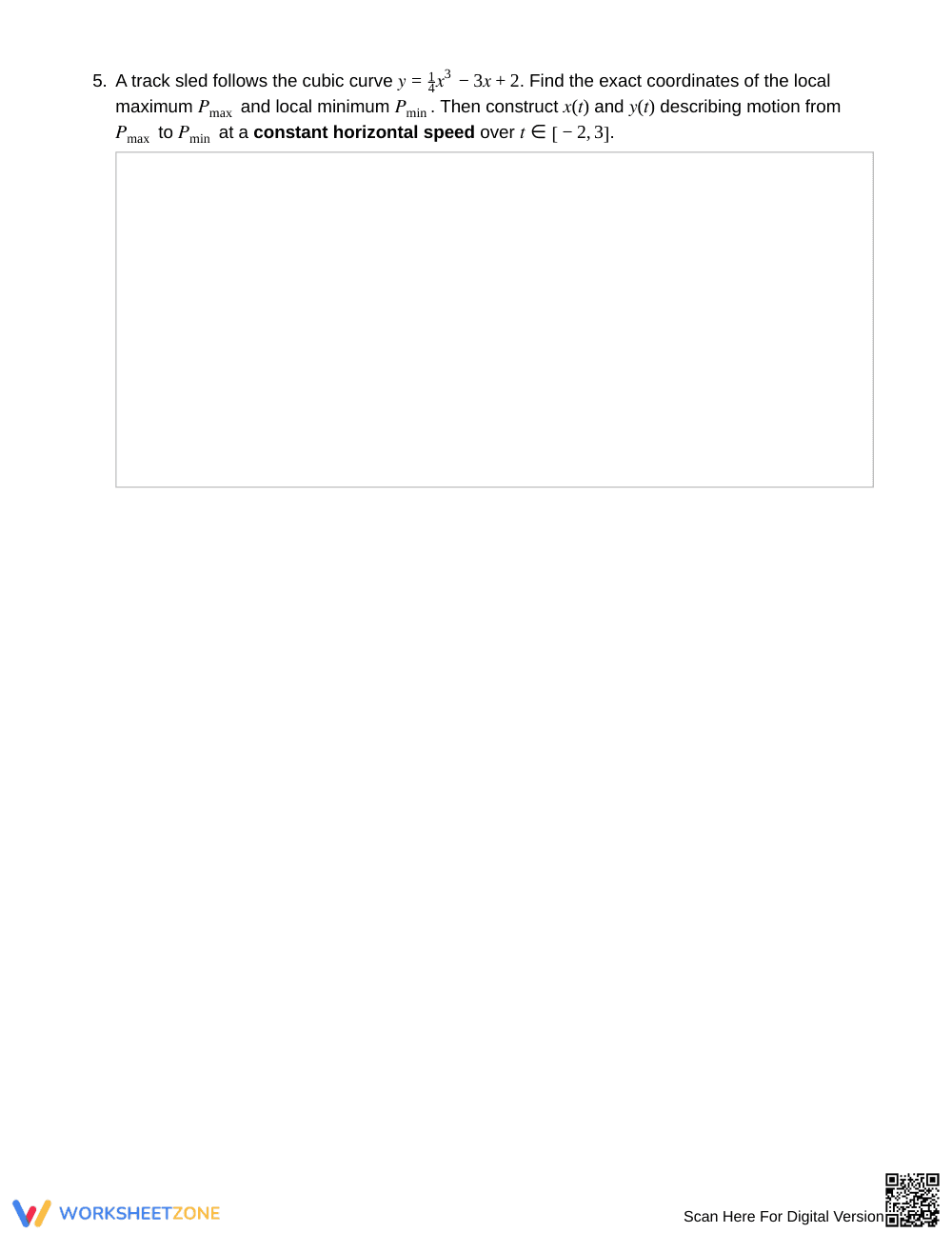
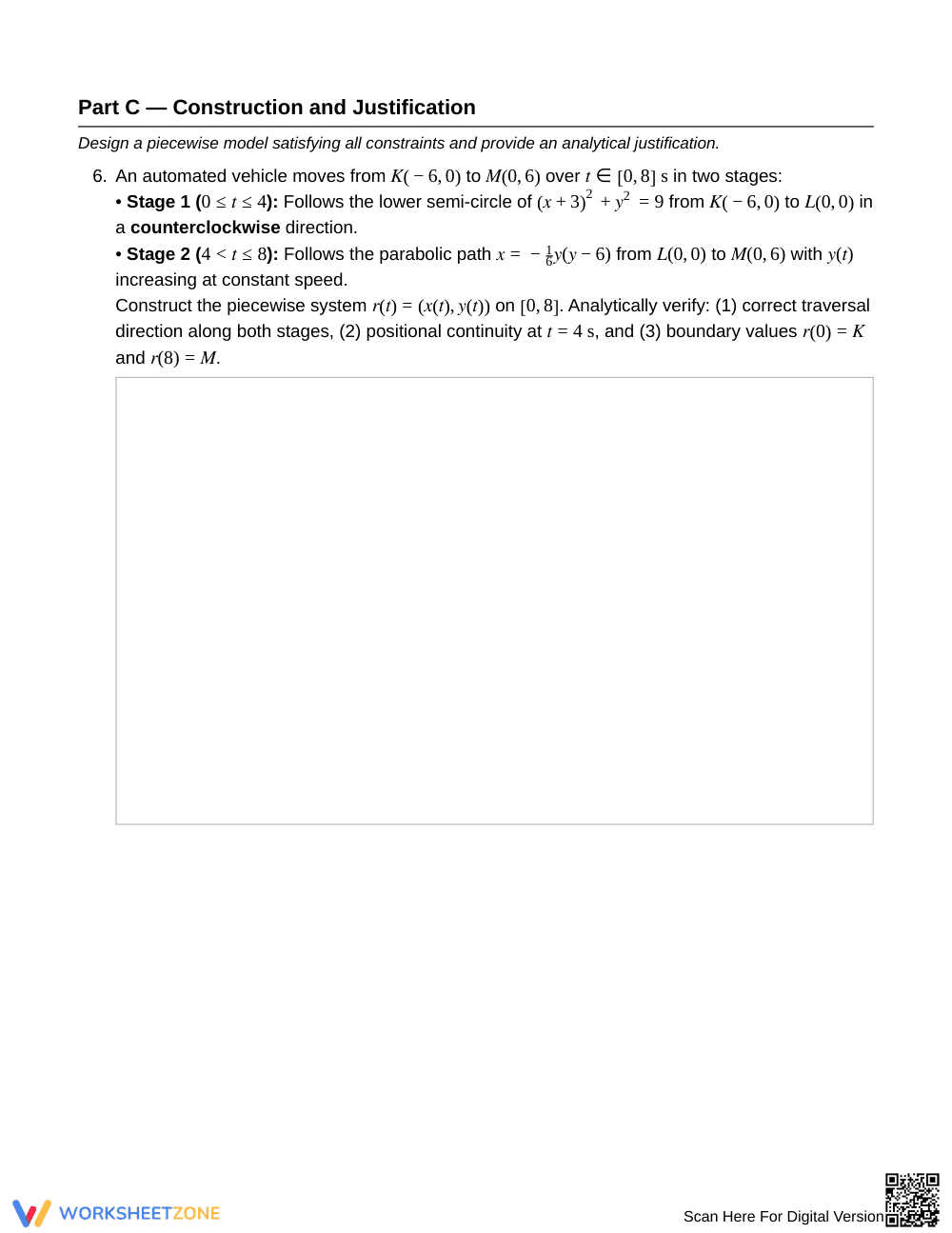

Complete Parameterization Worksheet | Grade 12 Precalculus
Paste this activity's link or code into your existing LMS (Google Classroom, Canvas, Teams, Schoology, Moodle, etc.).
Students can open and work on the activity right away, with no student login required.
You'll still be able to track student progress and results from your teacher account.
This Grade 12 Precalculus worksheet equips advanced mathematics students to construct precise parametric equations defined by specified directions and bounded intervals. Learners translate physical constraints—including linear paths, elliptical rotations, and piecewise curves—into vector functions, developing a rigorous understanding of dynamic orientation and parameter domains across six structured exercises.
At a Glance
- Grade: 12 · Subject: Precalculus
- Standard:
Parametric Modeling— Represent motion along curves using parameter intervals and directional components- Skill Focus: Construct parameterizations with specified direction and domain
- Format: 5 pages · 6 problems · Answer key included · PDF
- Best For: Advanced precalculus practice and analytical modeling
- Time: 45–60 minutes
What's Inside
The 5-page student document features six analytical problems across three sections, accompanied by a built-in Parameterization Reference guide for lines, rotations, and polar curves. Scaffolded tasks incorporate vector displacement prompts and phase milestone tables, while advanced items require complete coordinate derivations. A full two-page answer key provides step-by-step vector algebra, domain interval verifications, and continuity proofs.
Skill Progression
- Guided Practice (Part A, Problems 1–2): Students use displacement vectors and milestone tables to construct linear and elliptical paths with predefined endpoints under direct scaffolding.
- Supported Practice (Part B, Problems 3–5): Learners independently construct coordinate equations for circular routes, reverse cardioids, and polynomial extrema paths, solving for angular speeds and parameter intervals.
- Independent Practice (Part C, Problem 6): Students autonomously synthesize a piecewise motion model uniting a semicircle and parabola, verifying direction, positional continuity, and boundary adherence.
This architecture follows a gradual-release model, transitioning students from scaffolded vector decomposition toward autonomous algebraic modeling and formal analytical justification.
Standards Alignment
This worksheet aligns with Precalculus curricular standards for Parametric Equations and Motion Modeling, which require students to represent curves parametrically, model the path and velocity of an object moving in a plane, and restrict parameter domains to delineate specific segments. Both standard codes can be copied directly into lesson plans, IEP goals, or district curriculum mapping tools.
How to Use It
Deploy this worksheet after direct instruction on parametric foundations as an intensive problem set or workshop. During work time, observe phase angle assignments in Problem 2 to diagnose misconceptions regarding clockwise versus counterclockwise velocity signs. Expected completion time ranges between 45 and 60 minutes depending on whether Part C is completed collaboratively or as an individual assessment.
Who It's For
This resource serves Grade 12 Precalculus and AP Precalculus students mastering coordinate modeling and vector kinematics. For differentiation, struggling students can reference the formula reference box and milestone tables, while advanced learners complete the piecewise proofs in Part C. Pair this practice set with dynamic graphing demonstrations of moving parametric particles.
Structured coordinate parameterization demands that high school mathematicians coordinate multiple representations, connecting geometric trajectories to temporal variables and bounded domains. According to Fisher & Frey (2014), instructional frameworks that deliberately transition learners from supported constraint problems to complex, unassisted multi-stage synthesis significantly increase conceptual retention and mathematical autonomy. By initiating practice with vector displacement scaffolding and phase argument milestone tables before requiring piecewise continuity verifications, this parameterization resource scaffolds the cognitive load inherent in kinematic modeling. Students learn to systematically deduce horizontal and vertical component functions, enforce rotational orientations, and restrict parameter intervals. Empirical findings from Fisher & Frey (2014) indicate that guided problem sequences that culminate in written justification cultivate durable algebraic reasoning. Consequently, mastering parameterization with specified directions prepares Grade 12 learners for the multi-variable vector analysis and calculus applications required in postsecondary STEM courses.


