





























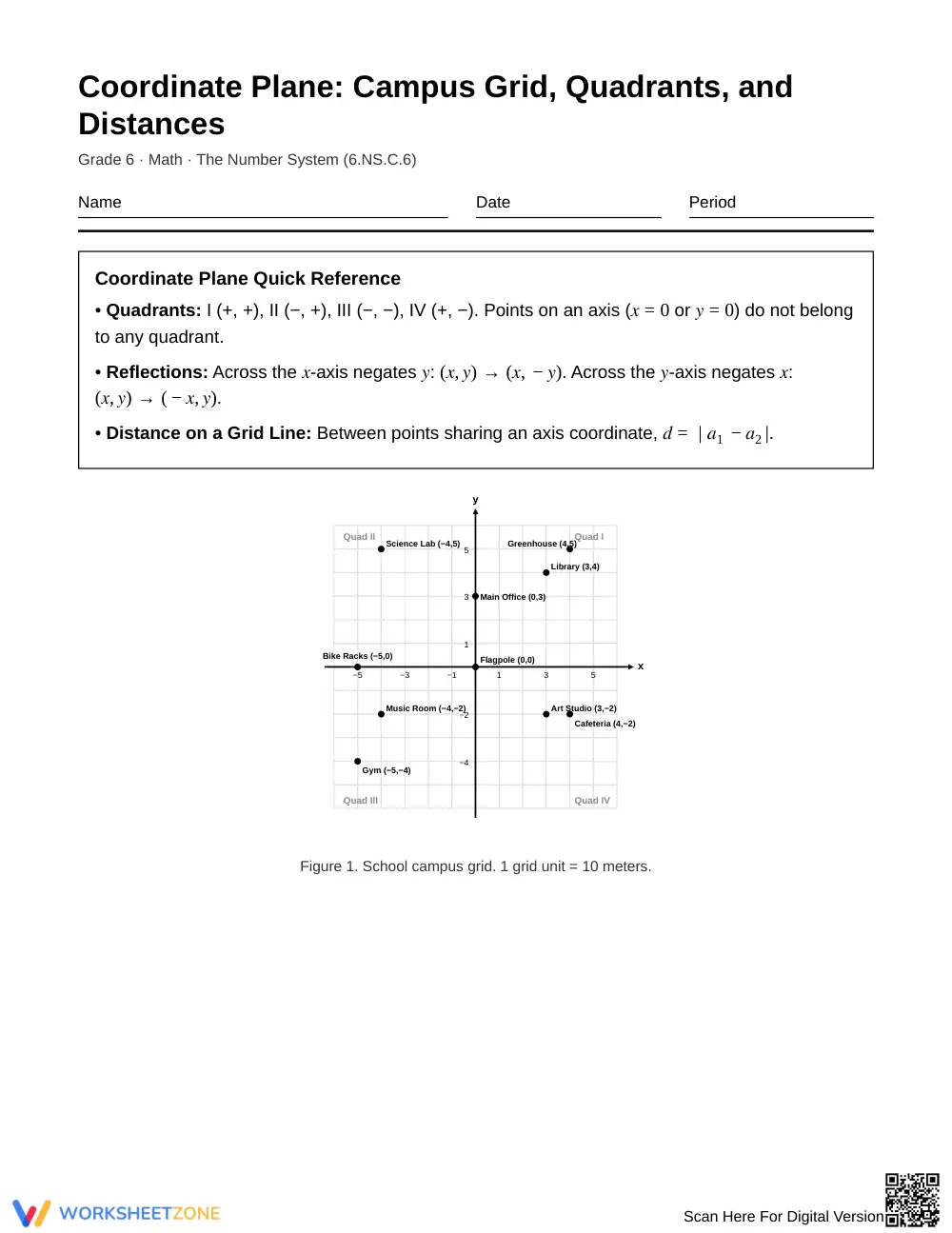


Complete Ordered Pairs & Quadrants Worksheet | Grade 6 Math

Paste this activity's link or code into your existing LMS (Google Classroom, Canvas, Teams, Schoology, Moodle, etc.).
Students can open and work on the activity right away, with no student login required.
You'll still be able to track student progress and results from your teacher account.
This Grade 6 math worksheet builds mastery in plotting ordered pairs across four quadrants, identifying reflections, and finding distances on grid lines. Anchored to a campus map, 16 structured problems connect integer signs with spatial coordinates and geometric reasoning.
At a Glance
- Grade: 6 · Subject: Math
- Standard:
6.NS.C.6— Understand signs of numbers in ordered pairs as indicating quadrant locations.- Skill Focus: Ordered Pairs and Quadrants
- Format: 4 pages · 16 problems · Answer key included · PDF
- Best For: Independent coordinate plane skill practice
- Time: 30–45 minutes
What's Inside
This 4-page resource includes a 2-page student worksheet and a 2-page answer key. A reference box defines quadrant signs, axis reflections, and absolute value distance rules. Students solve conceptual multiple-choice items, campus grid applications, and multi-step transfer problems involving reflections and perimeter.
Skill Progression
- Guided Practice (Items 1–4): Multiple-choice questions target quadrant signs, axis locations, and distance formulas.
- Supported Practice (Items 5–12): Map-based tasks ask students to identify coordinates, locate quadrants, reflect points, and compute horizontal and vertical distances.
- Independent Practice (Items 13–16): Multi-step problems require students to correct coordinate misconceptions, evaluate double reflections, and calculate perimeter.
This sequence uses gradual release to move learners from basic identification to complex spatial reasoning.
Standards Alignment
This worksheet aligns directly to primary standard 6.NS.C.6: Understand rational numbers as points on number lines and coordinate planes with negative coordinates. It also supports 6.NS.C.8 through distance calculations between points sharing an axis coordinate. Both standard codes can be copied directly into lesson plans, IEP goals, or district curriculum mapping tools.
How to Use It
Assign this worksheet after direct instruction on four-quadrant grids for independent practice or paired work. During class, check Part B items 7 and 8 as a formative checkpoint to ensure students distinguish reflections before attempting Part C. Completion time is 30 to 45 minutes.
Who It's For
This resource serves Grade 6 math classrooms, Tier 2 intervention groups, and accelerated fifth graders. The reference guide and visual map support diverse learning needs. Pair this worksheet with an interactive coordinate grid activity or an introductory integer lesson.
Grade 6 standard 6.NS.C.6 requires students to position rational number ordered pairs across all four quadrants and recognize how coordinate signs indicate spatial reflections. According to Fisher & Frey (2014), structured instructional materials that sequence tasks from guided conceptual sorting to authentic application produce significant gains in procedural fluency and conceptual transfer. This worksheet operationalizes that framework through a 16-task progression centered on an intuitive school campus grid. Learners move methodically from identifying quadrant sign conventions to calculating rectilinear distances with absolute value expressions, effectively overcoming common student misconceptions about axis intercepts and negative coordinates. With two student practice pages and an aligned two-page answer key, this resource provides classroom teachers with verifiable formative assessment data, ensuring middle school students build the foundational geometric and algebraic skills essential for advanced coordinate plane mathematics.


