




























Views
Downloads



Complete Nuclear Decay Worksheet | Grades 9-12 Science

Paste this activity's link or code into your existing LMS (Google Classroom, Canvas, Teams, Schoology, Moodle, etc.).
Students can open and work on the activity right away, with no student login required.
You'll still be able to track student progress and results from your teacher account.
Mastering nuclear reactions requires connecting atomic transformations to mathematical decay models. This 4-page worksheet guides high school science students through 26 rigorous tasks analyzing alpha, beta, and gamma decay. Students balance nuclear equations, graph half-life decay, trace decay series, and evaluate radiation shielding to demonstrate mastery of matter and energy changes.
At a Glance
- Grade: Grades 9–12 · Subject: Science
- Standard: High School Physical Science — Model nuclear decay processes, balance equations, and calculate half-life rates
- Skill Focus: Radioactive decay mechanisms, nuclear equations, and half-life calculations
- Format: 4 pages · 26 problems · Answer key included · PDF
- Best For: Cumulative unit assessment or review
- Time: 45–60 minutes
What's Inside
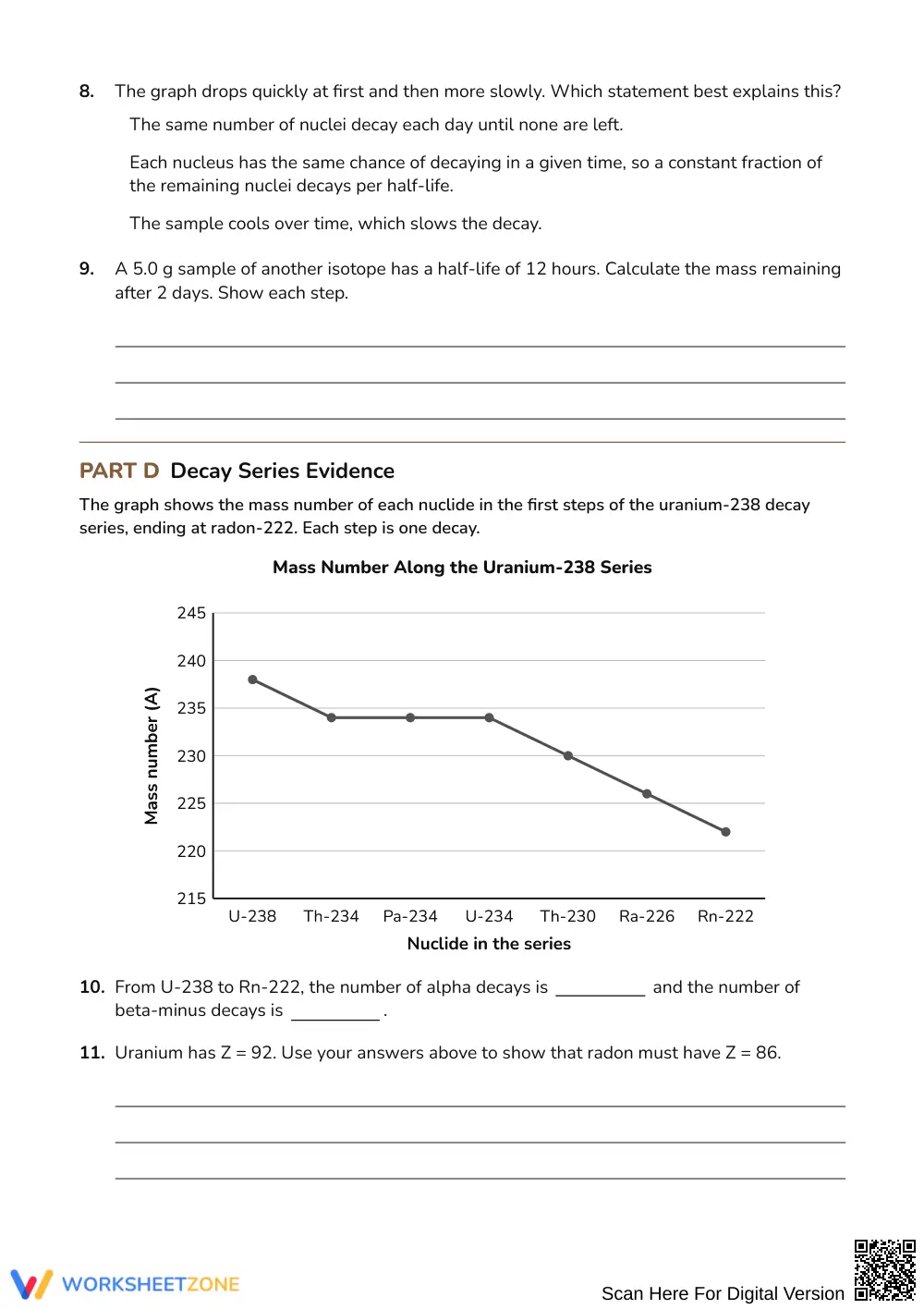
The 4-page assessment delivers 26 structured items across five sections. Part A reviews decay particles and conservation rules. Part B investigates penetrating power and tissue safety. Parts C and D feature half-life graphs and the uranium-238 decay cascade, while Part E examines mass defect and medical isotopes. A complete 4-page answer key provides step-by-step solutions.
Skill Progression
- Guided Practice (Part A): Students use a reference table to evaluate mass and charge conservation in nuclear equations (6 tasks).
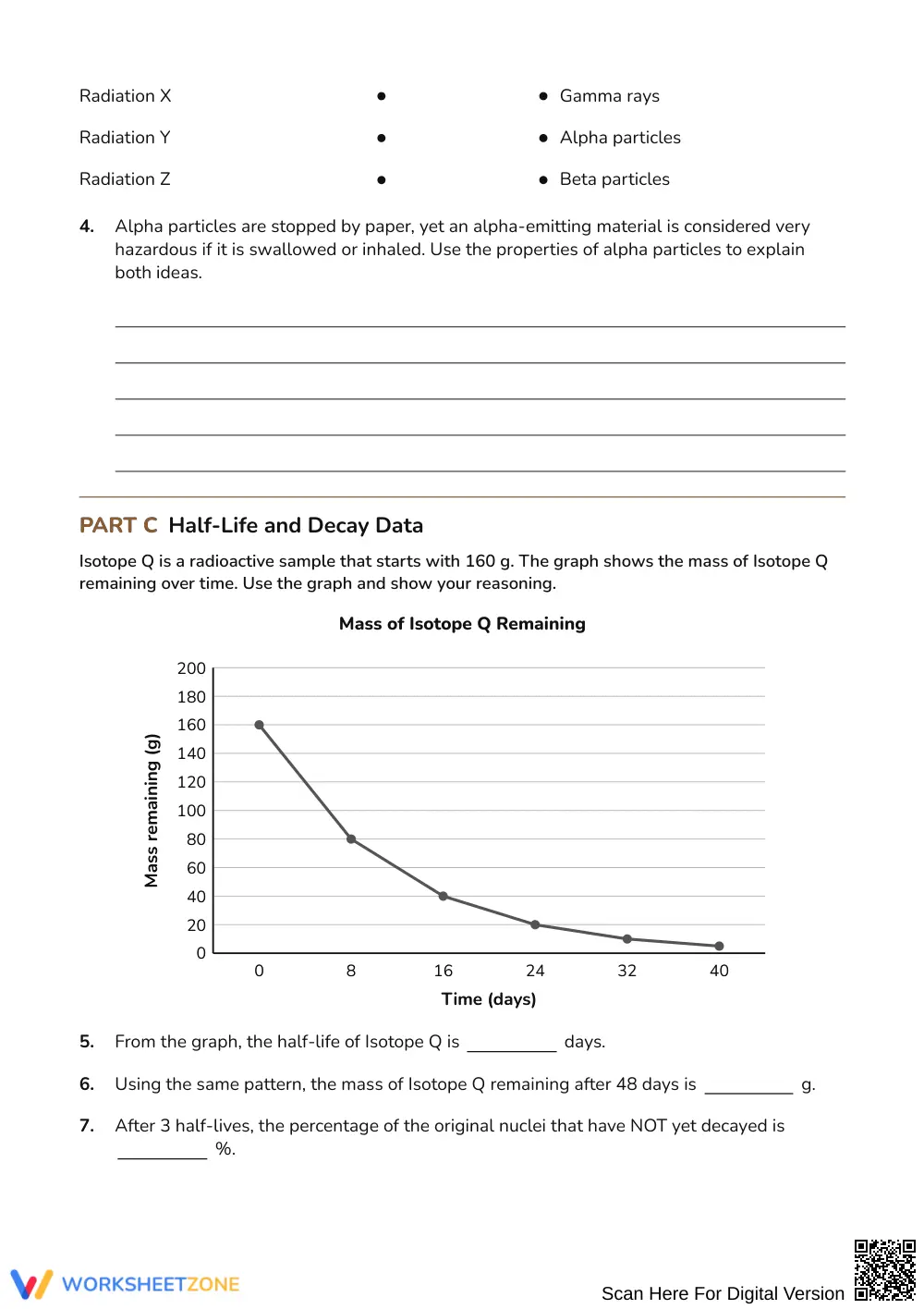
- Supported Practice (Parts B & C): Learners analyze penetrating power and calculate remaining mass from half-life graphs using step-by-step prompts (11 tasks).
- Independent Practice (Parts D & E): Students trace multi-step decay series, calculate atomic numbers, and evaluate real-world medical isotope scenarios (9 tasks).
This progression reflects the gradual-release model, advancing students from structured equation balancing to autonomous quantitative analysis.
Standards Alignment
This resource aligns with high school physical science standards governing nuclear processes and conservation of matter. Students develop models showing how alpha, beta, and gamma emissions alter nuclear composition while releasing energy. Supporting standards emphasize quantitative relationships in radioactive half-life calculations. Both standard alignment descriptions can be copied directly into lesson plans, IEP goals, or district curriculum mapping tools.
How to Use It
Administer this worksheet after direct instruction on decay modes and half-life math. Use it as a 45-to-60-minute cumulative exam, or assign sections across multiple days for formative assessment. During group work on Part C, observe whether students recognize that decay is exponential rather than linear, quickly correcting anyone who subtracts equal mass rather than halving the remaining amount.
Who It's For
This resource serves general chemistry, physical science, and introductory physics classes in grades 9 through 12. Teachers can provide the Part A summary table as an ongoing accommodation for emerging learners or task advanced students with unassisted decay series calculations. Pair this assessment with a direct instruction lesson or a cloud chamber simulation for optimal reinforcement.
Rigorous high school science instruction requires connecting particulate nuclear models with authentic mathematical decay patterns. Empirical research synthesized by Fisher & Frey (2014) confirms that secondary students grasp complex physical phenomena most effectively when scaffolded practice precedes autonomous problem-solving. This 26-task cumulative assessment operationalizes foundational physical science standards by leading learners through five distinct phases of radioactive decay analysis. Students balance nuclear equations, evaluate radiation penetration barriers, calculate exponential half-life rates, trace multi-step decay series, and connect mass deficit to energy release via relativistic principles. By grounding abstract equations in empirical laboratory data and practical medical scenarios, this instructional tool ensures that students build durable scientific literacy, resolve persistent misconceptions regarding exponential decay, and gain the quantitative reasoning skills demanded by advanced chemistry and physics curricula. It serves as a verified, standards-aligned benchmark for departmental tracking.


