































Complete Multiplication by 7s: Patterns & Missing Values

Paste this activity's link or code into your existing LMS (Google Classroom, Canvas, Teams, Schoology, Moodle, etc.).
Students can open and work on the activity right away, with no student login required.
You'll still be able to track student progress and results from your teacher account.
This Grade 3 math worksheet builds operational fluency with sevens through systematic pattern analysis, visual arrays, and missing values. Students complete multiplication tables, evaluate dot arrays, and solve unknown-factor equations. The 22 targeted problems guide learners toward conceptual understanding and reliable fact recall.
At a Glance
- Grade: 3 · Subject: Math
- Standard:
3.OA.C.7— Fluently multiply and divide within 100 using patterns and relationships- Skill Focus: Multiplication facts of 7, skip-counting, and missing factors
- Format: 3 pages · 22 problems · Answer key included · PDF
- Best For: Targeted small group intervention and skills practice
- Time: 25–35 minutes
What's Inside
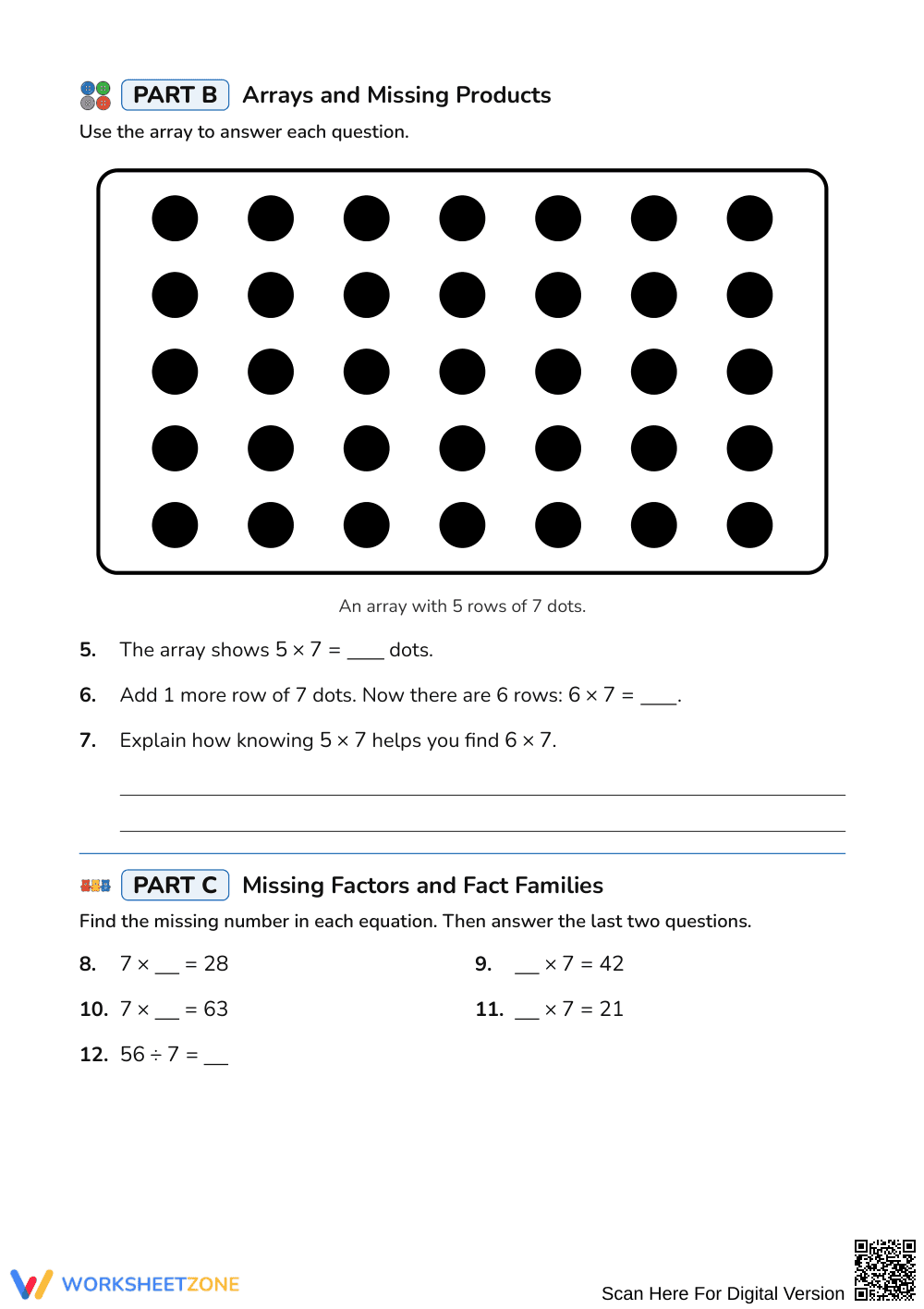
This 3-page printable worksheet contains 22 scaffolded math problems and a matching 3-page answer key. Students engage with a multiplication table, skip-counting sequences, a visual dot array, missing-factor equations, a division fact-family task, an applied word problem, and an error-analysis reflection prompt.
Skill Progression
- Guided practice (Part A, 14 tasks): Students complete a reference table and skip-counting prompts with high visual support.
- Supported practice (Part B, 2 tasks): Learners use a dot array to add groups of 7 to known facts.
- Independent practice (Part C, 6 tasks): Students solve missing factors, division relationships, word problems, and error analysis independently.
This structure follows a gradual-release model, moving students from guided visual tables to unassisted algebraic problem solving.
Standards Alignment
The worksheet aligns directly with `3.OA.C.7` for multiplying and dividing fluently within 100 using properties of operations. It also supports `3.OA.A.4` by having students find the unknown number in multiplication and division equations. Both standard codes can be copied directly into lesson plans, IEP goals, or district curriculum mapping tools.
How to Use It
Use Parts A and B during direct instruction to teach derived fact strategies after reviewing fives facts. Assign Part C after direct instruction for independent practice or formative assessment. During work time, observe whether students calculate 6 × 7 by counting individual units or by adding 7 to 35. Students typically finish in 25 to 35 minutes.
Who It's For
This printable serves Grade 3 general education classrooms, as well as Grade 4 students requiring tier-two intervention with sevens facts. Accommodate developing learners by allowing continued access to the Part A table, and challenge advanced students to write original word problems. Pair this activity with a visual multiplication chart or array manipulatives.
According to Fisher & Frey (2014), purposeful instructional scaffolding enables elementary students to transition effectively from concrete representations to abstract operational fluency. This Grade 3 math worksheet operationalizes that framework to address standard 3.OA.C.7, which requires students to fluently multiply and divide within 100. By structuring learning across 22 problems spanning table patterns, visual dot arrays, and missing-factor equations, the resource grounds student reasoning in foundational relationships rather than isolated rote memorization. Learners explore the distributive principle by building onto known anchor facts, such as adding seven to five times seven to find six times seven, before analyzing algebraic unknowns and critiquing common misconceptions. Integrating visual modeling with conceptual problem solving ensures that students internalize mathematical structures, fostering long-term retention and flexible calculation skills essential for upper elementary mathematics achievement across diverse classroom settings.


