





























Complete Motion Graph Data Worksheet | Grade 12 Physics
Paste this activity's link or code into your existing LMS (Google Classroom, Canvas, Teams, Schoology, Moodle, etc.).
Students can open and work on the activity right away, with no student login required.
You'll still be able to track student progress and results from your teacher account.
This Grade 12 physics worksheet equips students to master kinematic reconciliation by cross-referencing piecewise motion graphs with synchronous numerical data. Learners evaluate slopes, signed definite integrals, and discrete sampling limits across four motion regimes to build rigorous mechanical reasoning for advanced physics.
At a Glance
- Grade: 12 · Subject: Physics
- Standard: Advanced Kinematics — Reconcile position, velocity, and acceleration graphs with discrete experimental data tables
- Skill Focus: Reconcile Graphs and Numerical Records
- Format: 5 pages · 10 problems · Answer key included · PDF
- Best For: Advanced Placement physics kinematic review and analysis
- Time: 45–60 minutes of focused classroom practice
What's Inside
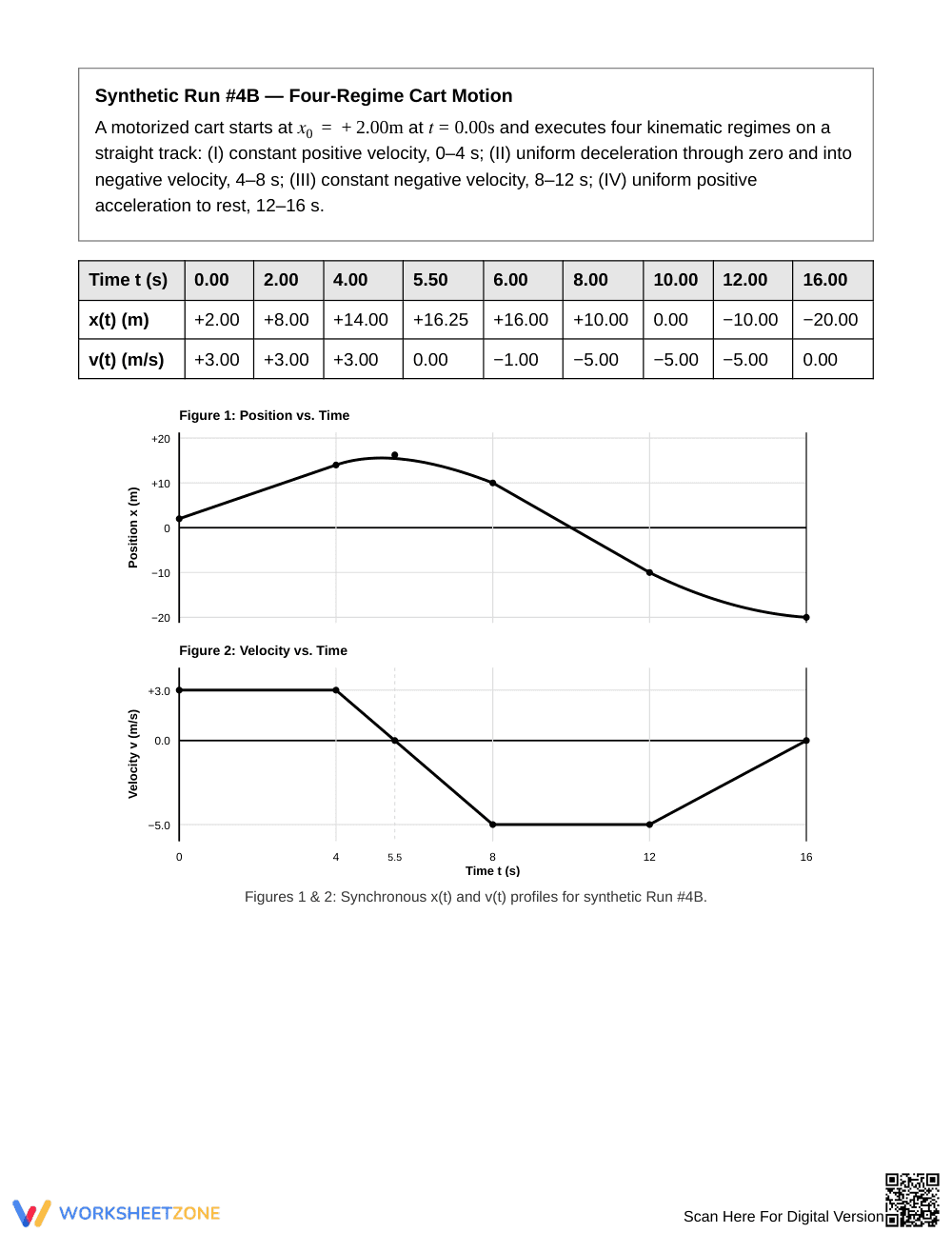
This 5-page printable resource includes a 10-problem student worksheet and a 3-page complete solution key. Based on a four-regime cart experiment, it integrates calculus reference rules, synchronous position and velocity graphs, coordinate tables, and step-by-step mathematical workspaces.
Skill Progression
- Guided practice (Part A, 2 tasks): Students extract direct values from tables and graphs, verifying synchronization and analyzing velocity at position extrema.
- Supported practice (Part B, 6 tasks): Learners calculate accelerations from slopes, integrate signed velocity-time areas to recover net displacement, and contrast average velocity with average speed.
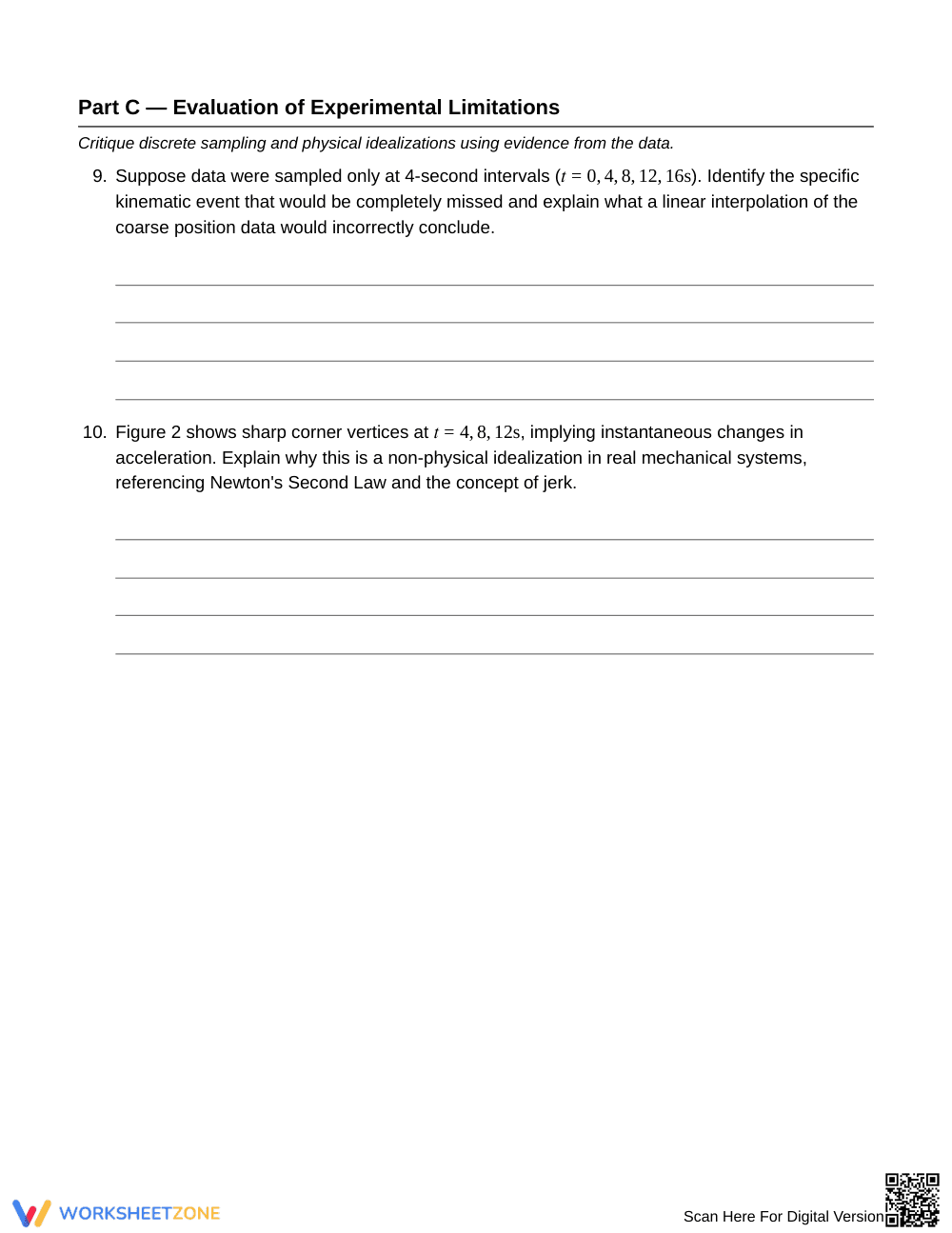
- Independent practice (Part C, 2 tasks): Students evaluate experimental limits by identifying kinematic events missed by coarse sampling and critiquing acceleration corner vertices via Newton's Second Law.
This structured sequence follows a gradual-release model from guided data extraction to independent physical critique.
Standards Alignment
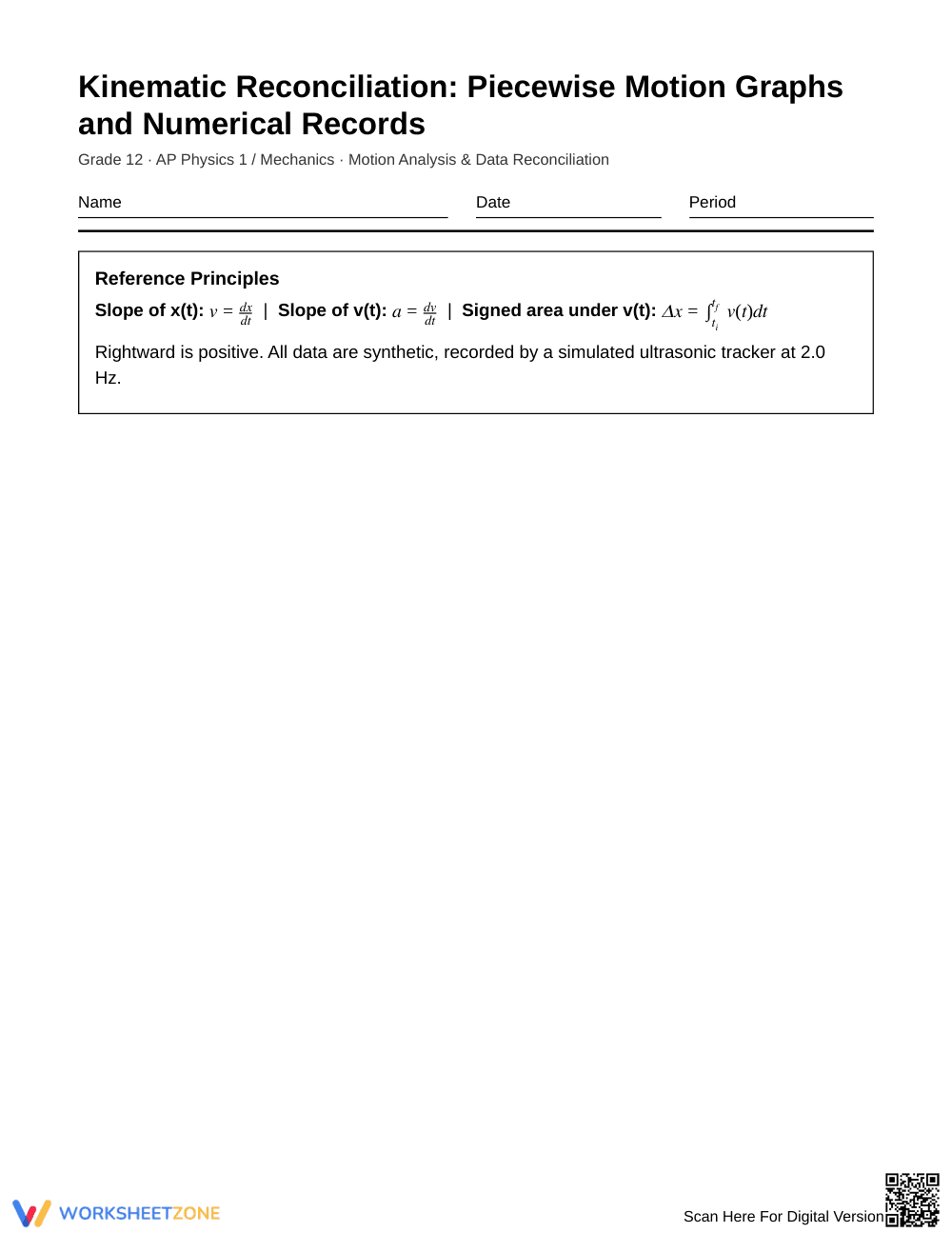
Aligned with high school physics and AP Mechanics standards, this task requires students to `represent motion using continuous functions, discrete data tables, and synchronous graphs.` Students translate between representations using derivative slopes and integral areas. Both standard codes can be copied directly into lesson plans, IEP goals, or district curriculum mapping tools.
How to Use It
Deploy this worksheet after direct instruction on motion graphs. During collaborative partner work, have students calculate signed areas before checking tabular values. Formatively check whether students recognize that negative acceleration during deceleration indicates an opposing net force. Completion requires 45 to 60 minutes.
Who It's For
This resource serves Grade 12 physics, AP Physics 1, and introductory mechanics students. For differentiation, provide highlighters to isolate positive and negative velocity areas. Pair this lesson with a real-time motion sensor lab demonstration.
Kinematic translation between graphical, tabular, and algebraic representations remains a critical benchmark for secondary physics mastery. According to Fisher & Frey (2014), structured instructional scaffolds that transition students through guided value extraction, quantitative calculation, and independent theoretical critique significantly deepen conceptual retention in complex science domains. This Grade 12 physics worksheet operationalizes that pedagogical framework across 10 targeted problems, requiring learners to reconcile piecewise motion graphs with discrete numerical records. By computing derivative slopes to determine acceleration, partitioning signed velocity-time areas into geometric displacement segments, and critiquing discrete data sampling limitations, students build robust mechanics competencies. The included 3-page comprehensive answer key outlines fully worked calculus-based derivations and explicit physical reasoning. This design ensures educators can systematically identify common kinematic misconceptions, verify quantitative accuracy, and accelerate student readiness for college-level mechanics assessments and laboratory investigations.


